1
The Oakley 'One of three' VCO Module
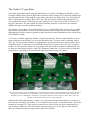
The Oakley ‘One of Three’ is a voltage controlled oscillator module that was inspired in part by the
VCO design of the later MiniMoogs. In this module I decided to create a VCO that sounded good
and performed well enough to keep up with the digital oscillators of modern day synthesisers.
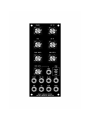
The VCO features sawtooth, pulse, triangle and a low distortion sine output. The duty cycle of the
pulse output may be controlled directly by a PCB mounted pot, and also an external voltage, the
sensitivity being controlled by another PCB mounted pot. The frequency of the VCO can be
controlled by two PCB mounted pots, one for fine, the other for coarse adjustment. These four pots
are designed to be fitted to the main board, and when special pot brackets are used, the PCB can be
firmly supported to the front panel.
The output levels for the sawtooth, sine and triangle are standardised at +/-5V, ie. 10V peak to peak.
The pulse wave output is also 10V peak to peak, but the peak levels vary with pulse width. The
Oakley VCO uses an interesting technique to maintain the average voltage over one cycle to zero
volts. This new circuit essentially adds an offset to the pulse output to compensate for the non zero
average voltage for any pulse wave that isn't a square wave. Ordinarily, one would see average DC
values varying from +5V to -5V as the PW is swept from one end to the other. In the new VCO, this
average level is kept at zero. This means that for narrow pulses, you now have a wave that goes
from just below 0V [down] to just below +10V [up]. For square waves, you have the usual +5V up
and -5V down. For wide pulses, you have a wave that is just below 0V [up] and just below -10V
[down]. The reason for this is that fast pulse width modulation no longer adds thumping to the
audio output. ie. fast EG sweeps of PW will sound great.
All outputs have an output impedance of roughly 1K.
The pulse output is also switchable between ‘centre modulated’ and ‘edge modulated’ forms of
pulse width modulation. Most VCOs will only offer edge modulated, in which only one edge of the
pulse wave is affected by the pulse width pot or modulating CV. The Oakley VCO allows you to
modulate either one edge (edge) or both (centre). In fixed pulse width applications this generally
makes no audible difference. However, when used with fast moving modulating CVs the difference
in timbre is apparent.
A high impedance synchronisation input is provided to prematurely reset the VCO waveform. With
this you can force the VCO’s operating frequency to that of an external sawtooth signal, say from
another VCO module. This input is level sensitive, so hard sync is possible with inputs of about
+3V or above. Inputs below this will cause only occasional synchronisation leading to interesting
harmonic structures.
Please note; that to cause hard sync effects the master ‘sync’ signal must be a sawtooth (falling
ramp shape) waveform of 10V peak to peak. The slave VCO will not sync to a ramp waveform
which typically has a rising ramp and does not feature the fast rising edge the VCO needs to lock on
to. These ramp waveforms are, in my opinion, erroneously called sawtooth by some manufacturers.
However, a simple inverting circuit will be sufficient to turn the waveform around the right way so
it can be used as a sync master.
The VCO supports the standard 1.00V/octave exponential voltage to frequency relationship.
However, a linear control input is also provided for constant depth frequency modulation.
Temperature compensation is performed by using a matched transistor pair in the exponential
convertor, and a high quality temperature sensitive resistor.




![Manual condicionador de sinal SD20 [PTBR]](http://vs1.manualzilla.com/store/data/006085115_1-891da68fb4d8bbd4bc5f0d8350060514-150x150.png)

