1
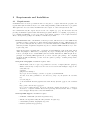
For both treatments, by default for convective stars (below 7700 K) an albedo of 0.5, and for
radiative stars an albedo of 1.0 is used. It is possible to choose different albedo values at program
start using the command line option(s) -aP value for the primary and -aS value for the secondary.
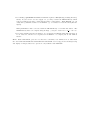
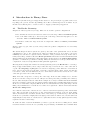
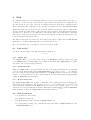
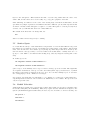
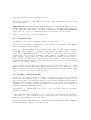
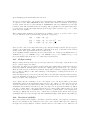
Gravity darkening is computed by
T (r, η, φ) = Tef f (
g(r, η, φ) β
) .
gef f
For the gravity brightening exponent, the results from [6] (Fig. 1 in the paper) are used, which
provide a smooth transition to the Von Zeipel (1924) exponent of 0.25 for radiative stars.
Notes: (i) The ’simple’ reflection treatment in [11] has been supplemented by a penumbral correction for the partial visibily of the other star, if it is at the horizon. This penumbral correction
assumes that the horizon is flat and that the other star is spherical, i.e. that the visible part is a
segment of a circle.
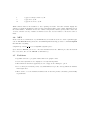
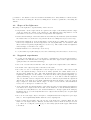
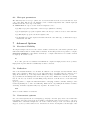
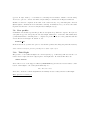
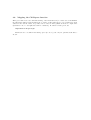
(ii) For the ’detailed’ reflection treatment, instead of the quadratic limb darkening law used by
[13], a square root law ([10])
√
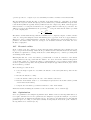
I(µ) = I(1)[1 − c(1 − µ) − d(1 − µ)]
is used (where µ is the cosine of the angle subtended by the emergent radiation and the direction
perpendicular to the stellar surface), and bolometric limb darkening coefficients are taken from [7].
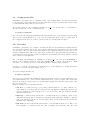
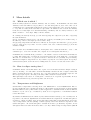
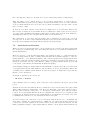
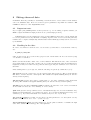
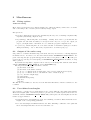
The normalization factor for the square root law was calculated as
1
.
π (1 − c/3 − d/5)
(iii) The temperature limit of 7700 K dividing stars with convective/radiative envelopes can
be changed by the environment variable NIGHTFALL RADIATIVE (within the range 4000 –
12000 K). This changes the albedo only (0.5 below, 1.0 above).
10.3
Spots
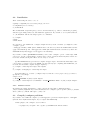
Spots are always circular, and characterized by four parameters: longitude λ, latitude β, radius
r, and a ’dimming’ factor Ap = Tp /T , i.e. the ratio of the (local) temperature Tp with spot to
the temperature T without spot. A detailed discussion of the trigonometric expressions used to
identify surface elements within the spot area can be found in [11], section I-3. In the ’detailed’
reflection treatment, reflection is calculated with spots, i.e. the spots are applied first, then the
reflection is calculated. For overlapping spots, in the overlap area the mean value of their Ap is
used.
10.4
Output flux
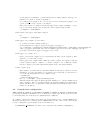
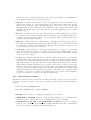
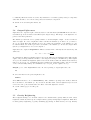
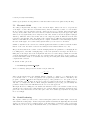
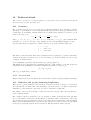
In the blackbody approximation, for each stellar component and each filter a (temperaturedependent) effective wavelength is computed, following Equation 3.30 in [4]:
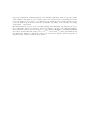
λef f = λ0 +
5µ2 (λp − λ0 )
√
,
λ0
where λ0 is the filter wavelength, and λp the wavelength of the blackbody peak for the effective
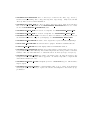
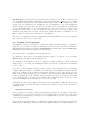
temperature of the respective component. The required second moments µ2 of the filter passbands
are computed following the prescription by [25], Equation 12:
µ2 ≃
F W (0.05)
,
4.4