1
where F W (0.05) is the full width at the 0.05 level.
For the ’model atmosphere’ option, fluxes for temperatures below 9800 K are from Hauschildt et
al. (private comm., 2006) PHOENIX models, otherwise flux tables from Kuruzc models ([19]).
are used. All models are for solar abundances. PHOENIX models below 2000 K incorporate dust
formation, with dust remaining in situ (no settling). The (originally monochromatic) fluxes have
been integrated over the filter passbands (as given in [20]). Surface gravities log g = 3.5 − 5.0 (in
steps of 0.5) are available.
Three different limb darkening approximations are available, a linear, a quadratic, and a square
root one, which are given by the following expressions, respectively:
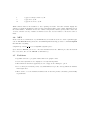
I(µ) = I(1)[1 − u(1 − µ)],
I(µ) = I(1)[1 − a(1 − µ) − b(1 − µ)2 ], and
√
I(µ) = I(1)[1 − c(1 − µ) − d(1 − µ)],
where µ is the cosine of the angle subtended by the emergent radiation and the direction perpendicular to the stellar surface. Limb darkening coefficients are from [7]. A discussion of the relative
merits of these three approximations can be found in [10].
Notes: (i) When tabulated values are used, for temperatures out of range (below 2000 K and above
31000 K for log g = 3.5, 39000 K for log g = 4.0, 49000 K for log g = 4.5, 50000 K for log g = 5.0)
the lowest/highest value is used (i.e. no extrapolation is attempted).
10.5
Eclipse testing
Eclipse testing follows the method proposed in [11]. First, the contact angle of the Roche lobes is
used to exclude eclipses, if possible.
If an eclipse is possible, for each surface element dS the line of sight (LOS) towards dS is tested for
intersection with the smallest sphere enclosing the eclipsing star (no intersection = not eclipsed).
Then the LOS is tested for intersection with the largest sphere within the eclipsing star (intersection = eclipsed). This procedure takes advantage of the simplicity of testing the intersection of a
line with a sphere.
If the LOS intersects the outer, but not the inner sphere, as a last (and computationally expensive)
resort, the minimum of the Roche potential along the LOS is searched, and compared against the
surface potential of the eclipsing star.
Notes: (i) In [11], the osculating cone (i.e. the tangent cone to the Roche surface at the inner
Lagrangian point L1 ) is used as the first eclipse criterion. According to [5], this can lead to serious
errors for mass ratios very different from unity, as the larger Roche lobe is concave at the L1 .
nightfall uses tabulated values from [5] (the cone angle φmax as given in their Table 2). (ii) In
[11], the coordinate frame of the eclipsed star is used, for eclipse testing, which seems not to work
for asynchroneous rotation. nightfall therefore uses the coordinate frame of the eclipsing star,
following [2]. (iii) In [11], it is proposed to evaluate the potential along the LOS at six steps only.
nightfall uses a more rigorous approach with a minimum finding routine (Brent’s algorithm [3]).
10.6
Fractional visibility
The eclipse testing routine assigns to each surface element a visibility of 0 (eclipsed) or 1 (visible).
However, the visibility is only evaluated for the centre of the element. This can lead to ’spikes’ in
the light curve, if large numbers of surface element centres become visible at once. Therefore, an