1
DRAFT: Water Quality Analysis Simulation Program (WASP)
Version 6.0
Number of Flow Fields-- To simulate settling of ON and OP, the user should select solids 1 flow
under advection. To simulate settling of PHYT, the user should select solids 2 flow. To
simulate PO4 settling, the user should select solids 3 flow. The user should also select water
column flow.
Particulate Transport, m3 /sec-- Time variable settling and resuspension rates for solids 1, solids
2, and solids 3 can be input using the continuity array BQ and the time function QT. For each
solids flow field, cross-sectional exchange areas (m2 ) for adjacent segment pairs are input using
the spatially-variable BQ. Time-variable settling velocities can be specified as a series of
velocities, in m/sec, versus time. If the units conversion factor is set to 1.157e-5, then these
velocities are input in units of m/day. These velocities are multiplied internally by crosssectional areas and treated as flows that carry particulate organic matter out of the water column.
9.6.3.
Boundary Parameters
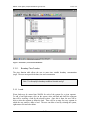
This group of parameters includes boundary concentrations, waste loads, and initial conditions.
Boundary concentrations must be specified for any segment receiving flow inputs, outputs, or
exchanges. Initial conditions include not only initial concentrations, but also the density and
solids transport field for each solid, and the dissolved fraction in each segment.
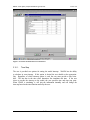
Boundary Concentrations, mg/L-- At each segment boundary, time variable concentrations must
be specified for PHYT, expressed as µg/L chlorophyll a. Time variable concentrations must also
be specified for either ON, NH3, and NO3, or OP and PO4. A boundary segment is
characterized by water exchanges from outside the network, including tributary inflows,
downstream outflows, and open water dispersive exchanges.
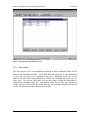
Waste Loads, kg/day-- For each point source discharge, time variable PHYT, ON, NH3, NO3,
OP, and PO4 loads can be specified. These loads can represent municipal and industrial
wastewater discharges, or urban and agricultural runoff.
If any phytoplankton loads are
specified, they should be in units of kg carbon/day.
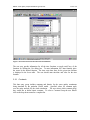
Solids Transport Field-- The transport fields associated with particulate settling must be specified
under initial conditions. Solids 1 (Field 3) is recommended for ON and OP. Solids 2 (Field 4) is
recommended for PHYT. Solids 3 (Field 5) is recommended for PO4.
Solid Density, g/cm3 -- A value of 0 can be entered for the nominal density of PHYT, ON, NH3,
NO3, OP, and PO4. This information is not used in EUTRO.
Initial Concentrations, mg/L-- Concentrations of PHYT, expressed as µg/L chlorophyll a and
either ON, NH3, and NO3, or OP and PO4 in each segment must be specified for the time at
which the simulation begins.
For the nonsimulated nutrients held constant, average
concentrations must be specified. These nutrient concentrations will remain constant throughout
the simulation and can affect PHYT through growth rate limitation (although nonsimulated
9-35