1
1. Introduction
CANDY simulates the dynamics of Carbon and Nitrogen in the unsaturated (vadose) zone of
agricultural used soils. The model application should preferably be focused on sites with a
rooting zone of up to 2m. The soil profile is divided into homogeneous layers of 1 dm. The
simulation proceeds in daily time steps. Starting from initial values for all variables the model
simulates the impact of management and climate on them. The following processes are
included:
• Climate conditions (access to database or generating climate date , correction of
systematic errors of observed precipitation)
• soil water dynamics (pot. and act. evapotranspiration, percolation through soil)
• soil temperature dynamics
• turnover (mineralisation and humification) of organic matter in soil
• nitrogen dynamics (mineralisation, immobilisation, uptake, leaching, gaseous
losses, symbiontic N-fixation)
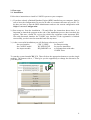
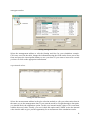
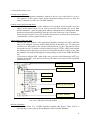
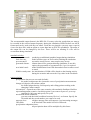
The system consists of a user interface that organises the access to the data and the
preparation of simulation tasks and the simulation model itself. A simulation task consists of a
site description and the scenario data. The site description includes the parameters of the soil
profile – that is for each horizon at least:
•
bulk and substrate density
•
soil moisture at field capacity and wilting point
•
texture indicator (particles < 6µm)
•
saturated conductivity
and the time course of climate data (daily time steps)
•
air temperature at 2m (°C)
•
global radiation (J/cm²)
•
precipitation (mm),
The scenario data consist of a description of initial conditions. These can be reconstructed
from detailed observations but should include at least
crop rotation and average yields before initial point
•
relative filling of field capacity
and the farming activities (management) on the field:
• soil tillage and irrigation
• application of mineral fertiliser and organic matter,
• sowing(emergence) and harvest.
•
The model has successfully been evaluated with different site conditions and scenarios.
Results are of course depending on the quality of input data. If high quality input data are
available the model error is about 2 VOL% and 20 kg/ha mineral nitrogen.
2