1
QNX ® Software Development Platform 6.6
QNX ® Software Development Platform 6.6
Multicore Processing User's Guide
©2006–2014,
QNX Software Systems Limited, a subsidiary of BlackBerry. All
rights reserved.
QNX Software Systems Limited
1001 Farrar Road
Ottawa, Ontario
K2K 0B3
Canada
Voice: +1 613 591-0931
Fax: +1 613 591-3579
Email: [email protected]
Web: http://www.qnx.com/
QNX, QNX CAR, Neutrino, Momentics, Aviage, Foundry27 are trademarks of
BlackBerry Limited that are registered and/or used in certain jurisdictions, and
used under license by QNX Software Systems Limited. All other trademarks
belong to their respective owners.
Electronic edition published: Friday, March 28, 2014
Multicore Processing User's Guide
Table of Contents
About This Guide
......................................................................................................................5
Typographical conventions .................................................................................................6
Technical support .............................................................................................................8
Chapter 1: What is Multicore Processing? .....................................................................................9
Chapter 2: A Quick Introduction to Multicore Processing ..............................................................11
Setting up the OS image .................................................................................................12
Trying symmetric multiprocessing .....................................................................................14
Trying bound multiprocessing ...........................................................................................15
Chapter 3: Developing Multicore Systems ...................................................................................17
Building a multicore image ..............................................................................................18
The impact of multicore ..................................................................................................19
To multicore or not to multicore ..............................................................................19
Thread affinity ......................................................................................................19
Multicore and synchronization primitives .................................................................22
Multicore and FIFO scheduling ...............................................................................22
Multicore and interrupts .........................................................................................22
Multicore and atomic operations .............................................................................23
Adaptive partitioning .............................................................................................24
Designing with multiprocessing in mind ............................................................................25
Use the multicore primitives ...................................................................................25
Assume that threads really do run concurrently ........................................................25
Break the problem down ........................................................................................25
Glossary ..................................................................................................................................29
Table of Contents
About This Guide
The Multicore Processing User's Guide describes how you can use symmetric
multiprocessing to get the most performance possible out of a multiprocessor system.
It also describes how to use bound multiprocessing to restrict which processors a
thread can run on.
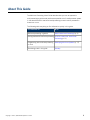
The following table may help you find information quickly in this guide:
For information on:
Go to:
Multicore processing in general
What is Multicore Processing? (p. 9)
Getting started with multicore processing A Quick Introduction to Multicore
Processing (p. 11)
Programming with multicore processing
Developing Multicore Systems (p. 17)
in mind
Terminology used in this guide
Copyright © 2014, QNX Software Systems Limited
Glossary
5
About This Guide
Typographical conventions
Throughout this manual, we use certain typographical conventions to distinguish
technical terms. In general, the conventions we use conform to those found in IEEE
POSIX publications.
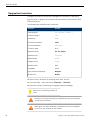
The following table summarizes our conventions:
Reference
Example
Code examples
if( stream == NULL )
Command options
-lR
Commands
make
Environment variables
PATH
File and pathnames
/dev/null
Function names
exit()
Keyboard chords
Ctrl –Alt –Delete
Keyboard input
Username
Keyboard keys
Enter
Program output
login:
Variable names
stdin
Parameters
parm1
User-interface components
Navigator
Window title
Options
We use an arrow in directions for accessing menu items, like this:
You'll find the Other... menu item under Perspective ➝ Show View .
We use notes, cautions, and warnings to highlight important messages:
Notes point out something important or
useful.
Cautions tell you about commands or procedures that may have unwanted
or undesirable side effects.
Warnings tell you about commands or procedures that could be dangerous
to your files, your hardware, or even yourself.
6
Copyright © 2014, QNX Software Systems Limited
Typographical conventions
Note to Windows users
In our documentation, we use a forward slash (/) as a delimiter in all pathnames,
including those pointing to Windows files. We also generally follow POSIX/UNIX
filesystem conventions.
Copyright © 2014, QNX Software Systems Limited
7
About This Guide
Technical support
Technical assistance is available for all supported products.
To obtain technical support for any QNX product, visit the Support area on our website
(www.qnx.com). You'll find a wide range of support options, including community
forums.
8
Copyright © 2014, QNX Software Systems Limited
Chapter 1
What is Multicore Processing?
Multiprocessing systems, whether discrete or multicore, can greatly improve your
applications' performance. As described in the Multicore Processing chapter of the
System Architecture guide, there's a multiprocessor version of the QNX Neutrino RTOS
that runs on:
• Pentium-based multiprocessor systems that conform to the Intel MultiProcessor
Specification (MP Spec)
• ARM-v7-based systems
If you have one of these systems, then you're probably itching to try it out, but are
wondering what you have to do to get QNX Neutrino running on it. Well, the answer
is not much. The only part of QNX Neutrino that's different for a multiprocessor system
is the microkernel — another example of the advantages of a microkernel architecture!
To determine how many processors there are on your system, look at the
num_cpu entry of the system page. For more information, see “Structure of
the system page” in the Customizing Image Startup Programs chapter of
Building Embedded Systems.
QNX Neutrino supports these operating modes for multiprocessing:
Asymmetric multiprocessing (AMP)
A separate OS, or a separate instantiation of the same OS, runs on each
CPU.
Symmetric multiprocessing (SMP)
A single instantiation of an OS manages all CPUs simultaneously, and
applications can float to any of them.
Bound multiprocessing (BMP)
A single instantiation of an OS manages all CPUs simultaneously, but you
can lock individual applications or threads to a specific CPU.
SMP lets you get the most performance out of your system, but you might need to use
BMP for the few applications that may not work under SMP, or if you want to explicitly
control the process-level distribution of CPU usage.
Copyright © 2014, QNX Software Systems Limited
9
Chapter 2
A Quick Introduction to Multicore Processing
This chapter gives you a quick hands-on introduction to multicore processing.
• Setting up the OS image (p. 12)
• Trying symmetric multiprocessing (p. 14)
• Trying bound multiprocessing (p. 15)
Copyright © 2014, QNX Software Systems Limited
11
A Quick Introduction to Multicore Processing
Setting up the OS image
1. Log in as root.
2. Go to the directory that holds the buildfile for your system's boot image (e.g.
/boot/build).
3. Create a copy of the buildfile. In this example, we'll call the copy
my_multicore.build.
4. Edit the copy (e.g. my_multicore.build).
5. Search for procnto. The line might look like this:
PATH=/proc/boot:/bin:/usr/bin:/opt/bin \
LD_LIBRARY_PATH=/proc/boot:/lib:/usr/lib:/lib/dll:/opt/lib \
procnto-instr
In a real buildfile, you can't use a backslash (\) to break a long line into
shorter pieces, but we've done that here, just to make the command easier
to read.
6. Change procnto to the appropriate multicore version; see /proc/boot to see
which uniprocessor version you're using, and then add -smp to it. For more
information, see procnto in the Utilities Reference. For example:
PATH=/proc/boot:/bin:/usr/bin:/opt/bin \
LD_LIBRARY_PATH=/proc/boot:/lib:/usr/lib:/lib/dll:/opt/lib \
procnto-smp-instr
Although the multiprocessing version of procnto has “SMP” in its name,
it also supports BMP. You can even use bound and symmetric
multiprocessing simultaneously on the same system.
7. Save your changes to the buildfile.
8. Generate a new boot image:
mkifs my_multicore.build my_multicore.ifs
9. Put the new image in place. In order to ensure you can still boot your system if an
error occurs, we recommend the following:
• If you're using the Power-Safe filesystem (fs-qnx6.so), add your image to
the ones in /.boot/ instead of overwriting an existing image.
• If you're using the QNX 4 filesystem (fs-qnx4.so), copy your current boot
image to /.altboot by doing the following:
cp /.altboot /.old_altboot
cp /.boot /.altboot
12
Copyright © 2014, QNX Software Systems Limited
Setting up the OS image
cp apsdma.ifs /.boot
10. Reboot your system.
Copyright © 2014, QNX Software Systems Limited
13
A Quick Introduction to Multicore Processing
Trying symmetric multiprocessing
1. Log in as a normal user.
2. Start some processes that run indefinitely. For example, use the hogs utility to
display which processes are using the most CPU:
hogs -n -%10
3. Use pidin sched to see which processor your processes are running on.
If you're using the IDE, you can use the System Information perspective to watch
the threads migrate.
4. Create a program called greedy.c that simply loops forever:
#include <stdlib.h>
int main( void )
{
while (1) {
}
return EXIT_SUCCESS;
}
5. Compile it, and then run it:
qcc -o greedy greedy.c
./greedy &
On a uniprocessor system, this would consume all the processing time (unless
you're using adaptive partitioning). On a multicore system, it consumes all the time
on one processor.
6. Use pidin sched to see which processor your other processes are running on.
They're likely running on different processors from greedy.
14
Copyright © 2014, QNX Software Systems Limited
Trying bound multiprocessing
Trying bound multiprocessing
1. Use the -C or -R option (or both) to the on utility to start a shell on a specific set
of processors:
on -C 0 ksh
2. Start some new processes from this shell. Note that they run only on the first
processor.
3. Use the -C or -R option (or both) to slay to change the runmask for one of these
processes. Note that the process runs only on the processors that you just specified,
while any children run on the processors you specified for the shell.
4. Use the -C or -R option (or both) and the -i option to slay to change the runmask
and inherit mask for one of these processes. Note that the process and its children
run only on the newly specified processors.
Copyright © 2014, QNX Software Systems Limited
15
Chapter 3
Developing Multicore Systems
Let's consider some of the things you should keep in mind when you're programming
for a multicore system.
Copyright © 2014, QNX Software Systems Limited
17
Developing Multicore Systems
Building a multicore image
Assuming you're already familiar with building a bootable image for a single-processor
system (as described in the Making an OS Image chapter in Building Embedded
Systems), let's look at what you have to change in the buildfile for a multicore system.
As we mentioned earlier, basically all you need to use is the multicore kernel
(procnto-smp) when building the image.
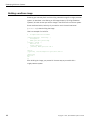
Here's an example of a buildfile:
#
A simple multicore buildfile
[virtual=x86,bios] .bootstrap = {
startup-bios
PATH=/proc/boot procnto-smp
}
[+script] .script = {
devc-con -e &
reopen /dev/con1
[+session] PATH=/proc/boot esh &
}
libc.so
[type=link] /usr/lib/ldqnx.so.2=/proc/boot/libc.so
[data=copy]
devc-con
esh
ls
After building the image, you proceed in the same way as you would with a
single-processor system.
18
Copyright © 2014, QNX Software Systems Limited
The impact of multicore
The impact of multicore
Although the actual changes to the way you set up the processor to run SMP are fairly
minor, the fact that you're running on a multicore system can have a major impact on
your software!
The main thing to keep in mind is this: in a single processor environment, it may be
a nice “design abstraction” to pretend that threads execute in parallel; under a
multicore system, they really do execute in parallel! (With BMP, you can make your
threads run on a specific CPU.)
In this section, we'll examine the impact of multicore on your system design.
To multicore or not to multicore
It's possible to use the non-multicore kernel on a multicore box. In this case, only
processor 0 will be used; the other processors won't run your code. This is a waste of
additional processors, of course, but it does mean that you can run images from
single-processor boxes on an multicore box. (You can also run SMP-ready images on
single-processor boxes.)
It's also possible to run the multicore kernel on a uniprocessor system, but it requires
a 486 or higher on x86 architectures.
Thread affinity
One issue that often arises in a multicore environment can be put like this: “Can I
make it so that one processor handles the GUI, another handles the database, and
the other two handle the realtime functions?”
The answer is: “Yes, absolutely.”
This is done through the magic of thread affinity, the ability to associate certain
programs (or even threads within programs) with a particular processor or processors.
Thread affinity works like this. When a thread starts up, its affinity mask (or runmask)
is set to allow it to run on all processors. This implies that there's no inheritance of
the thread affinity mask, so it's up to the thread to use ThreadCtl() with the
_NTO_TCTL_RUNMASK control flag to set its runmask:
if (ThreadCtl( _NTO_TCTL_RUNMASK, (void *)my_runmask) == -1) {
/* An error occurred. */
}
The runmask is simply a bitmap; each bit position indicates a particular processor.
For example, the runmask 0x05 (binary 00000101) allows the thread to run on
processors 0 (the 0x01 bit) and 2 (the 0x04 bit).
Copyright © 2014, QNX Software Systems Limited
19
Developing Multicore Systems
If you use _NTO_TCTL_RUNMASK, the runmask is limited to the size of an
int (currently 32 bits). Threads created by the calling thread don't inherit the
specified runmask.
If you want to support more processors than will fit in an int, or you want to
set the inherit mask, you'll need to use the
_NTO_TCTL_RUNMASK_GET_AND_SET_INHERIT command described below.
The <sys/neutrino.h> file defines some macros that you can use to work with a
runmask:
RMSK_SET(cpu, p)
Set the bit for cpu in the mask pointed to by p.
RMSK_CLR(cpu, p)
Clear the bit for cpu in the mask pointed to by p.
RMSK_ISSET(cpu, p)
Determine if the bit for cpu is set in the mask pointed to by p.
The CPUs are numbered from 0. These macros work with runmasks of any length.
Bound multiprocessing (BMP) is a variation on SMP that lets you specify which
processors a process or thread and its children can run on. To specify this, you use
an inherit mask.
To set a thread's inherit mask, you use ThreadCtl() with the
_NTO_TCTL_RUNMASK_GET_AND_SET_INHERIT control flag. Conceptually, the
structure that you pass with this command is as follows:
struct _thread_runmask {
int size;
unsigned runmask[size];
unsigned inherit_mask[size];
};
If you set the runmask member to a nonzero value, ThreadCtl() sets the runmask of
the calling thread to the specified value. If you set the runmask member to zero, the
runmask of the calling thread isn't altered.
If you set the inherit_mask member to a nonzero value, ThreadCtl() sets the calling
thread's inheritance mask to the specified value(s); if the calling thread creates any
children by calling pthread_create(), fork(), spawn(), vfork(), and exec(), the children
inherit this mask. If you set the inherit_mask member to zero, the calling thread's
inheritance mask isn't changed.
20
Copyright © 2014, QNX Software Systems Limited
The impact of multicore
If you look at the definition of _thread_runmask in <sys/neutrino.h>, you'll
see that it's actually declared like this:
struct _thread_runmask {
int
size;
/* unsigned
runmask[size];
*/
/* unsigned
inherit_mask[size]; */
};
This is because the number of elements in the runmask and inherit_mask arrays
depends on the number of processors in your multicore system. You can use the
RMSK_SIZE() macro to determine how many unsigned integers you need for the masks;
pass the number of CPUs (found in the system page) to this macro.
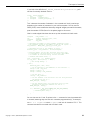
Here's a code snippet that shows how to set up the runmask and inherit mask:
unsigned
int
unsigned
void
num_elements = 0;
*rsizep, masksize_bytes, size;
*rmaskp, *imaskp;
*my_data;
/* Determine the number of array elements required to hold
* the runmasks, based on the number of CPUs in the system. */
num_elements = RMSK_SIZE(_syspage_ptr->num_cpu);
/* Determine the size of the runmask, in bytes. */
masksize_bytes = num_elements * sizeof(unsigned);
/*
*
*
*
Allocate memory for the data structure that we'll pass
to ThreadCtl(). We need space for an integer (the number
of elements in each mask array) and the two masks
(runmask and inherit mask). */
size = sizeof(int) + 2 * masksize_bytes;
if ((my_data = malloc(size)) == NULL) {
/* Not enough memory. */
…
} else {
memset(my_data, 0x00, size);
/* Set
rsizep
rmaskp
imaskp
up pointers to the "members" of the structure. */
= (int *)my_data;
= rsizep + 1;
= rmaskp + num_elements;
/* Set the size. */
*rsizep = num_elements;
/* Set the runmask. Call this macro once for each processor
the thread can run on. */
RMSK_SET(cpu1, rmaskp);
/* Set the inherit mask. Call this macro once for each
processor the thread's children can run on. */
RMSK_SET(cpu1, imaskp);
if ( ThreadCtl( _NTO_TCTL_RUNMASK_GET_AND_SET_INHERIT,
my_data) == -1) {
/* Something went wrong. */
…
}
}
You can also use the -C and -R options to the on command to launch processes with
a runmask (assuming they don't set their runmasks programmatically); for example,
use on -C 1 io-pkt-v4 to start io-pkt-v4 and lock all threads to CPU 1. This
command sets both the runmask and the inherit mask.
Copyright © 2014, QNX Software Systems Limited
21
Developing Multicore Systems
You can also use the same options to the slay command to modify the runmask of
a running process or thread. For example, slay -C 0 io-pkt-v4 moves all of
io-pkt-v4's threads to run on CPU 0. If you use the -C and -R options, slay sets
the runmask; if you also use the -i option, slay also sets the process's or thread's
inherit mask to be the same as the runmask.
Multicore and synchronization primitives
Standard synchronization primitives (barriers, mutexes, condvars, semaphores, and
all of their derivatives, e.g. sleepon locks) are safe to use on a multicore box. You don't
have to do anything special here.
Multicore and FIFO scheduling
A common single-processor “trick” for coordinated access to a shared memory region
is to use FIFO scheduling between two threads running at the same priority. The idea
is that one thread will access the region and then call SchedYield() to give up its use
of the processor. Then, the second thread would run and access the region. When it
was done, the second thread too would call SchedYield(), and the first thread would
run again. Since there's only one processor, both threads would cooperatively share
that processor.
This FIFO trick won't work on an SMP system, because both threads may run
simultaneously on different processors. You'll have to use the more “proper” thread
synchronization primitives (e.g. a mutex), or use BMP to tie the threads to specific
CPUs.
Multicore and interrupts
The following method is closely related to the FIFO scheduling trick. On a
single-processor system, a thread and an interrupt service routine are mutually
exclusive, because the ISR runs at a higher priority than any thread. Therefore, the
ISR can preempt the thread, but the thread can never preempt the ISR. So the only
“protection” required is for the thread to indicate that during a particular section of
code (the critical section) interrupts should be disabled.
Obviously, this scheme breaks down in a multicore system, because again the thread
and the ISR could be running on different processors.
The solution in this case is to use the InterruptLock() and InterruptUnlock() calls to
ensure that the ISR won't preempt the thread at an unexpected point. But what if the
thread preempts the ISR? The solution is the same: use InterruptLock() and
InterruptUnlock() in the ISR as well.
22
Copyright © 2014, QNX Software Systems Limited
The impact of multicore
We recommend that you always use InterruptLock() and InterruptUnlock(),
both in the thread and in the ISR. The small amount of extra overhead on a
single-processor box is negligible.
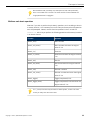
Multicore and atomic operations
Note that if you wish to perform simple atomic operations, such as adding a value to
a memory location, it isn't necessary to turn off interrupts to ensure that the operation
won't be preempted. Instead, use the functions provided in the C include file
<atomic.h>, which let you perform the following operations with memory locations
in an atomic manner:
Function
Operation
atomic_add()
Add a number
atomic_add_value()
Add a number and return the original
value of *loc
atomic_clr()
Clear bits
atomic_clr_value()
Clear bits and return the original value of
*loc
atomic_set()
Set bits
atomic_set_value()
Set bits and return the original value of
*loc
atomic_sub()
Subtract a number
atomic_sub_value()
Subtract a number and return the original
value of *loc
atomic_toggle()
Toggle (complement) bits
atomic_toggle_value()
Toggle (complement) bits and return the
original value of *loc
The *_value() functions may be slower on some systems, so don't use them
unless you really want the return value.
Copyright © 2014, QNX Software Systems Limited
23
Developing Multicore Systems
Adaptive partitioning
You can use adaptive partitioning on a multicore system, but there are some interactions
to watch out for.
For more information, see “Using adaptive partitioning and multicore together” in the
Adaptive Partitioning Scheduling Details chapter of the Adaptive Partitioning User's
Guide.
24
Copyright © 2014, QNX Software Systems Limited
Designing with multiprocessing in mind
Designing with multiprocessing in mind
You may not have a multicore system today, but wouldn't it be great if your software
just ran faster on one when you or your customer upgrade the hardware?
While the general topic of how to design programs so that they can scale to N processors
is still the topic of research, this section contains some general tips.
Use the multicore primitives
Don't assume that your program will run only on one processor. This means staying
away from the FIFO synchronization trick mentioned above. Also, you should use the
multicore-aware InterruptLock() and InterruptUnlock() functions.
By doing this, you'll be “multicore-ready” with little negative impact on a
single-processor system.
Assume that threads really do run concurrently
As mentioned above, it isn't merely a useful “programming abstraction” to pretend
that threads run simultaneously; you should design as if they really do. That way, when
you move to a multicore system, you won't have any nasty surprises (but you can use
BMP if you have problems and don't want to modify the code).
Break the problem down
Most problems can be broken down into independent, parallel tasks. Some are easy
to break down, some are hard, and some are impossible. Generally, you want to look
at the data flow going through a particular problem. If the data flows are independent
(i.e. one flow doesn't rely on the results of another), this can be a good candidate for
parallelization within the process by starting multiple threads. Consider the following
graphics program snippet:
do_graphics ()
{
int
x;
for (x = 0; x < XRESOLUTION; x++) {
do_one_line (x);
}
}
In the above example, we're doing ray-tracing. We've looked at the problem and decided
that the function do_one_line() only generates output to the screen — it doesn't rely
on the results from any other invocation of do_one_line().
To make optimal use of a multicore system, you would start multiple threads, each
running on one processor.
Copyright © 2014, QNX Software Systems Limited
25
Developing Multicore Systems
The question then becomes how many threads to start. Obviously, starting
XRESOLUTION threads (where XRESOLUTION is far greater than the number of
processors, perhaps 1024 to 4) isn't a particularly good idea — you're creating a lot
of threads, all of which will consume stack resources and kernel resources as they
compete for the limited pool of CPUs.
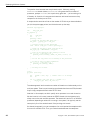
A simple solution would be to find out the number of CPUs that you have available to
you (via the system page pointer) and divide the work up that way:
#include <sys/syspage.h>
int
num_x_per_cpu;
do_graphics ()
{
int
num_cpus;
int
i;
pthread_t *tids;
// figure out how many CPUs there are...
num_cpus = _syspage_ptr -> num_cpu;
// allocate storage for the thread IDs
tids = malloc (num_cpus * sizeof (pthread_t));
// figure out how many X lines each CPU can do
num_x_per_cpu = XRESOLUTION / num_cpus;
// start up one thread per CPU, passing it the ID
for (i = 0; i < num_cpus; i++) {
pthread_create (&tids[i], NULL, do_lines, (void *) i);
}
// now all the "do_lines" are off running on the processors
// we need to wait for their termination
for (i = 0; i < num_cpus; i++) {
pthread_join (tids[i], NULL);
}
// now they are all done
}
void *
do_lines (void *arg)
{
int
cpunum = (int) arg;
int
x;
// convert void * to an integer
for (x = cpunum * num_x_per_cpu; x < (cpunum + 1) *
num_x_per_cpu; x++) { do_line (x);
}
}
The above approach lets the maximum number of threads run simultaneously on the
multicore system. There's no point creating more threads than there are CPUs, because
they'll simply compete with each other for CPU time.
Note that in this example, we didn't specify which processor to run each thread on.
We don't need to in this case, because the READY thread with the highest priority
always runs on the next available processor. The threads will tend to run on different
processors (depending on what else is running in the system). You typically use the
same priority for all the worker threads if they're doing similar work.
An alternative approach is to use a semaphore. You could preload the semaphore with
the count of available CPUs. Then, you create threads whenever the semaphore
26
Copyright © 2014, QNX Software Systems Limited
Designing with multiprocessing in mind
indicates that a CPU is available. This is conceptually simpler, but involves the overhead
of creating and destroying threads for each iteration.
Copyright © 2014, QNX Software Systems Limited
27
Glossary
asymmetric multiprocessing (AMP)
A separate OS, or a separate instantiation of the same OS, runs on each
CPU.
bound multiprocessing (BMP)
A single instantiation of an OS manages all CPUs simultaneously, but you
can lock individual applications or threads to a specific CPU.
discrete (or traditional) multiprocessor system
A system that has separate physical processors hooked up in multiprocessing
mode over a board-level bus.
hard thread affinity
A user-specified binding of a thread to a set of processors, done by means
of a runmask. Contrast soft thread affinity.
inherit mask
A bitmask that specifies which processors a thread's children can run on.
Contrast runmask.
multicore system
A chip that has one physical processor with multiple CPUs interconnected
over a chip-level bus.
runmask
A bitmask that indicates which processors a thread can run on. Contrast
inherit mask.
soft thread affinity
The scheme whereby the microkernel tries to dispatch a thread to the
processor where it last ran, in an attempt to reduce thread migration from
one processor to another, which can affect cache performance. Contrast
hard thread affinity.
symmetric multiprocessing (SMP)
A single instantiation of an OS manages all CPUs simultaneously, and
applications can float to any of them.
Copyright © 2014, QNX Software Systems Limited
29
Multicore Processing User's Guide
Index
_NTO_TCTL_RUNMASK 19
_NTO_TCTL_RUNMASK_GET_AND_SET_INHERIT 20
_thread_runmask 21
A
affinity, thread 19
AMP (Asymmetric Multiprocessing) 9
atomic operations 23
B
BMP (Bound Multiprocessing) 9, 15, 20
trying it 15
buildfiles 12, 18
modifying for multicore processing 12
sample 18
C
CPUs, number of 26
F
FIFO scheduling, using with multicore 22
I
images, building for multicore 18
inherit mask 20
InterruptLock() 22, 25
interrupts, handling 22
InterruptUnlock() 22, 25
ISR, preemption considerations 22
M
multicore processing 9, 18, 22, 25
building an image for 18
designing for 25
interrupts and 22
sample buildfile for 18
mutexes 22
Copyright © 2014, QNX Software Systems Limited
O
on utility 15, 21
operations, atomic 23
OS images, building for multicore 12, 18
P
pidin 14
processes, processor running on 14, 15
displaying 14
specifying 15
processors, determining number of 9
procnto*-smp 12, 18
R
RMSK_CLR() 20
RMSK_ISSET() 20
RMSK_SET() 20
RMSK_SIZE() 21
runmask 19
S
scheduling policies, using FIFO with multicore 22
SchedYield(), using with multicore 22
slay 15, 22
SMP (Symmetric Multiprocessing) 9, 14
trying it 14
synchronization primitives and multicore 22
system page, number of CPUs 26
T
tasks, parallel 25
Technical support 8
thread affinity 19
ThreadCtl() 19, 20
threads, running concurrently 19, 25
Typographical conventions 6
31
Index
32
Copyright © 2014, QNX Software Systems Limited