1
Page
1e
Issue 02.08
LiPoTx Operating instructions - Transmitter battery
1 Introduction
It’s hardly comforting when you notice that the capacity of your transmitter battery is
clearly declining, and its self-discharge rate is so high in any case.
The LiPoTx is the answer, as it is a replacement pack which fits in the existing battery
compartment of many transmitters.
• Integral balancer (works while the pack is on charge)
• Integral safety circuits, to ensure - as far as possible - that the battery and the transmitter cannot be damaged by incorrect charging (e.g. if a NiCd program is used).
• Simulation of declining Ni-Cd battery voltage to provide compatibility with existing
battery state indicators (only required for LiPoTx.gra).
2.1 Installation notes for the Graupner mc 10 … mc 24
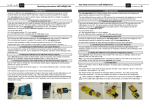
Fit the pack into the battery compartment between the rubber bands, with the cable on the
left and the circuit board (type sticker) inverted, fitting exactly in the battery compartment
depression (the flat face of the battery should be “up”, facing the transmitter back cover).
2.2 Installation notes for the MPX 3010, 3030, 4000
Unfortunately it is necessary to modify the battery compartment slightly in order to
accommodate the 3200 mAh pack: two of the vertical ribs in the well must be removed,
using side cutters, a cut-off disc or a similar tool.
Place the battery in the battery compartment with the cable on the right and the circuit
board (type sticker) facing “up” at the left. Pack foam rubber or similar round the battery
inside the compartment to ensure that it cannot shift.
3 The battery in use
Locate the lead attached to the battery, and insert the plug in the socket to which the
previous battery pack was connected. This automatically ensures that the pack can be
charged in the usual way via the transmitter’s standard charge socket, and that energy is
fed to the transmitter through this cable when it is switched on. This means: you do not
have to make any changes at all when using the transmitter.
4 Charging technique
As mentioned above, the charge lead should be inserted into the standard charge socket
on the transmitter, i.e. the battery can be charged in the usual manner when the transmitter is switched off.
The only point to remember is that you should use a special Lithium battery charger. This
should be set up in such a way that the charge current does not exceed the maximum
permitted rate stated in the transmitter operating instructions, nor the maximum charge
current printed on the battery (or in the Specification at the end of these instructions).
The lower of the two values must be observed.
Hint: Refresh- or Reflex-charging must be switched off!
Be sure to set the battery-specific cell count on the charger.
If a nearly full battery is connected to the charger, the charger might detect „over oltage“,
“wrong cell count“ or similar. This is normal and caused by a (voltage increasing) diode
path which is not short circuited in the first moment of charging.
LiPoTx Operating instructions - Transmitter battery
Issue 02.08, Page
2e
5 Special features, protective circuitry
We have employed a little trick with the three-cell Graupner battery pack to ensure that
the transmitter meter indicates the state of the LiPo pack in a similar way to a conventional Nickel battery: the pack feeds a declining voltage to the transmitter, starting when
approximately half its capacity is discharged, mimicking the voltage curve of a Nickel
battery. This gives the pilot plenty of warning that the battery is nearing the end of its
useful capacity.
The battery state indicator for the two-cell MPX transmitter battery is not specially modified.
5.1 Inadvertently charging the battery using a NiCd or NiMH battery charge program.
5.1.1 Charging at currents up to 2 A: towards the end of the charge process the battery
will be fed an excess voltage of around 0.1 Volt. The battery is then disconnected from
the charger, and the charger’s output is short-circuited to earth by the LiPoTx (via three
diodes). At this point any Schulze charger will emit a low-voltage warning, or display a
message indicating that the battery should be disconnected. The short-circuit is removed
again as soon as the charge current falls to zero. Note that the battery will generally not
be completely fully charged at this point, since the voltage declines when the charge
current is cut off.
5.1.2 Charging at currents above 2.5 A: the LiPoTx detects excess current, and the
battery is then disconnected from the charger as under 5.1.1. The charger’s output is
short-circuited to earth by the LiPoTx (via three diodes). The short-circuit condition may
generate a variety of error messages on Schulze chargers, but in all cases the result
should be to cut off the charge current.
5.2 Short-circuiting the charge lead
Discharge currents above about 1.4 A: the LiPoTx switches off the output voltage and
waits until the unacceptable load or short-circuit is removed.
6 Specifications
LiPoTx-2000.mpx - 2 Zellen, 2,0 Ah (2s-1p-2000), 7,4 V, Replaces 7,2 V Nickel-Packs
Max. charge voltage / max. charge current
8,4 volts / 2 amperes*
Size
82*42*22 mm
Weight
116 grammes
LiPoTx-3200.mpx - 2 Zellen, 3,2 Ah (2s-1p-3200), 7,4 V, Replaces 7,2 V Nickel-Packs
Max. charge voltage / max. charge current
8,4 volts / 2 amperes*
Size
135*42*20 mm
Weight
184 grammes
LiPoTx-2000.graupner - 3 Zellen, 2,0 Ah (3s-1p-2000), 11,1 V Repl. 9,6 V Nickel-Packs
Max. charge voltage / max. charge current
12,6 volts / 2 amperes*
Size
82*42*30 mm
Weight
166 grammes
LiPoTx-3200.graupner - 3 Zellen, 3,2 Ah (3s-1p-3200), 11,1 V Repl. 9,6 V Nickel-Packs
Max. charge voltage / max. charge current
12,6 volts / 2 amperes*
Size
135*42*29mm
Weight
271 grammes
(*) limited by the connecting lead, the circuit board tracks and the connector.
Page
3e
Issue 03.06
LiPoPerfekt battery pack - Important hints
Common hints on using Lithium batteries
• Read the charging/discharging conditions of the battery as well as the instructions in the supplementary
handling precautions carefully and observe them at all times.
• Do not disassemble, modify, heat or short-circuit the battery.
• Do not burn the battery or store it in a hot area.
• Do not drop the battery and/or apply excessive mechanical stress to it.
• Do not allow the battery to get wet.
• Use for charging only the LiPoCard resp. a charger in conjunction with the LiPo-Balancer and its
activated safety circuit/circuits (*).
• During discharging, use suited additional Schulze devices to protect the battery. We recommend the
LiPoBalancer for test series and in your model the LiPoDiMATIC(*).
(*) Otherwise the lifetime of the battery can be rapidly reduced.
1 Charging instructions
• Lithium batteries must not be charged and / or operated in any combination with primary cells (dry cells)
or other types of rechargeable battery (Nickel, Lead-acid batteries), or other types of Lithium cells (e.g. LiIo with Li-Po), with cells of different capacity and / or make, and with cells of different maximum load
capacity.
• Lithium batteries must not be charged using any charger or charge program which was intended for
Nickel batteries (Ni-Cd or NiMH). These batteries must only be charged using a specialised unit such as
the Schulze LiPoCard, or a charger such as the Schulze isl 6, nextGeneration or isl 8 series; these
devices include programs for charging Lithium batteries.
FIRE HAZARD! - if you do not observe the battery manufacturer’s charging instructions, you risk damaging and even ruining the batteries (swelling, explosion); this can result in fire.
In particular please remember that the number of cells in the pack must be set correctly on the charger;
note: this applies only to the number of cells wired in series. Parallel-wired cells are “seen” by the charger
simply as one (1) cell “of large capacity”.
• Before charging the cells it is essential to check the cell count setting and the maximum charge voltage
on the charger.
• Before charging the cells it is essential to check the maximum charge current setting.
• Keep the battery well away from inflammable materials and volatile gases.
• During any charge / discharge process the balancer, the charger / discharger and the connected
batteries must be placed on a non-inflammable, heat-resistant and electrically non-conductive surface.
Such surfaces include ceramic dishes and flower pots, and special fireproof plastic or aluminium cases
(these must be insulated, e.g. using plaster sheets).
• Don’t charge batteries in the car - the seats burn very well …
• Supervise the charge process constantly - if the battery swells up, disconnect it from the charger
immediately.
• Burning batteries should be extinguished with dry sand or a powder fire extinguisher - never with water explosion hazard!
• Never attempt to recharge dead or damaged cells - this can have particularly disastrous results if these
cells are part of a pack which also includes “healthy” cells.
• Protect the cells from mechanical loads!
2 Useful life
• Observe the charge current and discharge current limits stated by the battery manufacturer. Do not
exceed the maximum values, as this brings a risk of drastic reduction in the pack’s useful life.
• Contrary to much published information, the professional protective circuit for Kokam cells defines the
lower and upper limits as 1.0 and 4.5 Volts per cell
(http://www.kokam.com/english/biz/care.html).
• The most common cause of unbalanced battery packs is not “deep-discharging” to below 3 V / cell, but
overloading through excessive discharge currents!
LiPoPerfekt battery pack - Important hints
Instructions
Issue 03.06, page
4e
• Be cautious with dealers’ statements such as maximum load currents of “15C” or “20C”; often this refers
to peak load values, and not continuous currents.
• Lithium cells lose a small amount of capacity every time they are charged, but the loss is much higher if
they are overloaded.
• Make sure your batteries are protected from short-circuit at all times! Whether the “short” is caused by a
screwdriver in your toolbox or by a house-key in your trouser pocket, the result is the same: overloaded
cells, and possibly a fire.
• If you deep-discharge a battery at a high current to a point below 1 V / cell, the result is invariably
irreparable damage. In any application where high motor currents are used, the discharge limit for packs
of identical cells must be in the range 2.4 … 3.0 V / cell. If the pack includes cells in different conditions,
the discharge limit should be set even higher, to avoid the danger that the weakest cell might fall below
the critical 1 V point when being discharged.
Our own experience shows that deep-discharges are not so critical if they are caused by the idle currents
of electronic circuits (speed controller not disconnected from the flight battery after the flight, balancer
powered by the battery and not removed after discharging the pack). However, if you discover a battery in
this condition, charge it initially using a very low current (1/20C or less) until it reaches a voltage within the
“working window” of the cells (for Li-Po cells that is 3.0 … 4.2 Volts).
• Since we are not in a position to ensure the proper use of the cells, the user is deemed to have accepted
the responsibility once he opens the sales package. Thereafter he has no claim against the manufacturer,
the importer, the dealer or the employees of those companies if an accident occurs in which personal
injury or property damage result.
3 Cell handling
• The voltage of brand-new cells and discharged cells is not zero; it is generally more than 3 Volts. Shortcircuit hazard!
• Never place cells or batteries on a conductive surface. Note that carbon fibre fuselages and carbon fibre
spars are conductive!
• Do not place batteries in a micro-wave oven!
• Schulze LiPoPerfekt battery packs are protected at many points against accidental short-circuit, using
cover plates, silicone, fabric tape and heat-shrink sleeving. Take care to avoid short-circuits at any
unprotected points, and keep an eye open for abraded areas of the heat-shrink sleeving; if you discover a
weak point, insulate it thoroughly.
• Keep individual cells and battery packs well away from youngsters, and store them out of the reach of
children at all times. Many cells look rather like chewing gum or chocolate bars, and this is potentially
confusing and dangerous.
• Do not open cells. The internal chemicals react with oxygen in the air and / or water, and in some
circumstances the reaction can be violent. If a cell should catch fire and you have no suitable extinguishing agent to hand (sand, extinguisher powder), allow it to burn out, taking care not to breathe in the
vapours generated by the fire.
• If the chemicals make contact with your eyes, immediately wash it off using plenty of water, and seek the
assistance of a specialist doctor.
• The manufacturer’s stated maximum discharge rates may be greatly exceeded when the cells are in use
(typical of RC usage), which means that the cells are working under experimental conditions. As a result
the manufacturer, the importer and the dealer are not liable for any claim under guarantee in respect of
capacity, useful life, storage and discharge characteristics.
4 Disposal
• Discharge the cells slowly, ideally using a 1 … 10 kOhm resistor, which you can leave attached to the
empty cells.
• Take the dead, discharged cells to your local battery collection point; packs purchased from us can also
be returned to us.
Schulze Elektronik GmbH • Prenzlauer Weg 6 • 64331 Weiterstadt • Fon: +49-6150-1306-5, Fax: 1306-99
www.schulze-elektronik-gmbh.com
[email protected]
• Germany •