1
Bulletin 71.2:92S
Type 92S Pilot-Operated Pressure
Reducing Regulator with Safety
Override Pilot
A Type 6492HM or 6492HTM safety override pilot is
available for the Type 92S. The Type 6492H pilot is
used in a series installation with the Type 6492HM
or 6492HTM safety override pilot installed on the
upstream regulator. The Type 6492HM or 6492HTM
safety override pilot senses pressure downstream
of the second valve, and prevents pressure from
rising above safe operating pressure in the event the
downstream valve fails. This system is approved by
ASME B31.1-1989, 122.14.2.A, and can replace an
ASME safety valve when vent piping is not practical
and Type 92S Pilot-Operated, Pressure Reducing
Regulator with Safety Override Pilot upstream steam
pressure does not exceed 400 psig / 27.6 bar. Local
codes and standards may require approval by an
appropriate authority prior to installation.
Operation
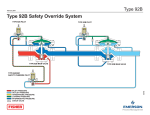
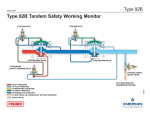
Once placed in operation, the upstream Type 6492H
pilot senses the intermediate pressure between both
valves, and the Type 6492HM or 6492HTM pilot
senses downstream pressure of the second valve. As
demand for flow increases, intermediate pressure will
fall causing the Type 6492H pilot to open. As the
Type 6492H pilot valve opens, loading pressure to the
main valve increases, opening the main valve.
The Type 6492HM or 6492HTM safety override
pilot remains open because its setpoint is above the
setpoint of the downstream valve. In the unlikely event
that the downstream valve fails open, downstream
pressure will rise above the downstream valve’s
setpoint. This pressure is sensed by the
Type 6492HM or 6492HTM safety override pilot. As
downstream pressure increases the safety override
pilot closes, reducing loading pressure to the main
valve, which positions the main valve to maintain
downstream pressure as specified per ASME Boiler
and Pressure Vessel Code, Section VIII.
In the event that the upstream valve fails, the
downstream regulator will prevent downstream
pressure from rising above safe operating levels.
It is recommended to install some type of warning
system, such as a sentinal relief valve, to warn the
operator that a valve has failed in the system. This
will prevent prolonged operation with one valve, which
could cause valve trim wear and noise associated with
operation at high differential pressures.
8
When operating in most steam systems, valve setpoints
should be in strict accordance to ASME Boiler and
Pressure Vessel Code, Section VIII. The Type 6492HM
or 6492HTM safety override pilot should be set at
10 psig / 0.69 bar or 10% above maximum downstream
operating pressure of the second valve, whichever
pressure is greater. For example, most HVAC systems
operate at 15 psig / 1.0 bar, so the safety override pilot
should be set no higher than 25 psig / 1.7 bar.
Capacity Information
Table 5 gives typical regulating capacities in pounds
per hour / kg/h of saturated steam. Capacities for
regulators with noise attenuation trim are the same as
for regulators without noise attenuation trim. Figure 8
shows a typical performance curve.
To determine regulating capacities at pressure settings
not given in Table 5 or to determine wide-open
capacities for relief sizing at any inlet pressure, use the
following procedure 1 or 2 as appropriate.
1. If the steam is saturated and the pressure drop across the regulator is critical (absolute outlet pressure is equal to approximately one-half or less
than one-half of the absolute inlet pressure), use the equation:
Q = (P1abs) (Cs)
where,
Q =  Flow capacity in pounds of saturated steam
per hour
P1abs  =  Absolute inlet pressure in psia (P1gauge + 14.7)
Cs =  Regulating or wide-open steam sizing coefficient
(see Table 3)
2. If the steam is superheated or if the pressure drop across the regulator is lower than critical (absolute outlet pressure is greater than approximately one-
half the absolute inlet pressure), use the valve sizing slide rule or the sizing nomographs
in Catalog 10.
Noise Abatement Information
A noise attenuation trim is available for use with
NPS 2 / DN 50 and larger Type 92S steam regulators
to provide an economical means for the reduction of
noise from high-velocity steam flow. Capacities for a
regulator equipped with a noise attenuation trim are
the same as for a regulator without noise attenuation
trim and are given in Table 5.