1
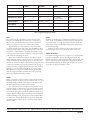
ATTACK
RELEASE
RATIO
KNEE
Vocals
Medium to Fast
Medium to Slow
2:1 to 4:1
Soft
Clicky Bass
Fast
Fast
4:1 or higher
Hard
Mushy Bass
Medium to Slow
Medium to Slow
4:1
Hard
Slow
4:1 or higher
(more sustain)
Hard
Raging Electric Guitar Fast
Acoustic Guitar
Medium to Slow
Medium to Slow
4:1
Medium
Brassy Horns
Fast
Fast
5:1 or higher
Hard
Drums (kick, snare)
Fast
Fast
4:1
Hard
Drums (cymbals)
Fast
Slow
2:1 to 10:1
Hard
Table 1. Suggested Compressor Settings
Bass
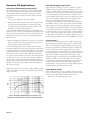
It is common for the sound mixer to reduce the bass signal
because it overwhelms the total system. Use a compressor to
smooth a bass sound by lessening the variations between the
strings or strongly resonant notes, and increasing sustain.
Typical settings for a bass guitar are a ratio of 4:1, with a
fast attack of 25 ms and a slow release of around 500 ms. These
settings should produce a strong, smooth bass line to start with,
but feel free to adjust further as necessary. A hard knee setting
is often preferred since all that is desired is to tame the excessive
peaks and leave everything else alone.
Where does a compressor belong in a bass player’s signal
chain? Well, that depends on how you want it to function. As a
compressor/limiter for the input signal, it goes after the bass (if
the bass has a line-level output) and before the preamp. If it were
to function as a limiter to protect the speakers in the bass rig, it
would go after the preamp and before the power amp. Another
method is to insert the unit in the effect loop of the preamp.
This allows the bass signal to be affected by the pre-amp first,
then the compressor/limiter, and then sent to the power amp.
This can be desirable with tube pre-amps.
Drums
Reducing the leading edge of a drum hit and bringing out more
of the “body” of the drum is another popular use of compressors.
Try ratios between 2:1 and 5:1 accompanied by fast attack and
release times. Listen carefully while changing the attack time to
find the final setting.
Cymbals need a fast attack but a slow release to allow the
sustain through. A low ratio of about 2:1 works well to start.
Digital Recording
For digital recording use the C4 to compress a too-wide dynamic
range into a signal that does not cause digital overload. The
Limiter is the primary tool for keeping things under control, but
a little compression with its threshold set just under the limiter
threshold level helps keep the limiting more subtle. To control a
stereo mix, set the mode switches to Slave.
Guitar
Here is a suggestion on how to achieve a lower volume without
sounding as if you are playing out of a transistor radio: set a slow
attack time with a medium to slow release and a relatively low
threshold. Experiment from these initial settings.
One of the favorite uses of compression by guitarists is to increase the sustain, or duration of a note after it is played. Carlos
Santana and Gabor Szabo are two musicians who use sustain to
great acclaim, although they did it the old-fashioned way of creating feedback by aiming the guitar pick-ups at the loudspeaker
and then jamming over it. A compressor creates a similar effect.
Set a high ratio and low threshold for long sustain, along with
fast attack and slow release. Again, experimentation produces
the best results.
©Rane Corporation 10802 47th Ave. W., Mukilteo WA 98275-5000 USA TEL 425-355-6000 FAX 425-347-7757 WEB www.rane.com
All features & specifications subject to change without notice. DOC 107487
Manual-11