1
panel.
- Fuse protection of the power relay
feeding circuit.
- Use of H05 RN-F type rubber covered
cables and wires of sections and types
suitable for the supply voltage and
specific working conditions.
NOTE: Protection against overcurrent
and differential protection must be
installed by the user upstream of the
appliance power intake.
minutes in order to accelerate the
renewal of air inside the oven and then,
close the door. During this process, do
not leave the oven unattended.
- At the end of the preheating phase, all
the metallic and refractory components
of the oven will have reached the
stabilization temperature and it will be
possible to use the oven in the normal
way.
- On subsequent uses of the oven, the
above described preheating procedure is
no longer required.
5. INSTRUCTIONS FOR USE OF THIS
APPLIANCE
7. PERIODICAL USE OF THE OVEN
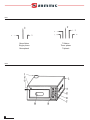
With reference to Figure 2, the appliance
includes the following controls:
Before use, check for the following points
and settings:
A- Graduated knob of the oven
temperature control thermostat (two
thermostats per cooking chamber).
B- Backlit indicators of the operation of
the heating resistors in each cooking
chamber (one indicator per thermostat)
C- Internal lighting ON/OFF switch.
D- Pyrometer for measuring the
temperature in the cooking chamber.
E- ON/OFF switch: in the 0/OFF position, it
isolates the electric circuit of the oven
from the mains; in the I/ON position, it
makes the circuit.
F- Cooking steam exhaust control knob.
G- Oven door handle.
H- Pyrex pane window for supervising
food during their cooking.
I- 80-mm round exhaust spout to be
connected to the outside with an
adequate pipe.
L- Safety thermostat at the back of the
oven, with built-in red-coloured reset.
- Introduce the plug into the socket
situated in the junction box.
- Check that the oven ON/OFF switch is in
the 0/OFF position.
- Verify if the magnetothermal and
differential switches are connected.
- Put the line breaker at the current outlet
in the I/ON position.
- Turn the knob of the thermostat to the
temperature required.
- Put the oven ON/OFF switch in the I/ON
position.
- Wait until the selected oven temperature
is reached (the light indicator turns off).
- When the temperature is reached, open
the door and introduce the pizzas, even
directly onto the refractory sole, without
any container or pan.
Figura 2.
The opening of the oven door results in
hot air escape and the consequent quick
fall of the cooking chamber temperature.
It is therefore advisable to open the door
only the time strictly necessary to
introduce or remove the pizzas or other
food products. This will save energy and
prevent thermal shocks inside the cooking
chamber.
6. OVEN START-UP
Before cooking food in the oven, it is
necessary to preheat the cooking chamber
adequately.
- Turn the knob of the control thermostat
to set the temperature at approx. 250ºC
and keep the oven working at this
temperature for about one hour.
- During the preheating of the oven, water
steam will develop, with an unpleasant
smell due to surface oxidation of the
enclosed resistors.
- On completion of the first cycle, all metal
will have stabilised and thereafter no
unpleasant smell will develop. Once the
preheating time has passed by, open the
front door and keep it open for a few
6 ENGLISH
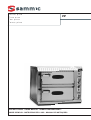
These ovens feature a cooking sole made
of special, non-toxic food-grade
refractories.
Doors with inspection windows enable a
visual control of the cooking of pizzas or
food products, without need for opening
the door.
On finishing a production cycle, turn the
oven off, by putting first the ON/OFF
switch and then the line breaker in their
0/OFF position.
8. MAINTENANCE OF THE OVEN
Operate the oven controls only in the
specified sequence, to prevent damages to
the devices due to misuse.
For cleaning the cooking chamber, wait
until the oven has completely cooled
down. Remove the plug from the socket
and place a 'Maintenance On' placard. The
refractory tiles may be cleaned with either
a water-moistened strong cloth or a steel
wire brush, but detergents, solvents and
chemicals whatsoever are prohibited.
The very high temperature reached will
automatically cause the sterilization of
anything inside the oven.
Hard-to-remove stains and charred
remains may be scraped off with a
suitable utensil, like a steel-blade spatula
with insulated handle, wearing protective
gloves too.
The external surfaces of the oven may be
cleaned with a soft sponge wetted in
water and pH-neutral, chlorophosphatefree detergent with a 90% content of
biodegradable surfactants.
Do not use creamy detergents containing
abrasives that will damage any surface
irremediably.
9. INFORMATION ON INCORRECT USERELATED HAZARDS
Although they are equipped with control
and safety thermostats, these ovens must
be attended by the user during the whole
process cycle.
- Keep the power cord and plug of the
oven in good condition, and all the
safety and circuit-breaking devices in the
power supply junction box and on the
oven as well.
- Protect the power cord against any
damage adequately and have it replaced
immediately if any failure or damage,
however superficial it may be, is
observed.
- At least once in a fortnight, check the
efficiency of the 'life-saving' differential
switch situated in the oven service line,
by pressing the test push-button.
- Neither install the oven in the open air
nor under any canopy or provisional
roof.
- The oven should be used inside civil or
industrial buildings.
- Do not spray water or any combustible