1
Interfacing Peripherals
Computer peripherals such as disc drives, printers, mice etc all work in totally different ways and linking them to
the processor is a difficult task. They all work at different speeds, use different codes, transfer different amounts
of data at a time and even work at different voltages.
Interfaces
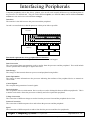
The interface is the link between the processor and the peripheral.
Its task is to transfer data so that the processor is delayed as little as possible.
Processor
Data Bus
Address Bus
Control Bus
Interface1
Interface2
Peripheral
Peripheral
Memory
Functional requirements of any peripheral device interface
The following may have to be completed before communication can happen:
Data Conversion
The conversion of data representation (code) to and/or from the processor and the peripheral. This could include
serial to parallel and/or analogue to digital conversion.
Data Storage
The storage of data in transit between processor and peripheral using buffers.
Status Information
The supply of status information to the processor indicating the readiness of the peripheral device to transmit or
receive data.
Control Signals
The reception and generation of control signals.
Device Selection
The recognition of device information. Device codes are used to distinguish between different peripherals. This is
a number code which allows the processor to identify and select a particular peripheral.
Voltage Conversion
The conversion of different voltages to and/or from the processor form and the peripheral device form.
Protocol Conversion
The conversion of different protocols to and/or from the processor and the peripheral.
Speed
The conversion of different speeds to and/or from the fast processor and the slow peripherals.
Higher Computing Systems - Peripherals
Produced by S Lambert, R Simpson and HSDU for City of Edinburgh Council, 2004
Infosheet 3.19