1
3.2
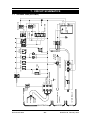
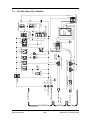
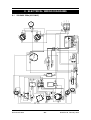
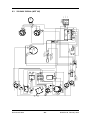
EXPLANATION OF CONTROL
SYSTEM
The control panel indicator light above the
thermostat knob cycles On and Off with the
thermostat to indicate when the gas burners
are on and the oven is heating.
The G32M and G32MS Turbofan convection
ovens feature multi-function operator controls
for which a correct understanding of their
operation is required before carrying out any
service or fault repair work. The control
device functions are explained as follows:
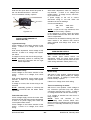
The G32M and G32MS Turbofan ovens have
an infrared surface combustion burner fitted in
a burner box underside the oven. The burner
box is directly ducted into the oven chamber
through a flue duct connecting to an opening
behind the oven circulation fan. The fan
draws the burner box heated air and products
of combustion directly into the oven chamber
(directly fired system) to maximise
performance. A flue exit in the top of the oven
chamber provides final flueing of the
combustion products out of the oven.
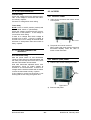
A power switch on the control panel isolates
all to the controls of the oven. With the power
switch Off all functions of the oven are
inoperable.
With the power switch On (illuminated) power
is directly supplied to the 60 minute bake
timer, steam (water injection) switch, door
microswitch, light switch, the temperature
control circuit, and the fan motor. The oven
circulation fan will continuously run whenever
the oven is switched on. The control panel
light switch will turn the oven lights on when
the door is closed. The oven lights will come
on automatically when the door is open, as
this is controlled by the door microswitch.
The burner being of an infrared type is
provided with primary combustion air at the
injector orifice intake at the front of the burner,
and draws in the primary air through the
venturi effect of the burner mixer tube elbow.
Additional secondary air is provided in the
burner box via an air intake on the underside
of the burner box that is intake ducted to the
air openings on the right hand side of the G32
base assembly.
The addition of the
secondary air allows for complete combustion
of the gas due to the infrared burner being
under the draft conditions of the oven fan
extraction on the burner box. Accordingly, the
infrared burner will display conventional
surface combustion infrared combustion
characteristics as well as having a flame
plume drafted toward the right hand side of
the oven (toward the burner box flue duct)
when viewed from the front of the oven, after
removal of the front service panel.
The 60 minute timer is a mechanical timer and
can therefore be operated with the oven’s
power switch On or Off. However, only with
the oven’s power switch On will the switch
contacts of the 60 minute timer turn on the
time-up buzzer and illuminate the time-up
indicator on the control panel. The buzzer
and time-up indicator provide indication that
the time setting has run down to zero and at
this point will remain On continuously until the
60 minute timer has been manually set back
to the Off (vertical) position. The 60 minute
timer does not control any other part of the
oven’s operating system as this timer is
independent of the temperature control and
heating system.
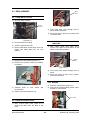
The burner is automatically controlled by the
main oven thermostat or hold thermostat, via
an automatic ignition and valve control device,
which operates a gas solenoid valve to
provide gas to the burner as required to
maintain the set thermostat temperature.
The steam (water injection) switch on the
control panel can be operated whenever the
power switch is On. The switch is momentary
and when depressed will operate the electric
solenoid valve at the rear of the oven and
inject water across the oven fan from the flat
spray (vertical) nozzle positioned at the rear of
the oven. Releasing the steam button will
close the solenoid valve. This feature is used
to instantaneously add steam into the oven.
NOTE: On 110 volt models the ignition
control and gas control valve operate on 24
volts AC through a 110 volt - 24 volt
transformer. For these models the thermostat
powers the transformer, whereas on 220-240
volt models the thermostat powers the ignition
control directly.
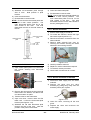
On the thermostat calling for heat, the
thermostat will switch power to the ignition
control. The ignition control will then power
the gas control valve to open the solenoids
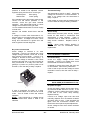
The temperature control of this oven is with a
capillary type thermostat which can be set to a
required cooking temperature.
Revision 6/F3590
-12-
© Moffat Ltd, February 2005