1
Benefits
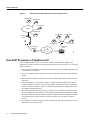
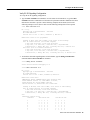
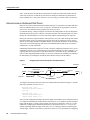
7 Any call-progress indications (or other signals that can be carried in-band) are cut through the
voice path as soon as an end-to-end audio channel is established. Signalling that can be detected
by the voice ports (for example, in-band DTMF digits after the call setup is complete) is also
trapped by the session application at either end of the connection and carried over the IP network
encapsulated in RTCP using the RTCP APP extension mechanism.
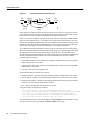
8 When either end of the call hangs up, the RSVP reservations are torn down (if RSVP is used) and
the session ends. Each end becomes idle, waiting for the next off-hook condition to trigger
another call setup.
Benefits
•
•
•
•
Toll bypass
Remote PBX presence over WANs
Unified voice/data trunking
POTS-Internet telephony gateways
List of Terms
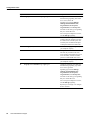
ACOM—Term used in G.165, “General Characteristics of International Telephone Connections and
International Telephone Circuits: Echo Cancellers.” ACOM is the combined loss achieved by the
echo canceller, which is the sum of the echo return loss, echo return loss enhancement, and nonlinear
processing loss for the call.
A-law—A companding technique commonly used in Europe. A-law is standardized as a 64-kbps
CODEC in ITU-T G.711.
Call leg—A logical connection between the router and either a telephony endpoint over a bearer
channel, or another endpoint using a session protocol.
CAS—Channel associated signalling. In E1 applications, timeslot 16 is used to transmit CAS
information. Each frame’s timeslot 16 carries signalling information (ABCD bits) for two of the
B-channel timeslots.
CIR—Committed information rate. The average rate of information transfer a subscriber (for
example, the network administrator) has stipulated for a Frame Relay PVC.
CODEC—coder-decoder. Device that typically uses pulse code modulation to transform analog
signals into a digital bit stream and digital signals back into analog signals. In Voice over IP, it
specifies the voice coder rate of speech for a dial peer.
Data link connection identifier (DLCI)—Frame Relay virtual circuit number corresponding to a
particular destination. The DLCI is part of the Frame Relay header and is usually 10 bits long.
Dial peer—An addressable call endpoint. In Voice over IP, there are two kinds of dial peers: POTS
and VoIP. In Voice over IP, you use dial peers to assign particular characteristics to call legs.
DS0—A 64-kbps channel on an E1 or T1 WAN interface.
DSP—Digital Signal Processor.
DTMF—Dual tone multifrequency. Use of two simultaneous voice-band tones for dial (such as
touch tone).
E1—Wide-area digital transmission scheme. E1 is the European equivalent of a T1 line. The E1’s
higher clock rate (2.048 MHz) allows for 32 64-kbps channels, which include one channel for
framing and one channel for D-channel information.
Voice over IP for the Cisco AS5300 3