1
ICT-257422
CHANGE
CHANGE: Enabling Innovation in the Internet Architecture through
Flexible Flow-Processing Extensions
Specific Targeted Research Project
FP7 ICT Objective 1.1 The Network of the Future
D3.3: Flow Processing Platform: Main
Implementation
Due date of deliverable: 30 September 2012
Actual submission date: October 26th, 2012
Start date of project
1 October 2010
Duration
36 months
Lead contractor for this deliverable
NEC
Version
Final, October 26, 2012
Confidentiality status
Public
c CHANGE Consortium 2012
Page 1 of (20)
Abstract
This deliverable describes the main implementation of the CHANGE flow processing platform and the
source code distribution that accompanies this document, which is restricted. We begin by covering
the platform requirements and the resulting platform design. We continue by describing the platform’s
API, that is, the set of functions that are externally visible. This allows CHANGE platforms to vary
significantly from each other in terms of hardware while still being able to inter-operate. In addition,
we provide a detailed description of the internal platform controller architecture. Finally, this document
gives a brief description of how to install and run a CHANGE platform.
Target Audience
Network experts and researchers. This document is public, but the accompanying source code is restricted to the Commission Services and groups specified by the consortium.
Disclaimer
This document contains material, which is the copyright of certain CHANGE consortium parties, and may
not be reproduced or copied without permission. All CHANGE consortium parties have agreed to the full
publication of this document. The commercial use of any information contained in this document may require
a license from the proprietor of that information.
Neither the CHANGE consortium as a whole, nor a certain party of the CHANGE consortium warrant that
the information contained in this document is capable of use, or that use of the information is free from risk,
and accept no liability for loss or damage suffered by any person using this information.
This document does not represent the opinion of the European Community, and the European Community is
not responsible for any use that might be made of its content.
Impressum
Full project title
CHANGE: Enabling Innovation in the Internet Architecture through
Flexible Flow-Processing Extensions
Title of the workpackage
Work Package 3. Flow Processing Platform Design and Development
Editor
Felipe Huici, NEC
Project Co-ordinator
Adam Kapovits, Eurescom
Technical Manager
Felipe Huici, NEC
Copyright notice
c 2012 Participants in project CHANGE
Page 2 of (20)
c CHANGE Consortium 2012
List of Authors
Authors
Felipe Huici (NEC), Costin Raiciu (PUB)
Participants
NEC (Editor), PUB
Work-package
WP3: Flow Processing Platform Design and Development
Confidentiality
Public (PU)
Nature
Report (R)
Version
1.0
Total number of pages
20
c CHANGE Consortium 2012
Page 3 of (20)
Contents
List of Authors
3
List of Figures
5
List of Tables
6
1
Introduction
7
1.1
Platform Requirements . . . . . . . . . . . . . . . . . . . . . . . . . . . . . . . . . . . . .
7
1.2
Flow Processing Platform Overview . . . . . . . . . . . . . . . . . . . . . . . . . . . . . .
8
2
3
4
External Interface: Primitives
2.0.1
High-Level API . . . . . . . . . . . . . . . . . . . . . . . . . . . . . . . . . . . . .
10
2.0.2
Low-Level API . . . . . . . . . . . . . . . . . . . . . . . . . . . . . . . . . . . . .
11
2.0.3
Return Values . . . . . . . . . . . . . . . . . . . . . . . . . . . . . . . . . . . . . .
11
2.0.4
Allocation Request Format . . . . . . . . . . . . . . . . . . . . . . . . . . . . . . .
12
Internal Architecture: the Controller
13
3.1
Controller Components . . . . . . . . . . . . . . . . . . . . . . . . . . . . . . . . . . . . .
13
3.2
Daemon Architecture and Communications . . . . . . . . . . . . . . . . . . . . . . . . . .
14
3.3
Tasks and Commands . . . . . . . . . . . . . . . . . . . . . . . . . . . . . . . . . . . . . .
14
3.3.1
Structure of Tasks and Commands . . . . . . . . . . . . . . . . . . . . . . . . . . .
15
3.3.2
Task Priorities . . . . . . . . . . . . . . . . . . . . . . . . . . . . . . . . . . . . .
15
3.3.3
Hot Patching . . . . . . . . . . . . . . . . . . . . . . . . . . . . . . . . . . . . . .
15
Initial Software Implementation
16
4.0.4
Platform Hardware Description . . . . . . . . . . . . . . . . . . . . . . . . . . . .
16
4.0.5
Platform Software Description . . . . . . . . . . . . . . . . . . . . . . . . . . . . .
16
4.0.6
Brief User’s Manual . . . . . . . . . . . . . . . . . . . . . . . . . . . . . . . . . .
17
4.0.6.1
Requirements . . . . . . . . . . . . . . . . . . . . . . . . . . . . . . . .
17
4.0.6.2
Installation . . . . . . . . . . . . . . . . . . . . . . . . . . . . . . . . . .
17
4.0.6.3
Running the Platform . . . . . . . . . . . . . . . . . . . . . . . . . . . .
17
Wide-Area Network Testbed . . . . . . . . . . . . . . . . . . . . . . . . . . . . . .
18
4.0.7
5
10
Conclusions
References
Page 4 of (20)
20
20
c CHANGE Consortium 2012
List of Figures
1.1
Flowstream Platform Overview. . . . . . . . . . . . . . . . . . . . . . . . . . . . . . . . .
8
3.1
Platform controller architecture overview, only control-plane connections are shown. . . . .
13
c CHANGE Consortium 2012
Page 5 of (20)
List of Tables
Page 6 of (20)
c CHANGE Consortium 2012
1
Introduction
The Internet has grown over the last twenty years to the point where it plays a crucial role in todays society
and business. By almost every measure, the Internet is a great success. It interconnects over a billion people,
running a wide range of applications, with new ones appearing regularly that take the world by storm. Yet
despite this success the Internet comes with important shortcomings. The limitations are well-known: the
Internet does not provide predictable quality of service, and does not provide a sufficiently robust and secure
infrastructure for critical applications. Worse, making changes to the basic Internet infrastructure is costly,
time-consuming and often unfeasible: operators are paid to run stable, always available networks which is
anathema to deploying new mechanisms.
To overcome these problems CHANGE introduces a new evolutionary (i.e., incrementally deployable) architecture based around the notion of flow processing platforms, or Flowstream platforms for short, located
throughout the network. The idea is that for specific flows that need special processing, flow owners discover
platforms along the path and request flow processing from them. What do we mean by “flow processing”?
Flow processing can encompass a large number of actions, from filtering, NAT, DPI to packet scrubbing and
monitoring, among others. In fact, as we envision at least certain versions of these platforms to be based on
general-purpose hardware, flow processing will be largely user-defined, and we expect the more interesting
uses of platforms will be for things that are currently not in existence.
The core of the CHANGE architecture relies, then, on these Flowstream platforms. Other deliverables of
the project (D4.2-D4.4) cover the architecture itself, including how users discover these platforms or how
off-path packets can actually make it to a platform. This deliverable, on the other hand, focuses on describing
the platforms themselves. We begin by giving a set of requirements for the platform, and give an overview
of the basic hardware structure of a platform. From there we describe the controller itself, that is, the software in charge of managing the platform. We conclude with a description of the software distribution that
accompanies this document, including a (brief) manual on how to set-up and run a CHANGE platform.
1.1
Platform Requirements
The goals outlined above dictate a number of requirements for the Flowstream platforms:
• Flexibility: platforms should be able to perform a wide range of flow processing.
• Dynamic Installation: platforms should be able to install new types of processing on demand.
• Dynamic Scalability: platforms should be able to scale their capabilities to meet dynamic demand.
• Isolation: platforms should be able to concurrently host different kinds of processing for different users
without one user’s processing affecting another’s. This includes taking measures so that untrusted code
is not able to adversely affect other users or the basic functionality of the platform.
c CHANGE Consortium 2012
Page 7 of (20)
• Flow Statistics: platforms should be able to provide at least basic on-demand per-flow statistics to
requesting users.
• High Performance: the platform should perform flow processing with good performance.
1.2
Flow Processing Platform Overview
As mentioned, Flowstream platforms have to have a fair amount of flexibility, both in terms of processing
and in the ability to dynamically install processing. While the CHANGE architecture does not dictate any
particular implementation of the platforms as long as they conform to a set of APIs, recent studies have shown
that x86 servers not only have the processing flexibility needed but can also yield high performance [?][?][?].
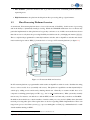
These, coupled with programmable commodity hardware switches such as OpenFlow switches and virtualization technologies such as XEN [?], form the basis of one type of Flowstream platform (see figure 1.1).
switch
processing module
processing module
processing module
Module Host A
control module
NETWORK
switch fabric
processing module
processing module
processing module
Module Host B
control module
processing module
flow table
processing module
processing module
Module Host C
USER INTERFACE
control module
controller
Figure 1.1: Flowstream Platform Overview.
In a Flowstream platform, a programmable switch such as an OpenFlow switch is used to distribute incoming
flows to various module hosts (essentially x86 servers). The platform’s capabilities can thus dynamically be
scaled up by adding servers and down by shutting them down. Generally we assume module hosts to be
computers containing general-purpose CPUs (e.g., x86 or x86 64 architectures). What system they actually
run can vary. For instance, a module host could run XEN, another one Linux and yet another one FreeBSD.
In addition, the module hosts contain a number of entities called processing modules (PMs) where the actual
network processing takes place. Here again, there are choices regarding a PM’s implementation. These can
range from a process in a Linux system (e.g., a process running Bro or Click [?]), a minimalistic OS or a full
virtual machine running on XEN1 .
1
The XEN case provides an easy way to provide isolation for untrusted code.
Page 8 of (20)
c CHANGE Consortium 2012
It is also worth pointing out that if needed, it is entirely possible to include a specialized hardware device
(e.g., a DPI box) in a Flowstream platform. After the flows are processed by the processing modules, the
switch is once again used to send them back out of the platform. Naturally, it might not always be necessary
to send flows out; for instance, if Flowstream is being used to monitor mirrored flows the processing modules
will act as sinks.
Flowstream also contains a controller which manages the entire platform and we will dedicate the rest of this
document to its description.
c CHANGE Consortium 2012
Page 9 of (20)
2
External Interface: Primitives
CHANGE platforms can vary widely in terms of the hardware they contain, from large deployments in datacenters consisting of commodity servers connected via switches (e.g., Openflow), to blade servers and even
single-host platforms. In order for such vastly different platforms to be able to interact under a common
CHANGE architecture we need to abstract a common API that summarizes the primitive functionality that is
needed in order to instantiate flow processing.
We’ve split the API into two parts: a high-level API which should be the most commonly used one; and a
low-level API for more advanced uses of CHANGE platforms. The software distribution that accompanies
this document implements both, but currently only makes the high-level API externally visible.
2.0.1
High-Level API
Here’s a list of the functions that a CHANGE platform must implement when conforming to its high-level
API:
• install allocation: Installs an allocation on a CHANGE platform. This includes instantiating
all necessary processing modules and creating connections between them and traffic coming into and
out of the platform. Returns an id for the allocation.
Name
alloc
Type
string
Parameters
Description
The allocation request (see section below)
• delete allocation: Deletes an allocation on a CHANGE platform. This includes removing
processing modules and the connections between them. No return value.
Name
alloc id
Parameters
Type
Description
integer The id of the allocation to delete
• deploy pm: Installs a new type of processing module on a CHANGE platform. This allows for
remotely updating a platform. No return value.
Name
pm name
pm src
Type
string
string
Parameters
Description
The name of the new processing module
The source code for the pm (see section 3).
• get pm info: Gets information about all processing modules currently supported by a platform.
Returns a list of two-tuples. Each tuple has a string providing a human description of what the pm does
and what parameter it takes, plus a dictionary describing the pm’s primitives (e.g., “Read”, see D2.4
section 4.4 for a full listing of these). Takes no parameters.
Page 10 of (20)
c CHANGE Consortium 2012
2.0.2
Low-Level API
Here’s a list of the functions that a CHANGE platform must implement when conforming to its low-level
API:
• create pm: Instantiates a processing module on a CHANGE platform. No return value.
Name
pm
Type
PM
Parameters
Description
The processing module to instantiate.
• delete pm: Removes a processing module from a CHANGE platform. No return value.
Name
pm
Parameters
Description
The processing module to remove.
Type
PM
• create connections: Creates connections between processing modules on a platform. Currently
this assumes the existence of an Openflow software switch. No return value.
Name
switch name
switch table id
alloc
Type
string
integer
string
Parameters
Description
The name of the Openflow switch.
The id of the table within the switch.
The allocation request describing the connections.
• delete connections: Creates connections between processing modules on a platform. Currently
this assumes the existence of an Openflow software switch. No return value.
Name
switch name
switch table id
alloc
2.0.3
Type
string
integer
string
Parameters
Description
The name of the Openflow switch.
The id of the table within the switch.
The allocation request describing the connections.
Return Values
All functions above return a common ReturnValue structure consisting of (1) a status code, (2) a message
in the form of a string and (3) a function-specific return value. For the status code, the values supported are:
Code
CODE NOT READY
CODE SUCCESS
CODE FAILURE
c CHANGE Consortium 2012
Value
-1
0
1
Explanation
The instruction is being carried out but is not finished
The instruction was carried out successfully
The instruction encountered problems when executing
Page 11 of (20)
In the case of CODE FAILURE, the message string that’s part of ReturnValue should include an explanation of what the problem was. Note that functions in the API saying that they have no return value still
return a ReturnValue object but with its third item set to void.
2.0.4
Allocation Request Format
At its most basic, a request to do network processing on a CHANGE platform (a allocation request) needs
to specify three things: (1) a set of parametrized processing modules to process the actual packets; (2) how
these processing modules should be inter-connected; and (3) where to receive packets from and where to send
them to when finished.
To achieve this, CHANGE platforms use a very simple language to describe an allocation request1 ; here’s an
example:
BASESYS=xen.clickos
ft :: FromNet("tun0", "ip,nw_src=10.10.1.2,nw_dst=8.8.8.8")
tt :: ToNet("tun1")
mirror1 :: Mirror(")
ft -> [0]mirror1[0]
-> tt
The first section of a config file defines key-value pairs. In the example, the configuration file that the processing module types should be instantiated as ClickOS virtual machines (a processing module such as a firewall
may support different kinds of implementations, for instance as a ClickOS vm, a Linux vm, or perhaps an
ipfw rule).
Next, the config defines the set of processing modules to be used, giving parameters for each of them where
appropriate. Finally, the config specifies how the processing modules are connected. Each module can have
a number of input and output ports, so users must explicitly specify which ports should be connected (the
numbers in brackets in the example above).
Note that other related mechanisms such as authentication and access control are handled separately from the
actual installation of an allocation request and are described in other deliverables.
1
Note that in previous deliverables we were using an XML-based description language. In contrast, this new language is much
simpler and accessible to users of the platform.
Page 12 of (20)
c CHANGE Consortium 2012
3
Internal Architecture: the Controller
Having described what a CHANGE platform looks like to the outside world, we now move on to describing
its internals, and in particular the architecture of the controller software that manages the platform.
3.1
Controller Components
While logically the controller is a single entity, in actuality it is implemented as a set of inter-communicating
daemons (see figure 3.1; only one module host is shown for simplicity’s sake). The separation of the controller
into a set of daemons allows us to break down its functionality into more manageable pieces that use common
daemon code. Further, this allows for different implementations of the daemons to exist as long as they
comply with a common interface. For instance, the Openflow daemon could have two versions: one for
a Linux-based Openflow switch talking to another daemon on the switch, and another one using NOX to
program a hardware switch using the Openflow protocol.
NETWORK
switch
processing module
procmoduled
resourced
USER INTERFACE
openflowd
monitord
modulehostd
controller host
module host
Figure 3.1: Platform controller architecture overview, only control-plane connections are shown.
The daemons comprising the Flowstream platform’s controller are as follows:
• Resource daemon: This is the controller’s main daemon, providing the interface to the outside world
through which Flowstream users/clients submit allocation requests (as described in the previous chapter).
This daemon takes care of receiving such requests and deciding how to allocate resources to them. It
talks to the module host, processing module and Openflow daemons in order to install these allocations. In addition, it receives both the Openflow statistics from the Openflow daemon and performance
statistics from the module hosts and processing modules via the monitoring daemon. Both of these are
used as input to the resource allocation algorithms.
c CHANGE Consortium 2012
Page 13 of (20)
• Openflow daemon: This daemon is in charge of inserting and removing the Openflow entries that
will direct traffic from the outward-facing ports (labeled “network” in the figure) to the necessary
module hosts and processing modules and then back out. In addition, this daemon periodically retrieves
Openflow statistics (e.g., per-flow byte and packet counts) and gives them to the resource daemon to
use as input for its resource allocation algorithms. This daemon can make use of existing Openflow
protocol implementations such as NOX [?] for communicating with the switch.
• Module host daemon: Runs on a module host and takes care, among other things, of instantiating and
deleting processing modules, as well as setting up the necessary networking to get flows in and out
of them. It also provides performance figures to the monitoring daemon about the current load of the
module host.
• Processing module daemon: Runs on a processing module and handles modifications to the processing it is doing, as well as reporting performance statistics to the monitoring daemon. Note that
depending on the implementation of the module host, it may or not be possible to run a daemon directly on the processing module. For instance, a processing module implemented as a minimalistic OS
running on a Xen module host may not be able to run the processing daemon. This could be overcome
by running the daemon on the module host (i.e., Xen’s dom0) and using Xen’s interface to modify the
properties of the processing module.
• Monitoring daemon: This daemon periodically gathers performance statistics about the platform from
the module host daemons, processing module daemons and the switch daemon, and gives these to the
resource daemon, which uses the data as input to the resource allocation algorithms.
3.2
Daemon Architecture and Communications
At a high level, a daemon consists of a stand-alone process running an XML-RPC server. We chose XMLRPC since it is simple to use and widely available in different programming languages. A daemon takes care
of executing two types of items: a task or a command. All daemons inherit from a common daemon class.
The basic idea behind the architecture of this class is that most of a daemon’s functionality resides in tasks
and commands, while the daemon itself simply takes care of receiving requests and instantiating the right
task or command for them. This simplifies the daemon itself, encourages code re-use (since commands or
tasks can be shared by multiple daemons) and enables mechanisms such as hot-patching. The exception are
functions that are common to many commands or tasks of the daemon; these functions typically reside in the
class that implements the daemon, or alternatively could be put in a library file.
3.3
Tasks and Commands
The main difference between a task and a command is that a command will block while waiting for a result
and a task will not. As a result, a command is generally meant to be used for carrying out a simple and
Page 14 of (20)
c CHANGE Consortium 2012
quick operation, such as registering a module host with the resource daemon. A task, on the other hand, is
asynchronous, and will immediately return after being called. Despite this, tasks, if so desired, can still return
a value.
The final difference between tasks and commands is that tasks can be assigned normal or high priority, and
also allow for compound tasks. A compound task is a task containing multiple sequential tasks. Tasks within
a compound task are executed by the daemon in the same order as they were added to the compound tasks
(FIFO). As a result, a compound task provides a convenient way of doing sequential execution of multiple
tasks. Of course, a developer could instead choose to mimic the mechanism using multiple regular tasks, but
the compound task interface is cleaner.
3.3.1
Structure of Tasks and Commands
The Flowstream controller’s tasks and commands will follow a two-tier structure. Tasks and commands
common to all daemons (for instance, a task to upgrade a daemon’s set of commands and tasks) will reside
in a common directory, while additional per-daemon directories will contain daemon-specific functionality.
In order to implement a new task (and similarly for a command), developers place a file in the relevant
daemon’s sub-directory under tasks, and in that file place a class that inherits from a task super-class. The
subclass will have to implement a run_task method that receives a single parameter containing all of the
method’s parameters. Which data structure this single parameter is depends entirely on the command’s implementer. If the method requires more than one parameter, these need to be packed into the single parameter,
for instance by using a list. After the method finishes performing its function, it returns a common return type
to signal the result of the operation back to the caller.
3.3.2
Task Priorities
Tasks will have at least two priority types, high and normal. As their names indicate, these are used to give
priority to some tasks over others, with normal tasks only running when no high priority tasks exist at the
daemon. For example, tasks that carry out background monitoring (for example, checking CPU loads on
module hosts) would be invoked with normal priority, while installing a user configuration would use high
priority.
3.3.3
Hot Patching
The controller’s daemons include a hot patching mechanism in order to provide the ability to upgrade a
daemon’s functionality without having to restart it. The simplest way of achieving this is to have all tasks
and commands dynamically loaded. In other words, when a request to execute a task arrives at a daemon,
the daemon looks in the relevant directory to see if a task with the given name exists, and if it does, loads
the task’s code and runs it. With this in place, introducing new tasks or commands to a daemon simplifies
to putting the relevant files in the daemon’s directory. For tasks or commands that are already loaded, their
respective modules are reloaded.
c CHANGE Consortium 2012
Page 15 of (20)
4
Initial Software Implementation
Previous chapters described the requirements and design of the platform, both from an external and internal
point of view. We now dedicate the rest of this document to describing the actual implementation of the
platform that is provided in the software distribution that accompanies this deliverable.
4.0.4
Platform Hardware Description
As previously mentioned, a platform’s hardware can consist of an entire data-center, a single rack of x86
servers connected via programmable switches or something smaller like a blade server. In essence, the
software abstracts from this by only assuming the existence of some sort of programmable switch (hardware
or software) that can pipe together processing modules sitting on module hosts. The only other assumption is
the availability of a server able to execute Python, the programming language that the platform controller is
coded in.
While the software can support different kinds of platforms, so far we have focused on single-host platforms,
that is, an entire platform implemented on a single x86 server. The main reason behind this is that it simplifies
the deployment story when trying to set-up the CHANGE wide-area testbed (see section at the end of this
chapter) since it would be hard to have partners make an entire rack of computers available. Having said
that, it is likely that at least for the boot camp there will be a larger version of the platform (i.e., with several
servers) available.
The platform consists, then, of a single x86 server running the controller software. It has a single module host
(itself), and uses Openvswitch [?], a software programmable switch that implements the Openflow protocol
among others, to pipe traffic between the platform’s external interfaces and the processing modules it runs.
For this first version of the platform we have chosen ClickOS as the system for implementing the processing
modules. In essence, the x86 server runs Xen, and the platform controller runs in Xen’s dom0, while the
processing modules are each a Xen virtual machine. Further, each processing module has (at least one)
virtual interface that gets added to Openvswitch when the virtual machine is created. Again, the platform’s
software is not bound to only ClickOS, and it is possible that in the future we will support other systems like
FlowOS for instantiating processing modules.
4.0.5
Platform Software Description
The distribution contains a tree structure consisting of the following directories and files:
• cmds: The commands for the various controller daemons.
• configs: Contains three types of configuration files: (1) platform description files describing a platform’s hardware; (2) base system description files describing the software/OS running on a platform;
and (3) allocation description files, samples of the type of processing that can be instantiated on a
platform.
Page 16 of (20)
c CHANGE Consortium 2012
• core: The main files of the platform controller.
• daemons: The platform daemons.
• pms: The various processing modules that a platform supports go here.
• tasks: The tasks for the various controller daemons.
In addition, the distribution comes with the file flowstream start.py that takes care of starting the
platform’s controller (i.e., all of its daemons) and the file flowstream exec.py which allows for the
installation of an allocation request (i.e., network processing on the platform). Usage for this is described in
the next section.
4.0.6
Brief User’s Manual
In this section we give a brief explanation of what’s required to run a CHANGE platform, including how to
install its software. We further cover how to get the controller running and how to install and delete allocation
requests (i.e., network processing) from it.
4.0.6.1
Requirements
The platform controller is implemented in Python, so a somewhat recent version of it is needed (at least
version 2.6). The platform’s current version uses ClickOS, for which Xen 4.1.2 is required. Further, the
software expects an Openvswitch switch to be in Xen’s dom0, and for Xen’s networking scripts to be adapted
such that the virtual machines’ virtual network interfaces are added to the switch. At least one physical
interface (the one that the platform is supposed to receive packets from) should be added to this switch.
4.0.6.2
Installation
Begin by unpacking the distribution tar ball with:
tar -xvzf flowstream.tgz
Next, you’ll need to modify a few things in the following platform configuration file:
configs/platformdesc/platdesc singlehost xen.xml
Mostly all you need to change are the paths to “xencfg” and “clickoslib” to point to the directories containing
the ClickOS Xen configuration and front-end API files, respectively. You might also want to modify the
directories that daemons log messages to (look at the log dir tags).
With this in place, you’re now ready to run the CHANGE platform.
4.0.6.3
Running the Platform
To start with, set the PYTHONPATH environment variable to point to the platform’s code:
export PYTHONPATH=[path/to/platform/srcs]
The distribution comes with a script for starting all the necessary daemons:
c CHANGE Consortium 2012
Page 17 of (20)
usage: flowstream_start.py [description file] [(module_host=yes|no)]}
Make sure you run the process as root and that you use a full path for the description file (this is the file you
modified in the previous section). Set the module host parameter to “no” (this is to distinguish from a
platform that contains multiple servers/module hosts). If successful, you should see console output stating
that the daemons are running. Note that the daemons will log messages to the directories specified in the
platform description file.
Once the controller is running, we’re ready to ask the platform to instantiate network processing. The
first step would be to create an allocation request configuration file (refer back to 2.0.4 and have a look
at mirrortest.conf in the allocation configuration directory for examples). Once this is done, we can
the following command to install it:
usage: python flowstream_exec.py [command] [(params)...]
For example, to install a configuration called “test.conf”, we would run:
python flowstream_exec.py InstallAllocation test.conf
If successfull, the command will print out the id of the (now running) allocation. We can then later use this
id to delete the allocation from the platform:
python flowstream_exec.py DeleteAllocation [allocation id]
4.0.7
Wide-Area Network Testbed
In order to test the CHANGE architecture in a realistic environment (e.g., one containing middleboxes, delays,
jitter, etc) we have started to deploy CHANGE platforms at various partner sites. We had initially considered
using Planetlab for this, as this would have given us a larger number of platforms and perhaps more geographical diversity. However, Planetlab’s boxes are rather restrictive: they run very old distributions, making
it hard to install some of the basic packages that our software rely on (even installing a somewhat recent
version of Python is challenging!); they do not allow users to tinker with network interfaces (even virtual
ones like tap devices); and clearly they cannot support a system like ClickOS which requires Xen. Still, the
controller software includes support for running a “Planetlab platform” using user-level Click to instantiate
processing modules in case it is needed in the future.
At this point in time we have set-up or are in the processing of setting up CHANGE platforms at the following
partner locations:
• NEC
• PUB
• UCL-BE
Page 18 of (20)
c CHANGE Consortium 2012
• TUB
It is likely that in the future we will add other platforms.
c CHANGE Consortium 2012
Page 19 of (20)
5
Conclusions
In this deliverable we covered the requirements, design and main implementation of the CHANGE platform.
In terms of hardware, a CHANGE platform can range from an entire data center, a rack of servers interconnected by a programmable switch, a blade server, or to a single x86 server. The platform’s controller
software can potentially support all of these, exposing a common interface so that different types of CHANGE
platforms can inter-operate.
This document further provided a detailed description of the controller as well as a brief user’s manual
depicting how to set up a platform and have network processing installed on it. So far the software distribution
focuses on a single-server platform running ClickOS for its processing modules, but it would be relatively
easy to extend this platform to setups containing more servers (as we might do for the CHANGE boot camp).
As future work, we’re currently in the process of setting up a wide-area testbed composed of CHANGE
platforms at (initially at least) four different geographical locations. The platform software is already running
at one of these, and we are currently finishing the install at other locations with the goal of testing the
CHANGE architecture as described in deliverable D4.4.
Page 20 of (20)
c CHANGE Consortium 2012