1
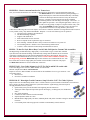
Receiving Antennas The performance of the NCC-1 is largely dependent on the receiving antennas and their installation. Please carefully read this section and make adjustments or changes to your antennas before using the NCC-1. The NCC-1 will function with almost any combination of antennas but it works best when INPUT A and B antennas have reasonably similar directional patterns. Optimum antenna spacing will vary with the frequency band and what you are trying to accomplish. There are two general rules for antenna spacing: If antennas are too close together (less than 1/10-wavelength), a very stable deep null can be produced but the system will lose gain or sensitivity. If the antennas are too far apart (generally more than 1-wavelength) the nulls and peaks in the pattern will become so sharp it might become impossible to maintain nulls or peaks on sky wave signals. With very wide spacing, signals will fade in and out more rapidly with ionospheric changes. Antenna Polarization It is generally not a good idea to mix polarization of antennas. Although this scheme can work when nulling a groundwave signal or noise, mixing polarizations generally makes nulls or peaks more difficult to find and maintain. When receiving skywave propagated signals, mixing a horizontal antenna with a vertical antenna almost always increases fading. Antenna Feedlines It is not necessary to use any special length of feedline with antennas used in this system or for antennas to be "resonant" or physically large. The front panel controls will compensate for feedline lengths. You should still use a good feedline and make good connections. DX Engineering recommends DXE-F6 75 Ω CATV style cable with weather-tight connectors such as DXE-SNS6 Snap-N-Seal, both available from DX Engineering. Antenna Sensitivity Receiving antennas should not have excessive signal level or gain. They only need enough gain or signal level to have very weak signals limited by external noise. Too much signal level from antennas is actually not good. Normally we should just hear a slight increase in noise (or weak signal) from no antenna connected to having one connected. We would then clearly hear a noise floor increase. For best weak signal reception, background noise of antennas should be around 5 dB, or about 1 S-Unit, above the NCC-1 noise floor. The NCC-1 is a very good match for DX Engineering Active Antenna arrays and closely matches their dynamic range. Higher noise floor antennas can be also be successfully used due to the built-in front panel adjustable attenuators. Antenna Bandwidth Wider bandwidth antennas produce the most stable and reliable performance. Very narrow bandwidth antennas do not work as well. A small resonant loop will be very narrow in response and -5-