1
AN-524
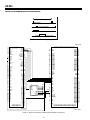
strobes to clock the serial port. The fldsiz routine programs SPORT1 for 16-bit words, which means SPORT1
will generate the RX data ready interrupt after 16 SCLKS
(16 FIFO read strobes).
insure that the servo loop is updated just once each
time a new compressed field size becomes available.
This leads to an interesting initialization problem. The
first DSP interrupt will occur BEFORE last code
(LCODE) occurs, since the Wavelet transform must
complete before the host can even start (let alone finish) reading the compressed field from the ADV601
FIFO. This program initializes the bin width/recip bin
width registers to a reasonable value. This initialization
is accomplished by the single call to bwcalc in the initialization code. All subsequent calls to bwcalc are
from the LCODE interrupt routine inside module
fldsiz.dsp.
Routine cntpara services the SPORT1 RX data ready interrupt. It merely bumps variable intaccum on each entrance. The other code toggles a debug bit that can be
observed with an oscilloscope to show that the interrupt
is unmasked and active, and that FIFO reads are actually
being seen by the program.
Routine newfield services the LCODE interrupt. On
each interrupt it copies intaccum into sportints and
resets intaccum. Then it calls bwcalc to update the
servo loop. Newfield currently uses Data Address Generator (DAG) registers I2 and M2 to write the debug
buffer fieldsz. It does not save the register contents in
memory when it returns from interrupt. Should some
other code alter I2 it could cause trouble. A released version of sport0.dsp might want to disable the fieldsz
writes for safety’s sake.
The watch_dog routine gains control on timer tick with
initialization set for 30 Hz. Watch_dog is looking for
start and stop of incoming video. When the video
stops, watch_dog zeros out the servo loop error integrator. This prevents a sizable error integral from one
video clip biasing the servo loop hard over at the beginning of the next clip. This is largely for convenience in
studying servo loop startup transients. You can stop
the video tape player, rewind and start over again and
have the servo start up the same way each time. Otherwise the startup on the second video clip depends upon
the previous video clip. Watch_dog detects video stop
by watching the field_cnt variable. When video
stops, the host stops reading the FIFO and the LCODE
interrupt stops occurring. This causes field_cnt to
stop changing. If field_cnt does not change after two
field times, watch_dog concludes that video has
stopped coming in.
Sportints needs proper scaling to yield field size in
pixels. Scaling must account for the 16:1 division done
in the serial port, the two pixels per 32-bit long word,
and the 4:1 hardware divider placed between the FIFO
read strobe and the serial port SCLK pin.
sport0.dsp
Sport0 handles reception of ADV601 statistics and transmission of bin width and reciprocal bin width register
data. As the name implies, it uses Serial Port 0 (SPORT0)
for the task. Sport0 writes recvflg and xmitflg to let
the rest of the system know when statistics read (receive) and bin width write (transmit) is active. The flags
are nonzero while transmit or receive is going on, and
zero when inactive. Pidbwc.dsp (main) uses recvflg to
start up transmission after the last statistics register is
read. Statistics are placed into array stats601 and bin
widths are transmitted out of array bw_recip_bw.
fldsiz.dsp
The fldsiz module updates variable sportints,
which is proportional to compressed field size, on each
Last Code (LCODE) interrupt. Despite some obsolete
comments in early versions of the code, sportints is
unscaled. It is just the raw interrupt count and must be
scaled into bytes by the user routine. The other variables in fldsiz are either local scratch variables or a
debug “history buffer” like fieldsz, and are not used
outside the fldsiz module. If compressed field size is
measured by other means, software changes will be
confined to this module.
Routine sport0_start is the one-time initialization
routine. It loads the SPORT0 control registers, initializes
variables and handles the first field problem. The system does not know which compression ratio is required
until it can see the compression ratio register. The compression ratio register will not be available until the first
statistics read occurs. Therefore, sport_start initializes the compression ratio register to a reasonable number to avoid trouble that might occur should the system
try to process a random value of compression ratio.
Serial Port 1 (SPORT1) is used by the EZ-KIT monitor to
load code and dump memory to the host, whereas the
Bin Width Calculator uses SPORT1 to count FIFO read
strobes. The fldsiz_start entry saves the settings of
all the SPORT1 control registers and the fldsiz_stop
routine restores them so the monitor will function after
a bin width calculation run and dump ram variables for
debug and test. For debugging in the software simulator, setting the ISCLK bit in the SPORT1 control register
causes simulated SPORT1 interrupts to occur. To function in real hardware the ISCLK bit (Internal Serial Port
Clock) must be clear, to allow the external FIFO read
Routine rite-reg is called by pidbwc.dsp (main) to
start up bin width register transmission. The advanced
“autobuffering” feature of ADSP-21xx family serial
ports is used to more input directly to data ram without
processor intervention. Rite_reg loads the Data
Address Generator (DAG) registers needed for autobuffering, turns on autobuffering, loads only the first
–6–