1
Programming with BlueNRG network processor
4
UM1686
Programming with BlueNRG network processor
The BlueNRG provides a high level interface to control its operation. This interface is called
ACI (application-controller interface). The ACI is implemented as an extension to the
standard Bluetooth HCI interface. Since BlueNRG is a network processor, the stack runs
inside the device itself. Hence, no library is required on the external microcontroller, except
for profiles and all the functions needed to communicate with the BlueNRG SPI interface.
The development kit software includes sample code that shows how to configure BlueNRG
and send commands or parsing events. The source library is called simple BlueNRG HCI to
distinguish it from the library for the complete profile framework (not present in the software
development kit). This library is able to handle multiple profiles at the same time and
supports several Bluetooth GATT-based profiles for BlueNRG. Documentation on the ACI is
provided in a separate document.
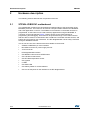
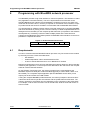
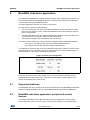
Figure 12. Profile framework structure
Proximity
FindMe
HOGP
...
...
...
Basic profile framework
4.1
Requirements
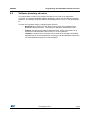
In order to communicate with BlueNRG network processor very few resources are needed
by the main processor. These are listed below:
–
SPI interface
–
Platform-dependent code to write/read to/from SPI
–
A timer to handle SPI timeouts or to run Bluetooth LE Profiles
Minimum requirements in terms of Flash and RAM space largely depend on the functionality
needed by the application, on the microprocessor that will run the code and on the compiler
toolchain used to build the firmware.
On the STM32L (Cortex-M3 core), the memory footprint for the code interfacing the
BlueNRG requires few kilobytes of Flash and RAM (typically 2-4 KB of Flash, and 0.8-1.5
KB of RAM). So a complete simple application (like the BlueNRG sensor demo) could
require just 15 KB of Flash and 2 KB of RAM.
If using the complete BlueNRG profile framework, the memory footprint is around 9 KB of
code and 3 KB of data for just the ACI interface and the profile framework functions. The
memory required for the profiles can vary depending on the complexity of the profile itself.
For example, code for HID-over-GATT host is around 6 KB, while for heart rate monitor is
around 2.3 KB.
24/39
DocID025464 Rev 2