1
to the actual location in the corpus file, which helps quickly looking for the
larger context when this is needed (it is this simple feature that is perhaps
most valued by the users). Cesax also allows exporting the database for use in
statistics.
This paper provides a walk through the process described above, and it
does so by taking the “progressive inversion” as an example.
2
The progressive inversion
The progressive inversion construction is a subtype of VP inversion [12]. It is
similar to the locative inversion, except that the first constituent is a participle
clause instead of a prepositional phrase, as for example (1a):
(1) a. [IP-PPL Trending away on either side of the port] was [NP-SBJ a bold
rocky coast, varied here and there with shingly and sandy beaches].
[fayrer-1900:54]
b. ?[Sbj A bold rocky coast] was trending away on either side of the port.
The uninverted variant of (1a) would be (1b), but the question mark indicates
that this is not quite okay for native speakers. The linguistic question I would
like to posit for the sake of this walk-through is: “Which features could
determine the appearance of a progressive inversion?”
3
Automatically finding examples
Having defined the research question, step (1) in the process of answering it
(see Introduction) is to define a query that automatically locates the necessary
examples of the linguistic feature that is being targeted. Sentences that
contain a progressive inversion need to have the following three elements:
1) Subject
2) Finite verb
3) Participle
Once sentences containing these three elements are located, the order of these
elements will show whether an inversion construction is being used
(participle-finite verb-subject) or some other construction (such as: subjectfinite verb-participle). The task of locating sentences and determining
whether they contain a progressive inversion or not can be accomplished in
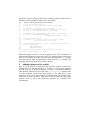
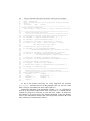
CorpusStudio by using the Xquery code in (2).3
What the code does is: select main clauses into variable $search (line 2),
put the subject of the main clause into $sbj (line 5), put the finite verb of the
main clause into $vfin (line 8), any participle of the main clause is put into
$ptcp (line 11), determine the word order (line 14,15), return this clause if all
the elements are there (line 18-23). The result of running the Xquery code (2)
consists of all the sentences containing the required elements for the
3
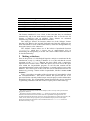
The code makes use of standard Xquery functionality (for-let-where-return, ifthen-else, the function “exists()”), some built-in Xquery functions (“ru:matches”,
“ru:relates”, “ru:back”), user-defined functions that are elsewhere in the code
(“tb:SomeChildNo”, “tb:SomeChild”), and user-defined global variables
(“$_matrixIP”, “$_subject”).