1
2) Construct a tab-separated text file where the „original‟ feature values are
replaced by numerical values (an additional table with the „index‟ to
these values is supplied separately);
3) Construct a separate .sps file (an SPSS „syntax‟ file).
Work with SPSS can be conducted by transferring the second (numerical
value) table to SPSS, and processing the .sps file with the feature values. An
SPSS user will, in addition to this, also need to specify which features are to
be excluded from statistic, which are the independent variables, and which
one is the dependent variable.
Work with memory-based language programs like „TiMBL‟ is also
supported [4]. Cesax allows preparing a training and test file with the
necessary features for further processing by TiMBL.
Since the purpose of this paper is to show how data gained through corpus
searches can be prepared for statistical processing, no attempt will be made to
figure out which of the independent variables play a role in determining
whether progressive inversion occurs or not.
8
Querying a database
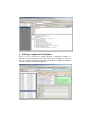
Once a database has been manually edited, as described in section 6, a user
will probably not want to go back to adjusting the original corpus query
(section 3) in order to make a new version of a database (e.g. one that
contains a selected subset, or one with adjusted feature values). This may,
due to the cyclic process of research in general, not always be circumvented,
but the CorpusStudio-Cesax combination does allow for one way out. If a
user wants to make an adapted database that (a) uses a subset of the features
available in the original one, or (b) that has records filtered out by additional
criteria, or (c) that uses additional features that can be calculated on the basis
of the existing ones, then this can be achieved by writing a query with the
database as input. The CorpusStudio manual contains information on how to
do this.
Returning now to the linguistic task that has been undertaken as an
example, I would not like to withhold the outcome to the interested reader.
The manually inspected corpus database yields a total of twelve examples of
the progressive inversion (against a total of 5-6 million words), and the first
clear one is found in early Modern English (1500-1700).
(5) a. and vpon the ryght hande goynge from Rama to Jherusalem, about
.xx. myle from Rama, is the castell of Emaus. [chaplain-e1-p2:289]
The example in (5) has the finite verb is preceded by a participle clause that
is headed by the present participle going. It clearly serves to introduce a new
„participant‟ in the narrative, namely the castle of „Emaus‟.
9
Discussion
This paper has shown a new, windows-based approach to research into
variation and change of syntactic constructions. The new approach is
centered around the programs CorpusStudio and Cesax, and makes heavy use