1
Chapter 1
Introduction
1.1
Goals of this lab
Our goal is to do a precision measurement of kb , Boltzmann’s constant. To
find Boltzmann’s constant, we measure voltage fluctuations known as Johnson
Noise over a resistor using a Spectrum Analyzer (SA). The SA is a complicated
piece of equipment and the measurements we want to perform will push their
limits. Thus, we need to understand how these instruments work at their most
basic level.
The first section is about understanding the properties of Johnson Noise as
well as other Random Processes. Dealing with random processes is very different
than deterministic systems. Developing tools to work with such systems is useful
in a wide variety of fields. We will quote the properties of Johnson Noise and
leave the physics of this phenomena to the references. The reason for this is
simple: there are already excellent derivations of this phenomena and I want
to focus myattention to developing tools to understand these derivations. The
tools are more similar to those in quantum and statistical mechanics than those
of classical mechanics.
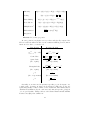
The second section will be focused on creating a set of tools in the frequency
domain. We start this section off with a review of Fourier Transforms and their
properties. The emphasis is not on carrying out tedious calculations, but using
the properties of Fourier Transforms and graphical techniques to quickly find
the answers. This is to help build physical intuition when dealing with the
frequency domain.
The third section is about taking data with the SA . The goal of the previous
two sections was to develop the conceptual basis to understand the workings of
the SA amplifier. We start with developing a model based on the first two
sections, access the limitations and capabilities of each instrument and create a
testing regime.
The final section is a brief overview about extracting kb . Most of the fitting
is done with a simple Mathematica script provided with the lab. From the
1