1
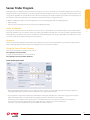
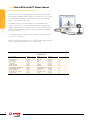
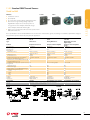
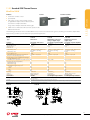
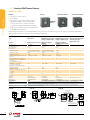
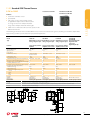
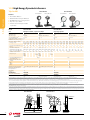
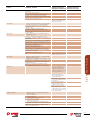
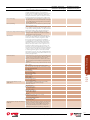
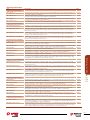
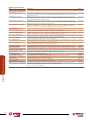
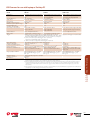
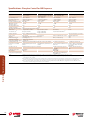
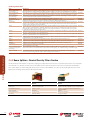
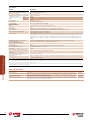
BeamGage® Standard
BeamGage® Professional
BeamGage® Enterprise
(all features in Standard plus) (all features in Pro plus)
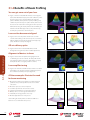
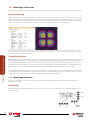
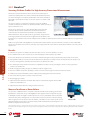
less than zero that result from noise when the
baseline is subtracted. Retaining fractional and
negative numbers in the processed signal can
increase the beam width measurement accuracy by
up to 10X over conventional baseline subtraction
and clip level methods. Spiricon’s Ultracal conforms
to the best method described in ISO 11146-3:2004.
Frame Averaging
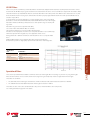
Up to 256 frames can be averaged for a signal-to-noise
ratio, S/N, improvement of up to 16X (Noise is averaged
up to 1/256th [8 fractional bits]). Data is processed and
stored in a 32bit format.
Frame Summing
Up to 256 frames can be summed to pull very weak
signals out of the noise.
Due to the precise nature of Ultracal baseline setting,
(i.e., a retention of both positive and negative noise
components) summing of frames can be performed
without generating a large offset in the baseline.
Convolution (Adjacent Pixel Averaging) Choice of 5 convolution algorithms for spatial
filtering for both display and calculations. Spatial
filtering improves the visual S/N.
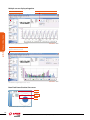
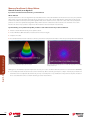
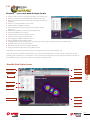
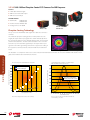
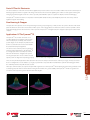
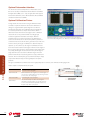
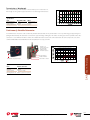
Beam Maker®
Beam Maker is a new feature that allows the user to
model both Laguerre-Gaussian and Hermite-Gaussian
laser beams in various modal configurations. With
these models you have verification and validation
tools that allows not only OSI but also the end user to
verify BeamGage’s basic beam width measurement
algorithms. It can also be used to model laser beams
with special input conditions such as signal-to-noise,
background offset, and bits per pixel resolution. This
allows the user to better understand the accuracy of
measurements made under both optimum and adverse
conditions. This tool provides the user with a method
to validate algorithms against current ISO standards
and methods. It can also be used to validate third party
algorithms by making the output data available for use
in third party applications.
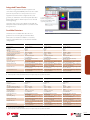
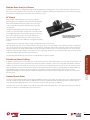
Camera Features
Camera features are governed by the capabilities of the
various cameras that will interface with these software
products, and second by which of these camera
features are implimented in the software. This section
will describe typical camera features supported in the
application.
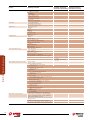
Black Level Control (used by Ultracal and Auto-X and
Auto-setup)
Gain Control (used by Auto-X and Auto-setup)
Exposure Control (used by Auto-X and Auto-setup)
User Programmable ROI
Pixel Binning
Pixel Sampling
Bits per pixel setting
External Trigger Input
Trigger Delay
Strobe Output
Strobe Delay
External Trigger Probe
Internal Trigger Probe
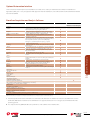
Camera related features in the
These are features related to but not generally
applications
dependent upon the camera design.
Gamma Correction
Gain Correction
Bad Pixel Correction
Lens Applied Option
Pixel scale settings
Magnification settings
Frame buffer settings
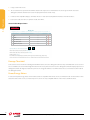
Ultracal
Enable Auto-X (auto exposure control)
Perform an Auto-Setup
8/10/12/14/16 bits per pixel
Select Format or ROI
Measure S/N ratio
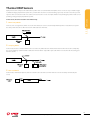
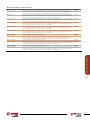
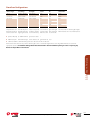
Trigger, Capture and Synchronization Capture methods are features related to the application
Methods
while Synchronization methods relate more to the
abilities of the specific camera. NOTE: Frame capture
rates are determined by many factors and are not
guaranteed for any specific operating configuration.
3.2.1.4 Beam Analysis
Features
131
For latest updates please visit our website: www.ophiropt.com/photonics
01.08.2013