1
A TROFF Tutorial
Brian W. Kernighan
Bell Laboratories
Murray Hill, New Jersey 07974
1. Introduction
troff [1] is a text-formatting program, written
by J. F. Ossanna, for producing high-quality printed
output from the phototypesetter on the UNIX and
GCOS operating systems. This document is an example of troff output.
The single most important rule of using troff is
not to use it directly, but through some intermediary.
In many ways, troff resembles an assembly language
— a remarkably powerful and flexible one — but
nonetheless such that many operations must be
specified at a level of detail and in a form that is too
hard for most people to use effectively.
For two special applications, there are programs that provide an interface to troff for the majority of users. eqn [2] provides an easy to learn
language for typesetting mathematics; the eqn user
need know no troff whatsoever to typeset mathematics. tbl [3] provides the same convenience for producing tables of arbitrary complexity.
For producing straight text (which may well
contain mathematics or tables), there are a number of
‘macro packages’ that define formatting rules and
operations for specific styles of documents, and
reduce the amount of direct contact with troff. In
particular, the ‘– ms’ [4] and PWB/MM [5] packages
for Bell Labs internal memoranda and external papers
provide most of the facilities needed for a wide range
of document preparation. (This memo was prepared
with ‘– ms’.) There are also packages for viewgraphs,
for simulating the older roff formatters on UNIX and
GCOS, and for other special applications. Typically
you will find these packages easier to use than troff
once you get beyond the most trivial operations; you
should always consider them first.
In the few cases where existing packages don’t
do the whole job, the solution is not to write an
entirely new set of troff instructions from scratch, but
to make small changes to adapt packages that already
exist.
In accordance with this philosophy of letting
someone else do the work, the part of troff described
here is only a small part of the whole, although it
tries to concentrate on the more useful parts. In any
case, there is no attempt to be complete. Rather, the
emphasis is on showing how to do simple things, and
how to make incremental changes to what already
exists. The contents of the remaining sections are:
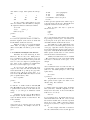
2.
3.
4.
5.
6.
7.
8.
9.
10.
11.
12.
13.
14.
Point sizes and line spacing
Fonts and special characters
Indents and line length
Tabs
Local motions: Drawing lines and characters
Strings
Introduction to macros
Titles, pages and numbering
Number registers and arithmetic
Macros with arguments
Conditionals
Environments
Diversions
Appendix: Typesetter character set
The troff described here is the C-language version
running on UNIX at Murray Hill, as documented in
[1].
To use troff you have to prepare not only the
actual text you want printed, but some information
that tells how you want it printed. (Readers who use
roff will find the approach familiar.) For troff the
text and the formatting information are often
intertwined quite intimately. Most commands to troff
are placed on a line separate from the text itself,
beginning with a period (one command per line). For
example,
Some text.
.ps 14
Some more text.
will change the ‘point size’, that is, the size of the
letters being printed, to ‘14 point’ (one point is 1/72
inch) like this:
Some text.
Some more text.
Occasionally, though, something special occurs
in the middle of a line — to produce