1
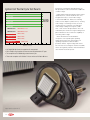
Ignition Coil Thermal Cycle Test Results
prevent any out-of-phase spark plug firing, the
OE specifications call for a maximum of 500 volts
of make voltage.
DELPHI COIL #1
Delphi utilizes a patented design feature called
“phased turn-on,” which is built into the coil’s
integrated circuitry to control make voltage
to fewer than 500 volts. Without a controlling
feature such as Delphi’s “phase turn-on,” limiting
make voltage is a challenge. In fact, the tests
conducted on the competitor coils indicated
make voltage readings of as high as 1,700
volts – well over the OE specification. The coils
marketed by the well known engine management
parts manufacturer do not have the capability of
controlling make voltage.
DELPHI COIL #2
DELPHI COIL #3
ALL 6 DELPHI
COILS PASSED
AFTER 233 HRS
DELPHI COIL #4
DELPHI COIL #5
DELPHI COIL #6
COMPETITOR COIL #1
FAILED PRE-TEST @ -40° F
COMPETITOR COIL #2
FAILED PRE-TEST @ 260° F
COMPETITOR COIL #3
FAILED @ 72 HRS
COMPETITOR COIL #4
FAILED @ 72 HRS
COMPETITOR COIL #5
FAILED @ 72 HRS
COMPETITOR COIL #6
0
48
FAILED @ 96 HRS
96
144
192
240
NUMBER OF HOURS
• Six Delphi (GN10114) and six competitor coils were tested.
• All six Delphi coils passed the 233 hour test and still performed to OE specs.
• Two competitor coils failed during pre-test thermal cycle.
• Three other competitor coils failed at 72 hours and one coil failed at 96 hours.
Delphi ignition coil (GN10114)
18
288
Other observations revealed that the
competitor coils required higher operating
voltage and current. This causes higher coil
operating temperatures and can lead to
premature failures. Higher voltage and current
also increases electromagnetic interference (EMI)
which can negatively interface with the ECM and
other internal electrical systems.