1
3 Multicast for Small Conferences
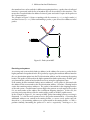
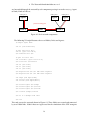
packet’s routing header is empty (apart from the group’s multicast address), and thus no
packet forwarding is required from the part of D4.
3.2.2
MSC header handling for routers
Non-MSC routers
A router that does not understand the MSC header forwards the packet towards the address
specified in the IPv6 destination field.
MSC capable routers
MSC capable routers read the addresses from the IP destination field and the routing header
and determine the outgoing interface for each destination. They then duplicate the packet
for each involved link. Each packet contains only the unicast addresses that can be reached
via that interface plus the multicast address identifying the group. This is the MSC functionality proposed in [6]; in this document, this concept is denoted standard MSC.
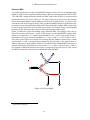
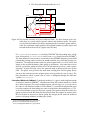
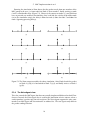
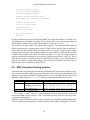
Figure 3.2 illustrates the standard MSC procedure for routers. The setup is the same as in
Figure 3.1, with S sending a packet to the group members D1-D4. All five routers (R1-R5)
are considered MSC capable. On receiving the packet sent by S, R1 performs routing table
lookups for all four addresses carried therein, detecting that D1 and D2 are reached via R2,
while the other two receivers are reached via R5. Thus, R1 produces two packet copies,
each one containing only the relevant addresses. R2 and R5 perform the same operation
on the packets they receive, thus optimizing the packet delivery. In this scenario, no packet
forwarding between end systems is necessary. If, for example, R2 had not been MSC capable, then the packet created by R1 would have been delivered to R3, which would have
forwarded it to D4 as shown in Figure 3.1.
D2
D2
D1
D1
R2
D2
R3
D1
D4 D3 D2 D1
S
R1
D4
D3
R5
R4
D4
D3
D3
Figure 3.2: Standard MSC
12
D4