1
1 Introduction
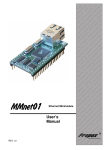
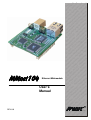
Thank you very much for having bought our minimodule MMnet104. It was created with the idea
of facilitating the communication of microprocessor systems through the Internet/Ethernet
networks.
The heart of the module is the RISC Atmega128 microcontroller with 128kB of program memory
and 128kB of (external) RAM memory, co-operating with the Ethernet RTL8018AS controller
(100BaseTX). The memory controller built around a programmable CPLD device manages the
address space of the microcontroller, generates address strobe/selection signals used during
extension of the server by external I/O units, and serves the banking of RAM memory. The
minimodule has an 8 MB DataFlash serial memory for storage of WWW pages and of any files
e.g. with measurement data. The memory is connected to a fast SPI bus with 8 Mb/s transmission
speed. The MMnet104 has been equipped with a RTC clock built around the DS1307 device,
connected to the I2C bus. Together with the RTC circuit goes a socket for a lithium battery
providing many guaranteed years of uninterrupted clock operation.
MMnet104 operates under real-time control RTOS allowing to build applications with the use of
pseudo-concurrency in which different tasks are started and executed in the form of separate
threads. This permits an easy construction of applications which require parallel execution of
several tasks, for example servicing the TCP/IP stack and realizing the algorithm of control of an
industrial process. The RTOS system has an extended interface for handling peripheral
equipment, thanks to which the communication with them occurs via drivers registered in the
system. The system has drivers for the Ethernet controller, serial ports, the 1-Wire bus, the DS
1820 thermometer, LCD display RTC clock and DataFlash memory. The kernel of the RTOS
system and the TCP/IP stack together with implemented DHCP, UDP, ICMP, SMTP protocols and
HTTP with simple CGI-s were compiled to libraries.
The system incorporates a series of demonstration applications (WWW server, FTP, Telnet, TCP
client, TCP server, temperature monitoring and control, applications in the RTOS system) which
are basing on completed functions present in the IP stack and RTOS operating system libraries.
Attached libraries permit independent experiments (e.g. creation of web pages using the CGI
technique without penetrating the lower layers of the IP stack and the RTOS operating system).
The MMnet104 is delivered loaded with the WWW Server application and WWW demonstration
pages with examples of using CGI and Flash. The configuration of the server (MAC address, IP,
gateway, change of WWW page) can be effected remotely through serial RS232 or FTP ports.
Sources in C-language and ready libraries are attached to the server; they can be used to realize
one’s own projects. To modify and compile, the free C-compile GCC or C-compiler from
ImageCraft can be put into use.
We wish you nothing but success and a lot of satisfaction in designing and
developing new electronic equipment based on the MMnet104 minimodule.
3