1
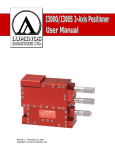
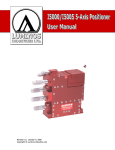
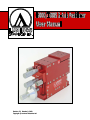
I3000/I3005 3-Axis Positioner User Manual
Introduction to the I3000/I3005 Photonics Positioner
Introduction to the I3000/I3005 Photonics Positioner
Welcome to the I3000/I3005 Photonics Positioner - a positioning system so stable and
easy to adjust that aligning singlemode optical fibers is as simple as tuning a radio!
There is no need to let go of the micrometers during operation; the I3000/I3005 is
extremely touch insensitive. And with the patented ergonomic inline design, all
micrometers are easily accessible on one side. Just rest your hand comfortably on the
table and enjoy the ease and efficiency of quickly aligning any type of fiber.
No fiber alignment challenge is too difficult - even 1-2 micron core lensed fibers can
easily be aligned. The Luminos I3000/I3005 uses a patented Ratio Drive™ for the X & Y
axes resulting in less hysteresis and increased resolution.
Conventional stacked stages have separate frames with each frame simply mounted on
the output of the previous stage. This results in the stiffness at the micrometer being
degraded by the lack of stiffness between the mounting reference and output of each
stage below it. Hand forces on the micrometer are then easily transmitted directly to the
output causing the alignment to wander; thus typically resulting in an adjust-release-wait
cycle by the operator.
In contrast, the I3000/I3005 consists of only two frames. The Z stage is one frame while
all the other micrometers are anchored to a shared fixed frame that is attached directly to
the output of the Z stage. The Z stage is exceptionally stiff and therefore is not a factor.
By sharing a common rigid frame, forces exerted on the micrometers by the operator
during adjustment are shunted directly to the base instead of to the output. The operator
can then quickly align without letting go.
The I3000/I3005 is also vibration and temperature insensitive. Internal viscous damping
eliminates many of the resonance effects typically associated with flexure stages.
Luminos stages generate extremely smooth linear motion utilizing patented flexure
technology. The error motion associated with frictional ball bearings has been eliminated
therefore these stages move with smooth monotonic motion. The force required from an
actuator in order to move a stage is also linear without the typical stiction that is found
with ball or frictional type stages.
In general, single stage flexure designs are subject to arcuate motional error as each
single stage moves in a physical arc. In the Luminos design, the large travel Z stage is a
frictionless dual compensated flexure design wherein two precision flexure stages are
made to move identically together such that the arcuate errors are eliminated. This
technique offers a straightness of motion that is comparable to a precision bearing stage
while affording a large travel not commonly found in flexure designs. The flexure stages
used for transverse ("X") and vertical ("Y") motion are single stage flexures; however,
they are oriented such that their resultant arcuate motions are in the large travel "Z"
direction (typically the optical axis). The overall result is that the Luminos stages can be
operated in even a manual mode without the operator experiencing objectionable off-axis
motion.
Luminos Industries Ltd.
1