1
 I. General Description
I.1
Use of the Rheometer
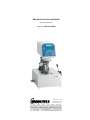
The R/S-CPS+ Rheometer is a good choice for use in quality control, product development and
research environments, especially where small sample volume and minimum instrument service requirements are important . It allows the rheological characterization of both Newtonian
and non-Newtonian fluids. The instrument benefits include a broad measurement range, testing
for Yield properties, and the ability to measure flow properties of fluids with delicate structures.
I.2
Measuring Principle
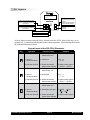
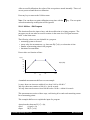
The R/S-CPS+ Rheometer is a rotational controlled stress instrument with geometries (cones
and plates) conforming to DIN specification 53-018.
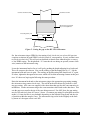
The geometry is directly connected to the motor shaft. A current is applied to the Rheometer
motor, and the resulting speed (RPM) is measured with an optical encoder directly connected
to the motor shaft. The applied torque is converted to shear stress (Tau), and the RPM is converted to shear rate (D) by the instrument electronics.
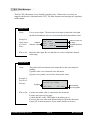
This is the controlled shear stress or CSS mode. The user defines the stress value and the instrument maintains that value.
The R/S CPS+ can also operate in controlled shear rate (CSR) mode where a feedback loop is
used: A speed or shear rate is entered by the user. The instrument ramps motor current up or
down (depending on the starting speed. If the instrument is at 0 rpm, and set point is 500 RPM
current is ramped up. If speed is 1000 RPM, current is ramped down). Speed is constantly
measured by the optical encoder and once the set point speed is achieved, minor adjustments in
the current applied to the motor are made, to maintain that speed.
Brookfield Engineering Labs., Inc.
Page M01-213-A0706