1
{...
}
else if ( IIRValue == IIR_THRE )
{...
}
/* THRE, transmit holding register empty */
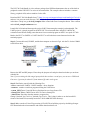
See in Table 276 on page 303 in the User Manual what is the meaning of the three bits 1-3 from the original
IIR register:
011
010
110
001
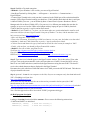
1 - Receive Line Status (RLS).
2a - Receive Data Available (RDA).
2b - Character Time-out Indicator (CTI).
3 - THRE Interrupt
For each of these situations, something else is done inside the corresponding branch of the “if” instruction
above. In other words, we first identify the interrupt, and for each ID we do something else. If none of the
expected IDs is found, we do nothing. Please take your time now to explain what’s done in each of these
cases. Read pages 303-304 in the User Manual for this. This is very important in order to understand the
overall operation of the example of this lab.
4. Lab Assignment
1) (not graded and should not be discussed in the lab report) Use a Debug session to step through the
execution of this program. The scope is for you to better understand its operation. See lab#1 for how to
use/run a debug session. See also documentation of the code bundle from NXP [7].
2) Answer the question: Why did we need to remove the ISP and RST jumpers in Example 1?
3) Describe in less than a page (typed, font size 11, single line spacing) all instructions inside the function
void UART0_IRQHandler (void) for each of the branches of the main “if” instruction. Include this in your
lab report.
4) Modify Example 1 such that the characters typed on the host’s keyboard are also displayed on the LCD
display on the board. (Hint: re-use code from Blinky2 example of lab#1)
5. Credits and references
[1] LPC17xx user’s manual; http://www.nxp.com/documents/user_manual/UM10360.pdf (part of lab#1
files)
[2] NXP LPC17xx Datasheet;
http://www.nxp.com/documents/data_sheet/LPC1769_68_67_66_65_64_63.pdf (part of lab#1 files)
[3] Schematic Diagram of the MCB1700 board; http://www.keil.com/mcb1700/mcb1700-schematics.pdf
(part of lab#2 files)
[4] MCB1700 Serial Ports; http://www.keil.com/support/man/docs/mcb1700/mcb1700_to_serial.htm
[5] UART entry on Wikipedia (click also on the references therein for RS-232);
http://en.wikipedia.org/wiki/Universal_asynchronous_receiver/transmitter
[6]
--Jonathan W. Valvano, Embedded Systems: Introduction to Arm Cortex-M3 Microcontrollers, 2012.
(Chapters 8,9)
--Pong P. Chu, FPGA Prototyping by VHDL Examples: Xilinx Spartan-3 Version, Wiley 2008. (Chapter 7)
--Lab manual of course http://homes.soic.indiana.edu/geobrown/c335 (Chapter 5)
--EE 472 Course Note Pack, Univ. of Washington, 2009,
http://abstract.cs.washington.edu/~shwetak/classes/ee472/notes/472_note_pack.pdf (Chapter 8)
9