1
processing as more variables and interface elements are considered. This means that SUPPLE’s
performance will degrade as the complexity of the user interface increases. Another difference is
SUPPLE‘s interface description, which contains some of the same information as the PUC specification
language but does not currently have a written syntax. Instead the description is defined by run-time
objects created by a programmer, much like the second-generation UIDE system.
3. Preliminary User Studies
Much of the related work shows that automatically generating interfaces is a hard problem, and no
previous system has successfully automatically created user interfaces measured to be of high-quality.
The problem can be broken down into two sub-problems: determining what information an abstract
appliance specification should include, and building an interface generator that can design usable and
aesthetically pleasing interfaces from those abstract specifications. As a beginning to solving these
problems, I started by hand-designing remote control interfaces for appliances (rather than begin with
designing the appliance specification language). Then user studies were conducted to compare the handdesigned interfaces to the manufacturers’ interfaces (full results of this study are described elsewhere
[19]). This approach allowed me to concentrate on what functional information about the appliance is
necessary to create a usable interface and to show that a PUC controller could be easier to use than
interfaces on actual appliances.
We chose to focus on two common appliances for our hand-designed interfaces: the Aiwa CX-NMT70
shelf stereo with its remote control, and the AT&T 1825 telephone/digital answering machine. We chose
these two appliances because both are common, readily available, and combine several functions into a
single unit. I own the Aiwa shelf stereo that we used, and the AT&T telephone is the standard unit
installed in many offices at Carnegie Mellon. Aiwa-brand stereos seem to be particularly common (at
least among our subject population) because ten of our twenty-five subjects owned Aiwa systems.
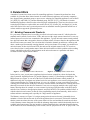
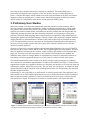
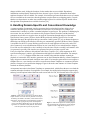
The hand-designed interfaces were created in two phases, initially as paper prototypes for a PalmOS
device and later as Visual Basic implementations on a Microsoft PocketPC (see Figure 3). Each interface
supported the complete set of appliance functions. At each phase, the interfaces were iteratively improved
with heuristic analyses, followed by a user study. The user study was dual-purpose: to compare the handdesigned interfaces with the interfaces on the actual appliances and to see what problems users had with
the hand-designed interfaces.
Unfortunately, it was not possible to use the PocketPC to actually control either of the appliances, but I
still wanted the users of the hand-designed interfaces to receive feedback from their actions in a manner
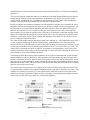
that was consistent with the appliances. Control was simulated for the users using a wireless network
from our PDA to a laptop. The laptop was connected to external speakers, and it generated audio
(a)
(b)
(c)
(d)
Figure 3. Hand-designed interfaces for the phone (a-b) and stereo (c-d). Functional interfaces for the PocketPC
are shown in b and d, and paper prototype interfaces for the Palm are shown in a and c.
11