1
RCD testing
What is an RCD?
The initials RCD stand for Residual Current Device – so where does
that get us? The dictionary tells us that the word “residual” refers
to “something remaining”, so a residual current device must be
concerned with something left over after two currents have been
compared. In fact, the RCD is an electrical device intended to
protect people and property from currents flowing incorrectly to
person, which part(s) of the body in which it flows, the time for
which it continues to flow and the health of the person concerned.
As far as we are concerned here, the most important of these
factors is the time for which the shock current is allowed to
continue. If the time concerned is greater than 40 milliseconds (40
ms, which is forty thousandths of a second or one twenty-fifth of
a second) there is a distinct likelihood of permanent damage to the
victim, or even of their death.
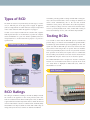
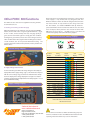
earth from the electrical supply. (fig 1).
1
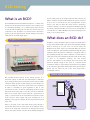
A typical RCD in a consumer unit
What does an RCD do?
An RCD is a device intended to protect people from death due to
RCD Unit
electric shock, which usually occurs due to current flowing through
them to earth (fig 2). In some cases it is used to reduce the
likelihood of fire in the event of an earth fault. When an electrical
circuit is healthy, the current flowing outwards through the phase
conductor (often called the live conductor) is exactly the same as
that returning through the neutral conductor. If current flows to
earth, this current passes through the live but returns via the earth,
so
there
is
an
imbalance
between
live
and
neutral
currents. This imbalance is the residual current. The device will
switch off quickly enough in the event of a residual current
exceeding its rating to ensure that the shock victim is very unlikely
to die. It must be appreciated that the RCD cannot prevent electric
shocks, but can ensure the risk of the shock being fatal is
considerably reduced.
2
Our standard electrical system in this country operates at a
theoretical voltage of 230 volts AC (abbreviated to 230V AC)
above earth potential; in fact, for historical reasons connected with
a European Union decision to unify voltages, it is more likely to be
in excess of 240V AC. The word “earth” in this sense should not
be taken as something we grow vegetables in, but as “the
general mass of earth”, or all of our surroundings, the floors, walls,
metal parts in our homes and so on. In the event of an earth fault,
where a live system makes contact with this “general mass of
earth”, a current, known as the earth fault current, flows to earth.
If this current is large enough and passes through part of a
building, a water pipe for example, the heat it generates may well
cause a fire.
More to the point, if the earth fault current passes through a
person, they will receive an electric shock. As we all know, electric
shocks can be fatal; how serious they are will depend on many
factors, such as the amount of electric current flowing through the
Electric shock due to lack of RCD