1
Types of RCD
It would be perfectly possible to design an RCD with a rating of 1
mA, a current so low that there can be no danger of death due to
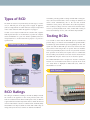
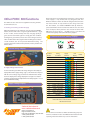
The RCD can exist in a very wide variety of forms (fig 3). In some
cases, it will form part of the plug used to supply an appliance
(such as a hedge trimmer or a lawn mower) or it may be incorporated
in the socket outlet into which the appliance is plugged.
electric shock. Unfortunately, due to the fact that electrical
insulation is never perfect, and another effect called capacitance,
there is always a leakage current to earth of more than this value,
even in a perfectly healthy circuit. Thus, an RCD with a rating as
low as this would trip at once, and so would be impracticable.
In other cases it may be included in the consumer unit, together
with the protective fuses or circuit breakers, to protect the complete
electrical installation or a part of it. Another possibility is that it is
incorporated into a circuit breaker whose purpose is to protect a
specific circuit.
Testing RCDs
It is essential to ensure that the RCD will operate as intended to
prevent danger, so it must be tested. All RCDs are provided with a
3
test button (fig. 4) that should be pressed regularly by the user. This
Different types of RCD
system tests that the RCD will open the circuit, and does not take
any account of how long it takes to operate. This test should be
carried out periodically by the user and is very useful to check the
basic operation of the device, but is quite useless to confirm that
the user will be protected in the event of an electric shock. This test
does NOT take the place of the tests we are about to explain.
The PDRC 380 RCD tester is designed to measure exactly the
fraction of a second taken for the device to operate in the event
of a fault, which is displayed in milliseconds (ms), which are
thousandths of a second.
A. RCD in consumers unit
B. Plug-in RCD for
protection of single
appliance
4
RCD Test button
C. Socket outlet incorporating RCD
RCD Ratings
The rating of an RCD has nothing to do with its ability to handle
the current to the appliance or the circuit protected, but is the
value of residual current at which it will operate. Thus, an RCD in
a typical domestic situation may well be able to switch off the load
current of 40 A but be rated at a residual current of 30 mA (thirty
thousandths of an ampere). RCDs are made with a wide range of
ratings, but by far the most common are 30 mA and 100 mA.
Test Button