1
California Air Resources Board
Instructional Guidance for Mandatory GHG Emissions Reporting
December 2008
10.1.2.2 Carbon content testing using on-line instrumentation or discrete sample
laboratory analysis (section 95125(d)(3)(A)):
The operator may use on-line instrumentation (e.g., a gas chromatograph) to
determine fuel gas carbon content. An important consideration in evaluating any online compositional analysis method is that the instrumentation and analytical
methodology used provide a complete characterization of all major species present in
the refinery fuel gas system. In practice, the operator should ensure good quality data
is gathered on ≥95 percent of the mass of hydrocarbons present in each RFG system
where on-line instrumentation is used. ARB staff recommends that instrumentation be
operated, maintained, and calibrated according to original equipment manufacturer
(OEM) specifications, and located appropriately in order to obtain a representative
sample of the RFG system in question.
For each RFG system where on-line instrumentation is used, the operator must
determine carbon content and fuel molecular weight at least once every eight hours
that RFG from the system is combusted. Measurements should be taken at
approximately the same relative period (beginning, middle, or end) during each 8 hour
period--or at times during each 8 hour window appropriate to provide for
representative sampling.
For each analysis, the operator will also need to calculate refinery fuel gas molecular
weight (kg fuel/kg-mole) using the data from the on-line instrumentation.
To calculate daily CO2 emissions, the current day carbon content values (kg C/kg fuel)
should be averaged to calculate daily average carbon content. Similarly, the fuel
molecular weight determinations should be averaged. These daily average carbon
content and fuel molecular values are then applied to the equation found in section
95125(d)(3)(A) along with the amount of RFG combusted, to calculate daily CO 2
emissions. Daily emissions are then summed to calculate annual emissions from each
RFG system.
10.1.2.3 System specific CO2 emission factor (section 95125(e)):
This third approach requires you to use an on-line high heat value (HHV) analyzer.
HHV data and a daily carbon content determination are used to derive a daily refinery
fuel system specific CO2 emission factor. This emission factor is then used with a daily
average RFG system HHV value (from the on-line analyzer) to calculate CO2 emissions.
1.
Calculate a RFG system specific daily emissions factor: You need to determine
the carbon content and HHV for the RFG system in order to calculate a CO2
emission factor. To do this, once per day, determine the carbon content (kg
C/kg fuel), molecular weight (kg fuel/kg-mole) and the HHV (Btu/scf) of the
RFG system. Carbon content and fuel molecular weight are measured by
drawing a representative RFG sample and performing a carbon analysis.
Carbon content and molecular weight may also be determined using an on-line
instrument.
High heating value is determined either using data from the carbon analysis or
from an on-line HHV analyzer. When using data from an on-line HHV analyzer,
the operator uses either the hourly average HHV value coinciding with the hour
in which the carbon content determination is made, or the hour in which the
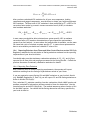
sample was collected for analysis. A daily emission factor (metric tonnes
10-3
Refineries