1
dot User’s Manual, December 22, 2009
D
34
Graph File Grammar
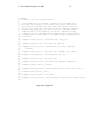
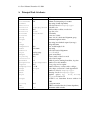
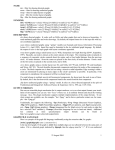
The following is an abstract grammar for the DOT language. Terminals are shown
in bold font and nonterminals in italics. Literal characters are given in single
quotes. Parentheses ( and ) indicate grouping when needed. Square brackets [
and ] enclose optional items. Vertical bars | separate alternatives.
graph
→ [strict] (digraph | graph) id ’{’ stmt-list ’}’
stmt-list
→ [stmt [’;’] [stmt-list ] ]
stmt
→ attr-stmt | node-stmt | edge-stmt | subgraph | id ’=’ id
attr-stmt
→ (graph | node | edge) attr-list
attr-list
→ ’[’ [a-list ] ’]’ [attr-list]
a-list
→ id ’=’ id [’,’] [a-list]
node-stmt
→ node-id [attr-list]
node-id
→ id [port]
port
→ port-location [port-angle] | port-angle [port-location]
port-location → ’:’ id | ’:’ ’(’ id ’,’ id ’)’
port-angle
→ ’@’ id
edge-stmt
→ (node-id | subgraph) edgeRHS [attr-list]
edgeRHS
→ edgeop (node-id | subgraph) [edgeRHS]
subgraph
→ [subgraph id] ’{’ stmt-list ’}’ | subgraph id
An id is any alphanumeric string not beginning with a digit, but possibly including underscores; or a number; or any quoted string possibly containing escaped
quotes.
An edgeop is -> in directed graphs and -- in undirected graphs.
The language supports C++-style comments: /* */ and //.
Semicolons aid readability but are not required except in the rare case that a
named subgraph with no body immediate precedes an anonymous subgraph, because under precedence rules this sequence is parsed as a subgraph with a heading
and a body.
Complex attribute values may contain characters, such as commas and white
space, which are used in parsing the DOT language. To avoid getting a parsing
error, such values need to be enclosed in double quotes.