1
Known Issues in v7.1
Saving New Data to User Material Files. The entire NASFLA material data base has been converted to
an XML-format as discussed above. However, in v7.1, when specifying a user-defined material in
NASFLA as “New Data” it is not yet possible to save a user-defined material into the new XML-format
files (e.g., USRMFC, USRMFM, etc.) and the checkbox to do this on the Material screen in NASFLA is
grayed-out. As a work-around, it is recommended that the user employ NASGRO v7.01 (or earlier) to
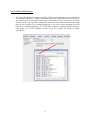
save the user-defined material data in the old file format and then use the v7.1 “Migrate User Data” utility
available on the NASGRO opening screen to convert the user material files to the new v7.1 XML format.
An alternative work-around would be to use an XML editor (or a plain text editor) to edit the v7.1 XMLformat user files directly. Please consult Appendix E for more information on the new material file
format. A future version of NASGRO will have the capability to save user-defined material data to the
XML-format database.
Post-Transition Crack Tip Output in Out2 File. When multi-degree-of-freedom (MDOF) crack models
having two or more crack tips automatically transition to other crack cases, the printed crack lengths in
the out2 file can sometimes be difficult to interpret. This is because the out2 file is printed based on the
crack-tip labels of the pre-transition crack case. After transition, when the type and number of crack tips
has changed, data may be printed in the wrong columns (or mislabeled) because the numbers of data
columns before and after transition do not match (but all the data are, in fact, printed). The real
“problem” is that the crack tip nomenclature genuinely changes from crack case to crack case, and it is
difficult to anticipate in advance what kind of transition will occur. This is a common problem that has
existed for some time in earlier versions of NASGRO and it is not specific to any particular crack case.
At present, the user needs to carefully examine the post-transition crack lengths in order to be clear in the
interpretation of the results. The NASGRO development team is investigating solutions to this
complicated output issue.
Net Section Yield (NSY) Residual Strength Calculation for Weight Function (WF) Models. The NSY
residual strength calculations (plots) for WF models are incorrect when one or more stress gradients are
input. The NSY failure mode calculation for WF models is correct during the NASFLA crack growth
analyses. The WF model Gi (G-factors) printed in the out2 file are incorrect since they are computed for
remote or uniform/constant loadings and not the input stress gradients; they are only used in plotting the
residual strength NSY curve. At present, the approach to take (for a WF model residual strength analysis)
would be to use the Limit Stress option on the Load Blocks page and specify the peak stress of the
gradient for each applicable stress component. The NASGRO development team is investigating
solutions to this issue.
Additions (NASFLA):
•
Crack growth constants for the following materials were added to the materials files:
o
o
o
o
o
o
o
o
o
B2IB18AB1
B2IB18AB8
B2IBA1AB1
B2IBA7AB1
B3GE28AC1
E2FB11AB8
E2FB13AB1
M2UA31AB1
M2UA32AB1
A225 Grd B PLT; L-C; Lab air; RT
A225 Grd B PLT; L-C; Lab air; -20F
A225 Grd B Weld; RT
A225 Grd B (Weld) HAZ; RT
A372 Cls V Forging; L-C; Dry air; RT
AOS 1146A PLT; L-T; Lab air; -20F
AOS 1146A PLT; L-T & T-L; Lab air; RT
2099-T83 Extrusion; L-T; Lab air; RT
2099-T83 Extrusion; T-L; Lab air; RT
7