1
reflectivity. There were 6 measurements in total in this mode, and each measurement was
performed immediately after the FMR measurement corresponds to the same orientation
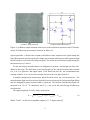
(Left FMR, Right FMR and so on). The exact position of these labels on the test mirror is
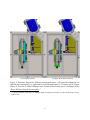
shown in Fig. 4b.
The flipper mirror reflectivity is computed as
Rf lipper =
IF M R
IN R
(1)
where IF M R is the signal strength at arbitrary wavelength in Flipper Mirror Reflection Mode, IN R
is the signal strength at the same arbitrary wavelength in the NR Mode.
The real mirror reflectivity is determined as
R=
IRM R
IF M R
(2)
where IRM R is the signal strength at arbitrary wavelength in RMR Mode, IF M R is the signal
strength at the same arbitrary wavelength in the FMR Mode.
The focal length of a lens is dependent on the incoming light’s wavelength. All three modes
project a focused image of the source (monochromator) onto the detector at 225nm. The focused
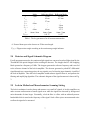
image size of each mode is listed in Table 1. The image will be slightly out of focus (blurry) at
higher and lower wavelength. The active area of the detector is 1cm×1cm which is sufficient to
detect the slightly blurred image.
Table 1 shows the distance between the important components in various different modes.
do : Distance between beam out slit of monochromator to focusing lens.
dl−f : Distance between focusing lens and flipper mirror.
df −d : Distance between flipper mirror and detector.
dl−d : Distance between focusing lens and detector.
df −m : Distance between flipper mirror and real mirror.
dm−d : Distance between real mirror and detector.
di : Total length of light path from the lens and detector (The sum of dl−f , df −d , dl−d , df −m and
dm−d for each mode).
5