1
HYDRODYNAMICS
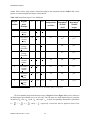
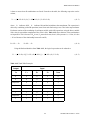
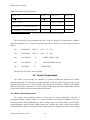
homologous parameter h/α2 or h/v2, v/α or α/v, and β/α2 or β/v2. The parameter used depends upon the
octant in which the curve is being plotted. The choice is made so that the values are bounded (i.e., the
denominators never vanish and, in the case of the capacity parameter, the range of variation is confined
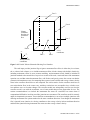
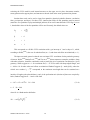
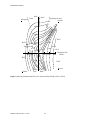
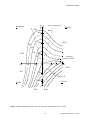
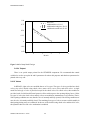
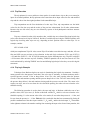
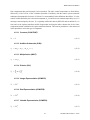
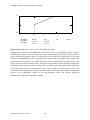
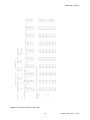
between plus and minus 1.0). Figure 2.4-3 is the homologous head curve that is obtained from the head
map in Figure 2.4-1. Note that not all points fall on a single curve. This is a result of the inexact nature of
the similarity theory. Real pumps do not perform exactly according to the similarity relations due to
leakage, viscous effects, etc.; however, the correspondence is surprisingly close, as evidenced by the tight
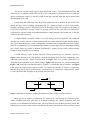
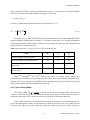
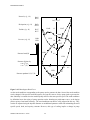
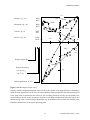
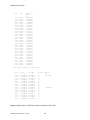
clustering of points. The homologous curve for the torque data of Figure 2.4-2 is shown on Figure 2.4-4.
Since the data do not form a single curve, the design operating usual approach is to use least squares or
other smoothing techniques to obtain curves passing through the point (1.0, 1.0). These curves must also be
continuous at the point v/α or α/v equal to + 1.0. The legends on Figure 2.4-3 and Figure 2.4-4 have a key
indicating which of the homologous parameters are used in each octant. All combinations of head, flow,
speed, and torque can now be located on a corresponding segment of the homologous curve. Note that the
impeller diameter parameter that appears in the dimensionless similarity parameters is not used in the
homologous reduction of the four-quadrant representation; thus, special considerations are necessary for
application of the data to a larger but geometrically similar pump. The advantage of using the homologous
pump performance data representation in a computer code is obvious. Two-dimensional data arrays and
two-dimensional interpolation are avoided, and, only two parameter tables and one-dimensional
interpolation are required.
2.4.8.1.3 Homologous Data and Scaling
In most system simulation tasks, complete pump performance data are not available. Usually, only
first-quadrant data are available (normal operation), and sometimes only the design or rated values are
known. In the case of full-scale nuclear power plant pumps, it is difficult to test the pumps in all octants of
operation or even very far from design conditions. The usual approach to obtain data for such systems is
through the use of scaled-down pump tests.
The scaled pump test data can be for the same physical pump operated at reduced speed or for a
pump scaled in size such that similarity is preserved. For the case of a pump scaled in size, it is necessary
to maintain the similarity in specific head, capacity, speed, and torque parameters. (Note that the diameter
was dropped in the development of the homologous performance model since a fixed configuration was
considered.) Consideration of the diameter change must be implicitly included in the selection of “rated”
parameters to properly account for changes in geometric scale. The homologous parameters, including the
impeller diameter, are given in Equations (2.4-13), (2.4-14), and (2.4-16). When a change in scale is
considered, an additional degree of freedom is possible, since only two parameters, the rated specific head
and capacity, must be held constant. The specific speed is also held fixed whenever both specific head and
capacity are kept fixed. There are many combinations of N and D for which this is possible.
The usual situation encountered in applications work is that homologous data exist for a similar
pump, and the question arises, “Can we use these data to simulate our pump by adjusting the rated
parameters?” The question can best be answered by the following statements. First, the best approach is to
51
NUREG/CR-5535/Rev 1-Vol II