1
EXPERIENCES
Five instruments hardware models with various degrees of fidelity became available later during the ESM development.
The initial hybrid design concept selected for the ESM allowed us integrating the newly available hardware models
while keeping the advantages of a flexible software simulation environment. The software simulation of instruments
replaces missing hardware instruments and provides the flexibility and functionalities not available with the instrument
hardware models. To have a telemetry en telecommanding resource with ESM did not only prove relevant for training,
but also for the debugging of the ground infrastructure which was quite complicated [8]. In retrospect a lot of simulators
were used before and during the project, but somehow they all had their purpose. The integration and data routing was
straightforward for the telemetry and telecommanding being routed via the EuTEF DHPU. The original objective to
have plug-and-play using the i-MDB import could be demonstrated. During the development several i-MDB updates
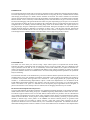
could be imported without any difficulties. The hardware is shown in Fig. 7 with the power load and thermal load
simulation on the left-middle and the control on the right. The TAXI-convertor is integrated on the left-bottom corner.
In the background the Columbus Emulator and EuTEF DHPU related equipment(upper half) is shown.
Fig. 7. Hardware overview of ESM components.
EuTEF DPHU EM
The central core of the facility was used for testing a major software patch to be uploaded onto the FM facility.
Following the update a reformatting of the on-board mass memory proved to be needed. This type of debugging could
only be performed with the EM. In view of unavailability of the EuTEF DHPU EM for repairs and the need for a
software development environment, a simplified EuTEF DHPU routing software simulation was added. For detailed
power load simulation facilities are available but have to be fine-tuned pending detailed requirements for operational
analysis and training.
The instruments in EuTEF can be scheduled using a set of files called the EuTEF Operations Plan (EOP). However, for
schedules lasting up to a week validation was difficult. As the ESM is a mix of software and hardware just speeding up
a simulation is not possible. Three approaches were considered: A. a time stepping method; B. a preprocessing of the
schedule; C. A dedicated checking implementation. Option A could not be implemented in view of limitations of the
EuTEF DHPU EM/Columbus Emulator time interface. Option B required pre-processing of an operational product
which is not attractive. For option C a dedicated tool was developed by Space Applications Services, Belgium, as
partner in the Erasmus USOC which proved to be sufficient, but for debugging the ESM set-up was needed.
RS-422 Instrument Implementation Experiences
Using the STD formalism the RS-422 instruments were modelled with realism depending on the instrument hardware
models which became available during the project. A DEBIE2 Engineering Model (EM) is available with one sensor.
The software supports all three sensors as in the FM. With the software model it is possible to exercise commands and
verify related error handling for bit parity checks. Using a hardware switch, selection is possible between the software
model and the EM hardware. For the purpose of testing DEBIE-2 science telemetry processing, an option has been
included to simulate large science packets. In the DEBIE2 user interface artificial packets are generated when
increasing the packet size. The number of packets sent after a single shot science packet acquisition can also be
specified. For DOSTEL an EM is available and only a few commands are implemented. For EXPOSE instrument a
limited data handling hardware model is available to connect to the DHPU EM. All commands are also implemented in