1
2.2 PROBE ASSEMBLY
The CCA consists of a probe assembly and a signal processor. The probe assembly is comprised
of the piston and sensor, which houses the electrodes that measure the streaming current. The
signal processor is the circuit board inside the CCA.
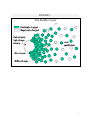
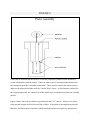
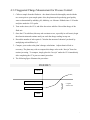
A simplified picture of the probe assembly is presented in Figure 2. The sample, which contains
the water to be characterized, flows into the cylinder (via side holes that are not shown.) Inside
the cylinder is a small piston that reciprocates vertically. Above the piston, the piston rod is
attached to an eccentric point on a crank driven by a motor. The piston’s velocity is thus
sinusoidal in nature.
The piston moves up and down inside a cylinder that is closed at the bottom. The space between
this piston and the cylinder is called the annulus, which is critical to the streaming current
device. The annulus has the shape of a thin, cylindrical “shell,” which contains sample fluid and
particles. The clearance between the piston and cylinder walls is several thousandths of an inch
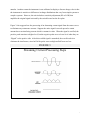
(in metric units, on the order of hundreds of microns.) As the piston reciprocates, it acts as a
pump: when moving downward, it forces sample out of the cylinder, upward through the
annulus. Note that the annular clearance is large enough to allow most particles in a typical
sample to pass in or out, but small enough to cause significant fluid velocity within this space.
After the piston reaches its downward position, it precedes upward, pulling fluid downward into
the increasing volume below this piston. All directions are thus reversed in this stage of the
piston’s travel. The constantly reciprocating piston ensures continuous renewal of sample, such
that changes in particle characteristics can be monitored.
CCA 3100
9