1
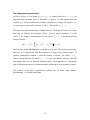
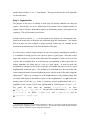
Suppose now that fˆ0 (L, H ) is an approximation to f0 (L, H ) , found by Monte Carlo
simulation using N (0,1) responses. For any given σ > 0 we approximate the density
f (L, H σ 2 )
by fˆ(L, H σ 2 ) = fˆ0 (L, σ −1H ) .
Figure 1 shows the approximation fˆ0 (L, H )
resulting from one particular Monte Carlo simulation (approximations converge
reasonably fast as a function of the number of simulated (L, H ) -pairs).
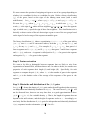
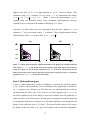
In practice, the null variance has to be determined from the data. Suppose σ̂ 2 is an
estimate of σ 2 (see later section on how σ̂ 2 is defined). Then our approximation for the
null distribution of the (L, H ) -pairs will be fˆ(L, H ) = f (L, H σˆ2 ) .
(a)
(b)
H
H
1.0
1.0
0.5
0.5
0.0
0.0
10
20
30
10
L
20
30
L
Figure 1: Contour plots showing the empirical distribution of (L,H)-pairs for simulated null data
with variance σ 2 = 1 . (a) The border between the rejection region (right region) and acceptance
region (left region) for one particular significance level α(λ) is shown as a broken line; (b) The
border between the rejection region (right region) and acceptance region (left region) for a different
significance level α(λ ') > α(λ) is shown as a broken line.
Step 4: Find significant genes
A gene is called significant in ACE if it belongs to a segment for which the density
fˆ(L, H )
is below a given threshold. This is analogous to how significance is defined in,
e.g., a common t-test. However, in ACE there are two situations that are treated as
exceptions from the above rule. First, genes in very short segments (say L ≤ Lmin ) are
not called significant even if the density is below the treshold, since the possibility of
outliers may have to be ruled out first. Second, genes in segments of moderate length and
low height (the shaded areas in Figure 1) are not called significant, even though the null
density is low in this part of the (L, H ) -space. The reason for this is that we don’t expect
the density in this part of the (L, H ) -space to be higher under the alternative hypothesis
37