1
Introduction to Serial Communication
1 INTRODUCTION TO SERIAL COMMUNICATION
In a serial interface the data bits are sent sequentially through a communication channel or bus. Several
technologies use the serial communication for data transfer, including the RS232 and RS485 interfaces.
The directions that specify the RS232 and RS485 standards, however, do neither specify the character format, nor
its sequence for the data transmission and reception. Therefore, besides the interface, it is also necessary to identify
the protocol used for the communication. Among the several existent protocols, one used a lot in the industry is the
Modbus-RTU protocol.
In the sequence the characteristics of the RS485 serial interface available for the SRW 01 smart relay will be
presented, as well as the Modbus-RTU protocol for the use of this interface.
1.1 THE MODBUS-RTU PROTOCOL
The Modbus protocol was developed by the company Modicon, part of Schneider Automation. It is defined in the
protocol: the format of the messages used by the elements that compose the Modbus network, the services (or
functions) that can be made available via network, and also how these elements exchange data in the network.
1.2 TRANSMISSION MODES
Two transmission modes are defined in the protocol specification: ASCII and RTU. The modes define the way the
message bytes are transmitted. It is not possible to use the two transmission modes in the same network.
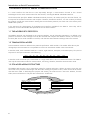
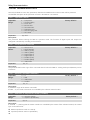
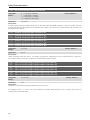
In the RTU mode, each transmitted word has 1 start bit, eight data bits, 2 stop bits, and without parity. Thus, the bit
sequence for one byte transmission is the following:
Start
B0
B1
B2
B3
B4
B5
B6
B7
Stop
Stop
In the RTU mode each data byte is transmitted as a single word with its value in hexadecimal format. The SRW 01
uses only this transmission mode for communication, not having, therefore, the ASCII communication mode.
1.3 RTU MODE MESSAGE STRUCTURE
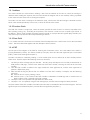
The Modbus-RTU structure uses a master-slave system for message exchange. It allows up to 247 slaves, but only
one master. Every communication begins with the master making a request to a slave, which answers to the master
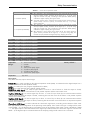
what has been asked. In both telegrams (request and answer), the used structure is the same: Address, Function
Code, Data and Checksum. Only the data content has a variable size.
Master request message
Address (1 byte)
Function code (1 byte)
Data (n bytes)
CRC (2 bytes)
Address (1 byte)
Function code (1 byte)
Data (n bytes)
CRC (2 bytes)
Slave response message
Figure 1.1 – Message structure
6