1
students will gain experience with high-level microcontroller system concepts like interrupts as
well as low-level concepts like assembly language programming, LED interfacing15.
Microprocessor courses are typically taught using different microcontroller chips. This approach
can be changed providing added educational benefits with the availability of field-programmable
gate array (FPGA) and associated soft-core processors15.
A new platform is currently being investigated for the microprocessor course partly enabled by
an equipment grant from Renesas Inc. The major advantages of the new platform include
sophisticated user friendly IDE, simple instructions set, ease of programming and DMA
controller support. The lab projects developed using QSK26A board were: Introduction to
M16C/26A, assembly language programming concepts, arithmetic and logic operations, general
purpose output operations, general purpose input polling for switch input, introduction to
interrupts and DMA transfer.
Description of M16C/26A
Renesas has a family of microcontrollers to address the market for various applications such as
automatic motor control, digital home electronics, inverter application and networks. The
M16C/26A is one of the many product offerings by Renesas in this domain. It is a 16-bit
microcontroller with on board in-circuit debugger/programmer interface, 64K bytes user flash,
A/D converter, 2 DMAC channels, 39 input/output (I/O) lines etc.
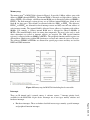
The M16C/26A 48-pin version block diagram16 is shown in Figure 2. These single-chip
microcomputers operate using sophisticated instructions featuring a high level of instruction
efficiency. With 1M byte of address space, they are capable of executing instructions at high
speed. In addition, this microcomputer contains a multiplier and a DMAC which combined with
fast instruction processing capability, makes it suitable for control of various OA (operational
amplifier), communication, and industrial equipment which requires high-speed arithmetic/logic
operations.
The variety of internal peripherals on the microcontroller reduces the need for external
components. Its core has been designed to take advantage of the best features of register based
architectures. The architecture makes it fast with efficient code execution. A hardware multiplier
circuit and two DMAC’s are implemented to speed up the processing.
Register configuration
The following is a description of the register configuration for the M16C/26A.
Page 14.829.5