1
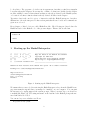
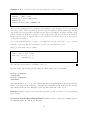
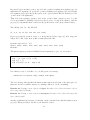
c = a · b, and also 1 < a and a < c. But then a divides n, and contradiction with the fact that
c is the smallest natural number greater than 1 that divides n. Thus, LD(n) must be a prime
number.
For a proof of the second item, suppose that n > 1, n is not a prime and that p = LD(n). Then
there is a natural number a > 1 with n = p · a. Thus, a divides n. Since p is the smallest divisor
of n with p > 1, we have that p ≤ a, and therefore p 2 ≤ p · a = n, i.e., (LD(n))2 ≤ n.
The operator · in a·b is a so-called infix operator. The operator is written between its arguments.
If an operator is written before its arguments we call this prefix notation. The product of a and
b in prefix notation would look like this: · a b.
In writing functional programs, the standard is prefix notation. In an expression op a b, op
is the function, and a and b are the arguments. The convention is that function application
associates to the left, so the expression op a b is interpreted as (op a) b.
Using prefix notation, we define the operation divides that takes two integer expressions and
produces a truth value. The truth values true and false are rendered in Haskell as True and
False, respectively.
The integer expressions that the procedure needs to work with are called the arguments of the
procedure. The truth value that it produces is called the value of the procedure.
Obviously, m divides n if and only if the remainder of the process of dividing n by m equals 0.
The definition of divides can therefore be phrased in terms of a predefined procedure rem for
finding the remainder of a division process:
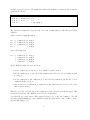
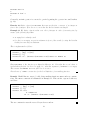
divides d n = rem n d == 0
The definition illustrates that Haskell uses = for ‘is defined as’ and == for identity. (The Haskell
symbol for non-identity is /=.)
A line of Haskell code of the form foo t = ... (or foo t1 t2 = ..., or foo t1 t2 t3= ...,
and so on) is called a Haskell equation. In such an equation, foo is called the function, and t
its argument.
Thus, in the Haskell equation divides d n = rem n d == 0, divides is the function, d is the
first argument, and n is the second argument.
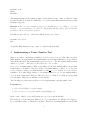
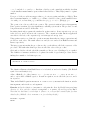
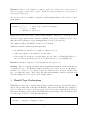
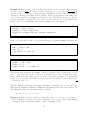
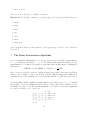
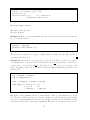
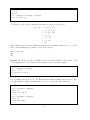
Exercise 3 Put the definition of divides in a file prime.hs. Start the Haskell interpreter hugs
(Section 1). Now give the command :load prime or :l prime, followed by pressing Enter.
Note that l is the letter l, not the digit 1. (Next to :l, a very useful command after you have
edited a file of Haskell code is :reload or :r, for reloading the file.)
Prelude> :l prime
Main>
4