1
Micro Digital X-ray Processor - Technical Reference Manual
mdo-microDXP-MAN-1.1.2
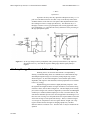
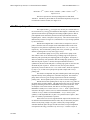
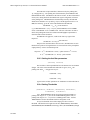
σt = sqrt( σf2 + (1+1/128)σe2)
Equation 4-6
This results in less than 0.5 eV degradation in resolution, even for very
long peaking times, when resolutions of order 130 eV are obtained.
4.4.2
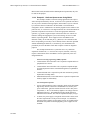
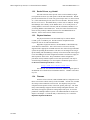
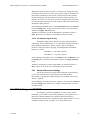
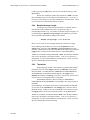
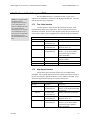
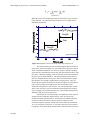
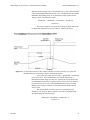
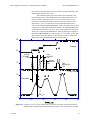
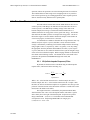
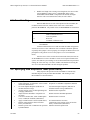
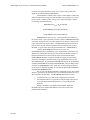
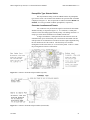
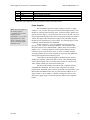
Applying a Baseline Cut
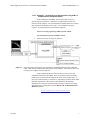
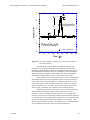
can improve performance
when the Baseline
Histogram is nonGaussian. Outlying data
points are‘cut’ from the
running Baseline Average
(though still included in the
histogram)
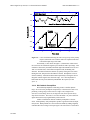
Raw Baseline Measurement
The output of the baseline filter (either the energy filter itself, or a
derivative of it) is sampled periodically in the explicit absence of an x-ray step,
defined by a baseline threshold. In practice, the DXP initially makes a series of
NB baseline measurements to compute a starting baseline mean. It then makes
additional baseline measurements at quasi-periodic intervals to keep the estimate
up to date. These values are stored internally and can be read out to construct a
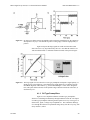
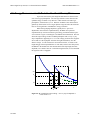
spectrum of baseline noise, referred to as the Baseline Histogram. This is
recommended because of its excellent diagnostic properties. When all
components in the spectrometer system are working properly, the baseline
spectrum should be Gaussian in shape with a standard deviation reflecting σn.
Deviations from this shape indicate various pathological conditions which may
also cause the x-ray spectrum to be distorted and therefore have to be fixed.
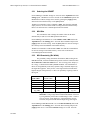
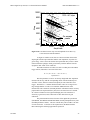
The situation is remedied by removing (“cutting”) outlying samples
from the baseline average described below. If the maximum in the baseline
distribution lies at E0, then captured baseline values that deviate from E0 by
more than ∆E+ and ∆E-, respectively, are not included in the running baseline
average. Note that all captured baseline values are included in the Baseline
Histogram, however, so that it is always a valid representation of the system’s
behavior.
4.4.3
Baseline Averaging in the DXP
A running average of baseline measurements is computed, which is
then subtracted from sampled peak values to compute the energy of
corresponding incident x-rays. The number of baseline samples averaged is set
in microManager as “Number of Baselines to Average”. In the DSP this is
converted into the parameter BLFILTER according to the equation:
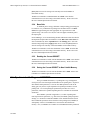
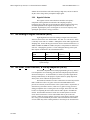
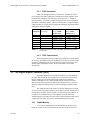
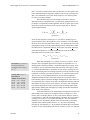
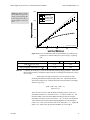
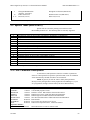
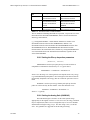
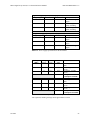
# baseline samples averaged = 32768 / BLFILTER
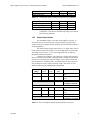
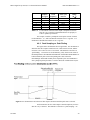
Decimation
# Baseline Samples to
Average
BLFILTER
(DSP Parameter)
0
2
4
64
128
256
512
256
128
Table 4.1:
Typical values used for baseline averaging. The best value for
each decimation should be determined empirically, though the
general trend illustrated in the table, i.e. larger number to average
for higher decimations, should be followed.
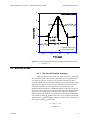
Physically, the baseline is a measure of the instantaneous slope
(volts/sec) for a pulsed-reset detector, and a measure of the DC offset for an RCfeedback preamplifier. For a perfect detector and preamplifier the baseline
value is independent of time. In fact, the variation in leakage current of the
8/6/2009
47