1
By integrating such applications into the routines of such patients as a method of
assisted living, their quality of life can be greatly improved through giving them more
independence as well as emotional stability.
1.2 Aim and scope of the thesis
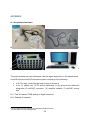
The Heilbronn University of Applied Sciences (Hochschule Heilbronn) has recently
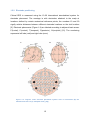
acquired equipment that can be used for recording the Electroencephalogram (EEG)
in the Bio-Signals Laboratory. These devices come with a fairly high price tag. The
idea was to take advantage of the availability of non-proprietary open source
software for real-time processing of brain signals, integrate it with the acquisition
device and build a functional laboratory-based BCI application: the P300 visual
speller.
Currently there are not fewer than 10 such open source BCI platforms. Among them,
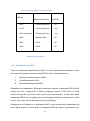
OpenViBE was chosen basing on the functionality and usability analysis (See
chapter 2) and the OpenViBE website [6].
1.3 The BCI Framework
1.3.1 Principle of the BCI
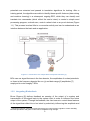
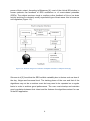
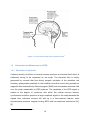
A typical BCI system involves acquisition of electrical signals from the brain’s neuron
activity and transforming them into commands to control an application. The user’s
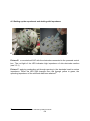
brain activity is recorded using a single or multiple electrodes attached to the scalp
for the EEG or directly onto the cortex, by surgical means, for the ECoG. Another
method is to use depth electrodes implanted in the brain. The most common BCIs
are EEG-based, as they are not only cheaper but also easier to set up.
The acquired EEG signal is digitized by an analog-to-digital converter and fed into a
computer for processing. Different characteristics can be observed in this ongoing
oscillatory activity depending on varying degrees of the user’s mental or physical
state (a relaxation EEG is different from the one recorded when the subject is
performing a mental activity for example). Specific features like amplitudes of evoked
2