1
Doc: UM2256
Issue:
C
Page: 6/14
Date: 12/9/94
Author:
PJM
i)
Slow Down Count Register
+ 14
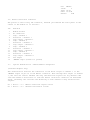
This 16-bit register is continuously compared with the top 16 bits of the step count
( bits 8-23 ). The comparison is sequential for all channels, and is interrupted by
addressing the module. Please note that addressing the module more often than every
20 microseconds may cause this scanning system to miss an event. The host computer
must calculate the number of steps taken during slow-down and write this
register accordingly:- e.g.
High speed = 1000 steps/sec., (so start/stop = 100 s/s), ramp time = 1 second. Number
of steps during ramp down = (High + start/stop) x time / 2.
This equates to the average speed during ramp down multiplied by the ramp time, which
in our example, will be 550 x 1 = 550. Now divide that by 256 and subtract 1 to
arrive at the number to be loaded = 1.
(We subtract 1 because the comparator is examining the top 16 count bits, and the
bottom 8 will all be '1' when equality occurs)
5.
Control and Status Register Format
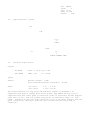
The format of this register is as follows:15
| 0
14 13
1 MAN
12
RUN
11
GO
10
FLT
09
FULL
08
HOME
07
06 05
INTEN 0 0
04 03 02 01 00
RDY 1 1 0 BUSY|
BUSY and RDY are complementary, and form the channel booking scheme. After power-up,
RDY is '1' and BUSY is '0'. When the CSR is first read, these are seen as such, i.e.
the channel is available, and the trailing edge of that read command sets the BUSY
flag to ensure that all further reads show BUSY as '1' and RDY as '0'. These two bits
stay in that state until a 'reset' is given, which involves writing a '1' to bit 0 this means 'finished using channel'.
Bits 1, 2, 3, 5, 6, 14 and 15 are 'fixed' by the VXI specification and are always
read as shown. Writing them has no effect.
Bit 7 is INTEN or Interrupt Enable, specific to this channel. If this bit is a '1',
then the appearance of any CSR bit which has a corresponding mask bit set to '1'
will cause this channel to assert its interrupt request. This may give rise to VME
IRQ4 as we see later.
Bit 8 is the state of the Home Limit switch (provided the outer or Dead Stop Limit is
open) - '1' = 'open' or 'hit limit' - read only.
Bit 9 is the same but for the Full Travel Limit - read only.
Bit 10 reflects the state of the drive system's Fault output, which is usually
continuously energised to indicate 'OK'; - read only.