1
The E682 is usually installed near the pixels it controls and their power supply, and acts as the “bridge” between the pixels
and the PC. The E682 receives the lighting intensity signals from the computer via a network (LAN) connection, and
converts them into a form suitable for operating the actual pixels.
The lighting control software determines what DMX (intensity) values need to be sent to each color of each pixel. The PC
software then forms this data into “packets”, each packet consisting of the current intensity value for each of up to 170
pixels or 510 channels (3 channels for each pixel), and sends these packets out over its Ethernet port. The packets travel
through your local network and eventually to the E682 via its Ethernet connection. The E682 then converts the DMX
intensity values into multiple streams of data that are sent on to the various strings of pixels. The controller uses its
configuration data, which you define via the controller’s web interface, to know how to reformat each piece of DMX data to
route it to the proper pixel in the form that pixel will understand. So the path is:
Lighting Software on PC -> Network -> E682 -> Pixels
The E682 is available in kit form, as a fully assembled and tested board, or as part of a complete system including the
E682, a power supply, enclosure, and cables (the PS1).
Like all SanDevices products, the E682 is manufactured in the USA.
Feature Summary:
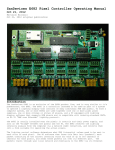
The E682 is a single PC board, approximately 4” x 7”, the mounting hole pattern is compatible with the “new style”
industry-standard Keptel or equivalent CG-1500 enclosure.
DMX data input via the SACN protocol, also known as E1.31, or DMX over Ethernet, using a 100mb Ethernet connection.
The E682 presently support up to 7 universes of Multicast SACN channels, which is enough to control nearly 1,200
individual RGB pixels, or up to 12 universes of Unicast SACN or Art-Net, which is enough to control more than 2,000
pixels. The use of the SACN or Art-Net protocols allows multiple universes of lighting channels over a single Ethernet
cable, and eliminates the need for multiple DMX ‘dongles’ at the controlling PC.
16 On-board individually-fused pluggable screw-terminal connectors for connecting up to 16 separate pixel strings or
strips. No soldering is required. Fuses are standard “Mini ATO” plug-in fuses.
All pixel strings are powered from the E682, no external pixel power wiring is needed in most cases. Please note that
some pixel configurations may require that some pixel power be supplied externally to the E682. This is typically needed
if driving long pixel chains, or a large quantity of 5 volt pixels.
The E682 is extremely versatile, with many programmable options, and many pixel types supported, including 5-bit
(software-expanded to 256 dim levels), 7-bit, 8-bit, and 12-bit pixels.
The E682 can be configured to operate multiple pixel types (up to 4 simultaneously), and multiple pixel voltages (up to 2
simultaneously).
The E682 is configured via your web browser by accessing the built-in web server using standard web form tools (check
boxes, buttons, drop-down lists, etc.
The E682 has a built-in regulated +5VDC output to power a small Ethernet switch.
The E682 is most commonly powered from the same power supply that operates the pixels, but may be powered by a
small dedicated power supply (7-24VDC at 500ma) if desired.
Outputs, in groups of 4, can be selected for “balanced” 2-wire operation, to drive standard wired RS-485 DMX devices, or
devices using the Renard protocol. In these cases the E682 acts as an E1.31 to DMX or Renard Bridge. In many cases
this will eliminate the need for separate hardware (DMX dongles or bridges), to handle traditional wired DMX fixtures or
Renard controllers.
The E682 supports 8-bit dimming (256 intensity levels) for the LPD6803 pixel type and 10-bit dimming for many “8-bit”
pixels by slightly varying the pixel intensity on each refresh. This feature is available for any string length of
TLS3001/CYT3005 pixels, and most 8-bit pixel types if string length is less than 55 pixels.