1
HARDWARE ARCHITECTURE
The CBX card provides an interface between CSC and central switch. CSC
makes any switch card access through CBX. CBX also handles power supply
errors in CSU and BTU. Each CCK-CBX-NSC complex form a security block
i.e. CBX0 cannot be used with CCK1. Thus there is a copy 0 complex and a
copy 1 complex. The CBX also synchronises all CSC accesses to CSU with the
16 MHz clock as well as BTU.
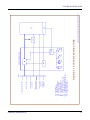
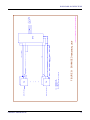
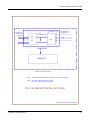
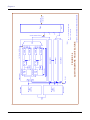
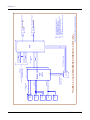
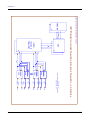
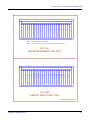
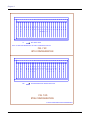
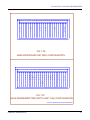
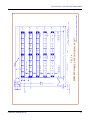
Fig. 3.12 depicts the clock distribution in C-DOT MAX-VE.
3.3.2.
Central Message Switch (CMS)
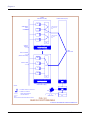
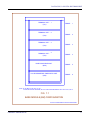
Central Message Switch (CMS) complex is the central message transfer point
of the switch. It is implemented as four different message switches, working
in load-sharing mode. Each message switch is a high performance message
routing block, implemented by using High Performance Message Switch
(HMS) card which has high speed 32 bit microprocessor MC 68040. This card
supports 39 HDLC links with flexibility of programming individual HDLC
links upto 750 kbps. All Central Message Switches (CMS1,2,3&4) are used
for routing of messages across the Base Modules. On the other hand only
CMS1 and CMS2 interface with the Administrative Module for routing
control message between Base Processors and Administrative Processor. This
communication is used to access office data for routing inter- module calls
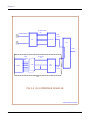
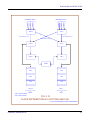
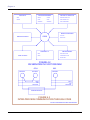
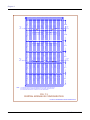
and administration and maintenance functions. Fig. 3.13 depicts the Central
Message Switch in C-DOT MAX-VE.
3.4.
ADMINISTRATIVE MODULE (AM)
Administrative Module (AM) consists of a duplicated 32-bit controller called the
Administrative Processor Controller (APC). It communicates with Base Processors
via the Central Message Switch for control messages and with the duplicated Input
Output Processors in the Input Output Module for interfacing peripheral devices
Administrative processor is responsible for global routing, translation, resource
allocation and all other functions that are provided centrally in C-DOT DSS MAX.
The implementation of AM is similar to Base Processor Complex of BM, using the
same hardware configuration.
3.5.
INPUT OUTPUT MODULE (IOM)
Input Output Module (IOM) consists of duplicated Input Output Processor (IOP).
The Input Output Processor (IOP) is a general purpose computer with UNIX
Operating System. It is used as the front end processor in C-DOT DSS. It handles
all the input and output functions in C-DOT DSS. The IOP is connected to AP/BP
via HDLC links. During normal operation, two IOPs interconnected by a HDLC
GENERAL DESCRIPTION
37