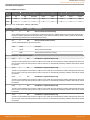
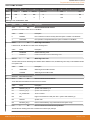
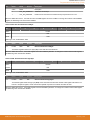
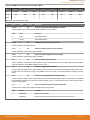
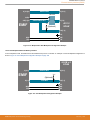
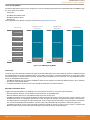
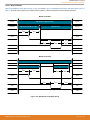
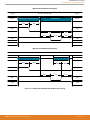
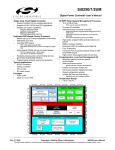
1
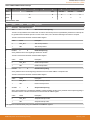
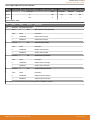
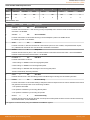
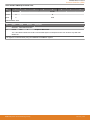
EFM8 Universal Bee Family
EFM8UB2 Reference Manual
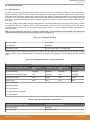
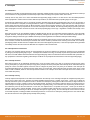
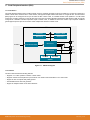
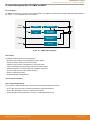
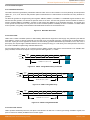
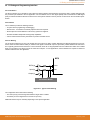
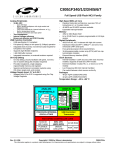
The EFM8UB2, part of the Universal Bee family of MCUs, is a
multi-purpose line of 8-bit microcontrollers with USB feature set.
These devices offer high value by integrating a USB peripheral interface with a high precision oscillator, clock recovery circuit, and integrated transceiver, making them ideal for
any full speed USB applications with no external components required. With an efficient
8051 core and precision analog, the EFM8UB2 family is also optimal for embedded applications.
• Pipelined 8-bit 8051 MCU Core with 48
MHz maximum operating frequency
• Up to 40 multifunction I/O pins
• Crystal-less full speed/low speed USB 2.0
compliant controller with 1 KB buffer
memory
• One differential 10-bit ADC and two analog
comparators
EFM8UB2 applications include the following:
• Consumer electronics
• Medical equipment
• USB I/O controls, dongles
• High-speed communication bridge
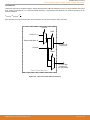
KEY FEATURES
• Internal 48 MHz oscillator with ±0.25%
accuracy with USB clock recovery supports
crystal-free USB and UART operation
• 2 UARTs, SPI, 2 SMBus/I2C serial
communications
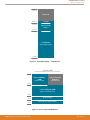
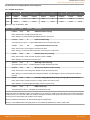
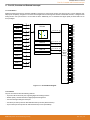
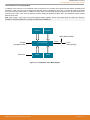
Core / Memory
Clock Management
CIP-51 8051 Core
(48 MHz)
Flash Program
Memory
RAM Memory
(up to 4352 bytes)
(up to 64 KB)
External
Oscillator
Debug Interface
with C2
Energy Management
High Frequency
48 MHz RC
Oscillator
Low Frequency
RC Oscillator
Internal LDO
Regulator
Power-On Reset
Brown-Out
Detector
5 V-to 3.3 V LDO
Regulator
8-bit SFR bus
Serial Interfaces
2 x UART
SPI
2 x I2C /
SMBus
USB
I/O Ports
External
Interrupts
Pin Reset
General Purpose I/O
Timers and Triggers
6 x Timers
PCA/PWM
Watchdog Timer
Analog Interfaces
ADC
Comparator 0
Comparator 1
Internal
Voltage
Reference
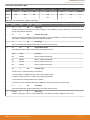
Lowest power mode with peripheral operational:
Normal
Idle
Suspend
silabs.com | Smart. Connected. Energy-friendly.
Shutdown
Rev. 0.2
EFM8UB2 Reference Manual
System Overview
1. System Overview
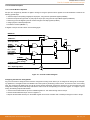
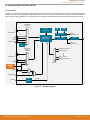
1.1 Introduction
C2D
Port I/O Configuration
Debug / Programming
Hardware
C2CK/RSTb
Digital Peripherals
Reset
Power-On
Reset
Supply
Monitor
VDD
VREGIN
Power
Net
Voltage
Regulators
UART0
CIP-51 8051 Controller
Core
Timers 0, 1,
2, 3, 4, 5
Priority
Crossbar
Decoder
PCA/WDT
SMBus 0
256 Byte RAM
SMBus 1
Crossbar Control
SFR
Bus
External Memory
Interface
External Oscillator
P1
Control
Low Freq.
Oscillator
VBUS
Full / Low
Speed
Transceiver
P2.n
Port 3
Drivers
P3.n
Port 4
Drivers
P4.n
Analog Peripherals
VREF
VDD
VREF
+
-+
Comparators
Controller
1 KB RAM
10-bit
500ksps
ADC
AMUX
D+
D-
Port 2
Drivers
P4
Data
USB Peripheral
P1.n
P2 / P3
Address
Internal Oscillator
Clock
Recovery
Port 1
Drivers
SPI
4/2 KB XRAM
GND
XTAL1
XTAL2
P0.n
UART1
64/32 KB ISP Flash
Program Memory
System Clock Setup
Port 0
Drivers
VDD
Temp
Sensor
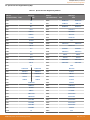
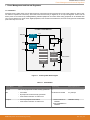
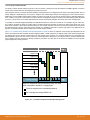
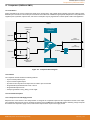
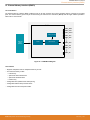
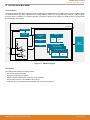
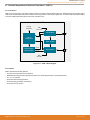
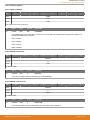
Figure 1.1. Detailed EFM8UB2 Block Diagram
silabs.com | Smart. Connected. Energy-friendly.
Rev. 0.2 | 1
EFM8UB2 Reference Manual
System Overview
1.2 Power
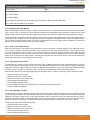
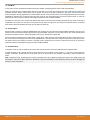
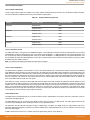
All internal circuitry draws power from the VDD supply pin. External I/O pins are powered from the VIO supply voltage (or VDD on devices without a separate VIO connection), while most of the internal circuitry is supplied by an on-chip LDO regulator. Control over the
device power can be achieved by enabling/disabling individual peripherals as needed. Each analog peripheral can be disabled when
not in use and placed in low power mode. Digital peripherals, such as timers and serial buses, have their clocks gated off and draw little
power when they are not in use.
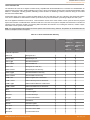
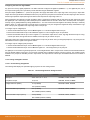
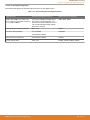
Table 1.1. Power Modes
Power Mode
Details
Mode Entry
Wake-Up Sources
Normal
Core and all peripherals clocked and fully operational
—
—
Set IDLE bit in PCON0
Any interrupt
Idle
• Core halted
• All peripherals clocked and fully operational
• Code resumes execution on wake event
Suspend
• Core and peripheral clocks halted
• Code resumes execution on wake event
1. Switch SYSCLK to
HFOSC0
2. Set SUSPEND bit in
HFO0CN
Shutdown
•
•
•
•
1. Set STOPCF bit in
REG01CN
2. Set STOP bit in
PCON0
All internal power nets shut down
5V regulator remains active (if enabled)
Pins retain state
Exit on pin or power-on reset
USB0 Bus Activity
• RSTb pin reset
• Power-on reset
1.3 I/O
Digital and analog resources are externally available on the device’s multi-purpose I/O pins. Port pins P0.0-P3.7 can be defined as general-purpose I/O (GPIO), assigned to one of the internal digital resources through the crossbar or dedicated channels, or assigned to an
analog function. Port pins P4.0-P4.7 can be used as GPIO. Additionally, the C2 Interface Data signal (C2D) is shared with P3.0 on
some packages.
• Up to 40 multi-functions I/O pins, supporting digital and analog functions.
• Flexible priority crossbar decoder for digital peripheral assignment.
• Two direct-pin interrupt sources with dedicated interrupt vectors (INT0 and INT1) available on P0 pins.
1.4 Clocking
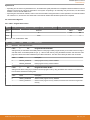
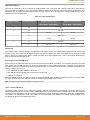
The CPU core and peripheral subsystem may be clocked by both internal and external oscillator resources. By default, the system
clock comes up running from the 48 MHz oscillator divided by 4, then divided by 8 (1.5 MHz).
• Provides clock to core and peripherals.
• 48 MHz internal oscillator (HFOSC0), accurate to ±1.5% over supply and temperature corners: accurate to +/- 0.25% when using
USB clock recovery.
• 80 kHz low-frequency oscillator (LFOSC0).
• External RC, C, CMOS, and high-frequency crystal clock options (EXTCLK) for QFP48 packages.
• External CMOS clock option (EXTCLK) for QFP32 and QFN32 packages.
• Internal oscillator has clock divider with eight settings for flexible clock scaling: 1, 2, 4, or 8.
silabs.com | Smart. Connected. Energy-friendly.
Rev. 0.2 | 2
EFM8UB2 Reference Manual
System Overview
1.5 Counters/Timers and PWM
Programmable Counter Array (PCA0)
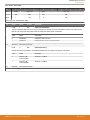
The programmable counter array (PCA) provides multiple channels of enhanced timer and PWM functionality while requiring less CPU
intervention than standard counter/timers. The PCA consists of a dedicated 16-bit counter/timer and one 16-bit capture/compare module for each channel. The counter/timer is driven by a programmable timebase that has flexible external and internal clocking options.
Each capture/compare module may be configured to operate independently in one of five modes: Edge-Triggered Capture, Software
Timer, High-Speed Output, Frequency Output, or Pulse-Width Modulated (PWM) Output. Each capture/compare module has its own
associated I/O line (CEXn) which is routed through the crossbar to port I/O when enabled.
•
•
•
•
•
•
•
•
•
16-bit time base.
Programmable clock divisor and clock source selection.
Up to five independently-configurable channels
8- or 16-bit PWM modes (edge-aligned operation).
Frequency output mode.
Capture on rising, falling or any edge.
Compare function for arbitrary waveform generation.
Software timer (internal compare) mode.
Integrated watchdog timer.
Timers (Timer 0, Timer 1, Timer 2, Timer 3, Timer 4, and Timer 5)
Several counter/timers are included in the device: two are 16-bit counter/timers compatible with those found in the standard 8051, and
the rest are 16-bit auto-reload timers for timing peripherals or for general purpose use. These timers can be used to measure time intervals, count external events and generate periodic interrupt requests. Timer 0 and Timer 1 are nearly identical and have four primary
modes of operation. The other timers offer both 16-bit and split 8-bit timer functionality with auto-reload and capture capabilities.
Timer 0 and Timer 1 include the following features:
• Standard 8051 timers, supporting backwards-compatibility with firmware and hardware.
• Clock sources include SYSCLK, SYSCLK divided by 12, 4, or 48, the External Clock divided by 8, or an external pin.
• 8-bit auto-reload counter/timer mode
• 13-bit counter/timer mode
• 16-bit counter/timer mode
• Dual 8-bit counter/timer mode (Timer 0)
Timer 2, Timer 3, Timer 4, and Timer 5 are 16-bit timers including the following features:
• Clock sources include SYSCLK, SYSCLK divided by 12, or the External Clock divided by 8.
• 16-bit auto-reload timer mode
• Dual 8-bit auto-reload timer mode
• USB start-of-frame or falling edge of LFOSC0 capture (Timer 2 and Timer 3)
Watchdog Timer (WDT0)
The device includes a programmable watchdog timer (WDT) integrated within the PCA0 peripheral. A WDT overflow forces the MCU
into the reset state. To prevent the reset, the WDT must be restarted by application software before overflow. If the system experiences
a software or hardware malfunction preventing the software from restarting the WDT, the WDT overflows and causes a reset. Following
a reset, the WDT is automatically enabled and running with the default maximum time interval. If needed, the WDT can be disabled by
system software. The state of the RSTb pin is unaffected by this reset.
The Watchdog Timer integrated in the PCA0 peripheral has the following features:
• Programmable timeout interval
• Runs from the selected PCA clock source
• Automatically enabled after any system reset
silabs.com | Smart. Connected. Energy-friendly.
Rev. 0.2 | 3
EFM8UB2 Reference Manual
System Overview
1.6 Communications and Other Digital Peripherals
Universal Serial Bus (USB0)
The USB0 module provides Full/Low Speed function for USB peripheral implementations. The USB function controller (USB0) consists
of a Serial Interface Engine (SIE), USB transceiver (including matching resistors and configurable pull-up resistors), 1 KB FIFO block,
and clock recovery mechanism for crystal-less operation. No external components are required. The USB0 module is Universal Serial
Bus Specification 2.0 compliant.
The USB0 module includes the following features:
• Full and Low Speed functionality.
• Implements 4 bidirectional endpoints.
• USB 2.0 compliant USB peripheral support (no host capability).
• Direct module access to 1 KB of RAM for FIFO memory.
• Clock recovery to meet USB clocking requirements with no external components.
Universal Asynchronous Receiver/Transmitter (UART0)
UART0 is an asynchronous, full duplex serial port offering modes 1 and 3 of the standard 8051 UART. Enhanced baud rate support
allows a wide range of clock sources to generate standard baud rates. Received data buffering allows UART0 to start reception of a
second incoming data byte before software has finished reading the previous data byte.
The UART module provides the following features:
• Asynchronous transmissions and receptions
• Baud rates up to SYSCLK/2 (transmit) or SYSCLK/8 (receive)
• 8- or 9-bit data
• Automatic start and stop generation
Universal Asynchronous Receiver/Transmitter (UART1)
UART1 is an asynchronous, full duplex serial port offering a variety of data formatting options. A dedicated baud rate generator with a
16-bit timer and selectable prescaler is included, which can generate a wide range of baud rates. A received data FIFO allows UART1
to receive multiple bytes before data is lost and an overflow occurs.
UART1 provides the following features:
• Asynchronous transmissions and receptions.
• Dedicated baud rate generator supports baud rates up to SYSCLK/2 (transmit) or SYSCLK/8 (receive)
• 5, 6, 7, 8, or 9 bit data.
• Automatic start and stop generation.
• Automatic parity generation and checking.
• Three byte FIFO on receive.
Serial Peripheral Interface (SPI0)
The serial peripheral interface (SPI) module provides access to a flexible, full-duplex synchronous serial bus. The SPI can operate as a
master or slave device in both 3-wire or 4-wire modes, and supports multiple masters and slaves on a single SPI bus. The slave-select
(NSS) signal can be configured as an input to select the SPI in slave mode, or to disable master mode operation in a multi-master
environment, avoiding contention on the SPI bus when more than one master attempts simultaneous data transfers. NSS can also be
configured as a firmware-controlled chip-select output in master mode, or disabled to reduce the number of pins required. Additional
general purpose port I/O pins can be used to select multiple slave devices in master mode.
The SPI module includes the following features:
• Supports 3- or 4-wire operation in master or slave modes.
• Supports external clock frequencies up to SYSCLK / 2 in master mode and SYSCLK / 10 in slave mode.
• Support for four clock phase and polarity options.
• 8-bit dedicated clock clock rate generator.
• Support for multiple masters on the same data lines.
silabs.com | Smart. Connected. Energy-friendly.
Rev. 0.2 | 4
EFM8UB2 Reference Manual
System Overview
System Management Bus / I2C (SMB0 and SMB1)
The SMBus I/O interface is a two-wire, bi-directional serial bus. The SMBus is compliant with the System Management Bus Specification, version 1.1, and compatible with the I2C serial bus.
The SMBus modules include the following features:
• Standard (up to 100 kbps) and Fast (400 kbps) transfer speeds.
• Support for master, slave, and multi-master modes.
• Hardware synchronization and arbitration for multi-master mode.
• Clock low extending (clock stretching) to interface with faster masters.
• Hardware support for 7-bit slave and general call address recognition.
• Firmware support for 10-bit slave address decoding.
• Ability to inhibit all slave states.
• Programmable data setup/hold times.
External Memory Interface (EMIF0)
The External Memory Interface (EMIF) enables access of off-chip memories and memory-mapped devices connected to the GPIO
ports. The external memory space may be accessed using the external move instruction (MOVX) with the target address specified in
either 8-bit or 16-bit formats.
• Supports multiplexed and non-multiplexed memory access.
• Four external memory modes:
• Internal only.
• Split mode without bank select.
• Split mode with bank select.
• External only
• Configurable ALE (address latch enable) timing.
• Configurable address setup and hold times.
• Configurable write and read pulse widths.
1.7 Analog
10-Bit Analog-to-Digital Converter (ADC0)
The ADC is a successive-approximation-register (SAR) ADC with 10-bit mode, integrated track-and hold and a programmable window
detector. The ADC is fully configurable under software control via several registers. The ADC may be configured to measure different
signals using the analog multiplexer. The voltage reference for the ADC is selectable between internal and external reference sources.
The ADC module is a Successive Approximation Register (SAR) Analog to Digital Converter (ADC). The key features of this ADC module are:
• Up to 32 external inputs.
• Differential or Single-ended 10-bit operation.
• Supports an output update rate of 500 ksps samples per second.
• Asynchronous hardware conversion trigger, selectable between software, external I/O and internal timer sources.
• Output data window comparator allows automatic range checking.
• Two tracking mode options with programmable tracking time.
• Conversion complete and window compare interrupts supported.
• Flexible output data formatting.
• Voltage reference selectable from external reference pin, on-chip precision reference (driven externally on reference pin), or VDD
supply.
• Integrated temperature sensor.
silabs.com | Smart. Connected. Energy-friendly.
Rev. 0.2 | 5
EFM8UB2 Reference Manual
System Overview
Low Current Comparators (CMP0, CMP1)
Analog comparators are used to compare the voltage of two analog inputs, with a digital output indicating which input voltage is higher.
External input connections to device I/O pins and internal connections are available through separate multiplexers on the positive and
negative inputs. Hysteresis, response time, and current consumption may be programmed to suit the specific needs of the application.
The comparator module includes the following features:
• Up to 5 external positive inputs.
• Up to 5 external negative inputs.
• Synchronous and asynchronous outputs can be routed to pins via crossbar.
• Programmable hysteresis between 0 and +/-20 mV.
• Programmable response time.
• Interrupts generated on rising, falling, or both edges.
1.8 Reset Sources
Reset circuitry allows the controller to be easily placed in a predefined default condition. On entry to this reset state, the following occur:
• The core halts program execution.
• Module registers are initialized to their defined reset values unless the bits reset only with a power-on reset.
• External port pins are forced to a known state.
• Interrupts and timers are disabled.
All registers are reset to the predefined values noted in the register descriptions unless the bits only reset with a power-on reset. The
contents of RAM are unaffected during a reset; any previously stored data is preserved as long as power is not lost. The Port I/O latches are reset to 1 in open-drain mode. Weak pullups are enabled during and after the reset. For Supply Monitor and power-on resets,
the RSTb pin is driven low until the device exits the reset state. On exit from the reset state, the program counter (PC) is reset, and the
system clock defaults to an internal oscillator. The Watchdog Timer is enabled, and program execution begins at location 0x0000.
Reset sources on the device include:
• Power-on reset
• External reset pin
• Comparator reset
• Software-triggered reset
• Supply monitor reset (monitors VDD supply)
• Watchdog timer reset
• Missing clock detector reset
• Flash error reset
• USB reset
1.9 Debugging
The EFM8UB2 devices include an on-chip Silicon Labs 2-Wire (C2) debug interface to allow flash programming and in-system debugging with the production part installed in the end application. The C2 interface uses a clock signal (C2CK) and a bi-directional C2 data
signal (C2D) to transfer information between the device and a host system. See the C2 Interface Specification for details on the C2
protocol.
1.10 Bootloader
All devices come pre-programmed with a USB bootloader. This bootloader resides in flash and can be erased if it is not needed.
silabs.com | Smart. Connected. Energy-friendly.
Rev. 0.2 | 6
EFM8UB2 Reference Manual
Memory Organization
2. Memory Organization
2.1 Memory Organization
The memory organization of the CIP-51 System Controller is similar to that of a standard 8051. There are two separate memory
spaces: program memory and data memory. Program and data memory share the same address space but are accessed via different
instruction types. Program memory consists of a non-volatile storage area that may be used for either program code or non-volatile
data storage. The data memory, consisting of "internal" and "external" data space, is implemented as RAM, and may be used only for
data storage. Program execution is not supported from the data memory space.
2.2 Program Memory
The CIP-51 core has a 64 KB program memory space. The product family implements some of this program memory space as in-system, re-programmable flash memory. Flash security is implemented by a user-programmable location in the flash block and provides
read, write, and erase protection. All addresses not specified in the device memory map are reserved and may not be used for code or
data storage.
MOVX Instruction and Program Memory
The MOVX instruction in an 8051 device is typically used to access external data memory. On the devices, the MOVX instruction is
normally used to read and write on-chip XRAM, but can be re-configured to write and erase on-chip flash memory space. MOVC instructions are always used to read flash memory, while MOVX write instructions are used to erase and write flash. This flash access
feature provides a mechanism for the product to update program code and use the program memory space for non-volatile data storage.
2.3 Data Memory
The RAM space on the chip includes both an "internal" RAM area which is accessed with MOV instructions, and an on-chip "external"
RAM area which is accessed using MOVX instructions. Total RAM varies, based on the specific device. The device memory map has
more details about the specific amount of RAM available in each area for the different device variants.
Internal RAM
There are 256 bytes of internal RAM mapped into the data memory space from 0x00 through 0xFF. The lower 128 bytes of data memory are used for general purpose registers and scratch pad memory. Either direct or indirect addressing may be used to access the lower
128 bytes of data memory. Locations 0x00 through 0x1F are addressable as four banks of general purpose registers, each bank consisting of eight byte-wide registers. The next 16 bytes, locations 0x20 through 0x2F, may either be addressed as bytes or as 128 bit
locations accessible with the direct addressing mode.
The upper 128 bytes of data memory are accessible only by indirect addressing. This region occupies the same address space as the
Special Function Registers (SFR) but is physically separate from the SFR space. The addressing mode used by an instruction when
accessing locations above 0x7F determines whether the CPU accesses the upper 128 bytes of data memory space or the SFRs. Instructions that use direct addressing will access the SFR space. Instructions using indirect addressing above 0x7F access the upper
128 bytes of data memory.
General Purpose Registers
The lower 32 bytes of data memory, locations 0x00 through 0x1F, may be addressed as four banks of general-purpose registers. Each
bank consists of eight byte-wide registers designated R0 through R7. Only one of these banks may be enabled at a time. Two bits in
the program status word (PSW) register, RS0 and RS1, select the active register bank. This allows fast context switching when entering
subroutines and interrupt service routines. Indirect addressing modes use registers R0 and R1 as index registers.
silabs.com | Smart. Connected. Energy-friendly.
Rev. 0.2 | 7
EFM8UB2 Reference Manual
Memory Organization
Bit Addressable Locations
In addition to direct access to data memory organized as bytes, the sixteen data memory locations at 0x20 through 0x2F are also accessible as 128 individually addressable bits. Each bit has a bit address from 0x00 to 0x7F. Bit 0 of the byte at 0x20 has bit address
0x00 while bit 7 of the byte at 0x20 has bit address 0x07. Bit 7 of the byte at 0x2F has bit address 0x7F. A bit access is distinguished
from a full byte access by the type of instruction used (bit source or destination operands as opposed to a byte source or destination).
The MCS-51™ assembly language allows an alternate notation for bit addressing of the form XX.B where XX is the byte address and B
is the bit position within the byte. For example, the instruction:
Mov
C, 22.3h
moves the Boolean value at 0x13 (bit 3 of the byte at location 0x22) into the Carry flag.
Stack
A programmer's stack can be located anywhere in the 256-byte data memory. The stack area is designated using the Stack Pointer
(SP) SFR. The SP will point to the last location used. The next value pushed on the stack is placed at SP+1 and then SP is incremented. A reset initializes the stack pointer to location 0x07. Therefore, the first value pushed on the stack is placed at location 0x08, which
is also the first register (R0) of register bank 1. Thus, if more than one register bank is to be used, the SP should be initialized to a
location in the data memory not being used for data storage. The stack depth can extend up to 256 bytes.
External RAM
On devices with more than 256 bytes of on-chip RAM, the additional RAM is mapped into the external data memory space (XRAM).
Addresses in XRAM area accessed using the external move (MOVX) instructions.
Note: The 16-bit MOVX write instruction is also used for writing and erasing the flash memory. More details may be found in the flash
memory section.
silabs.com | Smart. Connected. Energy-friendly.
Rev. 0.2 | 8
EFM8UB2 Reference Manual
Memory Organization
2.4 Memory Map
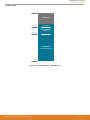
0xFFFF
Reserved
0xFBFF
0xFBFE
Lock Byte
Security Page
512 Bytes
0xFA00
63 KB Flash
(126 x 512 Byte pages)
0x0000
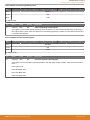
Figure 2.1. Flash Memory Map — 64 KB Devices
silabs.com | Smart. Connected. Energy-friendly.
Rev. 0.2 | 9
EFM8UB2 Reference Manual
Memory Organization
0xFFFF
Reserved
0x7FFF
0x7FFE
Lock Byte
Security Page
512 Bytes
0x7E00
32 KB Flash
(64 x 512 Byte pages)
0x0000
Figure 2.2. Flash Memory Map — 32 KB Devices
On-Chip RAM
Accessed with MOV Instructions as Indicated
0xFF
Upper 128 Bytes
RAM
Special Function
Registers
(Indirect Access)
(Direct Access)
0x80
0x7F
Lower 128 Bytes RAM
(Direct or Indirect Access)
0x30
0x2F
0x20
0x1F
0x00
Bit-Addressable
General-Purpose Register Banks
Figure 2.3. Direct / Indirect RAM Memory
silabs.com | Smart. Connected. Energy-friendly.
Rev. 0.2 | 10
EFM8UB2 Reference Manual
Memory Organization
On-Chip XRAM
Accessed with MOVX Instructions
0xFFFF
Shadow XRAM
Duplicates 0x0000-0x0FFF
On 4096 B boundaries
0x1000
0x0FFF
XRAM
4096 Bytes
USB FIFO XRAM
1024 Bytes
(USBCLK Domain)
0x07FF
0x0400
0x0000
Figure 2.4. XRAM Memory
silabs.com | Smart. Connected. Energy-friendly.
Rev. 0.2 | 11
EFM8UB2 Reference Manual
Special Function Registers
3. Special Function Registers
3.1 Special Function Register Access
The direct-access data memory locations from 0x80 to 0xFF constitute the special function registers (SFRs). The SFRs provide control
and data exchange with the CIP-51's resources and peripherals. The CIP-51 duplicates the SFRs found in a typical 8051 implementation as well as implementing additional SFRs used to configure and access the sub-systems unique to the MCU. This allows the addition of new functionality while retaining compatibility with the MCS-51 ™ instruction set.
The SFR registers are accessed anytime the direct addressing mode is used to access memory locations from 0x80 to 0xFF. SFRs
with addresses ending in 0x0 or 0x8 (e.g., P0, TCON, SCON0, IE, etc.) are bit-addressable as well as byte-addressable. All other SFRs
are byte-addressable only. Unoccupied addresses in the SFR space are reserved for future use. Accessing these areas will have an
indeterminate effect and should be avoided.
SFR Paging
The CIP-51 features SFR paging, allowing the device to map many SFRs into the 0x80 to 0xFF memory address space. The SFR
memory space has 256 pages. In this way, each memory location from 0x80 to 0xFF can access up to 256 SFRs. The EFM8UB2
devices utilize multiple SFR pages. All of the common 8051 SFRs are available on all pages. Certain SFRs are only available on a
subset of pages. SFR pages are selected using the SFRPAGE register. The procedure for reading and writing an SFR is as follows:
1. Select the appropriate SFR page using the SFRPAGE register.
2. Use direct accessing mode to read or write the special function register (MOV instruction).
The SFRPAGE register only needs to be changed in the case that the SFR to be accessed does not exist on the currently-selected
page. See the SFR memory map for details on the locations of each SFR. It is good practice inside of interrupt service routines to save
the current SFRPAGE at the beginning of the ISR and restore this value at the end.
Interrupts and SFR Paging
In any system which changes the SFRPAGE while interrupts are active, it is good practice to save the current SFRPAGE value upon
ISR entry, and then restore the SFRPAGE before exiting the ISR. This ensures that SFRPAGE will remain at the desired setting when
returning from the ISR.
silabs.com | Smart. Connected. Energy-friendly.
Rev. 0.2 | 12
EFM8UB2 Reference Manual
Special Function Registers
3.2 Special Function Register Memory Map
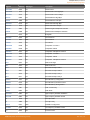
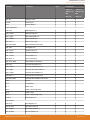
Table 3.1. Special Function Registers by Address
Address
(*bit-addressable)
SFR Page
0x00
Address
0x0F
(*bit-addressable)
SFR Page
0x00
0x0F
0x80*
P0
0xC0*
SMB0CN0
SMB1CN0
0x81
SP
0xC1
SMB0CF
SMB1CF
0x82
DPL
0xC2
SMB0DAT
SMB1DAT
0x83
DPH
0xC3
ADC0GTL
0x84
EMI0TC
0xC4
ADC0GTH
0x85
EMI0CF
0xC5
ADC0LTL
0x86
LFO0CN
0xC6
ADC0LTH
0x87
PCON0
0xC7
P4
0x88*
TCON
0xC8*
0x89
TMOD
0xC9
0x8A
TL0
0xCA
TMR2RLL
TMR5RLL
0x8B
TL1
0xCB
TMR2RLH
TMR5RLH
0x8C
TH0
0xCC
TMR2L
TMR5L
0x8D
TH1
0xCD
TMR2H
TMR5H
0x8E
CKCON0
0xCE
SMB0ADM
SMB1ADM
0x8F
PSCTL
0xCF
SMB0ADR
SMB1ADR
0x90*
P1
0xD0*
PSW
TMR2CN0
TMR5CN0
REG01CN
0x91
TMR3CN0
TMR4CN0
0xD1
REF0CN
0x92
TMR3RLL
TMR4RLL
0xD2
SCON1
0x93
TMR3RLH
TMR4RLH
0xD3
SBUF1
0x94
TMR3L
TMR4L
0xD4
P0SKIP
0x95
TMR3H
TMR4H
0xD5
P1SKIP
0x96
USB0ADR
0xD6
P2SKIP
0x97
USB0DAT
0xD7
USB0XCN
0x98*
SCON0
0xD8*
PCA0CN0
0x99
SBUF0
0xD9
PCA0MD
0x9A
CMP1CN0
0xDA
PCA0CPM0
0x9B
CMP0CN0
0xDB
PCA0CPM1
0x9C
CMP1MD
0xDC
PCA0CPM2
0x9D
CMP0MD
0xDD
PCA0CPM3
0x9E
CMP1MX
0xDE
PCA0CPM4
0x9F
CMP0MX
0xDF
P3SKIP
0xA0*
P2
0xE0*
ACC
silabs.com | Smart. Connected. Energy-friendly.
Rev. 0.2 | 13
EFM8UB2 Reference Manual
Special Function Registers
Address
(*bit-addressable)
SFR Page
0x00
Address
0x0F
(*bit-addressable)
SFR Page
0x00
0x0F
0xA1
SPI0CFG
0xE1
XBR0
0xA2
SPI0CKR
0xE2
XBR1
0xA3
SPI0DAT
0xE3
XBR2
0xA4
P0MDOUT
0xE4
0xA5
P1MDOUT
0xE5
SMOD1
0xA6
P2MDOUT
0xE6
EIE1
0xA7
P3MDOUT
0xE7
EIE2
0xA8*
IE
0xE8*
ADC0CN0
0xA9
CLKSEL
0xE9
PCA0CPL1
0xAA
EMI0CN
0xEA
PCA0CPH1
0xAB
-
0xEB
PCA0CPL2
0xAC
SBCON1
0xEC
PCA0CPH2
0xAD
-
0xED
PCA0CPL3
0xAE
P4MDOUT
0xEE
PCA0CPH3
0xAF
PFE0CN
0xEF
RSTSRC
0xB0*
P3
0xF0*
B
0xB1
XOSC0CN
0xF1
P0MDIN
0xB2
HFO0CN
0xF2
P1MDIN
0xB3
HFO0CAL
0xF3
P2MDIN
0xB4
SBRLL1
0xF4
P3MDIN
0xB5
SBRLH1
0xF5
P4MDIN
0xB6
FLSCL
0xF6
EIP1
0xB7
FLKEY
0xF7
EIP2
0xB8*
IP
0xF8*
SPI0CN0
0xF9
PCA0L
0xB9
-
SMBTC
IT01CF
CKCON1
0xBA
AMX0N
0xFA
PCA0H
0xBB
AMX0P
0xFB
PCA0CPL0
0xBC
ADC0CF
0xFC
PCA0CPH0
0xBD
ADC0L
0xFD
PCA0CPL4
0xBE
ADC0H
0xFE
PCA0CPH4
0xBF
SFRPAGE
0xFF
VDM0CN
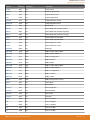
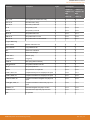
Table 3.2. Special Function Registers by Name
Register
Address SFR Pages
Description
ACC
0xE0
ALL
Accumulator
ADC0CF
0xBC
ALL
ADC0 Configuration
silabs.com | Smart. Connected. Energy-friendly.
Rev. 0.2 | 14
EFM8UB2 Reference Manual
Special Function Registers
Register
Address SFR Pages
Description
ADC0CN0
0xE8
ALL
ADC0 Control
ADC0GTH
0xC4
ALL
ADC0 Greater-Than High Byte
ADC0GTL
0xC3
ALL
ADC0 Greater-Than Low Byte
ADC0H
0xBE
ALL
ADC0 Data Word High Byte
ADC0L
0xBD
ALL
ADC0 Data Word Low Byte
ADC0LTH
0xC6
ALL
ADC0 Less-Than High Byte
ADC0LTL
0xC5
ALL
ADC0 Less-Than Low Byte
AMX0N
0xBA
ALL
AMUX0 Negative Multiplexer Selection
AMX0P
0xBB
ALL
AMUX0 Positive Multiplexer Selection
B
0xF0
ALL
B Register
CKCON0
0x8E
ALL
Clock Control 0
CKCON1
0xE4
0x0F
Clock Control 1
CLKSEL
0xA9
ALL
Clock Select
CMP0CN0
0x9B
ALL
Comparator 0 Control 0
CMP0MD
0x9D
ALL
Comparator 0 Mode
CMP0MX
0x9F
ALL
Comparator 0 Multiplexer Selection
CMP1CN0
0x9A
ALL
Comparator 1 Control 0
CMP1MD
0x9C
ALL
Comparator 1 Mode
CMP1MX
0x9E
ALL
Comparator 1 Multiplexer Selection
DPH
0x83
ALL
Data Pointer High
DPL
0x82
ALL
Data Pointer Low
EIE1
0xE6
ALL
Extended Interrupt Enable 1
EIE2
0xE7
ALL
Extended Interrupt Enable 2
EIP1
0xF6
ALL
Extended Interrupt Priority 1
EIP2
0xF7
ALL
Extended Interrupt Priority 2
EMI0CF
0x85
ALL
External Memory Configuration
EMI0CN
0xAA
ALL
External Memory Interface Control
EMI0TC
0x84
ALL
External Memory Timing Control
FLKEY
0xB7
ALL
Flash Lock and Key
FLSCL
0xB6
ALL
Flash Scale
HFO0CAL
0xB3
ALL
High Frequency Oscillator Calibration
HFO0CN
0xB2
ALL
High Frequency Oscillator Control
IE
0xA8
ALL
Interrupt Enable
IP
0xB8
ALL
Interrupt Priority
IT01CF
0xE4
0x00
INT0/INT1 Configuration
LFO0CN
0x86
ALL
Low Frequency Oscillator Control
P0
0x80
ALL
Port 0 Pin Latch
silabs.com | Smart. Connected. Energy-friendly.
Rev. 0.2 | 15
EFM8UB2 Reference Manual
Special Function Registers
Register
Address SFR Pages
Description
P0MDIN
0xF1
ALL
Port 0 Input Mode
P0MDOUT
0xA4
ALL
Port 0 Output Mode
P0SKIP
0xD4
ALL
Port 0 Skip
P1
0x90
ALL
Port 1 Pin Latch
P1MDIN
0xF2
ALL
Port 1 Input Mode
P1MDOUT
0xA5
ALL
Port 1 Output Mode
P1SKIP
0xD5
ALL
Port 1 Skip
P2
0xA0
ALL
Port 2 Pin Latch
P2MDIN
0xF3
ALL
Port 2 Input Mode
P2MDOUT
0xA6
ALL
Port 2 Output Mode
P2SKIP
0xD6
ALL
Port 2 Skip
P3
0xB0
ALL
Port 3 Pin Latch
P3MDIN
0xF4
ALL
Port 3 Input Mode
P3MDOUT
0xA7
ALL
Port 3 Output Mode
P3SKIP
0xDF
ALL
Port 3 Skip
P4
0xC7
ALL
Port 4 Pin Latch
P4MDIN
0xF5
ALL
Port 4 Input Mode
P4MDOUT
0xAE
ALL
Port 4 Output Mode
PCA0CN0
0xD8
ALL
PCA Control 0
PCA0CPH0
0xFC
ALL
PCA Channel 0 Capture Module High Byte
PCA0CPH1
0xEA
ALL
PCA Channel 1 Capture Module High Byte
PCA0CPH2
0xEC
ALL
PCA Channel 2 Capture Module High Byte
PCA0CPH3
0xEE
ALL
PCA Channel 3 Capture Module High Byte
PCA0CPH4
0xFE
ALL
PCA Channel 4 Capture Module High Byte
PCA0CPL0
0xFB
ALL
PCA Channel 0 Capture Module Low Byte
PCA0CPL1
0xE9
ALL
PCA Channel 1 Capture Module Low Byte
PCA0CPL2
0xEB
ALL
PCA Channel 2 Capture Module Low Byte
PCA0CPL3
0xED
ALL
PCA Channel 3 Capture Module Low Byte
PCA0CPL4
0xFD
ALL
PCA Channel 4 Capture Module Low Byte
PCA0CPM0
0xDA
ALL
PCA Channel 0 Capture/Compare Mode
PCA0CPM1
0xDB
ALL
PCA Channel 1 Capture/Compare Mode
PCA0CPM2
0xDC
ALL
PCA Channel 2 Capture/Compare Mode
PCA0CPM3
0xDD
ALL
PCA Channel 3 Capture/Compare Mode
PCA0CPM4
0xDE
ALL
PCA Channel 4 Capture/Compare Mode
PCA0H
0xFA
ALL
PCA Counter/Timer High Byte
PCA0L
0xF9
ALL
PCA Counter/Timer Low Byte
PCA0MD
0xD9
ALL
PCA Mode
silabs.com | Smart. Connected. Energy-friendly.
Rev. 0.2 | 16
EFM8UB2 Reference Manual
Special Function Registers
Register
Address SFR Pages
Description
PCON0
0x87
ALL
Power Control
PFE0CN
0xAF
ALL
Prefetch Engine Control
PSCTL
0x8F
ALL
Program Store Control
PSW
0xD0
ALL
Program Status Word
REF0CN
0xD1
ALL
Voltage Reference Control
REG01CN
0xC9
ALL
Voltage Regulator Control
RSTSRC
0xEF
ALL
Reset Source
SBCON1
0xAC
ALL
UART1 Baud Rate Generator Control
SBRLH1
0xB5
ALL
UART1 Baud Rate Generator High Byte
SBRLL1
0xB4
ALL
UART1 Baud Rate Generator Low Byte
SBUF0
0x99
ALL
UART0 Serial Port Data Buffer
SBUF1
0xD3
ALL
UART1 Serial Port Data Buffer
SCON0
0x98
ALL
UART0 Serial Port Control
SCON1
0xD2
ALL
UART1 Serial Port Control
SFRPAGE
0xBF
ALL
SFR Page
SMB0ADM
0xCE
0x00
SMBus 0 Slave Address Mask
SMB0ADR
0xCF
0x00
SMBus 0 Slave Address
SMB0CF
0xC1
0x00
SMBus 0 Configuration
SMB0CN0
0xC0
0x00
SMBus 0 Control
SMB0DAT
0xC2
0x00
SMBus 0 Data
SMB1ADM
0xCE
0x0F
SMBus 1 Slave Address Mask
SMB1ADR
0xCF
0x0F
SMBus 1 Slave Address
SMB1CF
0xC1
0x0F
SMBus 1 Configuration
SMB1CN0
0xC0
0x0F
SMBus 1 Control
SMB1DAT
0xC2
0x0F
SMBus 1 Data
SMBTC
0xB9
0x0F
SMBus Timing and Pin Control
SMOD1
0xE5
ALL
UART1 Mode
SP
0x81
ALL
Stack Pointer
SPI0CFG
0xA1
ALL
SPI0 Configuration
SPI0CKR
0xA2
ALL
SPI0 Clock Rate
SPI0CN0
0xF8
ALL
SPI0 Control
SPI0DAT
0xA3
ALL
SPI0 Data
TCON
0x88
ALL
Timer 0/1 Control
TH0
0x8C
ALL
Timer 0 High Byte
TH1
0x8D
ALL
Timer 1 High Byte
TL0
0x8A
ALL
Timer 0 Low Byte
TL1
0x8B
ALL
Timer 1 Low Byte
silabs.com | Smart. Connected. Energy-friendly.
Rev. 0.2 | 17
EFM8UB2 Reference Manual
Special Function Registers
Register
Address SFR Pages
Description
TMOD
0x89
ALL
Timer 0/1 Mode
TMR2CN0
0xC8
0x00
Timer 2 Control 0
TMR2H
0xCD
0x00
Timer 2 High Byte
TMR2L
0xCC
0x00
Timer 2 Low Byte
TMR2RLH
0xCB
0x00
Timer 2 Reload High Byte
TMR2RLL
0xCA
0x00
Timer 2 Reload Low Byte
TMR3CN0
0x91
0x00
Timer 3 Control 0
TMR3H
0x95
0x00
Timer 3 High Byte
TMR3L
0x94
0x00
Timer 3 Low Byte
TMR3RLH
0x93
0x00
Timer 3 Reload High Byte
TMR3RLL
0x92
0x00
Timer 3 Reload Low Byte
TMR4CN0
0x91
0x0F
Timer 4 Control 0
TMR4H
0x95
0x0F
Timer 4 High Byte
TMR4L
0x94
0x0F
Timer 4 Low Byte
TMR4RLH
0x93
0x0F
Timer 4 Reload High Byte
TMR4RLL
0x92
0x0F
Timer 4 Reload Low Byte
TMR5CN0
0xC8
0x0F
Timer 5 Control 0
TMR5H
0xCD
0x0F
Timer 5 High Byte
TMR5L
0xCC
0x0F
Timer 5 Low Byte
TMR5RLH
0xCB
0x0F
Timer 5 Reload High Byte
TMR5RLL
0xCA
0x0F
Timer 5 Reload Low Byte
USB0ADR
0x96
ALL
USB0 Indirect Address
USB0DAT
0x97
ALL
USB0 Data
USB0XCN
0xD7
ALL
USB0 Transceiver Control
VDM0CN
0xFF
ALL
Supply Monitor Control
XBR0
0xE1
ALL
Port I/O Crossbar 0
XBR1
0xE2
ALL
Port I/O Crossbar 1
XBR2
0xE3
ALL
Port I/O Crossbar 2
XOSC0CN
0xB1
ALL
External Oscillator Control
silabs.com | Smart. Connected. Energy-friendly.
Rev. 0.2 | 18
EFM8UB2 Reference Manual
Special Function Registers
3.3 SFR Access Control Registers
3.3.1 SFRPAGE: SFR Page
Bit
7
6
5
4
3
Name
SFRPAGE
Access
RW
Reset
0x00
2
1
0
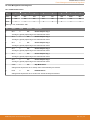
SFR Page = ALL; SFR Address: 0xBF
Bit
Name
Reset
7:0
SFRPAGE 0x00
Access
Description
RW
SFR Page.
Specifies the SFR Page used when reading, writing, or modifying special function registers.
silabs.com | Smart. Connected. Energy-friendly.
Rev. 0.2 | 19
EFM8UB2 Reference Manual
Flash Memory
4. Flash Memory
4.1 Introduction
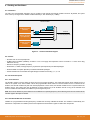
On-chip, re-programmable flash memory is included for program code and non-volatile data storage. The flash memory is organized in
512-byte pages. It can be erased and written through the C2 interface or from firmware by overloading the MOVX instruction. Any individual byte in flash memory must only be written once between page erase operations.
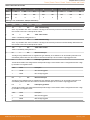
0xFFFF
Reserved
0xFBFF
0xFBFE
Lock Byte
Security Page
512 Bytes
0xFA00
63 KB Flash
(126 x 512 Byte pages)
0x0000
Figure 4.1. Flash Memory Map — 64 KB Devices
silabs.com | Smart. Connected. Energy-friendly.
Rev. 0.2 | 20
EFM8UB2 Reference Manual
Flash Memory
0xFFFF
Reserved
0x7FFF
0x7FFE
Lock Byte
Security Page
512 Bytes
0x7E00
32 KB Flash
(64 x 512 Byte pages)
0x0000
Figure 4.2. Flash Memory Map — 32 KB Devices
4.2 Features
The flash memory has the following features:
• Up to 64 KB organized in 512-byte sectors.
• In-system programmable from user firmware.
• Security lock to prevent unwanted read/write/erase access.
silabs.com | Smart. Connected. Energy-friendly.
Rev. 0.2 | 21
EFM8UB2 Reference Manual
Flash Memory
4.3 Functional Description
4.3.1 Security Options
The CIP-51 provides security options to protect the flash memory from inadvertent modification by software as well as to prevent the
viewing of proprietary program code and constants. The Program Store Write Enable (bit PSWE in register PSCTL) and the Program
Store Erase Enable (bit PSEE in register PSCTL) bits protect the flash memory from accidental modification by software. PSWE must
be explicitly set to 1 before software can modify the flash memory; both PSWE and PSEE must be set to 1 before software can erase
flash memory. Additional security features prevent proprietary program code and data constants from being read or altered across the
C2 interface.
A Security Lock Byte located in flash user space offers protection of the flash program memory from access (reads, writes, or erases)
by unprotected code or the C2 interface. See the specific device memory map for the location of the security byte. The flash security
mechanism allows the user to lock "n" flash pages, starting at page 0, where "n" is the 1s complement number represented by the
Security Lock Byte.
Note: The page containing the flash Security Lock Byte is unlocked when no other flash pages are locked (all bits of the Lock Byte are
1) and locked when any other flash pages are locked (any bit of the Lock Byte is 0).
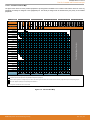
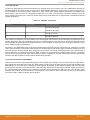
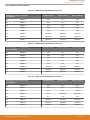
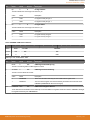
Table 4.1. Security Byte Decoding
Security Lock Byte
111111101b
1s Complement
00000010b
Flash Pages Locked
3 (First two flash pages + Lock Byte Page)
The level of flash security depends on the flash access method. The three flash access methods that can be restricted are reads,
writes, and erases from the C2 debug interface, user firmware executing on unlocked pages, and user firmware executing on locked
pages.
Table 4.2. Flash Security Summary—Firmware Permissions
Permissions according to the area firmware is executing from:
Target Area for Read / Write / Erase
Unlocked User
Page
Locked User Page
Unlocked Data
Page
Locked Data Page
Any Unlocked Page
[R] [W] [E]
[R] [W] [E]
[R] [W] [E]
[R] [W] [E]
Locked Page (except security page)
reset
[R] [W] [E]
reset
[R] [W] [E]
Locked Security Page
reset
[R] [W]
reset
[R] [W]
Reserved Area
reset
reset
reset
reset
[R] = Read permitted
[W] = Write permitted
[E] = Erase permitted
reset = Flash error reset triggered
n/a = Not applicable
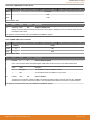
Table 4.3. Flash Security Summary—C2 Permissions
Target Area for Read / Write / Erase
Permissions from C2 interface
Any Unlocked Page
[R] [W] [E]
Any Locked Page
Device Erase Only
silabs.com | Smart. Connected. Energy-friendly.
Rev. 0.2 | 22
EFM8UB2 Reference Manual
Flash Memory
Target Area for Read / Write / Erase
Permissions from C2 interface
Reserved Area
None
[R] = Read permitted
[W] = Write permitted
[E] = Erase permitted
Device Erase Only = No read, write, or individual page erase is allowed. Must erase entire flash space.
None = Read, write and erase are not permitted
4.3.2 Programming the Flash Memory
Writes to flash memory clear bits from logic 1 to logic 0 and can be performed on single byte locations. Flash erasures set bits back to
logic 1 and occur only on full pages. The write and erase operations are automatically timed by hardware for proper execution; data
polling to determine the end of the write/erase operation is not required. Code execution is stalled during a flash write/erase operation.
The simplest means of programming the flash memory is through the C2 interface using programming tools provided by Silicon Labs or
a third party vendor. Firmware may also be loaded into the device to implement code-loader functions or allow non-volatile data storage. To ensure the integrity of flash contents, it is strongly recommended that the on-chip supply monitor be enabled in any system that
includes code that writes and/or erases flash memory from software.
4.3.2.1 Flash Lock and Key Functions
Flash writes and erases by user software are protected with a lock and key function. The FLKEY register must be written with the correct key codes, in sequence, before flash operations may be performed. The key codes are 0xA5 and 0xF1. The timing does not matter, but the codes must be written in order. If the key codes are written out of order or the wrong codes are written, flash writes and
erases will be disabled until the next system reset. Flash writes and erases will also be disabled if a flash write or erase is attempted
before the key codes have been written properly. The flash lock resets after each write or erase; the key codes must be written again
before another flash write or erase operation can be performed.
4.3.2.2 Flash Page Erase Procedure
The flash memory is erased one page at a time by firmware using the MOVX write instruction with the address targeted to any byte
within the page. Before erasing a page of flash memory, flash write and erase operations must be enabled by setting the PSWE and
PSEE bits in the PSCTL register to logic 1 (this directs the MOVX writes to target flash memory and enables page erasure) and writing
the flash key codes in sequence to the FLKEY register. The PSWE and PSEE bits remain set until cleared by firmware.
Erase operation applies to an entire page (setting all bytes in the page to 0xFF). To erase an entire page, perform the following steps:
1. Disable interrupts (recommended).
2. Write the first key code to FLKEY: 0xA5.
3. Write the second key code to FLKEY: 0xF1.
4. Set the PSEE bit (register PSCTL).
5. Set the PSWE bit (register PSCTL).
6. Using the MOVX instruction, write a data byte to any location within the page to be erased.
7. Clear the PSWE and PSEE bits.
4.3.2.3 Flash Byte Write Procedure
The flash memory is written by firmware using the MOVX write instruction with the address and data byte to be programmed provided
as normal operands in DPTR and A. Before writing to flash memory using MOVX, flash write operations must be enabled by setting the
PSWE bit in the PSCTL register to logic 1 (this directs the MOVX writes to target flash memory) and writing the flash key codes in
sequence to the FLKEY register. The PSWE bit remains set until cleared by firmware. A write to flash memory can clear bits to logic 0
but cannot set them. A byte location to be programmed should be erased (already set to 0xFF) before a new value is written.
To write a byte of flash, perform the following steps:
1. Disable interrupts (recommended).
2. Write the first key code to FLKEY: 0xA5.
3. Write the second key code to FLKEY: 0xF1.
4. Set the PSWE bit (register PSCTL).
5. Clear the PSEE bit (register PSCTL).
silabs.com | Smart. Connected. Energy-friendly.
Rev. 0.2 | 23
EFM8UB2 Reference Manual
Flash Memory
6. Using the MOVX instruction, write a single data byte to the desired location within the desired page.
7. Clear the PSWE bit.
4.3.3 Flash Write and Erase Precautions
Any system which contains routines which write or erase flash memory from software involves some risk that the write or erase routines
will execute unintentionally if the CPU is operating outside its specified operating range of supply voltage, system clock frequency or
temperature. This accidental execution of flash modifying code can result in alteration of flash memory contents causing a system failure that is only recoverable by re-flashing the code in the device.
To help prevent the accidental modification of flash by firmware, hardware restricts flash writes and erasures when the supply monitor is
not active and selected as a reset source. As the monitor is enabled and selected as a reset source by default, it is recommended that
systems writing or erasing flash simply maintain the default state.
The following sections provide general guidelines for any system which contains routines which write or erase flash from code. Additional flash recommendations and example code can be found in AN201: Writing to Flash From Firmware, available from the Silicon
Laboratories website.
Voltage Supply Maintenance and the Supply Monitor
• If the system power supply is subject to voltage or current "spikes," add sufficient transient protection devices to the power supply to
ensure that the supply voltages listed in the Absolute Maximum Ratings table are not exceeded.
• Make certain that the minimum supply rise time specification is met. If the system cannot meet this rise time specification, then add
an external supply brownout circuit to the RSTb pin of the device that holds the device in reset until the voltage supply reaches the
lower limit, and re-asserts RSTb if the supply drops below the low supply limit.
• Do not disable the supply monitor. If the supply monitor must be disabled in the system, firmware should be added to the startup
routine to enable the on-chip supply monitor and enable the supply monitor as a reset source as early in code as possible. This
should be the first set of instructions executed after the reset vector. For C-based systems, this may involve modifying the startup
code added by the C compiler. See your compiler documentation for more details. Make certain that there are no delays in software
between enabling the supply monitor and enabling the supply monitor as a reset source.
Note: The supply monitor must be enabled and enabled as a reset source when writing or erasing flash memory. A flash error reset
will occur if either condition is not met.
• As an added precaution if the supply monitor is ever disabled, explicitly enable the supply monitor and enable the supply monitor as
a reset source inside the functions that write and erase flash memory. The supply monitor enable instructions should be placed just
after the instruction to set PSWE to a 1, but before the flash write or erase operation instruction.
• Make certain that all writes to the RSTSRC (Reset Sources) register use direct assignment operators and explicitly do not use the
bit-wise operators (such as AND or OR). For example, "RSTSRC = 0x02" is correct. "RSTSRC |= 0x02" is incorrect.
• Make certain that all writes to the RSTSRC register explicitly set the PORSF bit to a 1. Areas to check are initialization code which
enables other reset sources, such as the Missing Clock Detector or Comparator, for example, and instructions which force a Software Reset. A global search on "RSTSRC" can quickly verify this.
PSWE Maintenance
• Reduce the number of places in code where the PSWE bit (in register PSCTL) is set to a 1. There should be exactly one routine in
code that sets PSWE to a 1 to write flash bytes and one routine in code that sets PSWE and PSEE both to a 1 to erase flash pages.
• Minimize the number of variable accesses while PSWE is set to a 1. Handle pointer address updates and loop variable maintenance
outside the "PSWE = 1;... PSWE = 0;" area.
• Disable interrupts prior to setting PSWE to a 1 and leave them disabled until after PSWE has been reset to 0. Any interrupts posted
during the flash write or erase operation will be serviced in priority order after the flash operation has been completed and interrupts
have been re-enabled by software.
• Make certain that the flash write and erase pointer variables are not located in XRAM. See your compiler documentation for instructions regarding how to explicitly locate variables in different memory areas.
• Add address bounds checking to the routines that write or erase flash memory to ensure that a routine called with an illegal address
does not result in modification of the flash.
silabs.com | Smart. Connected. Energy-friendly.
Rev. 0.2 | 24
EFM8UB2 Reference Manual
Flash Memory
System Clock
• If operating from an external crystal-based source, be advised that crystal performance is susceptible to electrical interference and is
sensitive to layout and to changes in temperature. If the system is operating in an electrically noisy environment, use the internal
oscillator or use an external CMOS clock.
• If operating from the external oscillator, switch to the internal oscillator during flash write or erase operations. The external oscillator
can continue to run, and the CPU can switch back to the external oscillator after the flash operation has completed.
4.4 Flash Control Registers
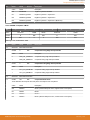
4.4.1 PSCTL: Program Store Control
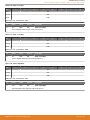
Bit
7
6
5
4
3
2
1
0
Name
Reserved
PSEE
PSWE
Access
R
RW
RW
0x00
0
0
Reset
SFR Page = ALL; SFR Address: 0x8F
Bit
Name
Reset
Access
7:2
Reserved
Must write reset value.
1
PSEE
0
RW
Description
Program Store Erase Enable.
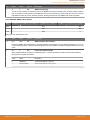
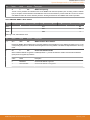
Setting this bit (in combination with PSWE) allows an entire page of flash program memory to be erased. If this bit is logic 1
and flash writes are enabled (PSWE is logic 1), a write to flash memory using the MOVX instruction will erase the entire
page that contains the location addressed by the MOVX instruction. The value of the data byte written does not matter.
0
Value
Name
Description
0
ERASE_DISABLED
Flash program memory erasure disabled.
1
ERASE_ENABLED
Flash program memory erasure enabled.
PSWE
0
Program Store Write Enable.
RW
Setting this bit allows writing a byte of data to the flash program memory using the MOVX write instruction. The flash location should be erased before writing data.
Value
Name
Description
0
WRITE_DISABLED
Writes to flash program memory disabled.
1
WRITE_ENABLED
Writes to flash program memory enabled; the MOVX write instruction targets flash
memory.
silabs.com | Smart. Connected. Energy-friendly.
Rev. 0.2 | 25
EFM8UB2 Reference Manual
Flash Memory
4.4.2 FLKEY: Flash Lock and Key
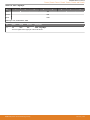
Bit
7
6
5
4
3
Name
FLKEY
Access
RW
Reset
0x00
2
1
0
SFR Page = ALL; SFR Address: 0xB7
Bit
Name
Reset
Access
Description
7:0
FLKEY
0x00
RW
Flash Lock and Key.
Write:
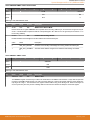
This register provides a lock and key function for flash erasures and writes. Flash writes and erases are enabled by writing
0xA5 followed by 0xF1 to the FLKEY register. Flash writes and erases are automatically disabled after the next write or
erase is complete. If any writes to FLKEY are performed incorrectly, or if a flash write or erase operation is attempted while
these operations are disabled, the flash will be permanently locked from writes or erasures until the next device reset. If an
application never writes to flash, it can intentionally lock the flash by writing a non-0xA5 value to FLKEY from firmware.
Read:
When read, bits 1-0 indicate the current flash lock state.
00: Flash is write/erase locked.
01: The first key code has been written (0xA5).
10: Flash is unlocked (writes/erases allowed).
11: Flash writes/erases are disabled until the next reset.
silabs.com | Smart. Connected. Energy-friendly.
Rev. 0.2 | 26
EFM8UB2 Reference Manual
Flash Memory
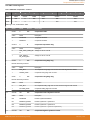
4.4.3 FLSCL: Flash Scale
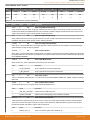
Bit
7
6
5
4
3
2
1
Name
FOSE
Reserved
FLRT
Reserved
Access
RW
RW
RW
RW
1
0x0
0
0x0
Reset
0
SFR Page = ALL; SFR Address: 0xB6
Bit
Name
Reset
Access
Description
7
FOSE
1
RW
Flash One-Shot Enable.
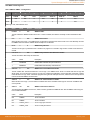
This bit enables the flash read one-shot (recommended). If the flash one-shot is disabled, the flash sense amps are enabled for a full clock cycle during flash reads, increasing the device power consumption.
Value
Name
Description
0
DISABLED
Disable the flash one-shot.
1
ENABLED
Enable the flash one-shot (recommended).
6:5
Reserved
Must write reset value.
4
FLRT
0
RW
Flash Read Timing.
This bit should be programmed to the smallest allowed value, according to the system clock speed.
3:0
Value
Name
Description
0
SYSCLK_BELOW_25_MHZ
SYSCLK <= 25 MHz.
1
SYSCLK_BELOW_48_MHZ
SYSCLK <= 48 MHz.
Reserved
Must write reset value.
silabs.com | Smart. Connected. Energy-friendly.
Rev. 0.2 | 27
EFM8UB2 Reference Manual
Device Identification
5. Device Identification
5.1 Unique Identifier
A 128-bit unique identifier (UID) is pre-loaded upon device reset into the last bytes of the XRAM area on all devices. The UID can be
read by firmware using MOVX instructions and through the debug port.
As the UID appears in RAM, firmware can overwrite the UID during normal operation. The bytes in memory will be automatically reinitialized with the UID value after any device reset. Firmware using this area of memory should always initialize the memory to a known
value, as any previous data stored at these locations will be overwritten and not retained through a reset.
Table 5.1. UID Location in Memory
Device
XRAM Addresses
EFM8UB20F64G
(MSB)
0x0FFF, 0x0FFE, 0x0FFD, 0x0FFC,
0x0FFB, 0x0FFA, 0x0FF9, 0x0FF8,
0x0FF7, 0x0FF6, 0x0FF5, 0x0FF4,
0x0FF3, 0x0FF2, 0x0FF1, 0x0FF0
(LSB)
EFM8UB20F32G
(MSB)
0x07FF, 0x07FE, 0x07FD, 0x07FC,
0x07FB, 0x07FA, 0x07F9, 0x07F8,
0x07F7, 0x07F6, 0x07F5, 0x07F4,
0x07F3, 0x07F2, 0x07F1, 0x07F0
(LSB)
silabs.com | Smart. Connected. Energy-friendly.
Rev. 0.2 | 28
EFM8UB2 Reference Manual
Interrupts
6. Interrupts
6.1 Introduction
The MCU core includes an extended interrupt system supporting multiple interrupt sources and priority levels. The allocation of interrupt
sources between on-chip peripherals and external input pins varies according to the specific version of the device.
Interrupt sources may have one or more associated interrupt-pending flag(s) located in an SFR local to the associated peripheral.
When a peripheral or external source meets a valid interrupt condition, the associated interrupt-pending flag is set to logic 1.
If interrupts are enabled for the source, an interrupt request is generated when the interrupt-pending flag is set. As soon as execution of
the current instruction is complete, the CPU generates an LCALL to a predetermined address to begin execution of an interrupt service
routine (ISR). Each ISR must end with an RETI instruction, which returns program execution to the next instruction that would have
been executed if the interrupt request had not occurred. If interrupts are not enabled, the interrupt-pending flag is ignored by the hardware and program execution continues as normal. The interrupt-pending flag is set to logic 1 regardless of whether the interrupt is enabled.
Each interrupt source can be individually enabled or disabled through the use of an associated interrupt enable bit in the IE and EIEn
registers. However, interrupts must first be globally enabled by setting the EA bit to logic 1 before the individual interrupt enables are
recognized. Setting the EA bit to logic 0 disables all interrupt sources regardless of the individual interrupt-enable settings.
Some interrupt-pending flags are automatically cleared by the hardware when the CPU vectors to the ISR or by other hardware conditions. However, most are not cleared by the hardware and must be cleared by software before returning from the ISR. If an interruptpending flag remains set after the CPU completes the return-from-interrupt (RETI) instruction, a new interrupt request will be generated
immediately and the CPU will re-enter the ISR after the completion of the next instruction.
6.2 Interrupt Sources and Vectors
The CIP51 core supports interrupt sources for each peripheral on the device. Software can simulate an interrupt for many peripherals
by setting any interrupt-pending flag to logic 1. If interrupts are enabled for the flag, an interrupt request will be generated and the CPU
will vector to the ISR address associated with the interrupt-pending flag. Refer to the data sheet section associated with a particular onchip peripheral for information regarding valid interrupt conditions for the peripheral and the behavior of its interrupt-pending flag(s).
6.2.1 Interrupt Priorities
Each interrupt source can be individually programmed to one of two priority levels: low or high. A low priority interrupt service routine
can be preempted by a high priority interrupt. A high priority interrupt cannot be preempted. Each interrupt has an associated interrupt
priority bit in the IP and EIPn registers, which are used to configure its priority level. Low priority is the default. If two interrupts are
recognized simultaneously, the interrupt with the higher priority is serviced first. If both interrupts have the same priority level, a fixed
order is used to arbitrate, based on the interrupt source's location in the interrupt vector table. Interrupts with a lower number in the
vector table have priority.
6.2.2 Interrupt Latency
Interrupt response time depends on the state of the CPU when the interrupt occurs. Pending interrupts are sampled and priority decoded on every system clock cycle. Therefore, the fastest possible response time is 5 system clock cycles: 1 clock cycle to detect the
interrupt and 4 clock cycles to complete the LCALL to the ISR. If an interrupt is pending when a RETI is executed, a single instruction is
executed before an LCALL is made to service the pending interrupt. Therefore, the maximum response time for an interrupt (when no
other interrupt is currently being serviced or the new interrupt is of greater priority) occurs when the CPU is performing an RETI instruction followed by a DIV as the next instruction. In this case, the response time is 18 system clock cycles: 1 clock cycle to detect the
interrupt, 5 clock cycles to execute the RETI, 8 clock cycles to complete the DIV instruction and 4 clock cycles to execute the LCALL to
the ISR. If the CPU is executing an ISR for an interrupt with equal or higher priority, the new interrupt will not be serviced until the
current ISR completes, including the RETI and following instruction. If more than one interrupt is pending when the CPU exits an ISR,
the CPU will service the next highest priority interrupt that is pending.
silabs.com | Smart. Connected. Energy-friendly.
Rev. 0.2 | 29
EFM8UB2 Reference Manual
Interrupts
6.2.3 Interrupt Summary
Table 6.1. Interrupt Priority Table
Interrupt Source
Vector
Priority
Primary Enable
Auxiliary Enable(s)
Reset
0x0000
Top
External Interrupt 0
0x0003
0
IE_EX0
-
TCON_IE0
Timer 0 Overflow
0x000B
1
IE_ET0
-
TCON_TF0
External Interrupt 1
0x0013
2
IE_EX1
-
TCON_IE1
Timer 1 Overflow
0x001B
3
IE_ET1
-
TCON_TF1
UART 0
0x0023
4
IE_ES0
-
SCON0_RI
-
Pending Flag(s)
-
-
SCON0_TI
Timer 2 Overflow
0x002B
5
IE_ET2
-
TMR2CN0_TF2H
TMR2CN0_TF2L
SPI0
0x0033
6
IE_ESPI0
-
SPI0CN0_MODF
SPI0CN0_RXOVRN
SPI0CN0_SPIF
SPI0CN0_WCOL
SMBus 0
0x003B
7
EIE1_ESMB0
USB0
0x0043
8
EIE1_EUSB0
ADC0 Window Compare
0x004B
-
SMB0CN_SI
CMIE_RSTINTE
CMINT_RSTINT
CMIE_RSUINTE
CMINT_RSUINT
CMIE_SOFE
CMINT_SOF
CMIE_SUSINTE
CMINT_SUSINT
IN1IE_EP0E
IN1INT_EP0
IN1IE_IN1E
IN1INT_IN1
IN1IE_IN2E
IN1INT_IN2
IN1IE_IN3E
IN1INT_IN3
OUT1IE_OUT1E
OUT1INT_OUT1
OUT1IE_OUT2E
OUT1INT_OUT2
OUT1IE_OUT3E
OUT1INT_OUT3
9
EIE1_EWADC0
-
ADC0CN0_ADWINT
ADC0 End of Conversion 0x0053
10
EIE1_EADC0
-
ADC0CN0_ADINT
PCA0
11
EIE1_EPCA0
0x005B
PCA0CPM0_ECCF
PCA0CN0_CCF0
PCA0CPM1_ECCF
PCA0CN0_CCF1
PCA0CPM2_ECCF
PCA0CN0_CCF2
PCA0CPM3_ECCF
PCA0CN0_CCF3
PCA0CPM4_ECCF
PCA0CN0_CCF4
PCA0CN0_CF
silabs.com | Smart. Connected. Energy-friendly.
Rev. 0.2 | 30
EFM8UB2 Reference Manual
Interrupts
Interrupt Source
Vector
Priority
Primary Enable
Auxiliary Enable(s)
Pending Flag(s)
Comparator 0
0x0063
12
EIE1_ECP0
CMP0MD_CPFIE
CMP0CN0_CPFIF
CMP0MD_CPRIE
CMP0CN0_CPRIF
CMP1MD_CPFIE
CMP1CN0_CPFIF
CMP1MD_CPRIE
CMP1CN0_CPRIF
Comparator 1
Timer 3 Overflow
0x006B
0x0073
13
14
EIE1_ECP1
EIE1_ET3
-
TMR3CN_TF3H
TMR3CN_TF3L
VBUS Level
0x007B
15
EIE2_EVBUS
-
UART 1
0x0083
16
EIE2_ES1
-
SCON1_RI
SCON1_TI
Reserved
0x008B
17
-
-
-
SMBus 1
0x0093
18
EIE2_ESMB1
-
SMB1CN0_SI
Timer 4 Overflow
0x009B
19
EIE2_ET4
-
TMR4CN0_TF4H
TMR4CN0_TF4L
Timer 5 Overflow
0x00A3
20
EIE2_ET5
-
TMR5CN0_TF5H
TMR5CN0_TF5L
silabs.com | Smart. Connected. Energy-friendly.
Rev. 0.2 | 31
EFM8UB2 Reference Manual
Interrupts
6.3 Interrupt Control Registers
6.3.1 IE: Interrupt Enable
Bit
7
6
5
4
3
2
1
0
Name
EA
ESPI0
ET2
ES0
ET1
EX1
ET0
EX0
Access
RW
RW
RW
RW
RW
RW
RW
RW
0
0
0
0
0
0
0
0
Reset
SFR Page = ALL; SFR Address: 0xA8 (bit-addressable)
Bit
Name
Reset
Access
Description
7
EA
0
RW
All Interrupts Enable.
Globally enables/disables all interrupts and overrides individual interrupt mask settings.
6
Value
Name
Description
0
DISABLED
Disable all interrupt sources.
1
ENABLED
Enable each interrupt according to its individual mask setting.
ESPI0
0
RW
SPI0 Interrupt Enable.
This bit sets the masking of the SPI0 interrupts.
5
Value
Name
Description
0
DISABLED
Disable all SPI0 interrupts.
1
ENABLED
Enable interrupt requests generated by SPI0.
ET2
0
RW
Timer 2 Interrupt Enable.
This bit sets the masking of the Timer 2 interrupt.
4
Value
Name
Description
0
DISABLED
Disable Timer 2 interrupt.
1
ENABLED
Enable interrupt requests generated by the TF2L or TF2H flags.
ES0
0
RW
UART0 Interrupt Enable.
This bit sets the masking of the UART0 interrupt.
3
Value
Name
Description
0
DISABLED
Disable UART0 interrupt.
1
ENABLED
Enable UART0 interrupt.
ET1
0
RW
Timer 1 Interrupt Enable.
This bit sets the masking of the Timer 1 interrupt.
Value
Name
Description
0
DISABLED
Disable all Timer 1 interrupt.
1
ENABLED
Enable interrupt requests generated by the TF1 flag.
silabs.com | Smart. Connected. Energy-friendly.
Rev. 0.2 | 32
EFM8UB2 Reference Manual
Interrupts
Bit
Name
Reset
Access
Description
2
EX1
0
RW
External Interrupt 1 Enable.
This bit sets the masking of External Interrupt 1.
1
Value
Name
Description
0
DISABLED
Disable external interrupt 1.
1
ENABLED
Enable interrupt requests generated by the INT1 input.
ET0
0
RW
Timer 0 Interrupt Enable.
This bit sets the masking of the Timer 0 interrupt.
0
Value
Name
Description
0
DISABLED
Disable all Timer 0 interrupt.
1
ENABLED
Enable interrupt requests generated by the TF0 flag.
EX0
0
RW
External Interrupt 0 Enable.
This bit sets the masking of External Interrupt 0.
Value
Name
Description
0
DISABLED
Disable external interrupt 0.
1
ENABLED
Enable interrupt requests generated by the INT0 input.
silabs.com | Smart. Connected. Energy-friendly.
Rev. 0.2 | 33
EFM8UB2 Reference Manual
Interrupts
6.3.2 IP: Interrupt Priority
Bit
7
6
5
4
3
2
1
0
Name
Reserved
PSPI0
PT2
PS0
PT1
PX1
PT0
PX0
Access
R
RW
RW
RW
RW
RW
RW
RW
Reset
1
0
0
0
0
0
0
0
SFR Page = ALL; SFR Address: 0xB8 (bit-addressable)
Bit
Name
Reset
Access
7
Reserved
Must write reset value.
6
PSPI0
0
RW
Description
Serial Peripheral Interface (SPI0) Interrupt Priority Control.
This bit sets the priority of the SPI0 interrupt.
5
Value
Name
Description
0
LOW
SPI0 interrupt set to low priority level.
1
HIGH
SPI0 interrupt set to high priority level.
PT2
0
RW
Timer 2 Interrupt Priority Control.
This bit sets the priority of the Timer 2 interrupt.
4
Value
Name
Description
0
LOW
Timer 2 interrupt set to low priority level.
1
HIGH
Timer 2 interrupt set to high priority level.
PS0
0
RW
UART0 Interrupt Priority Control.
This bit sets the priority of the UART0 interrupt.
3
Value
Name
Description
0
LOW
UART0 interrupt set to low priority level.
1
HIGH
UART0 interrupt set to high priority level.
PT1
0
RW
Timer 1 Interrupt Priority Control.
This bit sets the priority of the Timer 1 interrupt.
2
Value
Name
Description
0
LOW
Timer 1 interrupt set to low priority level.
1
HIGH
Timer 1 interrupt set to high priority level.
PX1
0
RW
External Interrupt 1 Priority Control.
This bit sets the priority of the External Interrupt 1 interrupt.
1
Value
Name
Description
0
LOW
External Interrupt 1 set to low priority level.
1
HIGH
External Interrupt 1 set to high priority level.
PT0
0
RW
Timer 0 Interrupt Priority Control.
This bit sets the priority of the Timer 0 interrupt.
silabs.com | Smart. Connected. Energy-friendly.
Rev. 0.2 | 34
EFM8UB2 Reference Manual
Interrupts
Bit
0
Name
Reset
Access
Value
Name
Description
0
LOW
Timer 0 interrupt set to low priority level.
1
HIGH
Timer 0 interrupt set to high priority level.
PX0
0
RW
Description
External Interrupt 0 Priority Control.
This bit sets the priority of the External Interrupt 0 interrupt.
Value
Name
Description
0
LOW
External Interrupt 0 set to low priority level.
1
HIGH
External Interrupt 0 set to high priority level.
silabs.com | Smart. Connected. Energy-friendly.
Rev. 0.2 | 35
EFM8UB2 Reference Manual
Interrupts
6.3.3 EIE1: Extended Interrupt Enable 1
Bit
7
6
5
4
3
2
1
0
Name
ET3
ECP1
ECP0
EPCA0
EADC0
EWADC0
EUSB0
ESMB0
Access
RW
RW
RW
RW
RW
RW
RW
RW
0
0
0
0
0
0
0
0
Reset
SFR Page = ALL; SFR Address: 0xE6
Bit
Name
Reset
Access
Description
7
ET3
0
RW
Timer 3 Interrupt Enable.
This bit sets the masking of the Timer 3 interrupt.
6
Value
Name
Description
0
DISABLED
Disable Timer 3 interrupts.
1
ENABLED
Enable interrupt requests generated by the TF3L or TF3H flags.
ECP1
0
RW
Comparator1 (CP1) Interrupt Enable.
This bit sets the masking of the CP1 interrupt.
5
Value
Name
Description
0
DISABLED
Disable CP1 interrupts.
1
ENABLED
Enable interrupt requests generated by the comparator 1 CPRIF or CPFIF flags.
ECP0
0
RW
Comparator0 (CP0) Interrupt Enable.
This bit sets the masking of the CP0 interrupt.
4
Value
Name
Description
0
DISABLED
Disable CP0 interrupts.
1
ENABLED
Enable interrupt requests generated by the comparator 0 CPRIF or CPFIF flags.
EPCA0
0
RW
Programmable Counter Array (PCA0) Interrupt Enable.
This bit sets the masking of the PCA0 interrupts.
3
Value
Name
Description
0
DISABLED
Disable all PCA0 interrupts.
1
ENABLED
Enable interrupt requests generated by PCA0.
EADC0
0
RW
ADC0 Conversion Complete Interrupt Enable.
This bit sets the masking of the ADC0 Conversion Complete interrupt.
2
Value
Name
Description
0
DISABLED
Disable ADC0 Conversion Complete interrupt.
1
ENABLED
Enable interrupt requests generated by the ADINT flag.
EWADC0
0
RW
ADC0 Window Comparison Interrupt Enable.
This bit sets the masking of ADC0 Window Comparison interrupt.
silabs.com | Smart. Connected. Energy-friendly.
Rev. 0.2 | 36
EFM8UB2 Reference Manual
Interrupts
Bit
1
Name
Reset
Access
Value
Name
Description
0
DISABLED
Disable ADC0 Window Comparison interrupt.
1
ENABLED
Enable interrupt requests generated by ADC0 Window Compare flag (ADWINT).
EUSB0
0
RW
Description
USB (USB0) Interrupt Enable.
This bit sets the masking of the USB0 interrupt.
0
Value
Name
Description
0
DISABLED
Disable all USB0 interrupts.
1
ENABLED
Enable interrupt requests generated by USB0.
ESMB0
0
RW
SMBus (SMB0) Interrupt Enable.
This bit sets the masking of the SMB0 interrupt.
Value
Name
Description
0
DISABLED
Disable all SMB0 interrupts.
1
ENABLED
Enable interrupt requests generated by SMB0.
silabs.com | Smart. Connected. Energy-friendly.
Rev. 0.2 | 37
EFM8UB2 Reference Manual
Interrupts
6.3.4 EIP1: Extended Interrupt Priority 1
Bit
7
6
5
4
3
2
1
0
Name
PT3
PCP1
PCP0
PPCA0
PADC0
PWADC0
PUSB0
PSMB0
Access
RW
RW
RW
RW
RW
RW
RW
RW
0
0
0
0
0
0
0
0
Reset
SFR Page = ALL; SFR Address: 0xF6
Bit
Name
Reset
Access
Description
7
PT3
0
RW
Timer 3 Interrupt Priority Control.
This bit sets the priority of the Timer 3 interrupt.
6
Value
Name
Description
0
LOW
Timer 3 interrupts set to low priority level.
1
HIGH
Timer 3 interrupts set to high priority level.
PCP1
0
RW
Comparator1 (CP1) Interrupt Priority Control.
This bit sets the priority of the CP1 interrupt.
5
Value
Name
Description
0
LOW
CP1 interrupt set to low priority level.
1
HIGH
CP1 interrupt set to high priority level.
PCP0
0
RW
Comparator0 (CP0) Interrupt Priority Control.
This bit sets the priority of the CP0 interrupt.
4
Value
Name
Description
0
LOW
CP0 interrupt set to low priority level.
1
HIGH
CP0 interrupt set to high priority level.
PPCA0
0
RW
Programmable Counter Array (PCA0) Interrupt Priority Control.
This bit sets the priority of the PCA0 interrupt.
3
Value
Name
Description
0
LOW
PCA0 interrupt set to low priority level.
1
HIGH
PCA0 interrupt set to high priority level.
PADC0
0
RW
ADC0 Conversion Complete Interrupt Priority Control.
This bit sets the priority of the ADC0 Conversion Complete interrupt.
2
Value
Name
Description
0
LOW
ADC0 Conversion Complete interrupt set to low priority level.
1
HIGH
ADC0 Conversion Complete interrupt set to high priority level.
PWADC0
0
RW
ADC0 Window Comparator Interrupt Priority Control.
This bit sets the priority of the ADC0 Window interrupt.
silabs.com | Smart. Connected. Energy-friendly.
Rev. 0.2 | 38
EFM8UB2 Reference Manual
Interrupts
Bit
1
Name
Reset
Access
Value
Name
Description
0
LOW
ADC0 Window interrupt set to low priority level.
1
HIGH
ADC0 Window interrupt set to high priority level.
PUSB0
0
RW
Description
USB (USB0) Interrupt Priority Control.
This bit sets the priority of the USB0 interrupt.
0
Value
Name
Description
0
LOW
USB0 interrupt set to low priority level.
1
HIGH
USB0 interrupt set to high priority level.
PSMB0
0
RW
SMBus (SMB0) Interrupt Priority Control.
This bit sets the priority of the SMB0 interrupt.
Value
Name
Description
0
LOW
SMB0 interrupt set to low priority level.
1
HIGH
SMB0 interrupt set to high priority level.
silabs.com | Smart. Connected. Energy-friendly.
Rev. 0.2 | 39
EFM8UB2 Reference Manual
Interrupts
6.3.5 EIE2: Extended Interrupt Enable 2
Bit
7
6
5
4
3
2
1
0
Name
Reserved
ET5
ET4
ESMB1
Reserved
ES1
EVBUS
Access
R
RW
RW
RW
RW
RW
RW
0x0
0
0
0
0
0
0
Reset
SFR Page = ALL; SFR Address: 0xE7
Bit
Name
Reset
Access
7:6
Reserved
Must write reset value.
5
ET5
0
RW
Description
Timer 5 Interrupt Enable.
This bit sets the masking of the Timer 5 interrupt.
4
Value
Name
Description
0
DISABLED
Disable Timer 5 interrupts.
1
ENABLED
Enable interrupt requests generated by the TF5L or TF5H flags.
ET4
0
RW
Timer 4 Interrupt Enable.
This bit sets the masking of the Timer 4 interrupt.
3
Value
Name
Description
0
DISABLED
Disable Timer 4interrupts.
1
ENABLED
Enable interrupt requests generated by the TF4L or TF4H flags.
ESMB1
0
RW
SMBus1 Interrupt Enable.
This bit sets the masking of the SMB1 interrupt.
Value
Name
Description
0
DISABLED
Disable all SMB1 interrupts.
1
ENABLED
Enable interrupt requests generated by SMB1.
2
Reserved
Must write reset value.
1
ES1
0
RW
UART1 Interrupt Enable.
This bit sets the masking of the UART1 interrupt.
0
Value
Name
Description
0
DISABLED
Disable UART1 interrupt.
1
ENABLED
Enable UART1 interrupt.
EVBUS
0
RW
VBUS Level Interrupt Enable.
This bit sets the masking of the VBUS interrupt.
Value
Name
Description
0
DISABLED
Disable all VBUS interrupts.
1
ENABLED
Enable interrupt requests generated by VBUS level sense.
silabs.com | Smart. Connected. Energy-friendly.
Rev. 0.2 | 40
EFM8UB2 Reference Manual
Interrupts
6.3.6 EIP2: Extended Interrupt Priority 2
Bit
7
6
5
4
3
2
1
0
Name
Reserved
PT5
PT4
PSMB1
Reserved
PS1
PVBUS
Access
R
RW
RW
RW
RW
RW
RW
0x0
0
0
0
0
0
0
Reset
SFR Page = ALL; SFR Address: 0xF7
Bit
Name
Reset
Access
7:6
Reserved
Must write reset value.
5
PT5
0
RW
Description
Timer 5 Interrupt Priority Control.
This bit sets the priority of the Timer 5 interrupt.
4
Value
Name
Description
0
LOW
Timer 5 interrupt set to low priority level.
1
HIGH
Timer 5 interrupt set to high priority level.
PT4
0
RW
Timer 4 Interrupt Priority Control.
This bit sets the priority of the Timer 4 interrupt.
3
Value
Name
Description
0
LOW
Timer 4 interrupt set to low priority level.
1
HIGH
Timer 4 interrupt set to high priority level.
PSMB1
0
RW
SMBus1 Interrupt Priority Control.
This bit sets the priority of the SMB1 interrupt.
Value
Name
Description
0
LOW
SMB1 interrupt set to low priority level.
1
HIGH
SMB1 interrupt set to high priority level.
2
Reserved
Must write reset value.
1
PS1
0
RW
UART1 Interrupt Priority Control.
This bit sets the priority of the UART1 interrupt.
0
Value
Name
Description
0
LOW
UART1 interrupt set to low priority level.
1
HIGH
UART1 interrupt set to high priority level.
PVBUS
0
RW
VBUS Level Interrupt Priority Control.
This bit sets the priority of the VBUS interrupt.
Value
Name
Description
0
LOW
VBUS interrupt set to low priority level.
1
HIGH
VBUS interrupt set to high priority level.
silabs.com | Smart. Connected. Energy-friendly.
Rev. 0.2 | 41
EFM8UB2 Reference Manual
Power Management and Internal Regulators
7. Power Management and Internal Regulators
7.1 Introduction
All internal circuitry draws power from the VDD supply pin. External I/O pins are powered from the VIO supply voltage (or VDD on devices without a separate VIO connection), while most of the internal circuitry is supplied by an on-chip LDO regulator. Control over the
device power can be achieved by enabling/disabling individual peripherals as needed. Each analog peripheral can be disabled when
not in use and placed in low power mode. Digital peripherals, such as timers and serial buses, have their clocks gated off and draw little
power when they are not in use.
Power Distribution
VREGIN
5V LDO
3.3V
USB PHY
D+
D-
VDD
Core LDO
GND
1.8V
CPU Core
RAM
Flash
Oscillators
Peripheral
Logic
Digital I/O
Interface
Port I/O Pins
Analog
Muxes
Figure 7.1. Power System Block Diagram
Table 7.1. Power Modes
Power Mode
Details
Mode Entry
Wake-Up Sources
Normal
Core and all peripherals clocked and fully operational
—
—
Set IDLE bit in PCON0
Any interrupt
Idle
• Core halted
• All peripherals clocked and fully operational
• Code resumes execution on wake event
Suspend
• Core and peripheral clocks halted
• Code resumes execution on wake event
silabs.com | Smart. Connected. Energy-friendly.
1. Switch SYSCLK to
HFOSC0
2. Set SUSPEND bit in
HFO0CN
USB0 Bus Activity
Rev. 0.2 | 42
EFM8UB2 Reference Manual
Power Management and Internal Regulators
Power Mode
Shutdown
Details
•
•
•
•
All internal power nets shut down
5V regulator remains active (if enabled)
Pins retain state
Exit on pin or power-on reset
Mode Entry
1. Set STOPCF bit in
REG01CN
2. Set STOP bit in
PCON0
Wake-Up Sources
• RSTb pin reset
• Power-on reset
7.2 Features
• Supports four power modes:
1. Normal mode: Core and all peripherals fully operational.
2. Idle mode: Core halted, peripherals fully operational, core waiting for interrupt to continue.
3. Suspend mode: May be used with USB0 peripheral to provide low current in USB suspend. Very fast wake-up time and code
resumes execution at the next instruction.
4. Shutdown mode: Lowest power state. Device is off, drawing very little current, and waiting ror a pin reset or power-on reset.
Note: Legacy 8051 Stop mode is also supported, where the internal LDO remains active, but a device reset is required to wake.
• Fully internal core LDO supplies power to majority of blocks.
• 5-to-3.3 V Regulator:
• Allows direct connection to USB supply net.
• Provides up to 100 mA for system-level use.
• Low power consumption in Suspend mode.
7.3 Idle Mode
In idle mode, CPU core execution is halted while any enabled peripherals and clocks remain active. Power consumption in idle mode is
dependent upon the system clock frequency and any active peripherals.
Setting the IDLE bit in the PCON0 register causes the hardware to halt the CPU and enter idle mode as soon as the instruction that
sets the bit completes execution. All internal registers and memory maintain their original data. All analog and digital peripherals can
remain active during idle mode.
Idle mode is terminated when an enabled interrupt is asserted or a reset occurs. The assertion of an enabled interrupt will cause the
IDLE bit to be cleared and the CPU to resume operation. The pending interrupt will be serviced and the next instruction to be executed
after the return from interrupt (RETI) will be the instruction immediately following the one that set the IDLE bit. If idle mode is terminated
by an internal or external reset, the CIP-51 performs a normal reset sequence and begins program execution at address 0x0000.
Note: If the instruction following the write of the IDLE bit is a single-byte instruction and an interrupt occurs during the execution phase
of the instruction that sets the IDLE bit, the CPU may not wake from idle mode when a future interrupt occurs. Therefore, instructions
that set the IDLE bit should be followed by an instruction that has two or more opcode bytes. For example:
// in ‘C’:
PCON0 |= 0x01; // set IDLE bit
PCON0 = PCON0; // ... followed by a 3-cycle dummy instruction
; in assembly:
ORL PCON0, #01h ; set IDLE bit
MOV PCON0, PCON0 ; ... followed by a 3-cycle dummy instruction
If enabled, the Watchdog Timer (WDT) will eventually cause an internal watchdog reset and thereby terminate the Idle mode. This feature protects the system from an unintended permanent shutdown in the event of an inadvertent write to the PCON0 register. If this
behavior is not desired, the WDT may be disabled by software prior to entering the idle mode if the WDT was initially configured to
allow this operation. This provides the opportunity for additional power savings, allowing the system to remain in the idle mode indefinitely, waiting for an external stimulus to wake up the system.
silabs.com | Smart. Connected. Energy-friendly.
Rev. 0.2 | 43
EFM8UB2 Reference Manual
Power Management and Internal Regulators
7.4 Stop Mode
In stop mode, the CPU is halted and peripheral clocks are stopped. Analog peripherals remain in their selected states.
Setting the STOP bit in the PCON0 register causes the controller core to enter stop mode as soon as the instruction that sets the bit
completes execution. Before entering stop mode, the system clock must be sourced by HFOSC0. In stop mode, the CPU and internal
clocks are stopped. Analog peripherals may remain enabled, but will not be provided a clock. Each analog peripheral may be shut down
individually by firmware prior to entering stop mode. Stop mode can only be terminated by an internal or external reset. On reset, the
device performs the normal reset sequence and begins program execution at address 0x0000.
If enabled as a reset source, the missing clock detector will cause an internal reset and thereby terminate the stop mode. If this reset is
undesirable in the system, and the CPU is to be placed in stop mode for longer than the missing clock detector timeout, the missing
clock detector should be disabled in firmware prior to setting the STOP bit.
7.5 Suspend Mode
Suspend mode is entered by setting the SUSPEND bit while operating from the internal 24.5 MHz oscillator (HFOSC0). Upon entry into
suspend mode, the hardware halts the high-frequency internal oscillator and goes into a low power state as soon as the instruction that
sets the bit completes execution. All internal registers and memory maintain their original data.
Suspend mode is terminated by any enabled wake or reset source. When suspend mode is terminated, the device will continue execution on the instruction following the one that set the SUSPEND bit. If the wake event was configured to generate an interrupt, the interrupt will be serviced upon waking the device. If suspend mode is terminated by an internal or external reset, the CIP-51 performs a
normal reset sequence and begins program execution at address 0x0000.
7.6 Shutdown Mode
In shutdown mode, the CPU is halted and the internal LDO is powered down. External I/O will retain their configured states.
To enter Shutdown mode, firmware should set the STOPCF bit in the regulator control register to 1, and then set the STOP bit in
PCON0. In Shutdown, the RSTb pin and a full power cycle of the device are the only methods of generating a reset and waking the
device.
Note: In Shutdown mode, all internal device circuitry is powered down, and no RAM nor registers are retained. The debug circuitry will
not be able to connect to a device while it is in Shutdown. Coming out of Shutdown mode, whether by POR or pin reset, will appear as
a power-on reset of the device.
silabs.com | Smart. Connected. Energy-friendly.
Rev. 0.2 | 44
EFM8UB2 Reference Manual
Power Management and Internal Regulators
7.7 5V-to-3.3V Regulator
The 5-to-3.3 V regulator is powered from the VREGIN pin on the device. When active, it regulates the input voltage to 3.3 V at the VDD
pin, providing up to 100 mA for the device and system. In addition to the normal mode of operation, the regulator has two low power
modes which may be used to reduce the supply current, and may be disabled when not in use.
Table 7.2. Voltage Regulator Operational Modes
Regulator Condition
SUSEN Bit
BIASENB Bit
REG1ENB Bit
Relative Power Consumption
Normal
0
0
0
highest
Suspend
1
0
0
low
Bias Disabled
x
1
0
extremely low
Disabled
x
1
1
off
The voltage regulator is enabled in normal mode by default. Normal mode offers the fastest response times, for systems with dynamically-changing loads.
For applications which can tolerate a lower regulator bandwidth but still require a tightly regulated output voltage, the regulator may be
placed in suspend mode. Suspend mode is activated when firmware sets the SUSEN bit. Suspend mode reduces the regulator bias
current at the expense of bandwidth.
For low power applications that can tolerate reduced output voltage accuracy and load regulation, the internal bias current may be disabled completely using the BIASENB bit. If firmware sets the BIASENB bit, the regulator will regulate the voltage using a method that is
more susceptible to process and temperature variations. In addition, the actual output voltage may drop substantially under heavy
loads. The bias should only be disabled for light loads (5 mA or less) or when the voltage regulator is disabled.
If the regulator is not used in a system, the VREGIN and VDD pins should be connected together. Firmware may disable the regulator
by writing both the REG1ENB and BIASENB bits in REG1CN to turn off the regulator and all associated bias currents.
silabs.com | Smart. Connected. Energy-friendly.
Rev. 0.2 | 45
EFM8UB2 Reference Manual
Power Management and Internal Regulators
7.8 Power Management Control Registers
7.8.1 PCON0: Power Control
Bit
7
6
5
4
3
2
1
0
Name
GF5
GF4
GF3
GF2
GF1
GF0
STOP
IDLE
Access
RW
RW
RW
RW
RW
RW
RW
RW
0
0
0
0
0
0
0
0
Reset
SFR Page = ALL; SFR Address: 0x87
Bit
Name
Reset
Access
Description
7
GF5
0
RW
General Purpose Flag 5.
This flag is a general purpose flag for use under firmware control.
6
GF4
0
RW
General Purpose Flag 4.
This flag is a general purpose flag for use under firmware control.
5
GF3
0
RW
General Purpose Flag 3.
This flag is a general purpose flag for use under firmware control.
4
GF2
0
RW
General Purpose Flag 2.
This flag is a general purpose flag for use under firmware control.
3
GF1
0
RW
General Purpose Flag 1.
This flag is a general purpose flag for use under firmware control.
2
GF0
0
RW
General Purpose Flag 0.
This flag is a general purpose flag for use under firmware control.
1
STOP
0
RW
Stop Mode Select.
Setting this bit will place the CIP-51 in Stop mode. This bit will always be read as 0.
0
IDLE
0
RW
Idle Mode Select.
Setting this bit will place the CIP-51 in Idle mode. This bit will always be read as 0.
silabs.com | Smart. Connected. Energy-friendly.
Rev. 0.2 | 46
EFM8UB2 Reference Manual
Power Management and Internal Regulators
7.8.2 REG01CN: Voltage Regulator Control
Bit
7
6
5
4
3
2
1
0
Name
REG0DIS
VBSTAT
Reserved
REG0MD
STOPCF
Reserved
REG1MD
Reserved
Access
RW
R
RW
RW
RW
RW
RW
RW
0
0
0
0
0
0
0
0
Reset
SFR Page = ALL; SFR Address: 0xC9
Bit
Name
Reset
Access
Description
7
REG0DIS
0
RW
Voltage Regulator (REG0) Disable.
This bit enables or disables the VREG0 Voltage Regulator.
6
Value
Name
Description
0
ENABLED
Enable the VREG0 Voltage Regulator.
1
DISABLED
Disable the VREG0 Voltage Regulator.
VBSTAT
0
R
VBUS Signal Status.
This bit indicates whether the device is connected to a USB network.
Value
Name
Description
0
NOT_SET
VBUS signal currently absent (device not attached to USB network).
1
SET
VBUS signal currently present (device attached to USB network).
5
Reserved
Must write reset value.
4
REG0MD
0
RW
VREG0 Voltage Regulator Mode.
This bit selects the Voltage Regulator mode for VREG0. When REG0MD is set to 1, the VREG0 voltage regulator operates
in lower power (suspend) mode.
3
Value
Name
Description
0
NORMAL
VREG0 Voltage Regulator in normal mode.
1
LOW_POWER
VREG0 Voltage Regulator in low power mode.
STOPCF
0
VREG1 Stop Mode Configuration.
RW
This bit configures the VREG1 regulator's behavior when the device enters stop mode.
Value
Name
Description
0
ACTIVE
VREG1 Regulator is still active in stop mode. Any enabled reset source will reset
the device.
1
SHUTDOWN
VREG1 Regulator is shut down in stop mode. Only the RSTb pin or power cycle
can reset the device.
2
Reserved
Must write reset value.
1
REG1MD
0
RW
VREG1 Voltage Regulator Mode.
This bit selects the Voltage Regulator mode for VREG1. When REG1MD is set to 1, the VREG1 voltage regulator operates
in lower power mode.
This bit should not be set to 1 if the VREG0 Voltage Regulator is disabled.
silabs.com | Smart. Connected. Energy-friendly.
Rev. 0.2 | 47
EFM8UB2 Reference Manual
Power Management and Internal Regulators
Bit
0
Name
Reset
Access
Value
Name
Description
0
NORMAL
VREG1 Voltage Regulator in normal mode.
1
LOW_POWER
VREG1 Voltage Regulator in low power mode.
Reserved
Must write reset value.
silabs.com | Smart. Connected. Energy-friendly.
Description
Rev. 0.2 | 48
EFM8UB2 Reference Manual
Clocking and Oscillators
8. Clocking and Oscillators
8.1 Introduction
The CPU core and peripheral subsystem may be clocked by both internal and external oscillator resources. By default, the system
clock comes up running from the 48 MHz oscillator divided by 4, then divided by 8 (1.5 MHz).
Clock Control
Divider:
1, 2, 4, 8
48 MHz Oscillator
(HFOSC0)
/2
/2
To core and peripherals
External Oscillator
Input (EXTCLK)
80 kHz Oscillator
(LFOSC0)
SYSCLK
Divider:
1, 2, 4, 8
Figure 8.1. Clock Control Block Diagram
8.2 Features
• Provides clock to core and peripherals.
• 48 MHz internal oscillator (HFOSC0), accurate to ±1.5% over supply and temperature corners: accurate to +/- 0.25% when using
USB clock recovery.
• 80 kHz low-frequency oscillator (LFOSC0).
• External RC, C, CMOS, and high-frequency crystal clock options (EXTCLK) for QFP48 packages.
• External CMOS clock option (EXTCLK) for QFP32 and QFN32 packages.
• Internal oscillator has clock divider with eight settings for flexible clock scaling: 1, 2, 4, or 8.
8.3 Functional Description
8.3.1 Clock Selection
The CLKSEL register is used to select the clock source for the system (SYSCLK). The CLKSL field selects which oscillator source is
used as the system clock, while CLKDIV controls the programmable divider. When an internal oscillator source is selected as the
SYSCLK, the external oscillator may still clock certain peripherals. In these cases, the external oscillator source is synchronized to the
SYSCLK source. The system clock may be switched on-the-fly between any of the oscillator sources so long as the selected clock
source is enabled and has settled, and CLKDIV may be changed at any time.
Note: Some device families do place restrictions on the difference in operating frequency when switching clock sources. Please see the
CLKSEL register description for details.
8.3.2 HFOSC0 48 MHz Internal Oscillator
HFOSC0 is a programmable internal high-frequency oscillator that is factory-calibrated to 48 MHz. The oscillator is automatically enabled when it is requested. The oscillator period can be adjusted via the HFO0CAL register to obtain other frequencies.
silabs.com | Smart. Connected. Energy-friendly.
Rev. 0.2 | 49
EFM8UB2 Reference Manual
Clocking and Oscillators
8.3.3 LFOSC0 80 kHz Internal Oscillator
LFOSC0 is a progammable low-frequency oscillator, factory calibrated to a nominal frequency of 80 kHz. A dedicated divider at the
oscillator output is capable of dividing the output clock by 1, 2, 4, or 8, using the OSCLD bits in the LFO0CN register. The OSCLF bits
can be used to coarsely adjust the oscillator’s output frequency.
The LFOSC0 circuit requires very little start-up time and may be selected as the system clock immediately following the register write
which enables the oscillator.
Calibrating LFOSC0
On-chip calibration of the LFOSC0 can be performed using a timer to capture the oscillator period, when running from a known time
base. When a timer is configured for L-F Oscillator capture mode, a rising edge of the low-frequency oscillator’s output will cause a
capture event on the corresponding timer. As a capture event occurs, the current timer value is copied into the timer reload registers.
By recording the difference between two successive timer capture values, the low-frequency oscillator’s period can be calculated. The
OSCLF bits can then be adjusted to produce the desired oscillator frequency.
silabs.com | Smart. Connected. Energy-friendly.
Rev. 0.2 | 50
EFM8UB2 Reference Manual
Clocking and Oscillators
8.3.4 External Crystal
If a crystal or ceramic resonator is used as the external oscillator, the crystal/resonator and a 10 MΩ resistor must be wired across the
XTAL1 and XTAL2 pins. Appropriate loading capacitors should be added to XTAL1 and XTAL2, and both pins should be configured for
analog I/O with the digital output drivers disabled.
The capacitors shown in the external crystal configuration provide the load capacitance required by the crystal for correct oscillation.
These capacitors are “in series” as seen by the crystal and “in parallel” with the stray capacitance of the XTAL1 and XTAL2 pins.
Note: The recommended load capacitance depends upon the crystal and the manufacturer. Refer to the crystal data sheet when completing these calculations.
The equation for determining the load capacitance for two capacitors is as follows:
CL =
CA × CB
CA + CB
+ CS
Figure 8.2. External Oscillator Load Capacitance
Where:
• CA and CB are the capacitors connected to the crystal leads.
• CS is the total stray capacitance of the PCB.
• The stray capacitance for a typical layout where the crystal is as close as possible to the pins is 2-5 pF per pin.
If CA and CB are the same (C), then the equation becomes the following:
CL =
C
+ CS
2
Figure 8.3. External Oscillator Load Capacitance with Equal Capacitors
For example, a tuning-fork crystal of 25 MHz has a recommended load capacitance of 12.5 pF. With a stray capacitance of 3 pF per pin
(6 pF total), the 13 pF capacitors yield an equivalent capacitance of 12.5 pF across the crystal.
15 pF
XTAL1
25 MHz
10 M
XTAL2
15 pF
Figure 8.4. 25 MHz External Crystal Example
Crystal oscillator circuits are quite sensitive to PCB layout. The crystal should be placed as close as possible to the XTAL pins on the
device. The traces should be as short as possible and shielded with ground plane from any other traces which could introduce noise or
interference. When using an external crystal, the external oscillator drive circuit must be configured by firmware for Crystal Oscillator
Mode or Crystal Oscillator Mode with divide by 2 stage. The divide by 2 stage ensures that the clock derived from the external oscillator
has a duty cycle of 50%. The External Oscillator Frequency Control value (XFCN) must also be specified based on the crystal frequency. For example, a 25 MHz crystal requires an XFCN setting of 111b.
silabs.com | Smart. Connected. Energy-friendly.
Rev. 0.2 | 51
EFM8UB2 Reference Manual
Clocking and Oscillators
Table 8.1. Recommended XFCN Settings for Crystal Mode
XFCN Field Setting
Crystal Frequency
Approximate Bias Current
000
f ≤ 20 kHz
0.5 µA
001
20 kHz < f ≤ 58 kHz
1.5 µA
010
58 kHz < f ≤ 155 kHz
4.8 µA
011
155 kHz < f ≤ 415 kHz
14 µA
100
415 kHz < f ≤ 1.1 MHz
40 µA
101
1.1 MHz < f ≤ 3.1 MHz
120 µA
110
3.1 MHz < f ≤ 8.2 MHz
550 µA
111
8.2 MHz < f ≤ 25 MHz
2.6 mA
When the crystal oscillator is first enabled, the external oscillator valid detector allows software to determine when the external system
clock has stabilized. Switching to the external oscillator before the crystal oscillator has stabilized can result in unpredictable behavior.
The recommended procedure for starting the crystal is as follows:
1. Configure XTAL1 and XTAL2 for analog I/O and disable the digital output drivers.
2. Disable the XTAL1 and XTAL2 digital output drivers by writing 1's to the appropriate bits in the port latch register.
3. Configure and enable the external oscillator.
4. Wait at least 1 ms
5. Poll for XCLKVLD set to 1.
6. Switch the system clock to the external oscillator.
silabs.com | Smart. Connected. Energy-friendly.
Rev. 0.2 | 52
EFM8UB2 Reference Manual
Clocking and Oscillators
8.3.5 External RC and C Modes
External RC Example
An RC network connected to the XTAL2 pin can be used as a basic oscillator. XTAL1 is not affected in RC mode.
VDD
XTAL1
XTAL2
Figure 8.5. External RC Oscillator Configuration
The capacitor should be no greater than 100 pF; however, for very small capacitors, the total capacitance may be dominated by parasitic capacitance in the PCB layout. To determine the required XFCN field value, first select the RC network value to produce the desired
frequency of oscillation, according to , where f = the frequency of oscillation in MHz, C = the capacitor value in pF, and R = the pull-up
resistor value in kΩ.
f =
1.23 × 10³
R×C
Figure 8.6. RC Mode Oscillator Frequency
For example, if the frequency desired is 100 kHz, let R = 246 kΩ and C = 50 pF:
f =
1.23 × 10³
1.23 × 103
=
= 100 kHz
R×C
246 × 50
Figure 8.7. RC Mode Oscillator Example
Referencing , the recommended XFCN setting for 100 kHz is 010.
When the RC oscillator is first enabled, the external oscillator valid detector allows firmware to determine when oscillation has stabilized. The recommended procedure for starting the RC oscillator is as follows:
1. Configure XTAL2 for analog I/O and disable the digital output drivers.
2. Configure and enable the external oscillator.
3. Poll for XCLKVLD = 1.
4. Switch the system clock to the external oscillator.
silabs.com | Smart. Connected. Energy-friendly.
Rev. 0.2 | 53
EFM8UB2 Reference Manual
Clocking and Oscillators
External Capacitor Example
If a capacitor is used as the external oscillator, the circuit should be configured as shown in . The capacitor should be added to XTAL2,
and XTAL2 should be configured for analog I/O with the digital output drivers disabled. XTAL1 is not affected in C mode.
XTAL1
XTAL2
Figure 8.8. External Capacitor Oscillator Configuration
The capacitor should be no greater than 100 pF; however, for very small capacitors, the total capacitance may be dominated by parasitic capacitance in the PCB layout. The oscillation frequency and the required XFCN field value determined by the following equation,
where f is the frequency in MHz, C is the capacitor value on XTAL2 in pF, and VDD is the power supply voltage in Volts:
f =
KF
C × V DD
Figure 8.9. C Mode Oscillator Frequency
For example, assume VDD = 3.0 V and f = 150 kHz. Since a frequency of roughly 150 kHz is desired, select the K Factor from as KF =
22:
f =
KF
C × V DD
0.150 MHz =
C=
22
C × 3.0
22
0.150 MHz × 3.0
C = 48.8 pF
Figure 8.10. C Mode Oscillator Example
Therefore, the XFCN value to use in this example is 011 and C is approximately 50 pF. The recommended startup procedure for C
mode is the same as RC mode.
silabs.com | Smart. Connected. Energy-friendly.
Rev. 0.2 | 54
EFM8UB2 Reference Manual
Clocking and Oscillators
Recommended XFCN Settings for RC and C Modes
Table 8.2. Recommended XFCN Settings for RC and C Modes
XFCN Field Setting
Approximate Frequency
Range
K Factor (C Mode)
Actual Measured Frequency
(C Mode)
000
f ≤ 25 kHz
K Factor = 0.87
f = 11 kHz, C = 33 pF
001
25 kHz < f ≤ 50 kHz
K Factor = 2.6
f = 33 kHz, C = 33 pF
010
50 kHz < f ≤ 100 kHz
K Factor = 7.7
f = 98 kHz, C = 33 pF
011
100 kHz < f ≤ 200 kHz
K Factor = 22
f = 270 kHz, C = 33 pF
100
200 kHz < f ≤ 400 kHz
K Factor = 65
f = 310 kHz, C = 46 pF
101
400 kHz < f ≤ 800 kHz
K Factor = 180
f = 890 kHz, C = 46 pF
110
800 kHz < f ≤ 1.6 MHz
K Factor = 664
f = 2.0 MHz, C = 46 pF
111
1.6 MHz < f ≤ 3.2 MHz
K Factor = 1590
f = 6.8 MHz, C = 46 pF
8.3.6 External CMOS
An external CMOS clock source is also supported as a core clock source. The XTAL2/EXTCLK pin on the device serves as the external
clock input when running in this mode. When not selected as the SYSCLK source, the EXTCLK input is always re-synchronized to
SYSCLK. XTAL1 is not used in external CMOS clock mode.
Note: When selecting the EXTCLK pin as a clock input source, the pin should be skipped in the crossbar and configured as a digital
input. Firmware should ensure that the external clock source is present or enable the missing clock detector before switching the
CLKSL field.
The external oscillator valid detector will always return zero when the external oscillator is configured to External CMOS Clock mode.
8.3.7 Clock Configuration
The USB module is capable of communication as a full or low speed USB function. Communication speed is selected via the SPEED
bit in USB0XCN. When operating as a low speed function, the USB clock must be 6 MHz. When operating as a full speed function, the
USB clock must be 48 MHz. The USB clock is selected using the USBCLK bit field in the CLKSEL register. A typical full speed application would configure the USB clock to run directly from the HFOSC1 oscillator, while a typical low speed application would configure the
clock for HFOSC1/8. The USB clock may also be derived from an external CMOS clock with various divider options. By default, the
clock to the USB module is turned off to save power.
Clock Recovery circuitry uses the incoming USB data stream to adjust the internal oscillator; this allows the internal oscillator to meet
the requirements for USB clock tolerance. Clock Recovery should always be used any time the USB block is clocked from the internal
HFOSC1 clock in full speed applications. When operating the USB module as a low speed function with Clock Recovery, software must
write 1 to the CRLOW bit to enable low speed Clock Recovery. Clock Recovery is typically not necessary in low speed mode. Single
Step Mode can be used to help the Clock Recovery circuitry to lock when high noise levels are present on the USB network. This mode
is not required (or recommended) in typical USB environments.
silabs.com | Smart. Connected. Energy-friendly.
Rev. 0.2 | 55
EFM8UB2 Reference Manual
Clocking and Oscillators
8.4 Clocking and Oscillator Control Registers
8.4.1 CLKSEL: Clock Select
Bit
7
6
5
4
3
2
1
Name
Reserved
USBCLK
OUTCLK
CLKSL
Access
R
RW
RW
RW
Reset
0
0x0
0
0x0
0
SFR Page = ALL; SFR Address: 0xA9
Bit
Name
Reset
7
Reserved
Must write reset value.
6:4
USBCLK
0x0
Value
Name
Description
0x0
HFOSC
USB clock (USBCLK) derived from the Internal High-Frequency Oscillator.
0x1
HFOSC_DIV_8
USB clock (USBCLK) derived from the Internal High-Frequency Oscillator / 8.
0x2
EXTOSC
USB clock (USBCLK) derived from the External Oscillator.
0x3
EXTOSC_DIV_2
USB clock (USBCLK) derived from the External Oscillator / 2.
0x4
EXTOSC_DIV_3
USB clock (USBCLK) derived from the External Oscillator / 3.
0x5
EXTOSC_DIV_4
USB clock (USBCLK) derived from the External Oscillator / 4.
0x6
LFOSC
USB clock (USBCLK) derived from the Internal Low-Frequency Oscillator.
OUTCLK
0
3
Access
RW
RW
Description
USB Clock Source Select Bits.
Crossbar Clock Out Select.
If the SYSCLK signal is enabled on the Crossbar, this bit selects between outputting SYSCLK and SYSCLK synchronized
with the Port I/O pins.
2:0
Value
Name
Description
0
SYSCLK
Enabling the Crossbar SYSCLK signal outputs SYSCLK.
1
SYSCLK_SYNC_IO
Enabling the Crossbar SYSCLK signal outputs SYSCLK synchronized with the
Port I/O.
CLKSL
0x0
System Clock Source Select Bits.
Value
Name
Description
0x0
DIVIDED_HFOSC_DIV_4
Clock (SYSCLK) derived from the Internal High-Frequency Oscillator / 4 and
scaled per the IFCN bits in register OSCICN.
0x1
EXTOSC
Clock (SYSCLK) derived from the External Oscillator circuit.
0x2
HFOSC_DIV_2
Clock (SYSCLK) derived from the Internal High-Frequency Oscillator / 2.
0x3
HFOSC
Clock (SYSCLK) derived from the Internal High-Frequency Oscillator.
0x4
LFOSC
Clock (SYSCLK) derived from the Internal Low-Frequency Oscillator and scaled
per the OSCLD bits in register OSCLCN.
RW
Prior to switching to a system clock frequency > 25 MHz, ensure that the FLRT bit in the FLSCL register has been set appropriately to
ensure proper flash read timing.
silabs.com | Smart. Connected. Energy-friendly.
Rev. 0.2 | 56
EFM8UB2 Reference Manual
Clocking and Oscillators
8.4.2 HFO0CAL: High Frequency Oscillator Calibration
Bit
7
6
5
4
3
Name
Reserved
OSCICL
Access
R
RW
Reset
0
Varies
2
1
0
SFR Page = ALL; SFR Address: 0xB3
Bit
Name
Reset
Access
7
Reserved
Must write reset value.
6:0
OSCICL
Varies
RW
Description
Internal Oscillator Calibration.
These bits determine the internal oscillator period. When set to 0000000b, the oscillator operates at its fastest setting.
When set to 1111111b, the oscillator operates at its slowest setting. The reset value is factory calibrated to generate an
internal oscillator frequency of 48 MHz. OSCICL should only be changed by firmware when the oscillator is disabled (IOSCEN = 0).
The contents of this register are undefined when USB clock recovery is enabled.
silabs.com | Smart. Connected. Energy-friendly.
Rev. 0.2 | 57
EFM8UB2 Reference Manual
Clocking and Oscillators
8.4.3 HFO0CN: High Frequency Oscillator Control
Bit
7
6
5
Name
IOSCEN
IFRDY
SUSPEND
Reserved
IFCN
Access
RW
R
RW
R
RW
1
1
0
0x0
0x0
Reset
4
3
2
1
0
SFR Page = ALL; SFR Address: 0xB2
Bit
Name
Reset
Access
Description
7
IOSCEN
1
RW
Oscillator Enable.
Value
Name
Description
0
DISABLED
Disable the High Frequency Oscillator.
1
ENABLED
Enable the High Frequency Oscillator.
IFRDY
1
Value
Name
Description
0
NOT_SET
The Internal High Frequency Oscillator is not running at the programmed frequency.
1
SET
The Internal High Frequency Oscillator is running at the programmed frequency.
6
5
SUSPEND 0
R
RW
Oscillator Frequency Ready Flag.
Oscillator Suspend Enable.
Setting this bit to logic 1 places the internal oscillator in suspend mode. The internal oscillator resumes operation when one
of the suspend mode awakening events occurs.
4:2
Reserved
Must write reset value.
1:0
IFCN
0x0
RW
Oscillator Frequency Divider Control.
The Internal High Frequency Oscillator is divided by the IFCN bit setting after a divide-by-4 stage.
Value
Name
Description
0x0
SYSCLK_DIV_8
SYSCLK can be derived from Internal H-F Oscillator divided by 8 (1.5 MHz).
0x1
SYSCLK_DIV_4
SYSCLK can be derived from Internal H-F Oscillator divided by 4 (3 MHz).
0x2
SYSCLK_DIV_2
SYSCLK can be derived from Internal H-F Oscillator divided by 2 (6 MHz).
0x3
SYSCLK_DIV_1
SYSCLK can be derived from Internal H-F Oscillator divided by 1 (12 MHz).
silabs.com | Smart. Connected. Energy-friendly.
Rev. 0.2 | 58
EFM8UB2 Reference Manual
Clocking and Oscillators
8.4.4 LFO0CN: Low Frequency Oscillator Control
Bit
7
6
Name
OSCLEN
OSCLRDY
OSCLF
OSCLD
Access
RW
R
RW
RW
0
1
Varies
0x3
Reset
5
4
3
2
1
0
SFR Page = ALL; SFR Address: 0x86
Bit
Name
Reset
Access
Description
7
OSCLEN
0
RW
Internal L-F Oscillator Enable.
This bit enables the internal low-frequency oscillator. Note that the low-frequency oscillator is automatically enabled when
the watchdog timer is active.
6
5:2
Value
Name
Description
0
DISABLED
Internal L-F Oscillator Disabled.
1
ENABLED
Internal L-F Oscillator Enabled.
OSCLRDY 1
R
Internal L-F Oscillator Ready.
Value
Name
Description
0
NOT_SET
Internal L-F Oscillator frequency not stabilized.
1
SET
Internal L-F Oscillator frequency stabilized.
OSCLF
Varies
RW
Internal L-F Oscillator Frequency Control.
Fine-tune control bits for the Internal L-F oscillator frequency. When set to 0000b, the L-F oscillator operates at its fastest
setting. When set to 1111b, the L-F oscillator operates at its slowest setting. The OSCLF bits should only be changed by
firmware when the L-F oscillator is disabled (OSCLEN = 0).
1:0
OSCLD
0x3
RW
Internal L-F Oscillator Divider Select.
Value
Name
Description
0x0
DIVIDE_BY_8
Divide by 8 selected.
0x1
DIVIDE_BY_4
Divide by 4 selected.
0x2
DIVIDE_BY_2
Divide by 2 selected.
0x3
DIVIDE_BY_1
Divide by 1 selected.
OSCLRDY is only set back to 0 in the event of a device reset or a change to the OSCLD bits.
silabs.com | Smart. Connected. Energy-friendly.
Rev. 0.2 | 59
EFM8UB2 Reference Manual
Clocking and Oscillators
8.4.5 XOSC0CN: External Oscillator Control
Bit
7
6
5
4
3
2
1
Name
XCLKVLD
XOSCMD
Reserved
XFCN
Access
R
RW
RW
RW
Reset
0
0x0
0
0x0
0
SFR Page = ALL; SFR Address: 0xB1
Bit
Name
Reset
Access
Description
7
XCLKVLD
0
R
External Oscillator Valid Flag.
Provides External Oscillator status and is valid at all times for all modes of operation except External CMOS Clock Mode
and External CMOS Clock Mode with divide by 2. In these modes, XCLKVLD always returns 0.
Value
Name
Description
0
NOT_SET
External Oscillator is unused or not yet stable.
1
SET
External Oscillator is running and stable.
XOSCMD
0x0
Value
Name
Description
0x0
DISABLED
External Oscillator circuit disabled.
0x2
CMOS
External CMOS Clock Mode.
0x3
CMOS_DIV_2
External CMOS Clock Mode with divide by 2 stage.
0x4
RC_DIV_2
RC Oscillator Mode with divide by 2 stage.
0x5
C_DIV_2
Capacitor Oscillator Mode with divide by 2 stage.
0x6
CRYSTAL
Crystal Oscillator Mode.
0x7
CRYSTAL_DIV_2
Crystal Oscillator Mode with divide by 2 stage.
3
Reserved
Must write reset value.
2:0
XFCN
0x0
6:4
RW
RW
External Oscillator Mode.
External Oscillator Frequency Control.
Controls the external oscillator bias current. The value selected for this field depends on the frequency range of the external
oscillator.
silabs.com | Smart. Connected. Energy-friendly.
Rev. 0.2 | 60
EFM8UB2 Reference Manual
Reset Sources and Power Supply Monitor
9. Reset Sources and Power Supply Monitor
9.1 Introduction
Reset circuitry allows the controller to be easily placed in a predefined default condition. On entry to this reset state, the following occur:
• The core halts program execution.
• Module registers are initialized to their defined reset values unless the bits reset only with a power-on reset.
• External port pins are forced to a known state.
• Interrupts and timers are disabled.
All registers are reset to the predefined values noted in the register descriptions unless the bits only reset with a power-on reset. The
contents of RAM are unaffected during a reset; any previously stored data is preserved as long as power is not lost. The Port I/O latches are reset to 1 in open-drain mode. Weak pullups are enabled during and after the reset. For Supply Monitor and power-on resets,
the RSTb pin is driven low until the device exits the reset state. On exit from the reset state, the program counter (PC) is reset, and the
system clock defaults to an internal oscillator. The Watchdog Timer is enabled, and program execution begins at location 0x0000.
Reset Sources
RSTb
Supply Monitor or
Power-up
Missing Clock Detector
Watchdog Timer
Software Reset
system reset
Comparator 0
Flash Error
USB Reset
Figure 9.1. Reset Sources Block Diagram
9.2 Features
Reset sources on the device include:
• Power-on reset
• External reset pin
• Comparator reset
• Software-triggered reset
• Supply monitor reset (monitors VDD supply)
• Watchdog timer reset
• Missing clock detector reset
• Flash error reset
• USB reset
silabs.com | Smart. Connected. Energy-friendly.
Rev. 0.2 | 61
EFM8UB2 Reference Manual
Reset Sources and Power Supply Monitor
9.3 Functional Description
9.3.1 Device Reset
Upon entering a reset state from any source, the following events occur:
• The processor core halts program execution.
• Special Function Registers (SFRs) are initialized to their defined reset values.
• External port pins are placed in a known state.
• Interrupts and timers are disabled.
SFRs are reset to the predefined reset values noted in the detailed register descriptions. The contents of internal data memory are
unaffected during a reset; any previously stored data is preserved. However, since the stack pointer SFR is reset, the stack is effectively lost, even though the data on the stack is not altered.
The port I/O latches are reset to 0xFF (all logic ones) in open-drain mode. Weak pullups are enabled during and after the reset. For
Supply Monitor and power-on resets, the RSTb pin is driven low until the device exits the reset state.
Note: During a power-on event, there may be a short delay before the POR circuitry fires and the RSTb pin is driven low. During that
time, the RSTb pin will be weakly pulled to the supply pin.
On exit from the reset state, the program counter (PC) is reset, the watchdog timer is enabled, and the system clock defaults to an
internal oscillator. Program execution begins at location 0x0000.
silabs.com | Smart. Connected. Energy-friendly.
Rev. 0.2 | 62
EFM8UB2 Reference Manual
Reset Sources and Power Supply Monitor
9.3.2 Power-On Reset
During power-up, the POR circuit fires. When POR fires, the device is held in a reset state and the RSTb pin is driven low until the
supply voltage settles above VRST. Two delays are present during the supply ramp time. First, a delay occurs before the POR circuitry
fires and pulls the RSTb pin low. A second delay occurs before the device is released from reset; the delay decreases as the supply
ramp time increases (supply ramp time is defined as how fast the supply pin ramps from 0 V to VRST). For ramp times less than 1 ms,
the power-on reset time (TPOR) is typically less than 0.3 ms. Additionally, the power supply must reach VRST before the POR circuit
releases the device from reset.
Su
pp
ly
Vo
l
ta
ge
volts
On exit from a power-on reset, the PORSF flag is set by hardware to logic 1. When PORSF is set, all of the other reset flags in the
RSTSRC register are indeterminate. (PORSF is cleared by all other resets.) Since all resets cause program execution to begin at the
same location (0x0000), software can read the PORSF flag to determine if a power-up was the cause of reset. The content of internal
data memory should be assumed to be undefined after a power-on reset. The supply monitor is enabled following a power-on reset.
t
Logic HIGH
RSTb
TPOR
Logic LOW
Power-On Reset
Figure 9.2. Power-On Reset Timing
silabs.com | Smart. Connected. Energy-friendly.
Rev. 0.2 | 63
EFM8UB2 Reference Manual
Reset Sources and Power Supply Monitor
9.3.3 Supply Monitor Reset
volts
The supply monitor senses the voltage on the device's supply pin and can generate a reset if the supply drops below the corresponding
threshold. This monitor is enabled and enabled as a reset source after initial power-on to protect the device until the supply is an adequate and stable voltage. When enabled and selected as a reset source, any power down transition or power irregularity that causes
the supply to drop below the reset threshold will drive the RSTb pin low and hold the core in a reset state. When the supply returns to a
level above the reset threshold, the monitor will release the core from the reset state. The reset status can then be read using the
device reset sources module. After a power-fail reset, the PORF flag reads 1 and all of the other reset flags in the RSTSRC register are
indeterminate. The power-on reset delay (tPOR) is not incurred after a supply monitor reset. The contents of RAM should be presumed
invalid after a supply monitor reset. The enable state of the supply monitor and its selection as a reset source is not altered by device
resets. For example, if the supply monitor is de-selected as a reset source and disabled by software using the VDMEN bit in the
VDM0CN register, and then firmware performs a software reset, the supply monitor will remain disabled and de-selected after the reset.
To protect the integrity of flash contents, the supply monitor must be enabled and selected as a reset source if software contains routines that erase or write flash memory. If the supply monitor is not enabled, any erase or write performed on flash memory will be ignored.
Supply Voltage
Reset Threshold
(VRST)
t
RSTb
Supply Monitor
Reset
Figure 9.3. Reset Sources
9.3.4 External Reset
The external RSTb pin provides a means for external circuitry to force the device into a reset state. Asserting an active-low signal on
the RSTb pin generates a reset; an external pullup and/or decoupling of the RSTb pin may be necessary to avoid erroneous noiseinduced resets. The PINRSF flag is set on exit from an external reset.
9.3.5 Missing Clock Detector Reset
The Missing Clock Detector (MCD) is a one-shot circuit that is triggered by the system clock. If the system clock remains high or low for
more than the MCD time window, the one-shot will time out and generate a reset. After a MCD reset, the MCDRSF flag will read 1,
signifying the MCD as the reset source; otherwise, this bit reads 0. Writing a 1 to the MCDRSF bit enables the Missing Clock Detector;
writing a 0 disables it. The state of the RSTb pin is unaffected by this reset.
9.3.6 Comparator (CMP0) Reset
Comparator0 can be configured as a reset source by writing a 1 to the C0RSEF flag. Comparator0 should be enabled and allowed to
settle prior to writing to C0RSEF to prevent any turn-on chatter on the output from generating an unwanted reset. The Comparator0
reset is active-low: if the non-inverting input voltage (on CP0+) is less than the inverting input voltage (on CP0–), the device is put into
the reset state. After a Comparator0 reset, the C0RSEF flag will read 1 signifying Comparator0 as the reset source; otherwise, this bit
reads 0. The state of the RSTb pin is unaffected by this reset.
silabs.com | Smart. Connected. Energy-friendly.
Rev. 0.2 | 64
EFM8UB2 Reference Manual
Reset Sources and Power Supply Monitor
9.3.7 PCA Watchdog Timer Reset
The programmable watchdog timer (WDT) function of the programmable counter array (PCA) can be used to prevent software from
running out of control during a system malfunction. The PCA WDT function can be enabled or disabled by software as described in the
PCA documentation. The WDT is enabled and clocked by SYSCLK/12 following any reset. If a system malfunction prevents user software from updating the WDT, a reset is generated and the WDTRSF bit in RSTSRC is set to 1. The state of the RSTb pin is unaffected
by this reset.
9.3.8 Flash Error Reset
If a flash read/write/erase or program read targets an illegal address, a system reset is generated. This may occur due to any of the
following:
• A flash write or erase is attempted above user code space.
• A flash read is attempted above user code space.
• A program read is attempted above user code space (i.e., a branch instruction to the reserved area).
• A flash read, write or erase attempt is restricted due to a flash security setting.
The FERROR bit is set following a flash error reset. The state of the RSTb pin is unaffected by this reset.
9.3.9 Software Reset
Software may force a reset by writing a 1 to the SWRSF bit. The SWRSF bit will read 1 following a software forced reset. The state of
the RSTb pin is unaffected by this reset.
9.3.10 USB Reset
Writing 1 to the USBRSF bit selects USB0 as a reset source. With USB0 selected as a reset source, a system reset will be generated
when either of the following occur:
• RESET signaling is detected on the USB network. The USB Function Controller (USB0) must be enabled for RESET signaling to be
detected.
• A falling or rising voltage on the VBUS pin.
The USBRSF bit will read 1 following a USB reset. The state of the RSTb pin is unaffected by this reset.
silabs.com | Smart. Connected. Energy-friendly.
Rev. 0.2 | 65
EFM8UB2 Reference Manual
Reset Sources and Power Supply Monitor
9.4 Reset Sources and Supply Monitor Control Registers
9.4.1 RSTSRC: Reset Source
Bit
7
6
5
4
3
2
1
0
Name
USBRSF
FERROR
C0RSEF
SWRSF
WDTRSF
MCDRSF
PORSF
PINRSF
Access
RW
R
RW
RW
R
RW
RW
R
Varies
Varies
Varies
Varies
Varies
Varies
Varies
Varies
Reset
SFR Page = ALL; SFR Address: 0xEF
Bit
Name
Reset
Access
Description
7
USBRSF
Varies
RW
USB Reset Enable and Flag.
Read: This bit reads 1 if USB caused the last reset.
Write: Writing a 1 to this bit enables the USB0 module as a reset source.
6
FERROR
Varies
R
Flash Error Reset Flag.
This read-only bit is set to '1' if a flash read/write/erase error caused the last reset.
5
C0RSEF
Varies
RW
Comparator0 Reset Enable and Flag.
Read: This bit reads 1 if Comparator 0 caused the last reset.
Write: Writing a 1 to this bit enables Comparator 0 (active-low) as a reset source.
4
SWRSF
Varies
RW
Software Reset Force and Flag.
Read: This bit reads 1 if last reset was caused by a write to SWRSF.
Write: Writing a 1 to this bit forces a system reset.
3
WDTRSF
Varies
R
Watchdog Timer Reset Flag.
This read-only bit is set to '1' if a watchdog timer overflow caused the last reset.
2
MCDRSF
Varies
RW
Missing Clock Detector Enable and Flag.
Read: This bit reads 1 if a missing clock detector timeout caused the last reset.
Write: Writing a 1 to this bit enables the missing clock detector. The MCD triggers a reset if a missing clock condition is
detected.
1
PORSF
Varies
RW
Power-On / Supply Monitor Reset Flag, and Supply Monitor Reset Enable.
Read: This bit reads 1 anytime a power-on or supply monitor reset has occurred.
Write: Writing a 1 to this bit enables the supply monitor as a reset source.
0
PINRSF
Varies
R
HW Pin Reset Flag.
This read-only bit is set to '1' if the RSTb pin caused the last reset.
Reads and writes of the RSTSRC register access different logic in the device. Reading the register always returns status information
to indicate the source of the most recent reset. Writing to the register activates certain options as reset sources. It is recommended to
not use any kind of read-modify-write operation on this register.
When the PORSF bit reads back '1' all other RSTSRC flags are indeterminate.
Writing '1' to the PORSF bit when the supply monitor is not enabled and stabilized may cause a system reset.
silabs.com | Smart. Connected. Energy-friendly.
Rev. 0.2 | 66
EFM8UB2 Reference Manual
Reset Sources and Power Supply Monitor
9.4.2 VDM0CN: Supply Monitor Control
Bit
7
6
Name
VDMEN
VDDSTAT
Reserved
Access
RW
R
R
Varies
Varies
Varies
Reset
5
4
3
2
1
0
SFR Page = ALL; SFR Address: 0xFF
Bit
Name
Reset
Access
Description
7
VDMEN
Varies
RW
Supply Monitor Enable.
This bit turns the supply monitor circuit on/off. The supply monitor cannot generate system resets until it is also selected as
a reset source in register RSTSRC. Selecting the supply monitor as a reset source before it has stabilized may generate a
system reset. In systems where this reset would be undesirable, a delay should be introduced between enabling the supply
monitor and selecting it as a reset source.
6
Value
Name
Description
0
DISABLED
Supply Monitor Disabled.
1
ENABLED
Supply Monitor Enabled.
VDDSTAT
Varies
R
Supply Status.
This bit indicates the current power supply status (supply monitor output).
5:0
Value
Name
Description
0
BELOW
VDD is at or below the supply monitor threshold.
1
ABOVE
VDD is above the supply monitor threshold.
Reserved
Must write reset value.
silabs.com | Smart. Connected. Energy-friendly.
Rev. 0.2 | 67
EFM8UB2 Reference Manual
CIP-51 Microcontroller Core
10. CIP-51 Microcontroller Core
10.1 Introduction
The CIP-51 microcontroller core is a high-speed, pipelined, 8-bit core utilizing the standard MCS-51™ instruction set. Any standard
803x/805x assemblers and compilers can be used to develop software. The MCU family has a superset of all the peripherals included
with a standard 8051. The CIP-51 includes on-chip debug hardware and interfaces directly with the analog and digital subsystems providing a complete data acquisition or control system solution.
DATA BUS
D8
TMP2
B REGISTER
STACK POINTER
SRAM
ADDRESS
REGISTER
PSW
D8
D8
D8
ALU
SRAM
(256 X 8)
D8
D8
TMP1
ACCUMULATOR
D8
D8
D8
DATA BUS
DATA BUS
SFR_ADDRESS
BUFFER
D8
DATA POINTER
D8
D8
SFR
BUS
INTERFACE
SFR_CONTROL
SFR_WRITE_DATA
SFR_READ_DATA
DATA BUS
PC INCREMENTER
PROGRAM COUNTER (PC)
PRGM. ADDRESS REG.
PIPELINE
RESET
MEM_ADDRESS
D8
MEM_CONTROL
A16
MEMORY
INTERFACE
MEM_READ_DATA
D8
CONTROL
LOGIC
SYSTEM_IRQs
CLOCK
D8
STOP
IDLE
MEM_WRITE_DATA
POWER CONTROL
REGISTER
INTERRUPT
INTERFACE
EMULATION_IRQ
D8
Figure 10.1. CIP-51 Block Diagram
silabs.com | Smart. Connected. Energy-friendly.
Rev. 0.2 | 68
EFM8UB2 Reference Manual
CIP-51 Microcontroller Core
Performance
The CIP-51 employs a pipelined architecture that greatly increases its instruction throughput over the standard 8051 architecture. The
CIP-51 core executes 76 of its 109 instructions in one or two clock cycles, with no instructions taking more than eight clock cycles. The
table below shows the distribution of instructions vs. the number of clock cycles required for execution.
Table 10.1. Instruction Execution Timing
Clocks to
Execute
1
Number of 26
Instructions
2
2 or 3*
3
3 or 4*
4
4 or 5*
5
8
50
5
14
7
3
1
2
1
Notes:
1. Conditional branch instructions (indicated by "2 or 3*", "3 or 4*" and "4 or 5*") require extra clock cycles if the branch is taken. See
the instruction table for more information.
10.2 Features
The CIP-51 Microcontroller core implements the standard 8051 organization and peripherals as well as additional custom peripherals
and functions to extend its capability. The CIP-51 includes the following features:
• Fast, efficient, pipelined architecture.
• Fully compatible with MCS-51 instruction set.
• 0 to 50 MHz operating clock frequency.
• 50 MIPS peak throughput with 50 MHz clock.
• Extended interrupt handler.
• Power management modes.
• On-chip debug logic.
• Program and data memory security.
10.3 Functional Description
10.3.1 Programming and Debugging Support
In-system programming of the flash program memory and communication with on-chip debug support logic is accomplished via the Silicon Labs 2-Wire development interface (C2).
The on-chip debug support logic facilitates full speed in-circuit debugging, allowing the setting of hardware breakpoints, starting, stopping and single stepping through program execution (including interrupt service routines), examination of the program's call stack, and
reading/writing the contents of registers and memory. This method of on-chip debugging is completely non-intrusive, requiring no RAM,
stack, timers, or other on-chip resources.
The CIP-51 is supported by development tools from Silicon Labs and third party vendors. Silicon Labs provides an integrated development environment (IDE) including editor, debugger and programmer. The IDE's debugger and programmer interface to the CIP-51 via
the C2 interface to provide fast and efficient in-system device programming and debugging. Third party macro assemblers and C compilers are also available.
10.3.2 Prefetch Engine
The CIP-51 core incorporates a 2-byte prefetch engine to enable faster core clock speeds. Because the access time of the flash memory is 40 ns, and the minimum instruction time is 20 ns, the prefetch engine is necessary for full-speed code execution. Instructions are
read from flash memory two bytes at a time by the prefetch engine and given to the CIP-51 processor core to execute. When running
linear code (code without any jumps or branches), the prefetch engine allows instructions to be executed at full speed. When a code
branch occurs, the processor may be stalled for up to two clock cycles while the next set of code bytes is retrieved from flash memory.
The PFE0CN register controls the behavior of the prefetch engine. When operating at speeds greater than 25 MHz, the prefetch engine
must be enabled. To enable the prefetch engine, both the FLRT and PFEN bit should be set to 1.
silabs.com | Smart. Connected. Energy-friendly.
Rev. 0.2 | 69
EFM8UB2 Reference Manual
CIP-51 Microcontroller Core
10.3.3 Instruction Set
The instruction set of the CIP-51 System Controller is fully compatible with the standard MCS-51™ instruction set. Standard 8051 development tools can be used to develop software for the CIP-51. All CIP-51 instructions are the binary and functional equivalent of their
MCS-51™ counterparts, including opcodes, addressing modes and effect on PSW flags. However, instruction timing is much faster
than that of the standard 8051.
All instruction timing on the CIP-51 controller is based directly on the core clock timing. This is in contrast to many other 8-bit architectures, where a distinction is made between machine cycles and clock cycles, with machine cycles taking multiple core clock cycles.
Due to the pipelined architecture of the CIP-51, most instructions execute in the same number of clock cycles as there are program
bytes in the instruction. Conditional branch instructions take one or two less clock cycles to complete when the branch is not taken as
opposed to when the branch is taken. The following table summarizes the instruction set, including the mnemonic, number of bytes,
and number of clock cycles for each instruction.
Note: It is recommended that the prefetch be used for optimal code execution timing. However, the prefetch can be disabled when the
device is in Suspend mode to save power.
Table 10.2. CIP-51 Instruction Set Summary
Mnemonic
Description
Bytes
Clock Cycles
prefetch on
prefetch on
SYSCLK = 12
MHz
SYSCLK = 48
MHz
FLRT = 0)
FLRT = 1)
Arithmetic Operations
ADD A, Rn
Add register to A
1
1
1
ADD A, direct
Add direct byte to A
2
2
2
ADD A, @Ri
Add indirect RAM to A
1
2
2
ADD A, #data
Add immediate to A
2
2
2
ADDC A, Rn
Add register to A with carry
1
1
1
ADDC A, direct
Add direct byte to A with carry
2
2
2
ADDC A, @Ri
Add indirect RAM to A with carry
1
2
2
ADDC A, #data
Add immediate to A with carry
2
2
2
SUBB A, Rn
Subtract register from A with borrow
1
1
1
SUBB A, direct
Subtract direct byte from A with borrow
2
2
2
SUBB A, @Ri
Subtract indirect RAM from A with borrow
1
2
2
SUBB A, #data
Subtract immediate from A with borrow
2
2
2
INC A
Increment A
1
1
1
INC Rn
Increment register
1
1
1
INC direct
Increment direct byte
2
2
2
INC @Ri
Increment indirect RAM
1
2
2
DEC A
Decrement A
1
1
1
DEC Rn
Decrement register
1
1
1
DEC direct
Decrement direct byte
2
2
2
DEC @Ri
Decrement indirect RAM
1
2
2
INC DPTR
Increment Data Pointer
1
1
1
silabs.com | Smart. Connected. Energy-friendly.
Rev. 0.2 | 70
EFM8UB2 Reference Manual
CIP-51 Microcontroller Core
Mnemonic
Description
Bytes
Clock Cycles
prefetch on
prefetch on
SYSCLK = 12
MHz
SYSCLK = 48
MHz
FLRT = 0)
FLRT = 1)
MUL AB
Multiply A and B
1
4
4
DIV AB
Divide A by B
1
8
8
DA A
Decimal adjust A
1
1
1
ANL A, Rn
AND Register to A
1
1
1
ANL A, direct
AND direct byte to A
2
2
2
ANL A, @Ri
AND indirect RAM to A
1
2
2
ANL A, #data
AND immediate to A
2
2
2
ANL direct, A
AND A to direct byte
2
2
2
ANL direct, #data
AND immediate to direct byte
3
3
3
ORL A, Rn
OR Register to A
1
1
1
ORL A, direct
OR direct byte to A
2
2
2
ORL A, @Ri
OR indirect RAM to A
1
2
2
ORL A, #data
OR immediate to A
2
2
2
ORL direct, A
OR A to direct byte
2
2
2
ORL direct, #data
OR immediate to direct byte
3
3
3
XRL A, Rn
Exclusive-OR Register to A
1
1
1
XRL A, direct
Exclusive-OR direct byte to A
2
2
2
XRL A, @Ri
Exclusive-OR indirect RAM to A
1
2
2
XRL A, #data
Exclusive-OR immediate to A
2
2
2
XRL direct, A
Exclusive-OR A to direct byte
2
2
2
XRL direct, #data
Exclusive-OR immediate to direct byte
3
3
3
CLR A
Clear A
1
1
1
CPL A
Complement A
1
1
1
RL A
Rotate A left
1
1
1
RLC A
Rotate A left through Carry
1
1
1
RR A
Rotate A right
1
1
1
RRC A
Rotate A right through Carry
1
1
1
SWAP A
Swap nibbles of A
1
1
1
MOV A, Rn
Move Register to A
1
1
1
MOV A, direct
Move direct byte to A
2
2
2
MOV A, @Ri
Move indirect RAM to A
1
2
2
MOV A, #data
Move immediate to A
2
2
2
Logical Operations
Data Transfer
silabs.com | Smart. Connected. Energy-friendly.
Rev. 0.2 | 71
EFM8UB2 Reference Manual
CIP-51 Microcontroller Core
Mnemonic
Description
Bytes
Clock Cycles
prefetch on
prefetch on
SYSCLK = 12
MHz
SYSCLK = 48
MHz
FLRT = 0)
FLRT = 1)
MOV Rn, A
Move A to Register
1
1
1
MOV Rn, direct
Move direct byte to Register
2
2
2
MOV Rn, #data
Move immediate to Register
2
2
2
MOV direct, A
Move A to direct byte
2
2
2
MOV direct, Rn
Move Register to direct byte
2
2
2
MOV direct, direct
Move direct byte to direct byte
3
3
3
MOV direct, @Ri
Move indirect RAM to direct byte
2
2
2
MOV direct, #data
Move immediate to direct byte
3
3
3
MOV @Ri, A
Move A to indirect RAM
1
2
2
MOV @Ri, direct
Move direct byte to indirect RAM
2
2
2
MOV @Ri, #data
Move immediate to indirect RAM
2
2
2
MOV DPTR, #data16
Load DPTR with 16-bit constant
3
3
3
MOVC A, @A+DPTR
Move code byte relative DPTR to A
1
3
6
MOVC A, @A+PC
Move code byte relative PC to A
1
3
3
MOVX A, @Ri
Move external data (8-bit address) to A
1
3
3
MOVX @Ri, A
Move A to external data (8-bit address)
1
3
3
MOVX A, @DPTR
Move external data (16-bit address) to A
1
3
3
MOVX @DPTR, A
Move A to external data (16-bit address)
1
3
3
PUSH direct
Push direct byte onto stack
2
2
2
POP direct
Pop direct byte from stack
2
2
2
XCH A, Rn
Exchange Register with A
1
1
1
XCH A, direct
Exchange direct byte with A
2
2
2
XCH A, @Ri
Exchange indirect RAM with A
1
2
2
XCHD A, @Ri
Exchange low nibble of indirect RAM with A
1
2
2
CLR C
Clear Carry
1
1
1
CLR bit
Clear direct bit
2
2
2
SETB C
Set Carry
1
1
2
SETB bit
Set direct bit
2
2
2
CPL C
Complement Carry
1
1
1
CPL bit
Complement direct bit
2
2
2
ANL C, bit
AND direct bit to Carry
2
2
2
ANL C, /bit
AND complement of direct bit to Carry
2
2
2
ORL C, bit
OR direct bit to carry
2
2
2
Boolean Manipulation
silabs.com | Smart. Connected. Energy-friendly.
Rev. 0.2 | 72
EFM8UB2 Reference Manual
CIP-51 Microcontroller Core
Mnemonic
Description
Bytes
Clock Cycles
prefetch on
prefetch on
SYSCLK = 12
MHz
SYSCLK = 48
MHz
FLRT = 0)
FLRT = 1)
ORL C, /bit
OR complement of direct bit to Carry
2
2
2
MOV C, bit
Move direct bit to Carry
2
2
2
MOV bit, C
Move Carry to direct bit
2
2
2
JC rel
Jump if Carry is set
2
2 or 4
2 or 6
JNC rel
Jump if Carry is not set
2
2 or 4
2 or 5
JB bit, rel
Jump if direct bit is set
3
3 or 5
3 or 7
JNB bit, rel
Jump if direct bit is not set
3
3 or 5
3 or 6
JBC bit, rel
Jump if direct bit is set and clear bit
3
3 or 5
3 or 7
ACALL addr11
Absolute subroutine call
2
4
6
LCALL addr16
Long subroutine call
3
5
7
RET
Return from subroutine
1
6
8
RETI
Return from interrupt
1
6
7
AJMP addr11
Absolute jump
2
4
6
LJMP addr16
Long jump
3
4
6
SJMP rel
Short jump (relative address)
2
4
6
JMP @A+DPTR
Jump indirect relative to DPTR
1
3
5
JZ rel
Jump if A equals zero
2
2 or 4
2 or 5
JNZ rel
Jump if A does not equal zero
2
2 or 4
2 or 5
CJNE A, direct, rel
Compare direct byte to A and jump if not equal
3
4 or 6
4 or 7
CJNE A, #data, rel
Compare immediate to A and jump if not equal
3
3 or 5
3 or 6
CJNE Rn, #data, rel
Compare immediate to Register and jump if not
equal
3
3 or 5
3 or 6
CJNE @Ri, #data, rel
Compare immediate to indirect and jump if not
equal
3
4 or 6
4 or 7
DJNZ Rn, rel
Decrement Register and jump if not zero
2
2 or 4
2 or 5
DJNZ direct, rel
Decrement direct byte and jump if not zero
3
3 or 5
3 or 7
NOP
No operation
1
1
1
Program Branching
silabs.com | Smart. Connected. Energy-friendly.
Rev. 0.2 | 73
EFM8UB2 Reference Manual
CIP-51 Microcontroller Core
Mnemonic
Description
Bytes
Clock Cycles
prefetch on
prefetch on
SYSCLK = 12
MHz
SYSCLK = 48
MHz
FLRT = 0)
FLRT = 1)
Notes:
• Rn: Register R0–R7 of the currently selected register bank.
• @Ri: Data RAM location addressed indirectly through R0 or R1.
• rel: 8-bit, signed (twos complement) offset relative to the first byte of the following instruction. Used by SJMP and all conditional
jumps.
• direct: 8-bit internal data location’s address. This could be a direct-access Data RAM location (0x00–0x7F) or an SFR (0x80–
0xFF).
• #data: 8-bit constant.
• #data16: 16-bit constant.
• bit: Direct-accessed bit in Data RAM or SFR.
• addr11: 11-bit destination address used by ACALL and AJMP. The destination must be within the same 2 KB page of program
memory as the first byte of the following instruction.
• addr16: 16-bit destination address used by LCALL and LJMP. The destination may be anywhere within the 8 KB program memory
space.
• There is one unused opcode (0xA5) that performs the same function as NOP. All mnemonics copyrighted © Intel Corporation
1980.
10.4 CPU Core Registers
10.4.1 DPL: Data Pointer Low
Bit
7
6
5
4
3
Name
DPL
Access
RW
Reset
0x00
2
1
0
SFR Page = ALL; SFR Address: 0x82
Bit
Name
Reset
Access
Description
7:0
DPL
0x00
RW
Data Pointer Low.
The DPL register is the low byte of the 16-bit DPTR. DPTR is used to access indirectly addressed flash memory or XRAM.
10.4.2 DPH: Data Pointer High
7
Bit
6
5
4
3
Name
DPH
Access
RW
Reset
0x00
2
1
0
SFR Page = ALL; SFR Address: 0x83
Bit
Name
Reset
Access
Description
7:0
DPH
0x00
RW
Data Pointer High.
The DPH register is the high byte of the 16-bit DPTR. DPTR is used to access indirectly addressed flash memory or XRAM.
silabs.com | Smart. Connected. Energy-friendly.
Rev. 0.2 | 74
EFM8UB2 Reference Manual
CIP-51 Microcontroller Core
10.4.3 SP: Stack Pointer
Bit
7
6
5
4
3
Name
SP
Access
RW
Reset
0x07
2
1
0
SFR Page = ALL; SFR Address: 0x81
Bit
Name
Reset
Access
Description
7:0
SP
0x07
RW
Stack Pointer.
The Stack Pointer holds the location of the top of the stack. The stack pointer is incremented before every PUSH operation.
The SP register defaults to 0x07 after reset.
10.4.4 ACC: Accumulator
Bit
7
6
5
4
Name
ACC
Access
RW
Reset
0x00
3
2
1
0
3
2
1
0
SFR Page = ALL; SFR Address: 0xE0 (bit-addressable)
Bit
Name
Reset
Access
Description
7:0
ACC
0x00
RW
Accumulator.
This register is the accumulator for arithmetic operations.
10.4.5 B: B Register
Bit
7
6
5
4
Name
B
Access
RW
Reset
0x00
SFR Page = ALL; SFR Address: 0xF0 (bit-addressable)
Bit
Name
Reset
Access
Description
7:0
B
0x00
RW
B Register.
This register serves as a second accumulator for certain arithmetic operations.
silabs.com | Smart. Connected. Energy-friendly.
Rev. 0.2 | 75
EFM8UB2 Reference Manual
CIP-51 Microcontroller Core
10.4.6 PSW: Program Status Word
Bit
7
6
5
Name
CY
AC
F0
Access
RW
RW
0
0
Reset
4
3
2
1
0
RS
OV
F1
PARITY
RW
RW
RW
RW
R
0
0x0
0
0
0
SFR Page = ALL; SFR Address: 0xD0 (bit-addressable)
Bit
Name
Reset
Access
Description
7
CY
0
RW
Carry Flag.
This bit is set when the last arithmetic operation resulted in a carry (addition) or a borrow (subtraction). It is cleared to logic
0 by all other arithmetic operations.
6
AC
0
RW
Auxiliary Carry Flag.
This bit is set when the last arithmetic operation resulted in a carry into (addition) or a borrow from (subtraction) the high
order nibble. It is cleared to logic 0 by all other arithmetic operations.
5
F0
0
RW
User Flag 0.
This is a bit-addressable, general purpose flag for use under firmware control.
4:3
RS
0x0
RW
Register Bank Select.
These bits select which register bank is used during register accesses.
2
Value
Name
Description
0x0
BANK0
Bank 0, Addresses 0x00-0x07
0x1
BANK1
Bank 1, Addresses 0x08-0x0F
0x2
BANK2
Bank 2, Addresses 0x10-0x17
0x3
BANK3
Bank 3, Addresses 0x18-0x1F
OV
0
RW
Overflow Flag.
This bit is set to 1 under the following circumstances:
1. An ADD, ADDC, or SUBB instruction causes a sign-change overflow.
2. A MUL instruction results in an overflow (result is greater than 255).
3. A DIV instruction causes a divide-by-zero condition.
The OV bit is cleared to 0 by the ADD, ADDC, SUBB, MUL, and DIV instructions in all other cases.
1
F1
0
RW
User Flag 1.
This is a bit-addressable, general purpose flag for use under firmware control.
0
PARITY
0
R
Parity Flag.
This bit is set to logic 1 if the sum of the eight bits in the accumulator is odd and cleared if the sum is even.
silabs.com | Smart. Connected. Energy-friendly.
Rev. 0.2 | 76
EFM8UB2 Reference Manual
CIP-51 Microcontroller Core
10.4.7 PFE0CN: Prefetch Engine Control
Bit
7
6
5
4
3
2
1
0
Name
Reserved
PFEN
Reserved
FLBWE
Access
R
RW
R
RW
0x0
1
0x0
0
Reset
SFR Page = ALL; SFR Address: 0xAF
Bit
Name
Reset
Access
7:6
Reserved
Must write reset value.
5
PFEN
1
RW
Description
Prefetch Enable.
The prefetch engine should be disabled when the device is in suspend mode to save power.
Value
Name
Description
0
DISABLED
Disable the prefetch engine (SYSCLK < 25 MHz).
1
ENABLED
Enable the prefetch engine (SYSCLK > 25 MHz).
4:1
Reserved
Must write reset value.
0
FLBWE
0
RW
Flash Block Write Enable.
This bit allows block writes to Flash memory from firmware.
Value
Name
Description
0
BLOCK_WRITE_DISABLED
Each byte of a firmware flash write is written individually.
1
BLOCK_WRITE_ENABLED
Flash bytes are written in groups of two.
silabs.com | Smart. Connected. Energy-friendly.
Rev. 0.2 | 77
EFM8UB2 Reference Manual
Port I/O, Crossbar and External Interrupts
11. Port I/O, Crossbar and External Interrupts
11.1 Introduction
Digital and analog resources are externally available on the device’s multi-purpose I/O pins. Port pins P0.0-P3.7 can be defined as general-purpose I/O (GPIO), assigned to one of the internal digital resources through the crossbar or dedicated channels, or assigned to an
analog function. Port pins P4.0-P4.7 can be used as GPIO. Additionally, the C2 Interface Data signal (C2D) is shared with P3.0 on
some packages.
UART0
SPI0
SMB0
CMP0 Out
CMP1 Out
SYSCLK
PCA (CEXn)
PCA (ECI)
Timer 0
Timer 1
Timer 2
UART1
SMBus1
2
4
Priority Crossbar
Decoder
2
P0.0
P0.1
P0.2
P0.3
P0.4
P0.5
P0.6
P0.7
P0, P1, P2, P3
2
P1.0
P1.1
P1.2
P1.3
P1.4
P1.5
P1.6
P1.7
2
1
3
1
1
1
ADC0 In
CMP0 In
CMP1 In
P0, P1, P2, P3, P4
P0, P1, P2, P3, P4
P0, P1, P2, P3, P4
INT0 / INT1
1
P0
Port
Control
and
Config
P2.0
P2.1
P2.2
P2.3
P2.4
P2.5
P2.6
P2.7
P3.0
P3.1
P3.2
P3.3
P3.4
P3.5
P3.6
P3.7
2
2
P4.0
P4.1
P4.2
P4.3
P4.4
P4.5
P4.6
P4.7
Figure 11.1. Port I/O Block Diagram
11.2 Features
The port control block offers the following features:
• Up to 40 multi-functions I/O pins, supporting digital and analog functions.
• Flexible priority crossbar decoder for digital peripheral assignment.
• Two drive strength settings for each port.
• Two direct-pin interrupt sources with dedicated interrupt vectors (INT0 and INT1).
• Up to 0 direct-pin interrupt sources with shared interrupt vector (Port Match).
silabs.com | Smart. Connected. Energy-friendly.
Rev. 0.2 | 78
EFM8UB2 Reference Manual
Port I/O, Crossbar and External Interrupts
11.3 Functional Description
11.3.1 Port I/O Modes of Operation
Port pins are configured by firmware as digital or analog I/O using the special function registers. Port I/O initialization consists of the
following general steps:
1. Select the input mode (analog or digital) for all port pins, using the Port Input Mode register (PnMDIN).
2. Select the output mode (open-drain or push-pull) for all port pins, using the Port Output Mode register (PnMDOUT).
3. Select any pins to be skipped by the I/O crossbar using the Port Skip registers (PnSKIP).
4. Assign port pins to desired peripherals.
5. Enable the crossbar (XBARE = 1).
A diagram of the port I/O cell is shown in the following figure.
WEAKPUD
(Weak Pull-Up Disable)
PxMDOUT.x
(1 for push-pull)
(0 for open-drain)
VDD
XBARE
(Crossbar
Enable)
VDD
(WEAK)
PORT
PAD
Px.x – Output
Logic Value
(Port Latch or
Crossbar)
PxMDIN.x
(1 for digital)
(0 for analog)
To/From Analog
Peripheral
GND
Px.x – Input Logic Value
(Reads 0 when pin is configured as an analog I/O)
Figure 11.2. Port I/O Cell Block Diagram
Configuring Port Pins For Analog Modes
Any pins to be used for analog functions should be configured for analog mode. When a pin is configured for analog I/O, its weak pullup, digital driver, and digital receiver are disabled. This saves power by eliminating crowbar current, and reduces noise on the analog
input. Pins configured as digital inputs may still be used by analog peripherals; however this practice is not recommended. Port pins
configured for analog functions will always read back a value of 0 in the corresponding Pn Port Latch register. To configure a pin as
analog, the following steps should be taken:
1. Clear the bit associated with the pin in the PnMDIN register to 0. This selects analog mode for the pin.
2. Set the bit associated with the pin in the Pn register to 1.
3. Skip the bit associated with the pin in the PnSKIP register to ensure the crossbar does not attempt to assign a function to the pin.
silabs.com | Smart. Connected. Energy-friendly.
Rev. 0.2 | 79
EFM8UB2 Reference Manual
Port I/O, Crossbar and External Interrupts
Configuring Port Pins For Digital Modes
Any pins to be used by digital peripherals or as GPIO should be configured as digital I/O (PnMDIN.n = 1). For digital I/O pins, one of
two output modes (push-pull or open-drain) must be selected using the PnMDOUT registers.
Push-pull outputs (PnMDOUT.n = 1) drive the port pad to the supply rails based on the output logic value of the port pin. Open-drain
outputs have the high side driver disabled; therefore, they only drive the port pad to the lowside rail when the output logic value is 0 and
become high impedance inputs (both high low drivers turned off) when the output logic value is 1.
When a digital I/O cell is placed in the high impedance state, a weak pull-up transistor pulls the port pad to the high side rail to ensure
the digital input is at a defined logic state. Weak pull-ups are disabled when the I/O cell is driven low to minimize power consumption,
and they may be globally disabled by setting WEAKPUD to 1. The user should ensure that digital I/O are always internally or externally
pulled or driven to a valid logic state to minimize power consumption. Port pins configured for digital I/O always read back the logic
state of the port pad, regardless of the output logic value of the port pin.
To configure a pin as a digital input:
1. Set the bit associated with the pin in the PnMDIN register to 1. This selects digital mode for the pin.
2. lear the bit associated with the pin in the PnMDOUT register to 0. This configures the pin as open-drain.
3. Set the bit associated with the pin in the Pn register to 1. This tells the output driver to “drive” logic high. Because the pin is configured as open-drain, the high-side driver is disabled, and the pin may be used as an input.
Open-drain outputs are configured exactly as digital inputs. The pin may be driven low by an assigned peripheral, or by writing 0 to the
associated bit in the Pn register if the signal is a GPIO.
To configure a pin as a digital, push-pull output:
1. Set the bit associated with the pin in the PnMDIN register to 1. This selects digital mode for the pin.
2. Set the bit associated with the pin in the PnMDOUT register to 1. This configures the pin as push-pull.
If a digital pin is to be used as a general-purpose I/O, or with a digital function that is not part of the crossbar, the bit associated with the
pin in the PnSKIP register can be set to 1 to ensure the crossbar does not attempt to assign a function to the pin. The crossbar must be
enabled to use port pins as standard port I/O in output mode. Port output drivers of all I/O pins are disabled whenever the crossbar is
disabled.
11.3.2 Analog and Digital Functions
11.3.2.1 Port I/O Analog Assignments
The following table displays the potential mapping of port I/O to each analog function.
Table 11.1. Port I/O Assignment for Analog Functions
Analog Function
Potentially Assignable Port Pins
SFR(s) Used For Assignment
ADC Input
P0.0 – P0.7, P1.2 – P1.4
ADC0MX, PnSKIP, PnMDIN
Comparator 0 Input
P1.0, P0.1
CMP0MX, PnSKIP, PnMDIN
Voltage Reference (VREF)
P1.5 (TQFP48)
REF0CN, PnSKIP, PnMDIN
P0.7 (LQFP32, QFN32)
External Oscillator Input (XTAL2)
P0.7 (TQFP48)
HFO0CN, PnSKIP, PnMDIN
Not available (LQFP32, QFN32)
External Oscillator Output (XTAL1)
P0.6 (TQFP48)
HFO0CN, PnSKIP, PnMDIN
Not available (LQFP32, QFN32)
silabs.com | Smart. Connected. Energy-friendly.
Rev. 0.2 | 80
EFM8UB2 Reference Manual
Port I/O, Crossbar and External Interrupts
11.3.2.2 Port I/O Digital Assignments
The following table displays the potential mapping of port I/O to each digital function.
Table 11.2. Port I/O Assignment for Digital Functions
Digital Function
Potentially Assignable Port Pins
SFR(s) Used For Assignment
UART0, SPI0, SMB0, CP0, CP0A, CP1,
CP1A, SYSCLK, PCA0 (CEX0-4 and ECI),
T0, T1, UART1, SMBus1
Any port pin available for assignment by
the crossbar. This includes P0.0 – P3.7
pins which have their PnSKIP bit set to ‘0’.
The crossbar will always assign UART0
pins to P0.4 and P0.5.
XBR0, XBR1, XBR2
External Interrupt 0, External Interrupt 1
P0.0 – P0.7
IT01CF
Conversion Start (CNVSTR)
P1.4 (TQFP48)
ADC0CN0
P0.6 (LQFP32, QFN32)
External Clock Input (EXTCLK)
P0.3 (LQFP32, QFN32)
CLKSEL
Any pin used for GPIO
P0.0 – P3.7
P0SKIP, P1SKIP, P2SKIP, P3SKIP
silabs.com | Smart. Connected. Energy-friendly.
Rev. 0.2 | 81
EFM8UB2 Reference Manual
Port I/O, Crossbar and External Interrupts
11.3.3 Priority Crossbar Decoder
The priority crossbar decoder assigns a priority to each I/O function, starting at the top with UART0. The XBRn registers are used to
control which crossbar resources are assigned to physical I/O port pins.
When a digital resource is selected, the least-significant unassigned port pin is assigned to that resource (excluding UART0, which is
always assigned to dedicated pins). If a port pin is assigned, the crossbar skips that pin when assigning the next selected resource.
Additionally, the the PnSKIP registers allow software to skip port pins that are to be used for analog functions, dedicated digital functions, or GPIO. If a port pin is to be used by a function which is not assigned through the crossbar, its corresponding PnSKIP bit should
be set to 1 in most cases. The crossbar skips these pins as if they were already assigned, and moves to the next unassigned pin.
It is possible for crossbar-assigned peripherals and dedicated functions to coexist on the same pin. For example, the port match function could be configured to watch for a falling edge on a UART RX line and generate an interrupt or wake up the device from a lowpower state. However, if two functions share the same pin, the crossbar will have control over the output characteristics of that pin and
the dedicated function will only have input access. Likewise, it is possible for firmware to read the logic state of any digital I/O pin assigned to a crossbar peripheral, but the output state cannot be directly modified.
Figure 11.3 Crossbar Priority Decoder Example Assignments on page 82 shows an example of the resulting pin assignments of the
device with UART0 and SPI0 enabled and P0.3 skipped (P0SKIP = 0x08). UART0 is the highest priority and it will be assigned first.
The UART0 pins can only appear at fixed locations (in this example, P0.4 and P0.5), so it occupies those pins. The next-highest enabled peripheral is SPI0. P0.0, P0.1 and P0.2 are free, so SPI0 takes these three pins. The fourth pin, NSS, is routed to P0.6 because
P0.3 is skipped and P0.4 and P0.5 are already occupied by the UART. Any other pins on the device are available for use as generalpurpose digital I/O or analog functions.
Port
Pin Number
P0
0
1
2
3
4
5
6
7
0
0
0
1
0
0
0
0
UART0-TX
UART0-RX
SPI0-SCK
SPI0-MISO
SPI0-MOSI
SPI0-NSS
Pin Skip Settings
P0SKIP
UART0 is assigned to fixed pins and has priority over SPI0.
SPI0 is assigned to available, un-skipped pins.
Port pins assigned to the associated peripheral.
P0.3 is skipped by setting P0SKIP.3 to 1.
Figure 11.3. Crossbar Priority Decoder Example Assignments
silabs.com | Smart. Connected. Energy-friendly.
Rev. 0.2 | 82
EFM8UB2 Reference Manual
Port I/O, Crossbar and External Interrupts
11.3.3.1 Crossbar Functional Map
The figure below shows all of the potential peripheral-to-pin assignments available to the crossbar. Note that this does not mean any
peripheral can always be assigned to the highlighted pins. The actual pin assignments are determined by the priority of the enabled
peripherals.
1
2
P4
3
4
5
6
7
0
1
2
3
4
5
6
7
N/A
0
N/A
7
N/A
6
N/A
5
N/A
0
P3
4
N/A
0
3
N/A
0
2
N/A
0
1
N/A
0
0
N/A
7
N/A
6
N/A
5
N/A
4
N/A
P2
3
N/A
2
C2D
0
1
WRb
0
0
VREF
QFP-48 Package
7
RDb
QFP-32 Package
6
VREF
5
ALE
P1
4
EXTCLK
QFN-32 Package
3
CNVSTR
2
XTAL
2
1
CNVS
TR
P0
0
XTAL
1
Port
Pin Number
A8 — A15, A0 — A7 or A8 — A15, D0 — D7 or AD0m — AD7m
UART0-TX
UART0-RX
SPI0-SCK
SPI0-MISO
SPI0-MOSI
SPI0-NSS*
SMB0-SDA
SMB0-SCL
Pins Not Available on Crossbar
CMP0-CP0
CMP0-CP0A
CMP1-CP1
CMP1-CP1A
SYSCLK
PCA0-CEX0
PCA0-CEX1
PCA0-CEX2
PCA0-CEX3
PCA0-CEX4
PCA0-ECI
Timer0-T0
Timer1-T1
UART1-TX
UART1-RX
SMB1-SDA
SMB1-SCL
Pin Skip Settings
0
0
0
0
0
0
P0SKIP
0
0
0
P1SKIP
0
0
0
0
0
0
0
P2SKIP
0
0
0
0
0
0
0
0
0
P3SKIP
The crossbar peripherals are assigned in priority order from top to bottom.
These boxes represent Port pins which can potentially be assigned to a peripheral.
Special Function Signals are not assigned by the crossbar. When these signals are enabled, the Crossbar should be manually configured to skip the corresponding port pins.
Pins can be “skipped” by setting the corresponding bit in PnSKIP to 1.
* NSS is only pinned out when the SPI is in 4-wire mode.
Figure 11.4. Full Crossbar Map
silabs.com | Smart. Connected. Energy-friendly.
Rev. 0.2 | 83
EFM8UB2 Reference Manual
Port I/O, Crossbar and External Interrupts
11.3.4 INT0 and INT1
Two direct-pin digital interrupt sources (INT0 and INT1) are included, which can be routed to port 0 pins. Additional I/O interrupts are
available through the port match function. As is the case on a standard 8051 architecture, certain controls for these two interrupt sources are available in the Timer0/1 registers. Extensions to these controls which provide additional functionality are available in the
IT01CF register. INT0 and INT1 are configurable as active high or low, edge- or level-sensitive. The IN0PL and IN1PL bits in the
IT01CF register select active high or active low; the IT0 and IT1 bits in TCON select level- or edge-sensitive. The table below lists the
possible configurations.
Table 11.3. INT0/INT1 configuration
IT0 or IT1
IN0PL or IN1PL
INT0 or INT1 Interrupt
1
0
Interrupt on falling edge
1
1
Interrupt on rising edge
0
0
Interrupt on low level
0
1
Interrupt on high level
INT0 and INT1 are assigned to port pins as defined in the IT01CF register. INT0 and INT1 port pin assignments are independent of any
crossbar assignments, and may be assigned to pins used by crossbar peripherals. INT0 and INT1 will monitor their assigned port pins
without disturbing the peripheral that was assigned the port pin via the crossbar. To assign a port pin only to INT0 and/or INT1, configure the crossbar to skip the selected pin(s).
IE0 and IE1 in the TCON register serve as the interrupt-pending flags for the INT0 and INT1 external interrupts, respectively. If an INT0
or INT1 external interrupt is configured as edge-sensitive, the corresponding interrupt pending flag is automatically cleared by the hardware when the CPU vectors to the ISR. When configured as level sensitive, the interrupt-pending flag remains logic 1 while the input is
active as defined by the corresponding polarity bit (IN0PL or IN1PL); the flag remains logic 0 while the input is inactive. The external
interrupt source must hold the input active until the interrupt request is recognized. It must then deactivate the interrupt request before
execution of the ISR completes or another interrupt request will be generated.
11.3.5 Direct Port I/O Access (Read/Write)
All port I/O are accessed through corresponding special function registers. When writing to a port, the value written to the SFR is latched to maintain the output data value at each pin. When reading, the logic levels of the port's input pins are returned regardless of the
XBRn settings (i.e., even when the pin is assigned to another signal by the crossbar, the port register can always read its corresponding
port I/O pin). The exception to this is the execution of the read-modify-write instructions that target a Port Latch register as the destination. The read-modify-write instructions when operating on a port SFR are the following: ANL, ORL, XRL, JBC, CPL, INC, DEC, DJNZ
and MOV, CLR or SETB, when the destination is an individual bit in a port SFR. For these instructions, the value of the latch register
(not the pin) is read, modified, and written back to the SFR.
silabs.com | Smart. Connected. Energy-friendly.
Rev. 0.2 | 84
EFM8UB2 Reference Manual
Port I/O, Crossbar and External Interrupts
11.4 Port I/O Control Registers
11.4.1 XBR0: Port I/O Crossbar 0
Bit
7
6
5
4
3
2
1
0
Name
CP1AE
CP1E
CP0AE
CP0E
SYSCKE
SMB0E
SPI0E
URT0E
Access
RW
RW
RW
RW
RW
RW
RW
RW
0
0
0
0
0
0
0
0
Reset
SFR Page = ALL; SFR Address: 0xE1
Bit
Name
Reset
Access
Description
7
CP1AE
0
RW
Comparator1 Asynchronous Output Enable.
Value
Name
Description
0
DISABLED
Asynchronous CP1 unavailable at Port pin.
1
ENABLED
Asynchronous CP1 routed to Port pin.
CP1E
0
Value
Name
Description
0
DISABLED
CP1 unavailable at Port pin.
1
ENABLED
CP1 routed to Port pin.
CP0AE
0
Value
Name
Description
0
DISABLED
Asynchronous CP0 unavailable at Port pin.
1
ENABLED
Asynchronous CP0 routed to Port pin.
CP0E
0
Value
Name
Description
0
DISABLED
CP0 unavailable at Port pin.
1
ENABLED
CP0 routed to Port pin.
SYSCKE
0
Value
Name
Description
0
DISABLED
SYSCLK unavailable at Port pin.
1
ENABLED
SYSCLK output routed to Port pin.
SMB0E
0
Value
Name
Description
0
DISABLED
SMBus 0 I/O unavailable at Port pins.
1
ENABLED
SMBus 0 I/O routed to Port pins.
SPI0E
0
6
5
4
3
2
1
RW
RW
RW
RW
RW
RW
silabs.com | Smart. Connected. Energy-friendly.
Comparator1 Output Enable.
Comparator0 Asynchronous Output Enable.
Comparator0 Output Enable.
SYSCLK Output Enable.
SMB0 I/O Enable.
SPI I/O Enable.
Rev. 0.2 | 85
EFM8UB2 Reference Manual
Port I/O, Crossbar and External Interrupts
Bit
0
Name
Reset
Access
Value
Name
Description
0
DISABLED
SPI I/O unavailable at Port pins.
1
ENABLED
SPI I/O routed to Port pins. The SPI can be assigned either 3 or 4 GPIO pins.
URT0E
0
Value
Name
Description
0
DISABLED
UART0 I/O unavailable at Port pin.
1
ENABLED
UART0 TX, RX routed to Port pins P0.4 and P0.5.
RW
silabs.com | Smart. Connected. Energy-friendly.
Description
UART0 I/O Output Enable.
Rev. 0.2 | 86
EFM8UB2 Reference Manual
Port I/O, Crossbar and External Interrupts
11.4.2 XBR1: Port I/O Crossbar 1
Bit
7
6
5
4
3
Name
WEAKPUD
XBARE
T1E
T0E
ECIE
PCA0ME
Access
RW
RW
RW
RW
RW
RW
0
0
0
0
0
0x0
Reset
2
1
0
SFR Page = ALL; SFR Address: 0xE2
Bit
Name
7
WEAKPUD 0
6
5
4
3
2:0
Reset
Access
Description
RW
Port I/O Weak Pullup Disable.
Value
Name
Description
0
PULL_UPS_ENABLED
Weak Pullups enabled (except for Ports whose I/O are configured for analog
mode).
1
PULL_UPS_DISABLED Weak Pullups disabled.
XBARE
0
Value
Name
Description
0
DISABLED
Crossbar disabled.
1
ENABLED
Crossbar enabled.
T1E
0
Value
Name
Description
0
DISABLED
T1 unavailable at Port pin.
1
ENABLED
T1 routed to Port pin.
T0E
0
Value
Name
Description
0
DISABLED
T0 unavailable at Port pin.
1
ENABLED
T0 routed to Port pin.
ECIE
0
Value
Name
Description
0
DISABLED
ECI unavailable at Port pin.
1
ENABLED
ECI routed to Port pin.
PCA0ME
0x0
Value
Name
Description
0x0
DISABLED
All PCA I/O unavailable at Port pins.
0x1
CEX0
CEX0 routed to Port pin.
0x2
CEX0_CEX1
CEX0, CEX1 routed to Port pins.
0x3
CEX0_CEX1_CEX2
CEX0, CEX1, CEX2 routed to Port pins.
RW
RW
RW
RW
RW
silabs.com | Smart. Connected. Energy-friendly.
Crossbar Enable.
T1 Enable.
T0 Enable.
PCA0 External Counter Input Enable.
PCA Module I/O Enable.
Rev. 0.2 | 87
EFM8UB2 Reference Manual
Port I/O, Crossbar and External Interrupts
Bit
Name
Reset
Access
Description
0x4
CEX0_CEX1_CEX2_C
EX3
CEX0, CEX1, CEX2, CEX3 routed to Port pins.
0x5
CEX0_CEX1_CEX2_C
EX3_CEX4
CEX0, CEX1, CEX2, CEX3, CEX4 routed to Port pins.
11.4.3 XBR2: Port I/O Crossbar 2
Bit
7
6
5
4
3
2
1
0
Name
Reserved
SMB1E
URT1E
Access
RW
RW
RW
Reset
0x00
0
0
SFR Page = ALL; SFR Address: 0xE3
Bit
Name
Reset
7:2
Reserved
Must write reset value.
1
SMB1E
0
Value
Name
Description
0
DISABLED
SMBus1 I/O unavailable at Port pins.
1
ENABLED
SMBus1 I/O routed to Port pins.
URT1E
0
Value
Name
Description
0
DISABLED
UART1 I/O unavailable at Port pin.
1
ENABLED
UART1 TX, RX routed to Port pins.
0
Access
RW
RW
silabs.com | Smart. Connected. Energy-friendly.
Description
SMBus1 I/O Enable.
UART1 I/O Output Enable.
Rev. 0.2 | 88
EFM8UB2 Reference Manual
Port I/O, Crossbar and External Interrupts
11.4.4 P0: Port 0 Pin Latch
Bit
7
6
5
4
3
2
1
0
Name
B7
B6
B5
B4
B3
B2
B1
B0
Access
RW
RW
RW
RW
RW
RW
RW
RW
1
1
1
1
1
1
1
1
Reset
SFR Page = ALL; SFR Address: 0x80 (bit-addressable)
Bit
Name
Reset
Access
Description
7
B7
1
RW
Port 0 Bit 7 Latch.
Value
Name
Description
0
LOW
P0.7 is low. Set P0.7 to drive low.
1
HIGH
P0.7 is high. Set P0.7 to drive or float high.
B6
1
6
RW
Port 0 Bit 6 Latch.
RW
Port 0 Bit 5 Latch.
RW
Port 0 Bit 4 Latch.
RW
Port 0 Bit 3 Latch.
RW
Port 0 Bit 2 Latch.
RW
Port 0 Bit 1 Latch.
RW
Port 0 Bit 0 Latch.
See bit 7 description
5
B5
1
See bit 7 description
4
B4
1
See bit 7 description
3
B3
1
See bit 7 description
2
B2
1
See bit 7 description
1
B1
1
See bit 7 description
0
B0
1
See bit 7 description
Writing this register sets the port latch logic value for the associated I/O pins configured as digital I/O.
Reading this register returns the logic value at the pin, regardless if it is configured as output or input.
silabs.com | Smart. Connected. Energy-friendly.
Rev. 0.2 | 89
EFM8UB2 Reference Manual
Port I/O, Crossbar and External Interrupts
11.4.5 P0MDIN: Port 0 Input Mode
Bit
7
6
5
4
3
2
1
0
Name
B7
B6
B5
B4
B3
B2
B1
B0
Access
RW
RW
RW
RW
RW
RW
RW
RW
1
1
1
1
1
1
1
1
Reset
SFR Page = ALL; SFR Address: 0xF1
Bit
Name
Reset
Access
Description
7
B7
1
RW
Port 0 Bit 7 Input Mode.
Value
Name
Description
0
ANALOG
P0.7 pin is configured for analog mode.
1
DIGITAL
P0.7 pin is configured for digital mode.
B6
1
6
RW
Port 0 Bit 6 Input Mode.
RW
Port 0 Bit 5 Input Mode.
RW
Port 0 Bit 4 Input Mode.
RW
Port 0 Bit 3 Input Mode.
RW
Port 0 Bit 2 Input Mode.
RW
Port 0 Bit 1 Input Mode.
RW
Port 0 Bit 0 Input Mode.
See bit 7 description
5
B5
1
See bit 7 description
4
B4
1
See bit 7 description
3
B3
1
See bit 7 description
2
B2
1
See bit 7 description
1
B1
1
See bit 7 description
0
B0
1
See bit 7 description
Port pins configured for analog mode have their weak pullup, digital driver, and digital receiver disabled.
silabs.com | Smart. Connected. Energy-friendly.
Rev. 0.2 | 90
EFM8UB2 Reference Manual
Port I/O, Crossbar and External Interrupts
11.4.6 P0MDOUT: Port 0 Output Mode
Bit
7
6
5
4
3
2
1
0
Name
B7
B6
B5
B4
B3
B2
B1
B0
Access
RW
RW
RW
RW
RW
RW
RW
RW
0
0
0
0
0
0
0
0
Reset
SFR Page = ALL; SFR Address: 0xA4
Bit
Name
Reset
Access
Description
7
B7
0
RW
Port 0 Bit 7 Output Mode.
Value
Name
Description
0
OPEN_DRAIN
P0.7 output is open-drain.
1
PUSH_PULL
P0.7 output is push-pull.
B6
0
RW
Port 0 Bit 6 Output Mode.
RW
Port 0 Bit 5 Output Mode.
RW
Port 0 Bit 4 Output Mode.
RW
Port 0 Bit 3 Output Mode.
RW
Port 0 Bit 2 Output Mode.
RW
Port 0 Bit 1 Output Mode.
RW
Port 0 Bit 0 Output Mode.
6
See bit 7 description
5
B5
0
See bit 7 description
4
B4
0
See bit 7 description
3
B3
0
See bit 7 description
2
B2
0
See bit 7 description
1
B1
0
See bit 7 description
0
B0
0
See bit 7 description
silabs.com | Smart. Connected. Energy-friendly.
Rev. 0.2 | 91
EFM8UB2 Reference Manual
Port I/O, Crossbar and External Interrupts
11.4.7 P0SKIP: Port 0 Skip
Bit
7
6
5
4
3
2
1
0
Name
B7
B6
B5
B4
B3
B2
B1
B0
Access
RW
RW
RW
RW
RW
RW
RW
RW
0
0
0
0
0
0
0
0
Reset
SFR Page = ALL; SFR Address: 0xD4
Bit
Name
Reset
Access
Description
7
B7
0
RW
Port 0 Bit 7 Skip.
Value
Name
Description
0
NOT_SKIPPED
P0.7 pin is not skipped by the crossbar.
1
SKIPPED
P0.7 pin is skipped by the crossbar.
B6
0
6
RW
Port 0 Bit 6 Skip.
RW
Port 0 Bit 5 Skip.
RW
Port 0 Bit 4 Skip.
RW
Port 0 Bit 3 Skip.
RW
Port 0 Bit 2 Skip.
RW
Port 0 Bit 1 Skip.
RW
Port 0 Bit 0 Skip.
See bit 7 description
5
B5
0
See bit 7 description
4
B4
0
See bit 7 description
3
B3
0
See bit 7 description
2
B2
0
See bit 7 description
1
B1
0
See bit 7 description
0
B0
0
See bit 7 description
silabs.com | Smart. Connected. Energy-friendly.
Rev. 0.2 | 92
EFM8UB2 Reference Manual
Port I/O, Crossbar and External Interrupts
11.4.8 P1: Port 1 Pin Latch
Bit
7
6
5
4
3
2
1
0
Name
B7
B6
B5
B4
B3
B2
B1
B0
Access
RW
RW
RW
RW
RW
RW
RW
RW
1
1
1
1
1
1
1
1
Reset
SFR Page = ALL; SFR Address: 0x90 (bit-addressable)
Bit
Name
Reset
Access
Description
7
B7
1
RW
Port 1 Bit 7 Latch.
Value
Name
Description
0
LOW
P1.7 is low. Set P1.7 to drive low.
1
HIGH
P1.7 is high. Set P1.7 to drive or float high.
B6
1
6
RW
Port 1 Bit 6 Latch.
RW
Port 1 Bit 5 Latch.
RW
Port 1 Bit 4 Latch.
RW
Port 1 Bit 3 Latch.
RW
Port 1 Bit 2 Latch.
RW
Port 1 Bit 1 Latch.
RW
Port 1 Bit 0 Latch.
See bit 7 description
5
B5
1
See bit 7 description
4
B4
1
See bit 7 description
3
B3
1
See bit 7 description
2
B2
1
See bit 7 description
1
B1
1
See bit 7 description
0
B0
1
See bit 7 description
Writing this register sets the port latch logic value for the associated I/O pins configured as digital I/O.
Reading this register returns the logic value at the pin, regardless if it is configured as output or input.
silabs.com | Smart. Connected. Energy-friendly.
Rev. 0.2 | 93
EFM8UB2 Reference Manual
Port I/O, Crossbar and External Interrupts
11.4.9 P1MDIN: Port 1 Input Mode
Bit
7
6
5
4
3
2
1
0
Name
B7
B6
B5
B4
B3
B2
B1
B0
Access
RW
RW
RW
RW
RW
RW
RW
RW
1
1
1
1
1
1
1
1
Reset
SFR Page = ALL; SFR Address: 0xF2
Bit
Name
Reset
Access
Description
7
B7
1
RW
Port 1 Bit 7 Input Mode.
Value
Name
Description
0
ANALOG
P1.7 pin is configured for analog mode.
1
DIGITAL
P1.7 pin is configured for digital mode.
B6
1
6
RW
Port 1 Bit 6 Input Mode.
RW
Port 1 Bit 5 Input Mode.
RW
Port 1 Bit 4 Input Mode.
RW
Port 1 Bit 3 Input Mode.
RW
Port 1 Bit 2 Input Mode.
RW
Port 1 Bit 1 Input Mode.
RW
Port 1 Bit 0 Input Mode.
See bit 7 description
5
B5
1
See bit 7 description
4
B4
1
See bit 7 description
3
B3
1
See bit 7 description
2
B2
1
See bit 7 description
1
B1
1
See bit 7 description
0
B0
1
See bit 7 description
Port pins configured for analog mode have their weak pullup, digital driver, and digital receiver disabled.
silabs.com | Smart. Connected. Energy-friendly.
Rev. 0.2 | 94
EFM8UB2 Reference Manual
Port I/O, Crossbar and External Interrupts
11.4.10 P1MDOUT: Port 1 Output Mode
Bit
7
6
5
4
3
2
1
0
Name
B7
B6
B5
B4
B3
B2
B1
B0
Access
RW
RW
RW
RW
RW
RW
RW
RW
0
0
0
0
0
0
0
0
Reset
SFR Page = ALL; SFR Address: 0xA5
Bit
Name
Reset
Access
Description
7
B7
0
RW
Port 1 Bit 7 Output Mode.
Value
Name
Description
0
OPEN_DRAIN
P1.7 output is open-drain.
1
PUSH_PULL
P1.7 output is push-pull.
B6
0
RW
Port 1 Bit 6 Output Mode.
RW
Port 1 Bit 5 Output Mode.
RW
Port 1 Bit 4 Output Mode.
RW
Port 1 Bit 3 Output Mode.
RW
Port 1 Bit 2 Output Mode.
RW
Port 1 Bit 1 Output Mode.
RW
Port 1 Bit 0 Output Mode.
6
See bit 7 description
5
B5
0
See bit 7 description
4
B4
0
See bit 7 description
3
B3
0
See bit 7 description
2
B2
0
See bit 7 description
1
B1
0
See bit 7 description
0
B0
0
See bit 7 description
silabs.com | Smart. Connected. Energy-friendly.
Rev. 0.2 | 95
EFM8UB2 Reference Manual
Port I/O, Crossbar and External Interrupts
11.4.11 P1SKIP: Port 1 Skip
Bit
7
6
5
4
3
2
1
0
Name
B7
B6
B5
B4
B3
B2
B1
B0
Access
RW
RW
RW
RW
RW
RW
RW
RW
0
0
0
0
0
0
0
0
Reset
SFR Page = ALL; SFR Address: 0xD5
Bit
Name
Reset
Access
Description
7
B7
0
RW
Port 1 Bit 7 Skip.
Value
Name
Description
0
NOT_SKIPPED
P1.7 pin is not skipped by the crossbar.
1
SKIPPED
P1.7 pin is skipped by the crossbar.
B6
0
6
RW
Port 1 Bit 6 Skip.
RW
Port 1 Bit 5 Skip.
RW
Port 1 Bit 4 Skip.
RW
Port 1 Bit 3 Skip.
RW
Port 1 Bit 2 Skip.
RW
Port 1 Bit 1 Skip.
RW
Port 1 Bit 0 Skip.
See bit 7 description
5
B5
0
See bit 7 description
4
B4
0
See bit 7 description
3
B3
0
See bit 7 description
2
B2
0
See bit 7 description
1
B1
0
See bit 7 description
0
B0
0
See bit 7 description
silabs.com | Smart. Connected. Energy-friendly.
Rev. 0.2 | 96
EFM8UB2 Reference Manual
Port I/O, Crossbar and External Interrupts
11.4.12 P2: Port 2 Pin Latch
Bit
7
6
5
4
3
2
1
0
Name
B7
B6
B5
B4
B3
B2
B1
B0
Access
RW
RW
RW
RW
RW
RW
RW
RW
1
1
1
1
1
1
1
1
Reset
SFR Page = ALL; SFR Address: 0xA0 (bit-addressable)
Bit
Name
Reset
Access
Description
7
B7
1
RW
Port 2 Bit 7 Latch.
Value
Name
Description
0
LOW
P2.7 is low. Set P2.7 to drive low.
1
HIGH
P2.7 is high. Set P2.7 to drive or float high.
B6
1
6
RW
Port 2 Bit 6 Latch.
RW
Port 2 Bit 5 Latch.
RW
Port 2 Bit 4 Latch.
RW
Port 2 Bit 3 Latch.
RW
Port 2 Bit 2 Latch.
RW
Port 2 Bit 1 Latch.
RW
Port 2 Bit 0 Latch.
See bit 7 description
5
B5
1
See bit 7 description
4
B4
1
See bit 7 description
3
B3
1
See bit 7 description
2
B2
1
See bit 7 description
1
B1
1
See bit 7 description
0
B0
1
See bit 7 description
Writing this register sets the port latch logic value for the associated I/O pins configured as digital I/O.
Reading this register returns the logic value at the pin, regardless if it is configured as output or input.
silabs.com | Smart. Connected. Energy-friendly.
Rev. 0.2 | 97
EFM8UB2 Reference Manual
Port I/O, Crossbar and External Interrupts
11.4.13 P2MDIN: Port 2 Input Mode
Bit
7
6
5
4
3
2
1
0
Name
B7
B6
B5
B4
B3
B2
B1
B0
Access
RW
RW
RW
RW
RW
RW
RW
RW
1
1
1
1
1
1
1
1
Reset
SFR Page = ALL; SFR Address: 0xF3
Bit
Name
Reset
Access
Description
7
B7
1
RW
Port 2 Bit 7 Input Mode.
Value
Name
Description
0
ANALOG
P2.7 pin is configured for analog mode.
1
DIGITAL
P2.7 pin is configured for digital mode.
B6
1
6
RW
Port 2 Bit 6 Input Mode.
RW
Port 2 Bit 5 Input Mode.
RW
Port 2 Bit 4 Input Mode.
RW
Port 2 Bit 3 Input Mode.
RW
Port 2 Bit 2 Input Mode.
RW
Port 2 Bit 1 Input Mode.
RW
Port 2 Bit 0 Input Mode.
See bit 7 description
5
B5
1
See bit 7 description
4
B4
1
See bit 7 description
3
B3
1
See bit 7 description
2
B2
1
See bit 7 description
1
B1
1
See bit 7 description
0
B0
1
See bit 7 description
Port pins configured for analog mode have their weak pullup, digital driver, and digital receiver disabled.
silabs.com | Smart. Connected. Energy-friendly.
Rev. 0.2 | 98
EFM8UB2 Reference Manual
Port I/O, Crossbar and External Interrupts
11.4.14 P2MDOUT: Port 2 Output Mode
Bit
7
6
5
4
3
2
1
0
Name
B7
B6
B5
B4
B3
B2
B1
B0
Access
RW
RW
RW
RW
RW
RW
RW
RW
0
0
0
0
0
0
0
0
Reset
SFR Page = ALL; SFR Address: 0xA6
Bit
Name
Reset
Access
Description
7
B7
0
RW
Port 2 Bit 7 Output Mode.
Value
Name
Description
0
OPEN_DRAIN
P2.7 output is open-drain.
1
PUSH_PULL
P2.7 output is push-pull.
B6
0
RW
Port 2 Bit 6 Output Mode.
RW
Port 2 Bit 5 Output Mode.
RW
Port 2 Bit 4 Output Mode.
RW
Port 2 Bit 3 Output Mode.
RW
Port 2 Bit 2 Output Mode.
RW
Port 2 Bit 1 Output Mode.
RW
Port 2 Bit 0 Output Mode.
6
See bit 7 description
5
B5
0
See bit 7 description
4
B4
0
See bit 7 description
3
B3
0
See bit 7 description
2
B2
0
See bit 7 description
1
B1
0
See bit 7 description
0
B0
0
See bit 7 description
silabs.com | Smart. Connected. Energy-friendly.
Rev. 0.2 | 99
EFM8UB2 Reference Manual
Port I/O, Crossbar and External Interrupts
11.4.15 P2SKIP: Port 2 Skip
Bit
7
6
5
4
3
2
1
0
Name
B7
B6
B5
B4
B3
B2
B1
B0
Access
RW
RW
RW
RW
RW
RW
RW
RW
0
0
0
0
0
0
0
0
Reset
SFR Page = ALL; SFR Address: 0xD6
Bit
Name
Reset
Access
Description
7
B7
0
RW
Port 2 Bit 7 Skip.
Value
Name
Description
0
NOT_SKIPPED
P2.7 pin is not skipped by the crossbar.
1
SKIPPED
P2.7 pin is skipped by the crossbar.
B6
0
6
RW
Port 2 Bit 6 Skip.
RW
Port 2 Bit 5 Skip.
RW
Port 2 Bit 4 Skip.
RW
Port 2 Bit 3 Skip.
RW
Port 2 Bit 2 Skip.
RW
Port 2 Bit 1 Skip.
RW
Port 2 Bit 0 Skip.
See bit 7 description
5
B5
0
See bit 7 description
4
B4
0
See bit 7 description
3
B3
0
See bit 7 description
2
B2
0
See bit 7 description
1
B1
0
See bit 7 description
0
B0
0
See bit 7 description
silabs.com | Smart. Connected. Energy-friendly.
Rev. 0.2 | 100
EFM8UB2 Reference Manual
Port I/O, Crossbar and External Interrupts
11.4.16 P3: Port 3 Pin Latch
Bit
7
6
5
4
3
2
1
0
Name
B7
B6
B5
B4
B3
B2
B1
B0
Access
RW
RW
RW
RW
RW
RW
RW
RW
1
1
1
1
1
1
1
1
Reset
SFR Page = ALL; SFR Address: 0xB0 (bit-addressable)
Bit
Name
Reset
Access
Description
7
B7
1
RW
Port 3 Bit 7 Latch.
Value
Name
Description
0
LOW
P3.7 is low. Set P3.7 to drive low.
1
HIGH
P3.7 is high. Set P3.7 to drive or float high.
B6
1
6
RW
Port 3 Bit 6 Latch.
RW
Port 3 Bit 5 Latch.
RW
Port 3 Bit 4 Latch.
RW
Port 3 Bit 3 Latch.
RW
Port 3 Bit 2 Latch.
RW
Port 3 Bit 1 Latch.
RW
Port 3 Bit 0 Latch.
See bit 7 description
5
B5
1
See bit 7 description
4
B4
1
See bit 7 description
3
B3
1
See bit 7 description
2
B2
1
See bit 7 description
1
B1
1
See bit 7 description
0
B0
1
See bit 7 description
Writing this register sets the port latch logic value for the associated I/O pins configured as digital I/O.
Reading this register returns the logic value at the pin, regardless if it is configured as output or input.
Port 3 consists of 8 bits (P3.0-P3.7) on TQFP48 packages and 1 bit (P3.0) on LQFP32 and QFN32 packages.
silabs.com | Smart. Connected. Energy-friendly.
Rev. 0.2 | 101
EFM8UB2 Reference Manual
Port I/O, Crossbar and External Interrupts
11.4.17 P3MDIN: Port 3 Input Mode
Bit
7
6
5
4
3
2
1
0
Name
B7
B6
B5
B4
B3
B2
B1
B0
Access
RW
RW
RW
RW
RW
RW
RW
RW
1
1
1
1
1
1
1
1
Reset
SFR Page = ALL; SFR Address: 0xF4
Bit
Name
Reset
Access
Description
7
B7
1
RW
Port 3 Bit 7 Input Mode.
Value
Name
Description
0
ANALOG
P3.7 pin is configured for analog mode.
1
DIGITAL
P3.7 pin is configured for digital mode.
B6
1
6
RW
Port 3 Bit 6 Input Mode.
RW
Port 3 Bit 5 Input Mode.
RW
Port 3 Bit 4 Input Mode.
RW
Port 3 Bit 3 Input Mode.
RW
Port 3 Bit 2 Input Mode.
RW
Port 3 Bit 1 Input Mode.
RW
Port 3 Bit 0 Input Mode.
See bit 7 description
5
B5
1
See bit 7 description
4
B4
1
See bit 7 description
3
B3
1
See bit 7 description
2
B2
1
See bit 7 description
1
B1
1
See bit 7 description
0
B0
1
See bit 7 description
Port pins configured for analog mode have their weak pullup, digital driver, and digital receiver disabled.
Port 3 consists of 8 bits (P3.0-P3.7) on TQFP48 packages and 1 bit (P3.0) on LQFP32 and QFN32 packages.
silabs.com | Smart. Connected. Energy-friendly.
Rev. 0.2 | 102
EFM8UB2 Reference Manual
Port I/O, Crossbar and External Interrupts
11.4.18 P3MDOUT: Port 3 Output Mode
Bit
7
6
5
4
3
2
1
0
Name
B7
B6
B5
B4
B3
B2
B1
B0
Access
RW
RW
RW
RW
RW
RW
RW
RW
0
0
0
0
0
0
0
0
Reset
SFR Page = ALL; SFR Address: 0xA7
Bit
Name
Reset
Access
Description
7
B7
0
RW
Port 3 Bit 7 Output Mode.
Value
Name
Description
0
OPEN_DRAIN
P3.7 output is open-drain.
1
PUSH_PULL
P3.7 output is push-pull.
B6
0
RW
Port 3 Bit 6 Output Mode.
RW
Port 3 Bit 5 Output Mode.
RW
Port 3 Bit 4 Output Mode.
RW
Port 3 Bit 3 Output Mode.
RW
Port 3 Bit 2 Output Mode.
RW
Port 3 Bit 1 Output Mode.
RW
Port 3 Bit 0 Output Mode.
6
See bit 7 description
5
B5
0
See bit 7 description
4
B4
0
See bit 7 description
3
B3
0
See bit 7 description
2
B2
0
See bit 7 description
1
B1
0
See bit 7 description
0
B0
0
See bit 7 description
Port 3 consists of 8 bits (P3.0-P3.7) on TQFP48 packages and 1 bit (P3.0) on LQFP32 and QFN32 packages.
silabs.com | Smart. Connected. Energy-friendly.
Rev. 0.2 | 103
EFM8UB2 Reference Manual
Port I/O, Crossbar and External Interrupts
11.4.19 P3SKIP: Port 3 Skip
Bit
7
6
5
4
3
2
1
0
Name
B7
B6
B5
B4
B3
B2
B1
B0
Access
RW
RW
RW
RW
RW
RW
RW
RW
0
0
0
0
0
0
0
0
Reset
SFR Page = ALL; SFR Address: 0xDF
Bit
Name
Reset
Access
Description
7
B7
0
RW
Port 3 Bit 7 Skip.
Value
Name
Description
0
NOT_SKIPPED
P3.7 pin is not skipped by the crossbar.
1
SKIPPED
P3.7 pin is skipped by the crossbar.
B6
0
6
RW
Port 3 Bit 6 Skip.
RW
Port 3 Bit 5 Skip.
RW
Port 3 Bit 4 Skip.
RW
Port 3 Bit 3 Skip.
RW
Port 3 Bit 2 Skip.
RW
Port 3 Bit 1 Skip.
RW
Port 3 Bit 0 Skip.
See bit 7 description
5
B5
0
See bit 7 description
4
B4
0
See bit 7 description
3
B3
0
See bit 7 description
2
B2
0
See bit 7 description
1
B1
0
See bit 7 description
0
B0
0
See bit 7 description
Port 3 consists of 8 bits (P3.0-P3.7) on TQFP48 packages and 1 bit (P3.0) on LQFP32 and QFN32 packages.
silabs.com | Smart. Connected. Energy-friendly.
Rev. 0.2 | 104
EFM8UB2 Reference Manual
Port I/O, Crossbar and External Interrupts
11.4.20 P4: Port 4 Pin Latch
Bit
7
6
5
4
3
2
1
0
Name
B7
B6
B5
B4
B3
B2
B1
B0
Access
RW
RW
RW
RW
RW
RW
RW
RW
1
1
1
1
1
1
1
1
Reset
SFR Page = ALL; SFR Address: 0xC7
Bit
Name
Reset
Access
Description
7
B7
1
RW
Port 4 Bit 7 Latch.
Value
Name
Description
0
LOW
P4.7 is low. Set P4.7 to drive low.
1
HIGH
P4.7 is high. Set P4.7 to drive or float high.
B6
1
6
RW
Port 4 Bit 6 Latch.
RW
Port 4 Bit 5 Latch.
RW
Port 4 Bit 4 Latch.
RW
Port 4 Bit 3 Latch.
RW
Port 4 Bit 2 Latch.
RW
Port 4 Bit 1 Latch.
RW
Port 4 Bit 0 Latch.
See bit 7 description
5
B5
1
See bit 7 description
4
B4
1
See bit 7 description
3
B3
1
See bit 7 description
2
B2
1
See bit 7 description
1
B1
1
See bit 7 description
0
B0
1
See bit 7 description
Writing this register sets the port latch logic value for the associated I/O pins configured as digital I/O.
Reading this register returns the logic value at the pin, regardless if it is configured as output or input.
Port 4 consists of 8 bits (P4.0-P4.7) on TQFP48 packages and is unavailable on LQFP32 and QFN32 packages.
silabs.com | Smart. Connected. Energy-friendly.
Rev. 0.2 | 105
EFM8UB2 Reference Manual
Port I/O, Crossbar and External Interrupts
11.4.21 P4MDIN: Port 4 Input Mode
Bit
7
6
5
4
3
2
1
0
Name
B7
B6
B5
B4
B3
B2
B1
B0
Access
RW
RW
RW
RW
RW
RW
RW
RW
1
1
1
1
1
1
1
1
Reset
SFR Page = ALL; SFR Address: 0xF5
Bit
Name
Reset
Access
Description
7
B7
1
RW
Port 4 Bit 7 Input Mode.
Value
Name
Description
0
ANALOG
P4.7 pin is configured for analog mode.
1
DIGITAL
P4.7 pin is configured for digital mode.
B6
1
6
RW
Port 4 Bit 6 Input Mode.
RW
Port 4 Bit 5 Input Mode.
RW
Port 4 Bit 4 Input Mode.
RW
Port 4 Bit 3 Input Mode.
RW
Port 4 Bit 2 Input Mode.
RW
Port 4 Bit 1 Input Mode.
RW
Port 4 Bit 0 Input Mode.
See bit 7 description
5
B5
1
See bit 7 description
4
B4
1
See bit 7 description
3
B3
1
See bit 7 description
2
B2
1
See bit 7 description
1
B1
1
See bit 7 description
0
B0
1
See bit 7 description
Port pins configured for analog mode have their weak pullup, digital driver, and digital receiver disabled.
Port 4 consists of 8 bits (P4.0-P4.7) on TQFP48 packages and is unavailable on LQFP32 and QFN32 packages.
silabs.com | Smart. Connected. Energy-friendly.
Rev. 0.2 | 106
EFM8UB2 Reference Manual
Port I/O, Crossbar and External Interrupts
11.4.22 P4MDOUT: Port 4 Output Mode
Bit
7
6
5
4
3
2
1
0
Name
B7
B6
B5
B4
B3
B2
B1
B0
Access
RW
RW
RW
RW
RW
RW
RW
RW
0
0
0
0
0
0
0
0
Reset
SFR Page = ALL; SFR Address: 0xAE
Bit
Name
Reset
Access
Description
7
B7
0
RW
Port 4 Bit 7 Output Mode.
Value
Name
Description
0
OPEN_DRAIN
P4.7 output is open-drain.
1
PUSH_PULL
P4.7 output is push-pull.
B6
0
RW
Port 4 Bit 6 Output Mode.
RW
Port 4 Bit 5 Output Mode.
RW
Port 4 Bit 4 Output Mode.
RW
Port 4 Bit 3 Output Mode.
RW
Port 4 Bit 2 Output Mode.
RW
Port 4 Bit 1 Output Mode.
RW
Port 4 Bit 0 Output Mode.
6
See bit 7 description
5
B5
0
See bit 7 description
4
B4
0
See bit 7 description
3
B3
0
See bit 7 description
2
B2
0
See bit 7 description
1
B1
0
See bit 7 description
0
B0
0
See bit 7 description
Port 4 consists of 8 bits (P4.0-P4.7) on TQFP48 packages and is unavailable on LQFP32 and QFN32 packages.
silabs.com | Smart. Connected. Energy-friendly.
Rev. 0.2 | 107
EFM8UB2 Reference Manual
Port I/O, Crossbar and External Interrupts
11.5 INT0 and INT1 Control Registers
11.5.1 IT01CF: INT0/INT1 Configuration
Bit
7
6
5
4
3
2
1
Name
IN1PL
IN1SL
IN0PL
IN0SL
Access
RW
RW
RW
RW
0
0x0
0
0x1
Reset
0
SFR Page = 0x0; SFR Address: 0xE4
Bit
Name
Reset
Access
Description
7
IN1PL
0
RW
INT1 Polarity.
Value
Name
Description
0
ACTIVE_LOW
INT1 input is active low.
1
ACTIVE_HIGH
INT1 input is active high.
IN1SL
0x0
INT1 Port Pin Selection.
6:4
RW
These bits select which port pin is assigned to INT1. This pin assignment is independent of the Crossbar; INT1 will monitor
the assigned port pin without disturbing the peripheral that has been assigned the port pin via the Crossbar. The Crossbar
will not assign the port pin to a peripheral if it is configured to skip the selected pin.
3
2:0
Value
Name
Description
0x0
P0_0
Select P0.0.
0x1
P0_1
Select P0.1.
0x2
P0_2
Select P0.2.
0x3
P0_3
Select P0.3.
0x4
P0_4
Select P0.4.
0x5
P0_5
Select P0.5.
0x6
P0_6
Select P0.6.
0x7
P0_7
Select P0.7.
IN0PL
0
Value
Name
Description
0
ACTIVE_LOW
INT0 input is active low.
1
ACTIVE_HIGH
INT0 input is active high.
IN0SL
0x1
INT0 Port Pin Selection.
RW
RW
INT0 Polarity.
These bits select which port pin is assigned to INT0. This pin assignment is independent of the Crossbar; INT0 will monitor
the assigned port pin without disturbing the peripheral that has been assigned the port pin via the Crossbar. The Crossbar
will not assign the port pin to a peripheral if it is configured to skip the selected pin.
Value
Name
Description
0x0
P0_0
Select P0.0.
0x1
P0_1
Select P0.1.
0x2
P0_2
Select P0.2.
silabs.com | Smart. Connected. Energy-friendly.
Rev. 0.2 | 108
EFM8UB2 Reference Manual
Port I/O, Crossbar and External Interrupts
Bit
Name
Reset
Access
0x3
P0_3
Select P0.3.
0x4
P0_4
Select P0.4.
0x5
P0_5
Select P0.5.
0x6
P0_6
Select P0.6.
0x7
P0_7
Select P0.7.
silabs.com | Smart. Connected. Energy-friendly.
Description
Rev. 0.2 | 109
EFM8UB2 Reference Manual
Analog-to-Digital Converter (ADC0)
12. Analog-to-Digital Converter (ADC0)
12.1 Introduction
The ADC is a successive-approximation-register (SAR) ADC with 10-bit mode, integrated track-and hold and a programmable window
detector. The ADC is fully configurable under software control via several registers. The ADC may be configured to measure different
signals using the analog multiplexer. The voltage reference for the ADC is selectable between internal and external reference sources.
ADC0
Positive Input
Multiplexer
Selection
Less
Than
Control /
Configuration
External Pins
Window Compare
ADWINT
(Window Interrupt)
Accumulator
ADC0
SAR Analog to
Digital Converter
VDD
GND
Greater
Than
Internal LDO
ADINT
(Interrupt Flag)
Temp
Sensor
Negative Input
Multiplexer
Selection
ADBUSY (On Demand)
Timer 0 Overflow
External Pins
Timer 1 Overflow
CNVSTR (External Pin)
GND
Trigger
Selection
1.2 / 2.4 V
Reference
(VREF)
VREF
VDD
Internal LDO
SYSCLK
Clock
Divider
SAR clock
Figure 12.1. ADC Block Diagram
silabs.com | Smart. Connected. Energy-friendly.
Rev. 0.2 | 110
EFM8UB2 Reference Manual
Analog-to-Digital Converter (ADC0)
12.2 Features
The ADC module is a Successive Approximation Register (SAR) Analog to Digital Converter (ADC). The key features of this ADC module are:
• Up to 32 external inputs.
• Differential or Single-ended 10-bit operation.
• Supports an output update rate of 500 ksps samples per second.
• Asynchronous hardware conversion trigger, selectable between software, external I/O and internal timer sources.
• Output data window comparator allows automatic range checking.
• Two tracking mode options with programmable tracking time.
• Conversion complete and window compare interrupts supported.
• Flexible output data formatting.
• Voltage reference selectable from external reference pin, on-chip precision reference (driven externally on reference pin), or VDD
supply.
• Integrated temperature sensor.
12.3 Functional Description
12.3.1 Clocking
The ADC is clocked by an adjustable conversion clock (SARCLK), which is a divided version of the selected system clock. The clock
divide value is determined by the ADSC field. In most applications, SARCLK should be adjusted to operate as fast as possible, without
exceeding the maximum electrical specifications. The SARCLK does not directly determine sampling times or sampling rates.
12.3.2 Voltage Reference Options
The voltage reference multiplexer for the ADC is configurable to use an externally connected voltage reference, the on-chip reference
voltage generator routed to the VREF pin, the unregulated power supply voltage (VDD), or the regulated 1.8 V internal supply. The
REFSL bit in the REF0CN register selects the reference source for the ADC. For an external source or the on-chip reference, REFSL
should be set to 0 to select the VREF pin. To use VDD as the reference source, REFSL should be set to 1. To override this selection
and use the internal regulator as the reference source, the REGOVR bit can be set to 1.
12.3.2.1 Internal Voltage Reference
The on-chip voltage reference circuit consists of a 1.2 V, temperature stable bandgap voltage reference generator and a selectablegain output buffer amplifier. The buffer is configured for 1x or 2x gain using the REFBGS bit in register REF0CN. On the 1x gain setting
the output voltage is nominally 1.2 V, and on the 2x gain setting the output voltage is nominally 2.4 V. The on-chip voltage reference
can be driven on the VREF pin by setting the REFBE bit in register REF0CN to a 1. The maximum load seen by the VREF pin must be
less than 200 µA to GND. Bypass capacitors of 0.1 μF and 4.7 μF are recommended from the VREF pin to GND, and a minimum of 0.1
µF is required. If the on-chip reference is not used, the REFBE bit should be cleared to 0.
Note: When using either an external voltage reference or the on-chip reference circuitry, the VREF pin should be configured as an
analog pin and skipped by the Digital Crossbar.
12.3.2.2 Supply or LDO Voltage Reference
For applications with a non-varying power supply voltage, using the power supply as the voltage reference can provide the ADC with
added dynamic range at the cost of reduced power supply noise rejection. Additionally, the internal 1.8 V LDO supply to the core may
be used as a reference. Neither of these reference sources are routed to the VREF pin, and do not require additional external decoupling.
12.3.2.3 External Voltage Reference
An external reference may be applied to the VREF pin. Bypass capacitors should be added as recommended by the manufacturer of
the external voltage reference. If the manufacturer does not provide recommendations, a 4.7 µF in parallel with a 0.1 µF capacitor is
recommended.
Note: The VREF pin is a multi-function GPIO pin. When using an external voltage reference, VREF should be configured as an analog
input and skipped by the crossbar.
silabs.com | Smart. Connected. Energy-friendly.
Rev. 0.2 | 111
EFM8UB2 Reference Manual
Analog-to-Digital Converter (ADC0)
12.3.3 Input Selection
The ADC has analog multiplexers which allow selection of external pins, the on-chip temperature sensor, the internal regulated supply,
VREF, the VDD supply, or GND for the positive and negative inputs. ADC input channels are selected using the AMX0P and AMX0N
registers.
Note: Any port pins selected as ADC inputs should be configured as analog inputs in their associated port configuration register, and
configured to be skipped by the crossbar.
12.3.3.1 Multiplexer Channel Selection
Table 12.1. ADC0 Positive Input Multiplexer Channels
AMX0P setting
Signal Name
QFP48 Pin Name
QFP32 Pin Name
QFN32 Pin Name
000000
ADC0P.0
P2.0
P1.0
P1.0
000001
ADC0P.1
P2.1
P1.1
P1.1
000010
ADC0P.2
P2.2
P1.2
P1.2
000011
ADC0P.3
P2.3
P1.3
P1.3
000100
ADC0P.4
P2.5
P1.4
P1.4
000101
ADC0P.5
P2.6
P1.5
P1.5
000110
ADC0P.6
P3.0
P1.6
P1.6
000111
ADC0P.7
P3.1
P1.7
P1.7
001000
ADC0P.8
P3.4
P2.0
P2.0
001001
ADC0P.9
P3.5
P2.1
P2.1
001010
ADC0P.10
P3.7
P2.2
P2.2
001011
ADC0P.11
P4.0
P2.3
P2.3
001100
ADC0P.12
P4.3
P2.4
P2.4
001101
ADC0P.13
P4.4
P2.5
P2.5
001110
ADC0P.14
P4.5
P2.6
P2.6
001111
ADC0P.15
P4.6
P2.7
P2.7
010000
ADC0P.16
Reserved
P3.0
P3.0
010001
ADC0P.17
P0.3
P0.0
P0.0
010010
ADC0P.18
P0.4
P0.1
P0.1
010011
ADC0P.19
P1.1
P0.4
P0.4
010100
ADC0P.20
P1.2
P0.5
P0.5
010101
ADC0P.21
P1.0
Reserved
Reserved
010110
ADC0P.22
P1.3
Reserved
Reserved
010111
ADC0P.23
P1.6
Reserved
Reserved
011000
ADC0P.24
P1.7
Reserved
Reserved
011001
ADC0P.25
P2.4
Reserved
Reserved
011010
ADC0P.26
P2.7
Reserved
Reserved
011011
ADC0P.27
P3.2
Reserved
Reserved
011100
ADC0P.28
P3.3
Reserved
Reserved
silabs.com | Smart. Connected. Energy-friendly.
Rev. 0.2 | 112
EFM8UB2 Reference Manual
Analog-to-Digital Converter (ADC0)
AMX0P setting
Signal Name
QFP48 Pin Name
QFP32 Pin Name
QFN32 Pin Name
011101
ADC0P.29
P3.6
Reserved
Reserved
011110
ADC0P.30
Internal Temperature Sensor
011111
ADC0P.31
VDD Supply Pin
100000
ADC0P.32
P4.1
Reserved
Reserved
100001
ADC0P.33
P4.2
Reserved
Reserved
100010
ADC0P.34
P4.7
Reserved
Reserved
100011 - 111111
ADC0P.35 - ADC0P.63
Reserved
Reserved
Reserved
Table 12.2. ADC0 Negative Input Multiplexer Channels
AMX0N setting
Signal Name
QFP48 Pin Name
QFP32 Pin Name
QFN32 Pin Name
000000
ADC0N.0
P2.0
P1.0
P1.0
000001
ADC0N.1
P2.1
P1.1
P1.1
000010
ADC0N.2
P2.2
P1.2
P1.2
000011
ADC0N.3
P2.3
P1.3
P1.3
000100
ADC0N.4
P2.5
P1.4
P1.4
000101
ADC0N.5
P2.6
P1.5
P1.5
000110
ADC0N.6
P3.0
P1.6
P1.6
000111
ADC0N.7
P3.1
P1.7
P1.7
001000
ADC0N.8
P3.4
P2.0
P2.0
001001
ADC0N.9
P3.5
P2.1
P2.1
001010
ADC0N.10
P3.7
P2.2
P2.2
001011
ADC0N.11
P4.0
P2.3
P2.3
001100
ADC0N.12
P4.3
P2.4
P2.4
001101
ADC0N.13
P4.4
P2.5
P2.5
001110
ADC0N.14
P4.5
P2.6
P2.6
001111
ADC0N.15
P4.6
P2.7
P2.7
010000
ADC0N.16
Reserved
P3.0
P3.0
010001
ADC0N.17
P0.3
P0.0
P0.0
010010
ADC0N.18
P0.4
P0.1
P0.1
010011
ADC0N.19
P1.1
P0.4
P0.4
010100
ADC0N.20
P1.2
P0.5
P0.5
010101
ADC0N.21
P1.0
Reserved
Reserved
010110
ADC0N.22
P1.3
Reserved
Reserved
010111
ADC0N.23
P1.6
Reserved
Reserved
011000
ADC0N.24
P1.7
Reserved
Reserved
011001
ADC0N.25
P2.4
Reserved
Reserved
011010
ADC0N.26
P2.7
Reserved
Reserved
silabs.com | Smart. Connected. Energy-friendly.
Rev. 0.2 | 113
EFM8UB2 Reference Manual
Analog-to-Digital Converter (ADC0)
AMX0N setting
Signal Name
QFP48 Pin Name
QFP32 Pin Name
QFN32 Pin Name
011011
ADC0N.27
P3.2
Reserved
Reserved
011100
ADC0N.28
P3.3
Reserved
Reserved
011101
ADC0N.29
P3.6
Reserved
Reserved
011110
ADC0N.30
Internal VREF
011111
ADC0N.31
Ground
100000
ADC0N.32
P4.1
Reserved
Reserved
100001
ADC0N.33
P4.2
Reserved
Reserved
100010
ADC0N.34
P4.7
Reserved
Reserved
100011 - 111111
ADC0N.35 - ADC0N.63
Reserved
Reserved
Reserved
12.3.4 Initiating Conversions
A conversion can be initiated in many ways, depending on the programmed state of the ADCM bitfield. Conversions may be initiated by
one of the following:
1. Software-triggered—Writing a 1 to the ADBUSY bit initiates the conversion.
2. Hardware-triggered—An automatic internal event such as a timer overflow initiates the conversion.
3. External pin-triggered—A rising edge on the CNVSTR input signal initiates the conversion.
Writing a 1 to ADBUSY provides software control of ADC0 whereby conversions are performed "on-demand". All other trigger sources
occur autonomous to code execution. When the conversion is complete, the ADC posts the result to its output register and sets the
ADC interrupt flag (ADINT). ADINT may be used to trigger a system interrupts, if enabled, or polled by firmware.
During a conversion, the ADBUSY bit is set to logic 1 and reset to logic 0 when the conversion is complete. However, the ADBUSY bit
should not be used to poll for ADC conversion completion. The ADC0 interrupt flag (ADINT) should be used instead of the ADBUSY bit.
Converted data is available in the ADC0 data registers, ADC0H:ADC0L, when the conversion is complete.
Note: The CNVSTR pin is a multi-function GPIO pin. When the CNVSTR input is used as the ADC conversion source, the associated
port pin should be skipped in the crossbar settings.
12.3.5 Input Tracking
Each ADC conversion must be preceded by a minimum tracking time to allow the voltage on the sampling capacitor to settle, and for
the converted result to be accurate.
silabs.com | Smart. Connected. Energy-friendly.
Rev. 0.2 | 114
EFM8UB2 Reference Manual
Analog-to-Digital Converter (ADC0)
Settling Time Requirements
The absolute minimum tracking time is given in the electrical specifications tables. It may be necessary to track for longer than the minimum tracking time specification, depending on the application. For example, if the ADC input is presented with a large series impedance, it will take longer for the sampling cap to settle on the final value during the tracking phase. The exact amount of tracking time
required is a function of all series impedance (including the internal mux impedance and any external impedance sources), the sampling capacitance, and the desired accuracy.
MUX Select
Input
Channel
RMUX
CSAMPLE
RCInput= RMUX * CSAMPLE
Note: The value of CSAMPLE depends on the PGA gain. See the electrical specifications for details.
Figure 12.2. ADC Eqivalent Input Circuit
The required ADC0 settling time for a given settling accuracy (SA) may be approximated as follows:
t = ln
( )
2n
x RTOTAL x CSAMPLE
SA
Where: SA is the settling accuracy, given as a fraction of an LSB (for example, 0.25 to settle within 1/4 LSB)
t is the required settling time in seconds
RTOTAL is the sum of the ADC mux resistance and any external source resistance.
CSAMPLE is the size of the ADC sampling capacitor.
n is the ADC resolution in bits.
When measuring any internal source, RTOTAL reduces to RMUX. See the electrical specification tables in the datasheet for ADC minimum settling time requirements as well as the mux impedance and sampling capacitor values.
silabs.com | Smart. Connected. Energy-friendly.
Rev. 0.2 | 115
EFM8UB2 Reference Manual
Analog-to-Digital Converter (ADC0)
Configuring the Tracking Time
The ADTM bit controls the ADC track-and-hold mode. In its default state the ADC input is continuously tracked, except when a conversion is in progress. A conversion will begin immediately when the start-of-conversion trigger occurs. When the ADTM bit is logic 1, each
conversion is preceded by a tracking period of 4 SAR clocks (after the start-of-conversion signal) for any internal conversion trigger
source. When the CNVSTR signal is used to initiate conversions with ADTM set to 1, ADC0 tracks only when CNVSTR is low; conversion begins on the rising edge of CNVSTR. Setting ADTM to 1 is primarily useful when AMUX settings are frequently changed and
conversions are started using the ADBUSY bit.
A. ADC0 Timing for External Trigger Source
CNVSTR
1 2 3 4 5 6 7 8 9 10 11 12 13 14
SAR Clocks
ADTM = 1
ADTM = 0
Low Power
or Convert
Track
Track or Convert
Convert
Low Power
Mode
Convert
Track
B. ADC0 Timing for Internal Trigger Source
Write '1' to ADBUSY,
Timer Overflow
1 2 3 4 5 6 7 8 9 10 11 12 13 14 15 16 17 18
SAR
Clocks
ADTM = 1
Low Power
or Convert
Convert
Low Power Mode
1 2 3 4 5 6 7 8 9 10 11 12 13 14
SAR
Clocks
ADTM = 0
Track
Track or
Convert
Convert
Track
Figure 12.3. Track and Conversion Example Timing (Normal, Non-Burst Operation)
silabs.com | Smart. Connected. Energy-friendly.
Rev. 0.2 | 116
EFM8UB2 Reference Manual
Analog-to-Digital Converter (ADC0)
12.3.6 Output Formatting
The conversion code format differs between single-ended and differential modes. The registers ADC0H and ADC0L contain the high
and low bytes of the output conversion code from the ADC at the completion of each conversion. Data can be right-justified or leftjustified, depending on the setting of the ADLJST bit.
When in single-ended mode, conversion codes are represented as 10-bit unsigned integers. Inputs are measured from 0 to VREF x
1023/1024. Unused bits in the ADC0H and ADC0L registers are set to 0.
Table 12.3. Single-Ended Output Code Example
Input Voltage
Right-Justified (ADLJST = 0)
Left-Justified (ADLJST = 1)
ADC0H:L
ADC0H:L
VREF x 1023/1024
0x03FF
0xFFC0
VREF x 512/1024
0x0200
0x8000
VREF x 256/1024
0x0100
0x4000
0
0x0000
0x0000
When in differential mode, conversion codes are represented as 10-bit signed 2's complement numbers. Inputs are measured from –
VREF to VREF x 511/512. For right-justified data, the unused MSBs of ADC0H are a sign-extension of the data word. For left-justified
data, the unused LSBs in the ADC0L register are set to 0.
Table 12.4. Differential Output Code Example
Input Voltage
Right-Justified (ADLJST = 0)
Left-Justified (ADLJST = 1)
ADC0H:L
ADC0H:L
VREF x 511/512
0x01FF
0x7FC0
VREF x 256/512
0x0100
0x4000
0
0x0000
0x0000
–VREF x 256/512
0xFF00
0xC000
–VREF
0xFE00
0x8000
silabs.com | Smart. Connected. Energy-friendly.
Rev. 0.2 | 117
EFM8UB2 Reference Manual
Analog-to-Digital Converter (ADC0)
12.3.7 Window Comparator
The ADC's programmable window detector continuously compares the ADC output registers to user-programmed limits, and notifies the
system when a desired condition is detected. This is especially effective in an interrupt driven system, saving code space and CPU
bandwidth while delivering faster system response times. The window detector interrupt flag (ADWINT) can also be used in polled
mode. The ADC Greater-Than (ADC0GTH, ADC0GTL) and Less-Than (ADC0LTH, ADC0LTL) registers hold the comparison values.
The window detector flag can be programmed to indicate when measured data is inside or outside of the user-programmed limits, depending on the contents of the ADC0GT and ADC0LT registers. The following tables show how the ADC0GT and ADC0LT registers
may be configured to set the ADWINT flag when the ADC output code is above, below, beween, or outside of specific values.
Table 12.5. ADC Window Comparator Example (Above 0x0080)
Comparison Register Settings
Output Code (ADC0H:L)
ADWINT Effects
0x03FF
ADWINT = 1
...
0x0081
ADC0GTH:L = 0x0080
0x0080
ADWINT Not Affected
0x007F
...
0x0001
ADC0LTH:L = 0x0000
0x0000
Table 12.6. ADC Window Comparator Example (Below 0x0040)
Comparison Register Settings
Output Code (ADC0H:L)
ADWINT Effects
ADC0GTH:L = 0x03FF
0x03FF
ADWINT Not Affected
0x03FE
...
0x0041
ADC0LTH:L = 0x0040
0x0040
0x003F
ADWINT = 1
...
0x0000
Table 12.7. ADC Window Comparator Example (Between 0x0040 and 0x0080)
Comparison Register Settings
Output Code (ADC0H:L)
ADWINT Effects
0x03FF
ADWINT Not Affected
...
0x0081
ADC0LTH:L = 0x0080
0x0080
0x007F
ADWINT = 1
...
0x0041
silabs.com | Smart. Connected. Energy-friendly.
Rev. 0.2 | 118
EFM8UB2 Reference Manual
Analog-to-Digital Converter (ADC0)
Comparison Register Settings
Output Code (ADC0H:L)
ADWINT Effects
ADC0GTH:L = 0x0040
0x0040
ADWINT Not Affected
0x003F
...
0x0000
Table 12.8. ADC Window Comparator Example (Outside the 0x0040 to 0x0080 range)
Comparison Register Settings
Output Code (ADC0H:L)
ADWINT Effects
0x03FF
ADWINT = 1
...
0x0081
ADC0GTH:L = 0x0080
0x0080
ADWINT Not Affected
0x007F
...
0x0041
ADC0LTH:L = 0x0040
0x0040
0x003F
ADWINT = 1
...
0x0000
silabs.com | Smart. Connected. Energy-friendly.
Rev. 0.2 | 119
EFM8UB2 Reference Manual
Analog-to-Digital Converter (ADC0)
12.3.8 Temperature Sensor
An on-chip analog temperature sensor is available to the ADC multiplexer input. To use the ADC to measure the temperature sensor,
the ADC mux channel should select the temperature sensor. The temperature sensor transfer function is shown in Figure 12.4 Temperature Sensor Transfer Function on page 120. The output voltage (VTEMP) is the positive ADC input when the ADC multiplexer is set
correctly. The TEMPE bit in register REF0CN enables/ disables the temperature sensor. While disabled, the temperature sensor defaults to a high impedance state and any ADC measurements performed on the sensor will result in meaningless data. Refer to the
electrical specification tables for the slope and offset parameters of the temperature sensor.
V
TEMP
Temp
C
=(
Slope x Temp
=( V
TEMP
-
C
) + Offset
Offset ) / Slope
Voltage
Slope (V / deg C)
Offset (V at 0 deg Celsius)
Temperature
Figure 12.4. Temperature Sensor Transfer Function
12.3.8.1 Temperature Sensor Calibration
The uncalibrated temperature sensor output is extremely linear and suitable for relative temperature measurements. For absolute temperature measurements, offset and/or gain calibration is recommended. Typically a 1-point (offset) calibration includes the following
steps:
1. Control/measure the ambient temperature (this temperature must be known).
2. Power the device, and delay for a few seconds to allow for self-heating.
3. Perform an ADC conversion with the temperature sensor selected as the ADC input.
4. Calculate the offset characteristics, and store this value in non-volatile memory for use with subsequent temperature sensor measurements.
silabs.com | Smart. Connected. Energy-friendly.
Rev. 0.2 | 120
EFM8UB2 Reference Manual
Analog-to-Digital Converter (ADC0)
12.4 ADC0 Control Registers
12.4.1 ADC0CF: ADC0 Configuration
Bit
7
6
5
4
3
2
1
0
Name
ADSC
ADLJST
Reserved
Access
RW
RW
RW
Reset
0x1F
0
0x0
SFR Page = ALL; SFR Address: 0xBC
Bit
Name
Reset
Access
Description
7:3
ADSC
0x1F
RW
SAR Clock Divider.
This field sets the ADC clock divider value. It should be configured to be as close to the maximum SAR clock speed as the
datasheet will allow. The SAR clock frequency is given by the following equation:
Fclksar = (Fsysclk) / (ADSC + 1)
2
1:0
ADLJST
0
RW
ADC0 Left Justify Select.
Value
Name
Description
0
RIGHT_JUSTIFIED
Data in the ADC0H:ADC0L registers is right-justified.
1
LEFT_JUSTIFIED
Data in the ADC0H:ADC0L registers is left-justified.
Reserved
Must write reset value.
12.4.2 ADC0H: ADC0 Data Word High Byte
Bit
7
6
5
4
3
Name
ADC0H
Access
RW
Reset
0x00
2
1
0
SFR Page = ALL; SFR Address: 0xBE
Bit
Name
Reset
Access
Description
7:0
ADC0H
0x00
RW
Data Word High Byte.
When read, this register returns the most significant byte of the 16-bit ADC data holding register (ADC0H:L) formatted according to the settings in ADLJST. Any unused bits for right-justified results will be zeroes.
silabs.com | Smart. Connected. Energy-friendly.
Rev. 0.2 | 121
EFM8UB2 Reference Manual
Analog-to-Digital Converter (ADC0)
12.4.3 ADC0L: ADC0 Data Word Low Byte
Bit
7
6
5
4
3
Name
ADC0L
Access
RW
Reset
0x00
2
1
0
SFR Page = ALL; SFR Address: 0xBD
Bit
Name
Reset
Access
Description
7:0
ADC0L
0x00
RW
Data Word Low Byte.
When read, this register returns the least significant byte of the 16-bit ADC data holding register (ADC0H:L) formatted according to the settings in ADLJST. Any unused bits for left-justified results will be zeroes.
12.4.4 ADC0GTH: ADC0 Greater-Than High Byte
Bit
7
6
5
4
3
Name
ADC0GTH
Access
RW
Reset
2
1
0
2
1
0
0xFF
SFR Page = ALL; SFR Address: 0xC4
Bit
Name
Reset
7:0
ADC0GTH 0xFF
Access
Description
RW
Greater-Than High Byte.
Most Significant Byte of the 16-bit Greater-Than window compare register.
12.4.5 ADC0GTL: ADC0 Greater-Than Low Byte
Bit
7
6
5
4
3
Name
ADC0GTL
Access
RW
Reset
0xFF
SFR Page = ALL; SFR Address: 0xC3
Bit
Name
Reset
Access
Description
7:0
ADC0GTL
0xFF
RW
Greater-Than Low Byte.
Least Significant Byte of the 16-bit Greater-Than window compare register.
silabs.com | Smart. Connected. Energy-friendly.
Rev. 0.2 | 122
EFM8UB2 Reference Manual
Analog-to-Digital Converter (ADC0)
12.4.6 ADC0LTH: ADC0 Less-Than High Byte
Bit
7
6
5
4
3
Name
ADC0LTH
Access
RW
Reset
0x00
2
1
0
2
1
0
SFR Page = ALL; SFR Address: 0xC6
Bit
Name
Reset
Access
Description
7:0
ADC0LTH
0x00
RW
Less-Than High Byte.
Most Significant Byte of the 16-bit Less-Than window compare register.
12.4.7 ADC0LTL: ADC0 Less-Than Low Byte
Bit
7
6
5
4
3
Name
ADC0LTL
Access
RW
Reset
0x00
SFR Page = ALL; SFR Address: 0xC5
Bit
Name
Reset
Access
Description
7:0
ADC0LTL
0x00
RW
Less-Than Low Byte.
Least Significant Byte of the 16-bit Less-Than window compare register.
silabs.com | Smart. Connected. Energy-friendly.
Rev. 0.2 | 123
EFM8UB2 Reference Manual
Analog-to-Digital Converter (ADC0)
12.4.8 ADC0CN0: ADC0 Control
Bit
7
6
5
4
3
Name
ADEN
ADTM
ADINT
ADBUSY
ADWINT
ADCM
Access
RW
RW
RW
RW
RW
RW
0
0
0
0
0
0x0
Reset
2
1
0
SFR Page = ALL; SFR Address: 0xE8 (bit-addressable)
Bit
Name
Reset
Access
Description
7
ADEN
0
RW
ADC Enable.
Value
Name
Description
0
DISABLED
ADC0 Disabled (low-power shutdown).
1
ENABLED
ADC0 Enabled (active and ready for data conversions).
ADTM
0
6
RW
Track Mode.
Selects between Normal or Delayed Tracking Modes.
5
Value
Name
Description
0
TRACK_NORMAL
Normal Track Mode. When ADC0 is enabled, conversion begins immediately following the start-of-conversion signal.
1
TRACK_DELAYED
Delayed Track Mode. When ADC0 is enabled, conversion begins 3 SAR clock cycles following the start-of-conversion signal. The ADC is allowed to track during
this time. Note that there is not a tracking delay when the external conversion
start (CNVSTR) is used as the start-of-conversion source.
ADINT
0
Conversion Complete Interrupt Flag.
RW
Set by hardware upon completion of a data conversion (ADBMEN=0), or a burst of conversions (ADBMEN=1). Can trigger
an interrupt. Must be cleared by firmware.
4
ADBUSY
0
RW
ADC Busy.
Writing 1 to this bit initiates an ADC conversion when ADCM = 000. This bit should not be polled to indicate when a conversion is complete. Instead, the ADINT bit should be used when polling for conversion completion.
3
ADWINT
0
RW
Window Compare Interrupt Flag.
Set by hardware when the contents of ADC0H:ADC0L fall within the window specified by ADC0GTH:ADC0GTL and
ADC0LTH:ADC0LTL. Can trigger an interrupt. Must be cleared by firmware.
2:0
ADCM
0x0
RW
Start of Conversion Mode Select.
Specifies the ADC0 start of conversion source. All remaining bit combinations are reserved.
Value
Name
Description
0x0
ADBUSY
ADC0 conversion initiated on write of 1 to ADBUSY.
0x1
TIMER0
ADC0 conversion initiated on overflow of Timer 0.
0x2
TIMER2
ADC0 conversion initiated on overflow of Timer 2.
0x3
TIMER1
ADC0 conversion initiated on overflow of Timer 1.
0x4
CNVSTR
ADC0 conversion initiated on rising edge of CNVSTR.
0x5
TIMER3
ADC0 conversion initiated on overflow of Timer 3.
0x6
TIMER4
ADC0 conversion initiated on overflow of Timer 4.
silabs.com | Smart. Connected. Energy-friendly.
Rev. 0.2 | 124
EFM8UB2 Reference Manual
Analog-to-Digital Converter (ADC0)
Bit
Name
Reset
0x7
TIMER5
Access
Description
ADC0 conversion initiated on overflow of Timer 5.
12.4.9 AMX0P: AMUX0 Positive Multiplexer Selection
Bit
7
6
5
4
3
2
Name
Reserved
AMX0P
Access
R
RW
0x0
0x00
Reset
1
0
1
0
SFR Page = ALL; SFR Address: 0xBB
Bit
Name
Reset
Access
7:6
Reserved
Must write reset value.
5:0
AMX0P
0x00
Description
RW
AMUX0 Positive Input Selection.
Selects the positive input channel for ADC0. For reserved bit combinations, no input is selected.
12.4.10 AMX0N: AMUX0 Negative Multiplexer Selection
Bit
7
6
5
4
3
2
Name
Reserved
AMX0N
Access
R
RW
0x0
0x00
Reset
SFR Page = ALL; SFR Address: 0xBA
Bit
Name
Reset
Access
7:6
Reserved
Must write reset value.
5:0
AMX0N
0x00
RW
Description
AMUX0 Negative Input Selection.
Selects the negative input channel for ADC0. For reserved bit combinations, no input is selected.
silabs.com | Smart. Connected. Energy-friendly.
Rev. 0.2 | 125
EFM8UB2 Reference Manual
Analog-to-Digital Converter (ADC0)
12.4.11 REF0CN: Voltage Reference Control
Bit
7
6
5
4
3
2
1
0
Name
REFBGS
Reserved
REGOVR
REFSL
TEMPE
Reserved
REFBE
Access
RW
R
RW
RW
RW
RW
RW
0
0x0
0
0
0
0
0
Reset
SFR Page = ALL; SFR Address: 0xD1
Bit
Name
Reset
Access
Description
7
REFBGS
0
RW
Reference Buffer Gain Select.
This bit selects between 1x and 2x gain for the on-chip voltage reference buffer.
Value
Name
Description
0
GAIN_2
The on-chip voltage reference buffer gain is 2.
1
GAIN_1
The on-chip voltage reference buffer gain is 1.
6:5
Reserved
Must write reset value.
4
REGOVR
0
RW
Regulator Reference Override.
This bit overrides the REFSL bit and allows the internal regulator to be used as a reference source.
3
Value
Name
Description
0
REFSL
The REFSL bit selects the voltage reference source.
1
VREG
Use the output of the internal regulator as the voltage reference source.
REFSL
0
RW
Voltage Reference Select.
This bit selects the ADC voltage reference.
2
Value
Name
Description
0
VREF
Use the VREF pin as the voltage reference.
1
VDD
Use VDD as the voltage reference.
TEMPE
0
RW
Temperature Sensor Enable.
Enables/Disables the internal temperature sensor.
Value
Name
Description
0
DISABLED
Disable the internal Temperature Sensor.
1
ENABLED
Enable the internal Temperature Sensor.
1
Reserved
Must write reset value.
0
REFBE
0
Value
Name
Description
0
DISABLED
Disable the internal reference buffer.
1
ENABLED
Enable the internal reference buffer. The internal voltage reference is driven on
the VREF pin.
RW
silabs.com | Smart. Connected. Energy-friendly.
Internal Reference Buffer Enable.
Rev. 0.2 | 126
EFM8UB2 Reference Manual
Comparators (CMP0 and CMP1)
13. Comparators (CMP0 and CMP1)
13.1 Introduction
Analog comparators are used to compare the voltage of two analog inputs, with a digital output indicating which input voltage is higher.
External input connections to device I/O pins and internal connections are available through separate multiplexers on the positive and
negative inputs. Hysteresis, response time, and current consumption may be programmed to suit the specific needs of the application.
CMPn
Positive Input
Selection
Programmable
Hysteresis
Port Pins
Internal LDO
CPnA
(asynchronous)
CMPn+
CPn
(synchronous)
CMPn-
D
Q
SYSCLK
Port Pins
Q
GND
Negative Input
Selection
Programmable
Response Time
Figure 13.1. Comparator Block Diagram
13.2 Features
The comparator module includes the following features:
• Up to 5 external positive inputs.
• Up to 5 external negative inputs.
• Synchronous and asynchronous outputs can be routed to pins via crossbar.
• Programmable hysteresis between 0 and +/-20 mV.
• Programmable response time.
• Interrupts generated on rising, falling, or both edges.
13.3 Functional Description
13.3.1 Response Time and Supply Current
Response time is the amount of time delay between a change at the comparator inputs and the comparator's reaction at the output.
The comparator response time may be configured in software via the CPMD field in the CMPnMD register. Selecting a longer response
time reduces the comparator supply current, while shorter response times require more supply current.
silabs.com | Smart. Connected. Energy-friendly.
Rev. 0.2 | 127
EFM8UB2 Reference Manual
Comparators (CMP0 and CMP1)
13.3.2 Hysteresis
The comparator hysteresis is software-programmable via its Comparator Control register CMPnCN. The user can program both the
amount of hysteresis voltage (referred to the input voltage) and the positive and negative-going symmetry of this hysteresis around the
threshold voltage.
The comparator hysteresis is programmable using the CPHYN and CPHYP fields in the Comparator Control Register CMPnCN. The
amount of negative hysteresis voltage is determined by the settings of the CPHYN bits. Settings of 20, 10, or 5 mV (nominal) of negative hysteresis can be programmed, or negative hysteresis can be disabled. In a similar way, the amount of positive hysteresis is determined by the setting the CPHYP bits.
Positive programmable
hysteresis (CPHYP)
CPnCPn+
Negative programmable
hysteresis (CPHYN)
CP0 (out)
Figure 13.2. Comparator Hysteresis Plot
13.3.3 Input Selection
Comparator inputs may be routed to port I/O pins or internal signals. When connected externally, the comparator inputs can be driven
from –0.25 V to (VDD) +0.25 V without damage or upset. The CMPnMX register selects the inputs for the associated comparator. The
CMXP field selects the comparator’s positive input (CPnP.x) and the CMXN field selects the comparator’s negative input (CPnN.x).
Note: Any port pins selected as comparator inputs should be configured as analog inputs in their associated port configuration register,
and configured to be skipped by the crossbar.
silabs.com | Smart. Connected. Energy-friendly.
Rev. 0.2 | 128
EFM8UB2 Reference Manual
Comparators (CMP0 and CMP1)
13.3.3.1 Multiplexer Channel Selection
Table 13.1. CMP0 Positive Input Multiplexer Channels
CMXP Setting in Reg- Signal Name
ister CMP0MX
QFP48 Pin Name
QFP32 Pin Name
QFN32 Pin Name
000
CMP0P.0
P2.0
P1.0
P1.0
001
CMP0P.1
P2.5
P1.4
P1.4
010
CMP0P.2
P3.4
P2.0
P2.0
011
CMP0P.3
P4.3
P2.4
P2.4
100
CMP0P.4
P0.3
P0.0
P0.0
101
CMP0P.5
Reserved
Reserved
Reserved
110
CMP0P.6
Reserved
Reserved
Reserved
111
CMP0P.7
Reserved
Reserved
Reserved
Table 13.2. CMP0 Negative Input Multiplexer Channels
CMXN Setting in
Register CMP0MX
Signal Name
QFP48 Pin Name
QFP32 Pin Name
QFN32 Pin Name
000
CMP0N.0
P2.1
P1.1
P1.1
001
CMP0N.1
P2.6
P1.5
P1.5
010
CMP0N.2
P3.5
P2.1
P2.1
011
CMP0N.3
P4.4
P2.5
P2.5
100
CMP0N.4
P0.4
P0.1
P0.1
101
CMP0N.5
Reserved
Reserved
Reserved
110
CMP0N.6
Reserved
Reserved
Reserved
111
CMP0N.7
Reserved
Reserved
Reserved
Table 13.3. CMP1 Positive Input Multiplexer Channels
CMXP Setting in Reg- Signal Name
ister CMP1MX
QFP48 Pin Name
QFP32 Pin Name
QFN32 Pin Name
000
CMP1P.0
P2.2
P1.2
P1.2
001
CMP1P.1
P3.0
P1.6
P1.6
010
CMP1P.2
P3.7
P2.2
P2.2
011
CMP1P.3
P4.5
Reserved
Reserved
100
CMP1P.4
P1.1
P0.4
P0.4
101
CMP1P.5
Reserved
Reserved
Reserved
110
CMP1P.6
Reserved
Reserved
Reserved
111
CMP1P.7
Reserved
Reserved
Reserved
silabs.com | Smart. Connected. Energy-friendly.
Rev. 0.2 | 129
EFM8UB2 Reference Manual
Comparators (CMP0 and CMP1)
Table 13.4. CMP1 Negative Input Multiplexer Channels
CMXN Setting in
Register CMP1MX
Signal Name
QFP48 Pin Name
QFP32 Pin Name
QFN32 Pin Name
000
CMP1N.0
P2.3
P1.3
P1.3
001
CMP1N.1
P3.1
P1.7
P1.7
010
CMP1N.2
P4.0
P2.3
P2.3
011
CMP1N.3
P4.6
Reserved
Reserved
100
CMP1N.4
P1.2
P0.5
P0.5
101
CMP1N.5
Reserved
Reserved
Reserved
110
CMP1N.6
Reserved
Reserved
Reserved
111
CMP1N.7
Reserved
Reserved
Reserved
13.3.4 Output Routing
The comparator’s synchronous and asynchronous outputs can optionally be routed to port I/O pins through the port I/O crossbar. The
output of either comparator may be configured to generate a system interrupt on rising, falling, or both edges. CMP0 may also be used
as a reset source or as a trigger to kill a PCA output channel.
The output state of the comparator can be obtained at any time by reading the CPOUT bit. The comparator is enabled by setting the
CPEN bit to logic 1, and is disabled by clearing this bit to logic 0. When disabled, the comparator output (if assigned to a port I/O pin via
the crossbar) defaults to the logic low state, and the power supply to the comparator is turned off.
Comparator interrupts can be generated on both rising-edge and falling-edge output transitions. The CPFIF flag is set to logic 1 upon a
comparator falling-edge occurrence, and the CPRIF flag is set to logic 1 upon the comparator rising-edge occurrence. Once set, these
bits remain set until cleared by software. The comparator rising-edge interrupt mask is enabled by setting CPRIE to a logic 1. The comparator falling-edge interrupt mask is enabled by setting CPFIE to a logic 1.
False rising edges and falling edges may be detected when the comparator is first powered on or if changes are made to the hysteresis
or response time control bits. Therefore, it is recommended that the rising-edge and falling-edge flags be explicitly cleared to logic 0 a
short time after the comparator is enabled or its mode bits have been changed, before enabling comparator interrupts.
silabs.com | Smart. Connected. Energy-friendly.
Rev. 0.2 | 130
EFM8UB2 Reference Manual
Comparators (CMP0 and CMP1)
13.4 CMP0 Control Registers
13.4.1 CMP0CN0: Comparator 0 Control 0
Bit
7
6
5
4
Name
CPEN
CPOUT
CPRIF
CPFIF
CPHYP
CPHYN
Access
RW
R
RW
RW
RW
RW
0
0
0
0
0x0
0x0
Reset
3
2
1
0
SFR Page = ALL; SFR Address: 0x9B
Bit
Name
Reset
Access
Description
7
CPEN
0
RW
Comparator Enable.
Value
Name
Description
0
DISABLED
Comparator disabled.
1
ENABLED
Comparator enabled.
CPOUT
0
Value
Name
Description
0
POS_LESS_THAN_NE
G
Voltage on CP0P < CP0N.
1
POS_GREATER_THAN_NEG
Voltage on CP0P > CP0N.
CPRIF
0
Comparator Rising-Edge Flag.
6
5
R
RW
Comparator Output State Flag.
Must be cleared by firmware.
4
Value
Name
Description
0
NOT_SET
No comparator rising edge has occurred since this flag was last cleared.
1
RISING_EDGE
Comparator rising edge has occurred.
CPFIF
0
Comparator Falling-Edge Flag.
RW
Must be cleared by firmware.
3:2
1:0
Value
Name
Description
0
NOT_SET
No comparator falling edge has occurred since this flag was last cleared.
1
FALLING_EDGE
Comparator falling edge has occurred.
CPHYP
0x0
Comparator Positive Hysteresis Control.
Value
Name
Description
0x0
DISABLED
Positive Hysteresis disabled.
0x1
ENABLED_MODE1
Positive Hysteresis = Hysteresis 1.
0x2
ENABLED_MODE2
Positive Hysteresis = Hysteresis 2.
0x3
ENABLED_MODE3
Positive Hysteresis = Hysteresis 3 (Maximum).
CPHYN
0x0
Comparator Negative Hysteresis Control.
RW
RW
silabs.com | Smart. Connected. Energy-friendly.
Rev. 0.2 | 131
EFM8UB2 Reference Manual
Comparators (CMP0 and CMP1)
Bit
Name
Reset
Access
Description
Value
Name
Description
0x0
DISABLED
Negative Hysteresis disabled.
0x1
ENABLED_MODE1
Negative Hysteresis = Hysteresis 1.
0x2
ENABLED_MODE2
Negative Hysteresis = Hysteresis 2.
0x3
ENABLED_MODE3
Negative Hysteresis = Hysteresis 3 (Maximum).
13.4.2 CMP0MD: Comparator 0 Mode
Bit
7
6
5
4
3
2
1
0
Name
Reserved
CPRIE
CPFIE
Reserved
CPMD
Access
R
RW
RW
R
RW
0x0
0
0
0x0
0x2
Reset
SFR Page = ALL; SFR Address: 0x9D
Bit
Name
Reset
7:6
Reserved
Must write reset value.
5
CPRIE
0
Value
Name
Description
0
RISE_INT_DISABLED
Comparator rising-edge interrupt disabled.
1
RISE_INT_ENABLED
Comparator rising-edge interrupt enabled.
CPFIE
0
Comparator Falling-Edge Interrupt Enable.
Value
Name
Description
0
FALL_INT_DISABLED
Comparator falling-edge interrupt disabled.
1
FALL_INT_ENABLED
Comparator falling-edge interrupt enabled.
3:2
Reserved
Must write reset value.
1:0
CPMD
0x2
4
Access
RW
RW
RW
Description
Comparator Rising-Edge Interrupt Enable.
Comparator Mode Select.
These bits affect the response time and power consumption of the comparator.
Value
Name
Description
0x0
MODE0
Mode 0 (Fastest Response Time, Highest Power Consumption)
0x1
MODE1
Mode 1
0x2
MODE2
Mode 2
0x3
MODE3
Mode 3 (Slowest Response Time, Lowest Power Consumption)
silabs.com | Smart. Connected. Energy-friendly.
Rev. 0.2 | 132
EFM8UB2 Reference Manual
Comparators (CMP0 and CMP1)
13.4.3 CMP0MX: Comparator 0 Multiplexer Selection
Bit
7
6
5
4
3
2
1
Name
Reserved
CMXN
Reserved
CMXP
Access
RW
RW
RW
RW
0
0x0
0
0x0
Reset
0
SFR Page = ALL; SFR Address: 0x9F
Bit
Name
Reset
Access
7
Reserved
Must write reset value.
6:4
CMXN
0x0
RW
Description
Comparator Negative Input MUX Selection.
This field selects the negative input for the comparator.
3
Reserved
Must write reset value.
2:0
CMXP
0x0
RW
Comparator Positive Input MUX Selection.
This field selects the positive input for the comparator.
silabs.com | Smart. Connected. Energy-friendly.
Rev. 0.2 | 133
EFM8UB2 Reference Manual
Comparators (CMP0 and CMP1)
13.5 CMP1 Control Registers
13.5.1 CMP1CN0: Comparator 1 Control 0
Bit
7
6
5
4
Name
CPEN
CPOUT
CPRIF
CPFIF
CPHYP
CPHYN
Access
RW
R
RW
RW
RW
RW
0
0
0
0
0x0
0x0
Reset
3
2
1
0
SFR Page = ALL; SFR Address: 0x9A
Bit
Name
Reset
Access
Description
7
CPEN
0
RW
Comparator Enable.
Value
Name
Description
0
DISABLED
Comparator disabled.
1
ENABLED
Comparator enabled.
CPOUT
0
Value
Name
Description
0
POS_LESS_THAN_NE
G
Voltage on CP1P < CP1N.
1
POS_GREATER_THAN_NEG
Voltage on CP1P > CP1N.
CPRIF
0
Comparator Rising-Edge Flag.
6
5
R
RW
Comparator Output State Flag.
Must be cleared by firmware.
4
Value
Name
Description
0
NOT_SET
No comparator rising edge has occurred since this flag was last cleared.
1
RISING_EDGE
Comparator rising edge has occurred.
CPFIF
0
Comparator Falling-Edge Flag.
RW
Must be cleared by firmware.
3:2
1:0
Value
Name
Description
0
NOT_SET
No comparator falling edge has occurred since this flag was last cleared.
1
FALLING_EDGE
Comparator falling edge has occurred.
CPHYP
0x0
Comparator Positive Hysteresis Control.
Value
Name
Description
0x0
DISABLED
Positive Hysteresis disabled.
0x1
ENABLED_MODE1
Positive Hysteresis = Hysteresis 1.
0x2
ENABLED_MODE2
Positive Hysteresis = Hysteresis 2.
0x3
ENABLED_MODE3
Positive Hysteresis = Hysteresis 3 (Maximum).
CPHYN
0x0
Comparator Negative Hysteresis Control.
RW
RW
silabs.com | Smart. Connected. Energy-friendly.
Rev. 0.2 | 134
EFM8UB2 Reference Manual
Comparators (CMP0 and CMP1)
Bit
Name
Reset
Access
Description
Value
Name
Description
0x0
DISABLED
Negative Hysteresis disabled.
0x1
ENABLED_MODE1
Negative Hysteresis = Hysteresis 1.
0x2
ENABLED_MODE2
Negative Hysteresis = Hysteresis 2.
0x3
ENABLED_MODE3
Negative Hysteresis = Hysteresis 3 (Maximum).
13.5.2 CMP1MD: Comparator 1 Mode
Bit
7
6
5
4
3
2
1
0
Name
Reserved
CPRIE
CPFIE
Reserved
CPMD
Access
R
RW
RW
R
RW
0x0
0
0
0x0
0x2
Reset
SFR Page = ALL; SFR Address: 0x9C
Bit
Name
Reset
7:6
Reserved
Must write reset value.
5
CPRIE
0
Value
Name
Description
0
RISE_INT_DISABLED
Comparator rising-edge interrupt disabled.
1
RISE_INT_ENABLED
Comparator rising-edge interrupt enabled.
CPFIE
0
Comparator Falling-Edge Interrupt Enable.
Value
Name
Description
0
FALL_INT_DISABLED
Comparator falling-edge interrupt disabled.
1
FALL_INT_ENABLED
Comparator falling-edge interrupt enabled.
3:2
Reserved
Must write reset value.
1:0
CPMD
0x2
4
Access
RW
RW
RW
Description
Comparator Rising-Edge Interrupt Enable.
Comparator Mode Select.
These bits affect the response time and power consumption of the comparator.
Value
Name
Description
0x0
MODE0
Mode 0 (Fastest Response Time, Highest Power Consumption)
0x1
MODE1
Mode 1
0x2
MODE2
Mode 2
0x3
MODE3
Mode 3 (Slowest Response Time, Lowest Power Consumption)
silabs.com | Smart. Connected. Energy-friendly.
Rev. 0.2 | 135
EFM8UB2 Reference Manual
Comparators (CMP0 and CMP1)
13.5.3 CMP1MX: Comparator 1 Multiplexer Selection
Bit
7
6
5
4
3
2
1
Name
Reserved
CMXN
Reserved
CMXP
Access
RW
RW
RW
RW
0
0x0
0
0x0
Reset
0
SFR Page = ALL; SFR Address: 0x9E
Bit
Name
Reset
Access
7
Reserved
Must write reset value.
6:4
CMXN
0x0
RW
Description
Comparator Negative Input MUX Selection.
This field selects the negative input for the comparator.
3
Reserved
Must write reset value.
2:0
CMXP
0x0
RW
Comparator Positive Input MUX Selection.
This field selects the positive input for the comparator.
silabs.com | Smart. Connected. Energy-friendly.
Rev. 0.2 | 136
EFM8UB2 Reference Manual
Programmable Counter Array (PCA0)
14. Programmable Counter Array (PCA0)
14.1 Introduction
The programmable counter array (PCA) provides multiple channels of enhanced timer and PWM functionality while requiring less CPU
intervention than standard counter/timers. The PCA consists of a dedicated 16-bit counter/timer and one 16-bit capture/compare module for each channel. The counter/timer is driven by a programmable timebase that has flexible external and internal clocking options.
Each capture/compare module may be configured to operate independently in one of five modes: Edge-Triggered Capture, Software
Timer, High-Speed Output, Frequency Output, or Pulse-Width Modulated (PWM) Output. Each capture/compare module has its own
associated I/O line (CEXn) which is routed through the crossbar to port I/O when enabled.
PCA0
SYSCLK
SYSCLK / 4
SYSCLK / 12
PCA Counter
Timer 0 Overflow
EXTCLK / 8
Sync
ECI
Sync
Control /
Configuration
Interrupt
Logic
SYSCLK
Channel 4 / WDT
CEX4
Mode Control
Channel 3
Capture
Mode
/ Compare
Control
Channel 2
Mode
Control 1
Capture
/ Compare
Channel
Mode
Control
Capture
/ Compare
Channel 0
CEX3
Output
Drive
Logic
CEX2
CEX1
CEX0
Mode
Control
Capture
/ Compare
Capture / Compare
Figure 14.1. PCA Block Diagram
14.2 Features
•
•
•
•
•
•
•
•
•
16-bit time base.
Programmable clock divisor and clock source selection.
Up to five independently-configurable channels
8- or 16-bit PWM modes (edge-aligned operation).
Frequency output mode.
Capture on rising, falling or any edge.
Compare function for arbitrary waveform generation.
Software timer (internal compare) mode.
Integrated watchdog timer.
silabs.com | Smart. Connected. Energy-friendly.
Rev. 0.2 | 137
EFM8UB2 Reference Manual
Programmable Counter Array (PCA0)
14.3 Functional Description
14.3.1 Counter / Timer
The 16-bit PCA counter/timer consists of two 8-bit SFRs: PCA0L and PCA0H. PCA0H is the high byte of the 16-bit counter/timer and
PCA0L is the low byte. Reading PCA0L automatically latches the value of PCA0H into a “snapshot” register; the following PCA0H read
accesses this “snapshot” register.
Note: Reading the PCA0L Register first guarantees an accurate reading of the entire 16-bit PCA0 counter.
Reading PCA0H or PCA0L does not disturb the counter operation. The CPS2–CPS0 bits in the PCA0MD register select the timebase
for the counter/timer.
When the counter/timer overflows from 0xFFFF to 0x0000, the Counter Overflow Flag (CF) in PCA0MD is set to logic 1 and an interrupt
request is generated if CF interrupts are enabled. Setting the ECF bit in PCA0MD to logic 1 enables the CF flag to generate an interrupt
request. The CF bit is not automatically cleared by hardware when the CPU vectors to the interrupt service routine and must be cleared
by software. Clearing the CIDL bit in the PCA0MD register allows the PCA to continue normal operation while the CPU is in Idle mode.
Table 14.1. PCA Timebase Input Options
CPS2:0
Timebase
000
System clock divided by 12
001
System clock divided by 4
010
Timer 0 overflow
011
High-to-low transitions on ECI (max rate = system clock divided by 4) 1
100
System clock
101
External oscillator source divided by 8 1
110
Low frequency oscillator divided by 8 1
111
Reserved
Note:
1. Synchronized with the system clock.
14.3.2 Interrupt Sources
The PCA0 module shares one interrupt vector among all of its modules. There are are several event flags that can be used to generate
a PCA0 interrupt. They are as follows: the main PCA counter overflow flag (CF), which is set upon a 16-bit overflow of the PCA0 counter; an intermediate overflow flag (COVF), which can be set on an overflow from the 8th–11th bit of the PCA0 counter; and the individual flags for each PCA channel (CCFn), which are set according to the operation mode of that module. These event flags are always set
when the trigger condition occurs. Each of these flags can be individually selected to generate a PCA0 interrupt using the corresponding interrupt enable flag (ECF for CF, ECOV for COVF, and ECCFn for each CCFn). PCA0 interrupts must be globally enabled before
any individual interrupt sources are recognized by the processor. PCA0 interrupts are globally enabled by setting the EA bit and the
EPCA0 bit to logic 1.
14.3.3 Capture/Compare Modules
Each module can be configured to operate independently in one of six operation modes: edge-triggered capture, software timer, highspeed output, frequency output, 8-bit pulse width modulator, or 16-bit pulse width modulator. Table 14.2 PCA0CPM and PCA0PWM Bit
Settings for PCA Capture/Compare Modules on page 139 summarizes the bit settings in the PCA0CPMn and PCA0PWM registers
used to select the PCA capture/compare module’s operating mode. Setting the ECCFn bit in a PCA0CPMn register enables the module's CCFn interrupt.
silabs.com | Smart. Connected. Energy-friendly.
Rev. 0.2 | 138
EFM8UB2 Reference Manual
Programmable Counter Array (PCA0)
Table 14.2. PCA0CPM and PCA0PWM Bit Settings for PCA Capture/Compare Modules
Operational Mode
PCA0CPMn
Bit Name
PWM16 ECOM
CAPP
CAPN
MAT
TOG
PWM
ECCF
Bit Number
7
6
5
4
3
2
1
0
Capture triggered by positive edge on CEXn
X
X
1
0
0
0
0
A
Capture triggered by negative edge on CEXn
X
X
0
1
0
0
0
A
Capture triggered by any transition on CEXn
X
X
1
1
0
0
0
A
Software Timer
X
B
0
0
1
0
0
A
High Speed Output
X
B
0
0
1
1
0
A
Frequency Output
X
B
0
0
0
1
1
A
8-Bit Pulse Width Modulator
0
B
0
0
C
0
1
A
16-Bit Pulse Width Modulator
1
B
0
0
C
0
1
A
Notes:
1. X = Don’t Care (no functional difference for individual module if 1 or 0).
2. A = Enable interrupts for this module (PCA interrupt triggered on CCFn set to 1).
3. B = When set to 0, the digital comparator is off. For high speed and frequency output modes, the associated pin will not toggle. In
any of the PWM modes, this generates a 0% duty cycle (output = 0).
4. C = When set, a match event will cause the CCFn flag for the associated channel to be set.
silabs.com | Smart. Connected. Energy-friendly.
Rev. 0.2 | 139
EFM8UB2 Reference Manual
Programmable Counter Array (PCA0)
14.3.4 Edge-Triggered Capture Mode
In this mode, a valid transition on the CEXn pin causes the PCA to capture the value of the PCA counter/timer and load it into the
corresponding module's 16-bit capture/compare register (PCA0CPLn and PCA0CPHn). The CAPPn and CAPNn bits in the PCA0CPMn
register are used to select the type of transition that triggers the capture: low-to-high transition (positive edge), high-to-low transition
(negative edge), or either transition (positive or negative edge). When a capture occurs, the Capture/Compare Flag (CCFn) in
PCA0CN0 is set to logic 1. An interrupt request is generated if the CCFn interrupt for that module is enabled. The CCFn bit is not automatically cleared by hardware when the CPU vectors to the interrupt service routine, and must be cleared by software. If both CAPPn
and CAPNn bits are set to logic 1, then the state of the port pin associated with CEXn can be read directly to determine whether a
rising-edge or falling-edge caused the capture.
CCFn (Interrupt Flag)
CAPPn
PCA0CPLn
PCA0CPHn
Capture
CEXn
CAPNn
PCA Clock
PCA0L
PCA0H
Figure 14.2. PCA Capture Mode Diagram
Note: The CEXn input signal must remain high or low for at least 2 system clock cycles to be recognized by the hardware.
silabs.com | Smart. Connected. Energy-friendly.
Rev. 0.2 | 140
EFM8UB2 Reference Manual
Programmable Counter Array (PCA0)
14.3.5 Software Timer (Compare) Mode
In Software Timer mode, the PCA counter/timer value is compared to the module's 16-bit capture/compare register (PCA0CPHn and
PCA0CPLn). When a match occurs, the Capture/Compare Flag (CCFn) in PCA0CN0 is set to logic 1. An interrupt request is generated
if the CCFn interrupt for that module is enabled. The CCFn bit is not automatically cleared by hardware when the CPU vectors to the
interrupt service routine, and it must be cleared by software. Setting the ECOMn and MATn bits in the PCA0CPMn register enables
Software Timer mode.
Note: When writing a 16-bit value to the PCA0 Capture/Compare registers, the low byte should always be written first. Writing to
PCA0CPLn clears the ECOMn bit to 0; writing to PCA0CPHn sets ECOMn to 1.
PCA0CPLn
PCA0CPHn
MATn (Match Enable)
ECOMn
(Compare Enable)
16-bit Comparator
PCA Clock
PCA0L
match
CCFn
(Interrupt Flag)
PCA0H
Figure 14.3. PCA Software Timer Mode Diagram
silabs.com | Smart. Connected. Energy-friendly.
Rev. 0.2 | 141
EFM8UB2 Reference Manual
Programmable Counter Array (PCA0)
14.3.6 High-Speed Output Mode
In High-Speed Output mode, a module’s associated CEXn pin is toggled each time a match occurs between the PCA Counter and the
module's 16-bit capture/compare register (PCA0CPHn and PCA0CPLn). When a match occurs, the capture/compare flag (CCFn) in
PCA0CN0 is set to logic 1. An interrupt request is generated if the CCFn interrupt for that module is enabled. The CCFn bit is not automatically cleared by hardware when the CPU vectors to the interrupt service routine. It must be cleared by software. Setting the TOGn,
MATn, and ECOMn bits in the PCA0CPMn register enables the High-Speed Output mode. If ECOMn is cleared, the associated pin
retains its state and not toggle on the next match event.
Note: When writing a 16-bit value to the PCA0 Capture/Compare registers, the low byte should always be written first. Writing to
PCA0CPLn clears the ECOMn bit to 0; writing to PCA0CPHn sets ECOMn to 1.
PCA0CPLn
PCA0CPHn
MATn (Match Enable)
ECOMn
(Compare Enable)
16-bit Comparator
match
CCFn
(Interrupt Flag)
Toggle
CEXn
PCA Clock
PCA0L
PCA0H
TOGn (Toggle Enable)
Figure 14.4. PCA High-Speed Output Mode Diagram
silabs.com | Smart. Connected. Energy-friendly.
Rev. 0.2 | 142
EFM8UB2 Reference Manual
Programmable Counter Array (PCA0)
14.3.7 Frequency Output Mode
Frequency Output Mode produces a programmable-frequency square wave on the module’s associated CEXn pin. The capture/
compare module high byte holds the number of PCA clocks to count before the output is toggled. The frequency of the square wave is
then defined as follows:
F CEXn =
F PCA
2 × PCA0CPHn
Note: A value of 0x00 in the PCA0CPHn register is equal to 256 for this equation.
Where FPCA is the frequency of the clock selected by the CPS2–0 bits in the PCA mode register PCA0MD. The lower byte of the capture/compare module is compared to the PCA counter low byte; on a match, n is toggled and the offset held in the high byte is added to
the matched value in PCA0CPLn. Frequency Output Mode is enabled by setting the ECOMn, TOGn, and PWMn bits in the PCA0CPMn
register.
Note: The MATn bit should normally be set to 0 in this mode. If the MATn bit is set to 1, the CCFn flag for the channel will be set when
the 16-bit PCA0 counter and the 16-bit capture/compare register for the channel are equal.
PCA0CPLn
8-bit Adder
PCA0CPHn
Adder
Enable
Toggle
ECOMn
(Compare Enable)
8-bit
Comparator
match
CEXn
TOGn (Toggle Enable)
PCA Clock
PCA0L
Figure 14.5. PCA Frequency Output Mode
14.3.8 PWM Waveform Generation
The PCA can generate edge-aligned PWM waveforms with resolutions of 8 or 16 bits. PWM resolution depends on the module setup,
as specified within the individual module PCA0CPMn registers as well as the PCA0PWM register. Modules can be configured for 8-bit
mode or for 16-bit mode individually using the PCA0CPMn registers.
silabs.com | Smart. Connected. Energy-friendly.
Rev. 0.2 | 143
EFM8UB2 Reference Manual
Programmable Counter Array (PCA0)
Edge Aligned PWM
When configured for edge-aligned mode, a module generates an edge transition at two points for every 2N PCA clock cycles, where N
is the selected PWM resolution in bits. In edge-aligned mode, these two edges are referred to as the “match” and “overflow” edges. The
polarity at the output pin is selectable and can be inverted by setting the appropriate channel bit to 1 in the PCA0POL register. Prior to
inversion, a match edge sets the channel to logic high, and an overflow edge clears the channel to logic low.
The match edge occurs when the the lowest N bits of the module’s PCA0CPn register match the corresponding bits of the main PCA0
counter register. For example, with 8-bit PWM, the match edge occurs any time bits 7-0 of the PCA0CPn register match bits 7-0 of the
PCA0 counter value.
The overflow edge occurs when an overflow of the PCA0 counter happens at the desired resolution. For example, with 8-bit PWM, the
overflow edge occurs when bits 7-0 of the PCA0 counter transition from all 1s to all 0s. All modules configured for edge-aligned mode at
the same resolution align on the overflow edge of the waveforms.
An example of the PWM timing in edge-aligned mode for two channels is shown here.
PCA Clock
Counter (PCA0) 0xFFFF
0x0000
0x0001
0x0002
Capture / Compare
(PCA0CP0)
0x0003
0x0004
0x0005
0x0001
Output (CEX0)
match edge
Capture / Compare
(PCA0CP1)
0x0005
Output (CEX1)
overflow edge
match edge
Figure 14.6. Edge-Aligned PWM Timing
For a given PCA resolution, the unused high bits in the PCA0 counter and the PCA0CPn compare registers are ignored, and only the
used bits of the PCA0CPn register determine the duty cycle. A 0% duty cycle for the channel is achieved by clearing the module’s
ECOM bit to 0. This will disable the comparison, and prevent the match edge from occuring.
Note: Although the PCA0CPn compare register determines the duty cycle, it is not always appropriate for firmware to update this register directly. See the sections on 8-bit and 16-bit PWM mode for additional details on adjusting duty cycle in the various modes.
Duty Cycle =
2N - PCA0CPn
2N
Figure 14.7. N-bit Edge-Aligned PWM Duty Cycle (N = PWM resolution)
silabs.com | Smart. Connected. Energy-friendly.
Rev. 0.2 | 144
EFM8UB2 Reference Manual
Programmable Counter Array (PCA0)
14.3.8.1 8-Bit PWM Mode
In 8-bit PWM mode, the duty cycle is determined by the value of the low byte of the PCA0CPn register (PCA0CPLn). To adjust the duty
cycle, PCA0CPLn should not normally be written directly. Instead, the recommendation is to adjust the duty cycle using the high byte of
the PCA0CPn register (register PCA0CPHn). This allows seamless updating of the PWM waveform as PCA0CPLn is reloaded
automatically with the value stored in PCA0CPHn during the overflow edge (in edge-aligned mode) or the up edge (in center-aligned
mode).
Setting the ECOMn and PWMn bits in the PCA0CPMn register and setting the CLSEL bits in register PCA0PWM to 00b enables 8-Bit
Pulse Width Modulator mode. If the MATn bit is set to 1, the CCFn flag for the module is set each time a match edge or up edge occurs.
The COVF flag in PCA0PWM can be used to detect the overflow (falling edge), which occurs every 256 PCA clock cycles.
14.3.8.2 16-Bit PWM Mode
A PCA module may also be operated in 16-Bit PWM mode. 16-bit PWM mode is independent of the other PWM modes. The entire
PCA0CP register is used to determine the duty cycle in 16-bit PWM mode.
To output a varying duty cycle, new value writes should be synchronized with the PCA CCFn match flag to ensure seamless updates.
16-Bit PWM mode is enabled by setting the ECOMn, PWMn, and PWM16n bits in the PCA0CPMn register. For a varying duty cycle,
the match interrupt flag should be enabled (ECCFn = 1 AND MATn = 1) to help synchronize the capture/compare register writes. If the
MATn bit is set to 1, the CCFn flag for the module is set each time a match edge or up edge occurs. The CF flag in PCA0CN0 can be
used to detect the overflow or down edge.
Important: When writing a 16-bit value to the PCA0 Capture/Compare registers, the low byte should always be written first. Writing to
PCA0CPLn clears the ECOMn bit to 0; writing to PCA0CPHn sets ECOMn to 1.
14.3.9 Watchdog Timer Mode
A programmable watchdog timer (WDT) function is available through the last PCA module (module 4). The WDT is used to generate a
reset if the time between writes to the WDT update register (PCA0CPH4) exceed a specified limit. The WDT can be configured and
enabled/disabled as needed by software. With the WDTE bit set in the PCA0MD register, the last module operates as a watchdog timer
(WDT). The module 4 high byte is compared to the PCA counter high byte; the module 4 low byte holds the offset to be used when
WDT updates are performed. The Watchdog Timer is enabled on reset. Writes to some PCA registers are restricted while the Watchdog Timer is enabled. The WDT will generate a reset shortly after code begins execution. To avoid this reset, the WDT should be explicitly disabled (and optionally re-configured and re-enabled if it is used in the system).
silabs.com | Smart. Connected. Energy-friendly.
Rev. 0.2 | 145
EFM8UB2 Reference Manual
Programmable Counter Array (PCA0)
Watchdog Timer Operation
While the WDT is enabled:
• PCA counter is forced on.
• Writes to PCA0L and PCA0H are not allowed.
• PCA clock source CPS field is frozen.
• PCA Idle control bit (CIDL) is frozen.
• Module 4 is forced into software timer mode.
• Writes to the Module 4 mode register (PCA0CPM4) are disabled.
While the WDT is enabled, writes to the CR bit will not change the PCA counter state; the counter will run until the WDT is disabled.
The PCA counter run control bit (CR) will read zero if the WDT is enabled but user software has not enabled the PCA counter. If a
match occurs between PCA0CPH4 and PCA0H while the WDT is enabled, a reset will be generated. To prevent a WDT reset, the WDT
may be updated with a write of any value to PCA0CPH4. Upon a PCA0CPH4 write, PCA0H plus the offset held in PCA0CPL4 is loaded
into PCA0CPH4.
Watchdog
PCA0CPHn
WDTE (Watchdog Enable)
8-bit
Comparator
WDLCK (Watchdog Lock)
Watchdog
PCA0CPLn
8-bit Adder
Adder
Enable
match
PCA0H
Reset
PCA0L overflow
Write to Watchdog
PCA0CPHn
Figure 14.8. PCA Module 4 with Watchdog Timer Enabled
The 8-bit offset held in PCA0CPH4 is compared to the upper byte of the 16-bit PCA counter. This offset value is the number of PCA0L
overflows before a reset. Up to 256 PCA clocks may pass before the first PCA0L overflow occurs, depending on the value of the
PCA0L when the update is performed. The total offset is then given by the following equation in PCA clocks:
Offset = (256 × PCA0CPL ) + (256 – PCA0L )
Note: PCA0L is the value of the PCA0L register at the time of the update in this equation.
The WDT reset is generated when PCA0L overflows while there is a match between PCA0CPH4 and PCA0H. Software may force a
WDT reset by writing a 1 to the CCF4 flag in the PCA0CN0 register while the WDT is enabled.
silabs.com | Smart. Connected. Energy-friendly.
Rev. 0.2 | 146
EFM8UB2 Reference Manual
Programmable Counter Array (PCA0)
Watchdog Timer Usage
To configure the WDT, perform the following tasks:
1. Disable the WDT by writing a 0 to the WDTE bit.
2. Select the desired PCA clock source (with the CPS field).
3. Load the WDT PCA0CPL with the desired WDT update offset value.
4. Configure the PCA Idle mode (set CIDL if the WDT should be suspended while the CPU is in Idle mode).
5. Enable the WDT by setting the WDTE bit to 1.
6. Reset the WDT timer by writing to PCA0CPH4.
The PCA clock source and Idle mode select cannot be changed while the WDT is enabled. The watchdog timer is enabled by setting
the WDTE or WDLCK bits in the PCA0MD register. When WDLCK is set, the WDT cannot be disabled until the next system reset. If
WDLCK is not set, the WDT is disabled by clearing the WDTE bit. The WDT is enabled following any reset. The PCA0 counter clock
defaults to the system clock divided by 12, PCA0L defaults to 0x00, and PCA0CPL2 defaults to 0x00. This results in a WDT timeout
interval of 256 PCA clock cycles, or 3072 system clock cycles. lists some example timeout intervals for typical system clocks.
Table 14.3. Watchdog Timer Timeout Intervals
System Clock (Hz)
PCA0CPL4
Timeout Interval (ms)
24,500,000
255
32.1
24,500,000
128
16.2
24,500,000
32
4.1
3,062,500
255
257
3,062,500
128
129.5
3,062,500
32
33.1
32,000
255
24576
32,000
128
12384
32,000
32
3168
Note: The values in this table assume SYSCLK/12 as the PCA clock source and a PCA0L value of 0x00 at the update time.
silabs.com | Smart. Connected. Energy-friendly.
Rev. 0.2 | 147
EFM8UB2 Reference Manual
Programmable Counter Array (PCA0)
14.4 PCA0 Control Registers
14.4.1 PCA0CN0: PCA Control 0
Bit
7
6
5
4
3
2
1
0
Name
CF
CR
Reserved
CCF4
CCF3
CCF2
CCF1
CCF0
Access
RW
RW
R
RW
RW
RW
RW
RW
0
0
0
0
0
0
0
0
Reset
SFR Page = ALL; SFR Address: 0xD8 (bit-addressable)
Bit
Name
Reset
Access
Description
7
CF
0
RW
PCA Counter/Timer Overflow Flag.
Set by hardware when the PCA Counter/Timer overflows from 0xFFFF to 0x0000. When the Counter/Timer Overflow (CF)
interrupt is enabled, setting this bit causes the CPU to vector to the PCA interrupt service routine. This bit is not automatically cleared by hardware and must be cleared by firmware.
6
CR
0
RW
PCA Counter/Timer Run Control.
This bit enables/disables the PCA Counter/Timer.
Value
Name
Description
0
STOP
Stop the PCA Counter/Timer.
1
RUN
Start the PCA Counter/Timer running.
5
Reserved
Must write reset value.
4
CCF4
0
RW
PCA Module 4 Capture/Compare Flag.
This bit is set by hardware when a match or capture occurs. When the CCF4 interrupt is enabled, setting this bit causes the
CPU to vector to the PCA interrupt service routine. This bit is not automatically cleared by hardware and must be cleared
by firmware.
3
CCF3
0
RW
PCA Module 3 Capture/Compare Flag.
This bit is set by hardware when a match or capture occurs. When the CCF3 interrupt is enabled, setting this bit causes the
CPU to vector to the PCA interrupt service routine. This bit is not automatically cleared by hardware and must be cleared
by firmware.
2
CCF2
0
RW
PCA Module 2 Capture/Compare Flag.
This bit is set by hardware when a match or capture occurs. When the CCF2 interrupt is enabled, setting this bit causes the
CPU to vector to the PCA interrupt service routine. This bit is not automatically cleared by hardware and must be cleared
by firmware.
1
CCF1
0
RW
PCA Module 1 Capture/Compare Flag.
This bit is set by hardware when a match or capture occurs. When the CCF1 interrupt is enabled, setting this bit causes the
CPU to vector to the PCA interrupt service routine. This bit is not automatically cleared by hardware and must be cleared
by firmware.
0
CCF0
0
RW
PCA Module 0 Capture/Compare Flag.
This bit is set by hardware when a match or capture occurs. When the CCF0 interrupt is enabled, setting this bit causes the
CPU to vector to the PCA interrupt service routine. This bit is not automatically cleared by hardware and must be cleared
by firmware.
silabs.com | Smart. Connected. Energy-friendly.
Rev. 0.2 | 148
EFM8UB2 Reference Manual
Programmable Counter Array (PCA0)
14.4.2 PCA0MD: PCA Mode
Bit
7
6
5
4
Name
CIDL
WDTE
WDLCK
Reserved
CPS
ECF
Access
RW
RW
RW
R
RW
RW
0
1
0
0
0x0
0
Reset
3
2
1
0
SFR Page = ALL; SFR Address: 0xD9
Bit
Name
Reset
Access
Description
7
CIDL
0
RW
PCA Counter/Timer Idle Control.
Specifies PCA behavior when CPU is in Idle Mode.
6
Value
Name
Description
0
NORMAL
PCA continues to function normally while the system controller is in Idle Mode.
1
SUSPEND
PCA operation is suspended while the system controller is in Idle Mode.
WDTE
1
RW
Watchdog Timer Enable.
If this bit is set, PCA Module 4 is used as the watchdog timer.
5
Value
Name
Description
0
DISABLED
Disable Watchdog Timer.
1
ENABLED
Enable PCA Module 4 as the Watchdog Timer.
WDLCK
0
RW
Watchdog Timer Lock.
This bit locks/unlocks the Watchdog Timer Enable. When WDLCK is set, the Watchdog Timer may not be disabled until the
next system reset.
Value
Name
Description
0
UNLOCKED
Watchdog Timer Enable unlocked.
1
LOCKED
Watchdog Timer Enable locked.
4
Reserved
Must write reset value.
3:1
CPS
0x0
RW
PCA Counter/Timer Pulse Select.
These bits select the timebase source for the PCA counter.
0
Value
Name
Description
0x0
SYSCLK_DIV_12
System clock divided by 12.
0x1
SYSCLK_DIV_4
System clock divided by 4.
0x2
T0_OVERFLOW
Timer 0 overflow.
0x3
ECI
High-to-low transitions on ECI (max rate = system clock divided by 4).
0x4
SYSCLK
System clock.
0x5
EXTOSC_DIV_8
External clock divided by 8 (synchronized with the system clock).
ECF
0
PCA Counter/Timer Overflow Interrupt Enable.
RW
This bit sets the masking of the PCA Counter/Timer Overflow (CF) interrupt.
silabs.com | Smart. Connected. Energy-friendly.
Rev. 0.2 | 149
EFM8UB2 Reference Manual
Programmable Counter Array (PCA0)
Bit
Name
Reset
Access
Description
Value
Name
Description
0
OVF_INT_DISABLED
Disable the CF interrupt.
1
OVF_INT_ENABLED
Enable a PCA Counter/Timer Overflow interrupt request when CF is set.
When the WDTE bit is set to 1, the other bits in the PCA0MD register cannot be modified. To change the contents of the PCA0MD
register, the Watchdog Timer must first be disabled.
14.4.3 PCA0L: PCA Counter/Timer Low Byte
Bit
7
6
5
4
3
Name
PCA0L
Access
RW
Reset
0x00
2
1
0
SFR Page = ALL; SFR Address: 0xF9
Bit
Name
Reset
Access
Description
7:0
PCA0L
0x00
RW
PCA Counter/Timer Low Byte.
The PCA0L register holds the low byte (LSB) of the 16-bit PCA Counter/Timer.
When the WDTE bit is set to 1, the PCA0L register cannot be modified by firmware. To change the contents of the PCA0L register,
the Watchdog Timer must first be disabled.
14.4.4 PCA0H: PCA Counter/Timer High Byte
Bit
7
6
5
4
3
Name
PCA0H
Access
RW
Reset
0x00
2
1
0
SFR Page = ALL; SFR Address: 0xFA
Bit
Name
Reset
Access
Description
7:0
PCA0H
0x00
RW
PCA Counter/Timer High Byte.
The PCA0H register holds the high byte (MSB) of the 16-bit PCA Counter/Timer. Reads of this register will read the contents of a "snapshot" register, whose contents are updated only when the contents of PCA0L are read.
When the WDTE bit is set to 1, the PCA0H register cannot be modified by firmware. To change the contents of the PCA0H register,
the Watchdog Timer must first be disabled.
silabs.com | Smart. Connected. Energy-friendly.
Rev. 0.2 | 150
EFM8UB2 Reference Manual
Programmable Counter Array (PCA0)
14.4.5 PCA0CPM0: PCA Channel 0 Capture/Compare Mode
Bit
7
6
5
4
3
2
1
0
Name
PWM16
ECOM
CAPP
CAPN
MAT
TOG
PWM
ECCF
Access
RW
RW
RW
RW
RW
RW
RW
RW
0
0
0
0
0
0
0
0
Reset
SFR Page = ALL; SFR Address: 0xDA
Bit
Name
Reset
Access
Description
7
PWM16
0
RW
Channel 0 16-bit Pulse Width Modulation Enable.
This bit enables 16-bit mode when Pulse Width Modulation mode is enabled.
6
Value
Name
Description
0
8_BIT
8-bit PWM selected.
1
16_BIT
16-bit PWM selected.
ECOM
0
RW
Channel 0 Comparator Function Enable.
This bit enables the comparator function.
5
CAPP
0
RW
Channel 0 Capture Positive Function Enable.
This bit enables the positive edge capture capability.
4
CAPN
0
RW
Channel 0 Capture Negative Function Enable.
This bit enables the negative edge capture capability.
3
MAT
0
RW
Channel 0 Match Function Enable.
This bit enables the match function. When enabled, matches of the PCA counter with a module's capture/compare register
cause the CCF0 bit in the PCA0MD register to be set to logic 1.
2
TOG
0
RW
Channel 0 Toggle Function Enable.
This bit enables the toggle function. When enabled, matches of the PCA counter with the capture/compare register cause
the logic level on the CEX0 pin to toggle. If the PWM bit is also set to logic 1, the module operates in Frequency Output
Mode.
1
PWM
0
RW
Channel 0 Pulse Width Modulation Mode Enable.
This bit enables the PWM function. When enabled, a pulse width modulated signal is output on the CEX0 pin. 8-bit PWM is
used if PWM16 is cleared to 0; 16-bit mode is used if PWM16 is set to 1. If the TOG bit is also set, the module operates in
Frequency Output Mode.
0
ECCF
0
RW
Channel 0 Capture/Compare Flag Interrupt Enable.
This bit sets the masking of the Capture/Compare Flag (CCF0) interrupt.
Value
Name
Description
0
DISABLED
Disable CCF0 interrupts.
1
ENABLED
Enable a Capture/Compare Flag interrupt request when CCF0 is set.
silabs.com | Smart. Connected. Energy-friendly.
Rev. 0.2 | 151
EFM8UB2 Reference Manual
Programmable Counter Array (PCA0)
14.4.6 PCA0CPL0: PCA Channel 0 Capture Module Low Byte
Bit
7
6
5
4
3
Name
PCA0CPL0
Access
RW
Reset
0x00
2
1
0
2
1
0
SFR Page = ALL; SFR Address: 0xFB
Bit
Name
Reset
7:0
PCA0CPL0 0x00
Access
Description
RW
PCA Channel 0 Capture Module Low Byte.
The PCA0CPL0 register holds the low byte (LSB) of the 16-bit capture module.
A write to this register will clear the module's ECOM bit to a 0.
14.4.7 PCA0CPH0: PCA Channel 0 Capture Module High Byte
Bit
7
6
5
4
3
Name
PCA0CPH0
Access
RW
Reset
0x00
SFR Page = ALL; SFR Address: 0xFC
Bit
Name
Reset
Access
Description
7:0
PCA0CPH
0
0x00
RW
PCA Channel 0 Capture Module High Byte.
The PCA0CPH0 register holds the high byte (MSB) of the 16-bit capture module.
A write to this register will set the module's ECOM bit to a 1.
silabs.com | Smart. Connected. Energy-friendly.
Rev. 0.2 | 152
EFM8UB2 Reference Manual
Programmable Counter Array (PCA0)
14.4.8 PCA0CPM1: PCA Channel 1 Capture/Compare Mode
Bit
7
6
5
4
3
2
1
0
Name
PWM16
ECOM
CAPP
CAPN
MAT
TOG
PWM
ECCF
Access
RW
RW
RW
RW
RW
RW
RW
RW
0
0
0
0
0
0
0
0
Reset
SFR Page = ALL; SFR Address: 0xDB
Bit
Name
Reset
Access
Description
7
PWM16
0
RW
Channel 1 16-bit Pulse Width Modulation Enable.
This bit enables 16-bit mode when Pulse Width Modulation mode is enabled.
6
Value
Name
Description
0
8_BIT
8-bit PWM selected.
1
16_BIT
16-bit PWM selected.
ECOM
0
RW
Channel 1 Comparator Function Enable.
This bit enables the comparator function.
5
CAPP
0
RW
Channel 1 Capture Positive Function Enable.
This bit enables the positive edge capture capability.
4
CAPN
0
RW
Channel 1 Capture Negative Function Enable.
This bit enables the negative edge capture capability.
3
MAT
0
RW
Channel 1 Match Function Enable.
This bit enables the match function. When enabled, matches of the PCA counter with a module's capture/compare register
cause the CCF1 bit in the PCA0MD register to be set to logic 1.
2
TOG
0
RW
Channel 1 Toggle Function Enable.
This bit enables the toggle function. When enabled, matches of the PCA counter with the capture/compare register cause
the logic level on the CEX1 pin to toggle. If the PWM bit is also set to logic 1, the module operates in Frequency Output
Mode.
1
PWM
0
RW
Channel 1 Pulse Width Modulation Mode Enable.
This bit enables the PWM function. When enabled, a pulse width modulated signal is output on the CEX1 pin. 8-bit PWM is
used if PWM16 is cleared to 0; 16-bit mode is used if PWM16 is set to 1. If the TOG bit is also set, the module operates in
Frequency Output Mode.
0
ECCF
0
RW
Channel 1 Capture/Compare Flag Interrupt Enable.
This bit sets the masking of the Capture/Compare Flag (CCF1) interrupt.
Value
Name
Description
0
DISABLED
Disable CCF1 interrupts.
1
ENABLED
Enable a Capture/Compare Flag interrupt request when CCF1 is set.
silabs.com | Smart. Connected. Energy-friendly.
Rev. 0.2 | 153
EFM8UB2 Reference Manual
Programmable Counter Array (PCA0)
14.4.9 PCA0CPL1: PCA Channel 1 Capture Module Low Byte
Bit
7
6
5
4
3
Name
PCA0CPL1
Access
RW
Reset
0x00
2
1
0
2
1
0
SFR Page = ALL; SFR Address: 0xE9
Bit
Name
Reset
7:0
PCA0CPL1 0x00
Access
Description
RW
PCA Channel 1 Capture Module Low Byte.
The PCA0CPL1 register holds the low byte (LSB) of the 16-bit capture module.
A write to this register will clear the module's ECOM bit to a 0.
14.4.10 PCA0CPH1: PCA Channel 1 Capture Module High Byte
Bit
7
6
5
4
3
Name
PCA0CPH1
Access
RW
Reset
0x00
SFR Page = ALL; SFR Address: 0xEA
Bit
Name
Reset
Access
Description
7:0
PCA0CPH
1
0x00
RW
PCA Channel 1 Capture Module High Byte.
The PCA0CPH1 register holds the high byte (MSB) of the 16-bit capture module.
A write to this register will set the module's ECOM bit to a 1.
silabs.com | Smart. Connected. Energy-friendly.
Rev. 0.2 | 154
EFM8UB2 Reference Manual
Programmable Counter Array (PCA0)
14.4.11 PCA0CPM2: PCA Channel 2 Capture/Compare Mode
Bit
7
6
5
4
3
2
1
0
Name
PWM16
ECOM
CAPP
CAPN
MAT
TOG
PWM
ECCF
Access
RW
RW
RW
RW
RW
RW
RW
RW
0
0
0
0
0
0
0
0
Reset
SFR Page = ALL; SFR Address: 0xDC
Bit
Name
Reset
Access
Description
7
PWM16
0
RW
Channel 2 16-bit Pulse Width Modulation Enable.
This bit enables 16-bit mode when Pulse Width Modulation mode is enabled.
6
Value
Name
Description
0
8_BIT
8-bit PWM selected.
1
16_BIT
16-bit PWM selected.
ECOM
0
RW
Channel 2 Comparator Function Enable.
This bit enables the comparator function.
5
CAPP
0
RW
Channel 2 Capture Positive Function Enable.
This bit enables the positive edge capture capability.
4
CAPN
0
RW
Channel 2 Capture Negative Function Enable.
This bit enables the negative edge capture capability.
3
MAT
0
RW
Channel 2 Match Function Enable.
This bit enables the match function. When enabled, matches of the PCA counter with a module's capture/compare register
cause the CCF2 bit in the PCA0MD register to be set to logic 1.
2
TOG
0
RW
Channel 2 Toggle Function Enable.
This bit enables the toggle function. When enabled, matches of the PCA counter with the capture/compare register cause
the logic level on the CEX2 pin to toggle. If the PWM bit is also set to logic 1, the module operates in Frequency Output
Mode.
1
PWM
0
RW
Channel 2 Pulse Width Modulation Mode Enable.
This bit enables the PWM function. When enabled, a pulse width modulated signal is output on the CEX2 pin. 8-bit PWM is
used if PWM16 is cleared to 0; 16-bit mode is used if PWM16 is set to 1. If the TOG bit is also set, the module operates in
Frequency Output Mode.
0
ECCF
0
RW
Channel 2 Capture/Compare Flag Interrupt Enable.
This bit sets the masking of the Capture/Compare Flag (CCF2) interrupt.
Value
Name
Description
0
DISABLED
Disable CCF2 interrupts.
1
ENABLED
Enable a Capture/Compare Flag interrupt request when CCF2 is set.
silabs.com | Smart. Connected. Energy-friendly.
Rev. 0.2 | 155
EFM8UB2 Reference Manual
Programmable Counter Array (PCA0)
14.4.12 PCA0CPL2: PCA Channel 2 Capture Module Low Byte
Bit
7
6
5
4
3
Name
PCA0CPL2
Access
RW
Reset
0x00
2
1
0
2
1
0
SFR Page = ALL; SFR Address: 0xEB
Bit
Name
Reset
7:0
PCA0CPL2 0x00
Access
Description
RW
PCA Channel 2 Capture Module Low Byte.
The PCA0CPL2 register holds the low byte (LSB) of the 16-bit capture module.
A write to this register will clear the module's ECOM bit to a 0.
14.4.13 PCA0CPH2: PCA Channel 2 Capture Module High Byte
Bit
7
6
5
4
3
Name
PCA0CPH2
Access
RW
Reset
0x00
SFR Page = ALL; SFR Address: 0xEC
Bit
Name
Reset
Access
Description
7:0
PCA0CPH
2
0x00
RW
PCA Channel 2 Capture Module High Byte.
The PCA0CPH2 register holds the high byte (MSB) of the 16-bit capture module.
A write to this register will set the module's ECOM bit to a 1.
silabs.com | Smart. Connected. Energy-friendly.
Rev. 0.2 | 156
EFM8UB2 Reference Manual
Programmable Counter Array (PCA0)
14.4.14 PCA0CPM3: PCA Channel 3 Capture/Compare Mode
Bit
7
6
5
4
3
2
1
0
Name
PWM16
ECOM
CAPP
CAPN
MAT
TOG
PWM
ECCF
Access
RW
RW
RW
RW
RW
RW
RW
RW
0
0
0
0
0
0
0
0
Reset
SFR Page = ALL; SFR Address: 0xDD
Bit
Name
Reset
Access
Description
7
PWM16
0
RW
Channel 3 16-bit Pulse Width Modulation Enable.
This bit enables 16-bit mode when Pulse Width Modulation mode is enabled.
6
Value
Name
Description
0
8_BIT
8-bit PWM selected.
1
16_BIT
16-bit PWM selected.
ECOM
0
RW
Channel 3 Comparator Function Enable.
This bit enables the comparator function.
5
CAPP
0
RW
Channel 3 Capture Positive Function Enable.
This bit enables the positive edge capture capability.
4
CAPN
0
RW
Channel 3 Capture Negative Function Enable.
This bit enables the negative edge capture capability.
3
MAT
0
RW
Channel 3 Match Function Enable.
This bit enables the match function. When enabled, matches of the PCA counter with a module's capture/compare register
cause the CCF3 bit in the PCA0MD register to be set to logic 1.
2
TOG
0
RW
Channel 3 Toggle Function Enable.
This bit enables the toggle function. When enabled, matches of the PCA counter with the capture/compare register cause
the logic level on the CEX3 pin to toggle. If the PWM bit is also set to logic 1, the module operates in Frequency Output
Mode.
1
PWM
0
RW
Channel 3 Pulse Width Modulation Mode Enable.
This bit enables the PWM function. When enabled, a pulse width modulated signal is output on the CEX3 pin. 8-bit PWM is
used if PWM16 is cleared to 0; 16-bit mode is used if PWM16 is set to 1. If the TOG bit is also set, the module operates in
Frequency Output Mode.
0
ECCF
0
RW
Channel 3 Capture/Compare Flag Interrupt Enable.
This bit sets the masking of the Capture/Compare Flag (CCF3) interrupt.
Value
Name
Description
0
DISABLED
Disable CCF3 interrupts.
1
ENABLED
Enable a Capture/Compare Flag interrupt request when CCF3 is set.
silabs.com | Smart. Connected. Energy-friendly.
Rev. 0.2 | 157
EFM8UB2 Reference Manual
Programmable Counter Array (PCA0)
14.4.15 PCA0CPL3: PCA Channel 3 Capture Module Low Byte
Bit
7
6
5
4
3
Name
PCA0CPL3
Access
RW
Reset
0x00
2
1
0
2
1
0
SFR Page = ALL; SFR Address: 0xED
Bit
Name
Reset
7:0
PCA0CPL3 0x00
Access
Description
RW
PCA Channel 3 Capture Module Low Byte.
The PCA0CPL3 register holds the low byte (LSB) of the 16-bit capture module.
A write to this register will clear the module's ECOM bit to a 0.
14.4.16 PCA0CPH3: PCA Channel 3 Capture Module High Byte
Bit
7
6
5
4
3
Name
PCA0CPH3
Access
RW
Reset
0x00
SFR Page = ALL; SFR Address: 0xEE
Bit
Name
Reset
Access
Description
7:0
PCA0CPH
3
0x00
RW
PCA Channel 3 Capture Module High Byte.
The PCA0CPH3 register holds the high byte (MSB) of the 16-bit capture module.
A write to this register will set the module's ECOM bit to a 1.
silabs.com | Smart. Connected. Energy-friendly.
Rev. 0.2 | 158
EFM8UB2 Reference Manual
Programmable Counter Array (PCA0)
14.4.17 PCA0CPM4: PCA Channel 4 Capture/Compare Mode
Bit
7
6
5
4
3
2
1
0
Name
PWM16
ECOM
CAPP
CAPN
MAT
TOG
PWM
ECCF
Access
RW
RW
RW
RW
RW
RW
RW
RW
0
0
0
0
0
0
0
0
Reset
SFR Page = ALL; SFR Address: 0xDE
Bit
Name
Reset
Access
Description
7
PWM16
0
RW
Channel 4 16-bit Pulse Width Modulation Enable.
This bit enables 16-bit mode when Pulse Width Modulation mode is enabled.
6
Value
Name
Description
0
8_BIT
8-bit PWM selected.
1
16_BIT
16-bit PWM selected.
ECOM
0
RW
Channel 4 Comparator Function Enable.
This bit enables the comparator function.
5
CAPP
0
RW
Channel 4 Capture Positive Function Enable.
This bit enables the positive edge capture capability.
4
CAPN
0
RW
Channel 4 Capture Negative Function Enable.
This bit enables the negative edge capture capability.
3
MAT
0
RW
Channel 4 Match Function Enable.
This bit enables the match function. When enabled, matches of the PCA counter with a module's capture/compare register
cause the CCF4 bit in the PCA0MD register to be set to logic 1.
2
TOG
0
RW
Channel 4 Toggle Function Enable.
This bit enables the toggle function. When enabled, matches of the PCA counter with the capture/compare register cause
the logic level on the CEX4 pin to toggle. If the PWM bit is also set to logic 1, the module operates in Frequency Output
Mode.
1
PWM
0
RW
Channel 4 Pulse Width Modulation Mode Enable.
This bit enables the PWM function. When enabled, a pulse width modulated signal is output on the CEX4 pin. 8-bit PWM is
used if PWM16 is cleared to 0; 16-bit mode is used if PWM16 is set to 1. If the TOG bit is also set, the module operates in
Frequency Output Mode.
0
ECCF
0
RW
Channel 4 Capture/Compare Flag Interrupt Enable.
This bit sets the masking of the Capture/Compare Flag (CCF4) interrupt.
Value
Name
Description
0
DISABLED
Disable CCF4 interrupts.
1
ENABLED
Enable a Capture/Compare Flag interrupt request when CCF4 is set.
silabs.com | Smart. Connected. Energy-friendly.
Rev. 0.2 | 159
EFM8UB2 Reference Manual
Programmable Counter Array (PCA0)
14.4.18 PCA0CPL4: PCA Channel 4 Capture Module Low Byte
Bit
7
6
5
4
3
Name
PCA0CPL4
Access
RW
Reset
0x00
2
1
0
2
1
0
SFR Page = ALL; SFR Address: 0xFD
Bit
Name
Reset
7:0
PCA0CPL4 0x00
Access
Description
RW
PCA Channel 4 Capture Module Low Byte.
The PCA0CPL4 register holds the low byte (LSB) of the 16-bit capture module.
A write to this register will clear the module's ECOM bit to a 0.
14.4.19 PCA0CPH4: PCA Channel 4 Capture Module High Byte
Bit
7
6
5
4
3
Name
PCA0CPH4
Access
RW
Reset
0x00
SFR Page = ALL; SFR Address: 0xFE
Bit
Name
Reset
Access
Description
7:0
PCA0CPH
4
0x00
RW
PCA Channel 4 Capture Module High Byte.
The PCA0CPH4 register holds the high byte (MSB) of the 16-bit capture module.
A write to this register will set the module's ECOM bit to a 1.
silabs.com | Smart. Connected. Energy-friendly.
Rev. 0.2 | 160
EFM8UB2 Reference Manual
External Memory Interface (EMIF0)
15. External Memory Interface (EMIF0)
15.1 Introduction
The External Memory Interface (EMIF) enables access of off-chip memories and memory-mapped devices connected to the GPIO
ports. The external memory space may be accessed using the external move instruction (MOVX) with the target address specified in
either 8-bit or 16-bit formats.
EMIF0
EMIF_WRb
EMIF_RDb
EMIF_ALEm
Timing Control
External
RAM
(XRAM)
Mode
Bus Control
EMIF_AD7
EMIF_AD6
EMIF_AD0
EMIF_A15
EMIF_A14
EMIF_A8
Figure 15.1. EMIF Block Diagram
15.2 Features
• Supports multiplexed and non-multiplexed memory access.
• Four external memory modes:
• Internal only.
• Split mode without bank select.
• Split mode with bank select.
• External only
• Configurable ALE (address latch enable) timing.
• Configurable address setup and hold times.
• Configurable write and read pulse widths.
silabs.com | Smart. Connected. Energy-friendly.
Rev. 0.2 | 161
EFM8UB2 Reference Manual
External Memory Interface (EMIF0)
15.3 Functional Description
15.3.1 Overview
The devices include RAM mapped into the external data memory space (XRAM). Devices with enough pins also have an External
Memory Interface (EMIF0) which can be used to access off-chip memories and memory-mapped devices connected to the GPIO ports.
The external memory space may be accessed using the external move instruction (MOVX) with the target address specified in either
the data pointer (DPTR), or with the target address low byte in R0 or R1 and the target address high byte in the External Memory Interface Control Register (EMI0CN).
When using the MOVX instruction to access on-chip RAM, no additional initialization is required, and the MOVX instruction execution
time is as specified in the core chapter. When using the MOVX instruction to access off-chip RAM or memory-mapped devices, both the
Port I/O and EMIF should be configured for communication with external devices, and MOVX instruction timing is based on the value
programmed in the Timing Control Register (EMI0TC).
Configuring the External Memory Interface for off-chip memory space access consists of four steps:
1. Configure the output modes of the associated port pins as either push-pull or open-drain (push-pull is most common) and skip the
associated pins in the Crossbar (if necessary).
2. Configure port latches to “park” the EMIF pins in a dormant state (usually by setting them to logic 1).
3. Select the memory mode (on-chip only, split mode without bank select, split mode with bank select, or off-chip only).
4. Set up timing to interface with off-chip memory or peripherals.
15.3.2 Port I/O Configuration
When the External Memory Interface is used for off-chip access, the associated port pins are shared between the EMIF and the GPIO
port latches. The Crossbar should be configured not to assign any signals to the associated port pins. In most configurations, the RDb,
WRb, and ALEm pins need to be skipped in the Crossbar to ensure they are controlled by their port latches.
The External Memory Interface claims the associated port pins for memory operations only during the execution of an off-chip MOVX
instruction. Once the MOVX instruction has completed, control of the Port pins reverts to the Port latches. The Port latches should be
explicitly configured to “park” the External Memory Interface pins in a dormant state, most commonly by setting them to a logic 1.
During the execution of the MOVX instruction, the External Memory Interface will explicitly disable the drivers on all port pins that are
acting as inputs (Data[7:0] during a Read operation, for example). For port pins acting as outputs (Data[7:0] during a Write operation,
for example), the External Memory Interface will not automatically enable the output driver. The output mode (whether the pin is configured as open-drain or push-pull) of bi-directional and output only pins should be configured to the desired mode when the pin is being
used as an output.
The output mode of the port pins while controlled by the GPIO latch is unaffected by the External Memory Interface operation and remains controlled by the PnMDOUT registers. In most cases, the output modes of all EMIF pins should be configured for push-pull
mode.
15.3.2.1 EMIF Pin Mapping
Table 15.1. Multiplexed EMIF Pin Mapping
Multiplexed EMIF Signal Name
Description
QFP48 Pin Name
QFP32 Pin Name
QFN32 Pin Name
WRb
Write Enable
P1.7
Not Available
Not Available
RDb
Read Enable
P1.6
Not Available
Not Available
ALEm
Address Latch Enable
P1.3
Not Available
Not Available
AD0m
Address/Data Bit 0
P4.0
Not Available
Not Available
AD1m
Address/Data Bit 1
P4.1
Not Available
Not Available
AD2m
Address/Data Bit 2
P4.2
Not Available
Not Available
AD3m
Address/Data Bit 3
P4.3
Not Available
Not Available
AD4m
Address/Data Bit 4
P4.4
Not Available
Not Available
silabs.com | Smart. Connected. Energy-friendly.
Rev. 0.2 | 162
EFM8UB2 Reference Manual
External Memory Interface (EMIF0)
Multiplexed EMIF Signal Name
Description
QFP48 Pin Name
QFP32 Pin Name
QFN32 Pin Name
AD5m
Address/Data Bit 5
P4.5
Not Available
Not Available
AD6m
Address/Data Bit 6
P4.6
Not Available
Not Available
AD7m
Address/Data Bit 7
P4.7
Not Available
Not Available
A8m
Address Bit 8
P3.0
Not Available
Not Available
A9m
Address Bit 9
P3.1
Not Available
Not Available
A10m
Address Bit 10
P3.2
Not Available
Not Available
A11m
Address Bit 11
P3.3
Not Available
Not Available
A12m
Address Bit 12
P3.4
Not Available
Not Available
A13m
Address Bit 13
P3.5
Not Available
Not Available
A14m
Address Bit 14
P3.6
Not Available
Not Available
A15m
Address Bit 15
P3.7
Not Available
Not Available
Table 15.2. Non-Multiplexed EMIF Pin Mapping
Non-Multiplexed EMIF
Signal Name
Description
QFP48 Pin Name
QFP32 Pin Name
QFN32 Pin Name
WRb
Write Enable
P1.7
Not Available
Not Available
RDb
Read Enable
P1.6
Not Available
Not Available
D0
Data Bit 0
P4.0
Not Available
Not Available
D1
Data Bit 1
P4.1
Not Available
Not Available
D2
Data Bit 2
P4.2
Not Available
Not Available
D3
Data Bit 3
P4.3
Not Available
Not Available
D4
Data Bit 4
P4.4
Not Available
Not Available
D5
Data Bit 5
P4.5
Not Available
Not Available
D6
Data Bit 6
P4.6
Not Available
Not Available
D7
Data Bit 7
P4.7
Not Available
Not Available
A0
Address Bit 0
P3.0
Not Available
Not Available
A1
Address Bit 1
P3.1
Not Available
Not Available
A2
Address Bit 2
P3.2
Not Available
Not Available
A3
Address Bit 3
P3.3
Not Available
Not Available
A4
Address Bit 4
P3.4
Not Available
Not Available
A5
Address Bit 5
P3.5
Not Available
Not Available
A6
Address Bit 6
P3.6
Not Available
Not Available
A7
Address Bit 7
P3.7
Not Available
Not Available
A8
Address Bit 8
P2.0
Not Available
Not Available
A9
Address Bit 9
P2.1
Not Available
Not Available
A10
Address Bit 10
P2.2
Not Available
Not Available
A11
Address Bit 11
P2.3
Not Available
Not Available
silabs.com | Smart. Connected. Energy-friendly.
Rev. 0.2 | 163
EFM8UB2 Reference Manual
External Memory Interface (EMIF0)
Non-Multiplexed EMIF
Signal Name
Description
QFP48 Pin Name
QFP32 Pin Name
QFN32 Pin Name
A12
Address Bit 12
P2.4
Not Available
Not Available
A13
Address Bit 13
P2.5
Not Available
Not Available
A14
Address Bit 14
P2.6
Not Available
Not Available
A15
Address Bit 15
P2.7
Not Available
Not Available
silabs.com | Smart. Connected. Energy-friendly.
Rev. 0.2 | 164
EFM8UB2 Reference Manual
External Memory Interface (EMIF0)
15.3.3 Multiplexed External Memory Interface
For a Multiplexed external memory interface, the Data Bus and the lower 8-bits of the Address Bus share the same Port pins: AD[7:0]m.
For most devices with an 8-bit interface, the upper address bits are not used and can be used as GPIO if the external memory interface
is used in 8-bit non-banked mode. If the external memory interface is used in 8-bit banked mode or 16-bit mode, then the address pins
will be driven with the upper address bits and cannot be used as GPIO.
A[15:8]m
Address Bus (16-bit or 8-bit)
LEDs/
Switches
Ethernet
VDD
EMIF
(Optional)
Controller
(8-bit
Interface)
8
AD[7:0]m
Address/Data Bus
AD[7:0]
CS
WR
RD
ALE
WRb
RDb
ALEm
Figure 15.2. Multiplexed Configuration Example
Many devices with a slave parallel memory interface, such as SRAM chips, only support a non-multiplexed memory bus. When interfacing to such a device, an external latch (74HC373 or equivalent logic gate) can be used to hold the lower 8-bits of the RAM address
during the second half of the memory cycle when the address/data bus contains data. The external latch, controlled by the ALEm (Address Latch Enable) signal, is automatically driven by the External Memory Interface logic. An example SRAM interface showing multiplexed to non-multiplexed conversion is shown in below.
This example is showing that the external MOVX operation can be broken into two phases delineated by the state of the ALEm signal.
During the first phase, ALEm is high and the lower 8-bits of the Address Bus are presented to AD[7:0]m. During this phase, the address
latch is configured such that the Q outputs reflect the states of the D inputs. When ALEm falls, signaling the beginning of the second
phase, the address latch outputs remain fixed and are no longer dependent on the latch inputs. Later in the second phase, the Data
Bus controls the state of the AD[7:0]m port at the time RDb or WRb is asserted.
silabs.com | Smart. Connected. Energy-friendly.
Rev. 0.2 | 165
EFM8UB2 Reference Manual
External Memory Interface (EMIF0)
A[15:8]m
Address Bus
A[15:8]
74HC373
ALEm
AD[7:0]m
Address/Data Bus
EMIF
D
Q
A[7:0]
4K X 8
SRAM
VDD
(Optional)
8
I/O[7:0]
CE
WE
OE
WRb
RDb
Figure 15.3. Multiplexed to Non-Multiplexed Configuration Example
15.3.4 Non-Multiplexed External Memory Interface
In Non-multiplexed mode, the Data Bus and the Address Bus pins are not shared. An example of a Non-multiplexed Configuration is
shown in Figure 15.4 Non-Multiplexed Configuration Example on page 166.
64 KB x 8
SRAM
A[15:0]
EMIF
Address Bus
A[15:0]
VDD
(Optional)
8
D[7:0]
WRb
RDb
Data Bus
I/O[7:0]
CE
WE
OE
Figure 15.4. Non-Multiplexed Configuration Example
silabs.com | Smart. Connected. Energy-friendly.
Rev. 0.2 | 166
EFM8UB2 Reference Manual
External Memory Interface (EMIF0)
15.3.5 Operating Modes
The external data memory space can be configured in one of four operating modes based on the EMIF Mode bits in the EMI0CF register. These modes are as follows:
• Internal Only
• Split Mode without Bank Select
• Split Mode with Bank Select
• External Only
Timing diagrams for the different modes can be found in the Multiplexed Mode Section.
Split Mode without
Bank Select
Internal Only
0xFFFF
0xFFFF
Split Mode with
Bank Select
0xFFFF
External Only
0xFFFF
On-Chip XRAM
On-Chip XRAM
Off-Chip Memory
On-Chip XRAM
Off-Chip Memory
Off-Chip Memory
On-Chip XRAM
On-Chip XRAM
On-Chip XRAM
0x0000
On-Chip XRAM
On-Chip XRAM
0x0000
0x0000
0x0000
Figure 15.5. EMIF Operating Modes
Internal Only
In Internal Only mode, all MOVX instructions will target the internal XRAM space on the device. Memory accesses to addresses beyond
the populated space will wrap and will always target on-chip XRAM. As an example, if the entire address space is consecutively written
and the data pointer is incremented after each write, the write pointer will always point to the first byte of on-chip XRAM after the last
byte of on-chip XRAM has been written.
• 8-bit MOVX operations use the contents of EMI0CN to determine the high-byte of the effective address and R0 or R1 to determine
the low-byte of the effective address.
• 16-bit MOVX operations use the contents of the 16-bit DPTR to determine the effective address.
Split Mode without Bank Select
In Split Mode without Bank Select, the XRAM memory map is split into two areas: on-chip space and off-chip space.
• Effective addresses below the on-chip XRAM boundary will access on-chip XRAM space.
• Effective addresses above the on-chip XRAM boundary will access off-chip space.
• 8-bit MOVX operations use the contents of EMI0CN to determine whether the memory access is onchip or off-chip. However, in the
No Bank Select mode, an 8-bit MOVX operation will not drive the upper bits A[15:8] of the Address Bus during an off-chip access.
This allows firmware to manipulate the upper address bits at will by setting the port state directly via the port latches. This behavior
is in contrast with Split Mode with Bank Select. The lower 8-bits of the Address Bus A[7:0] are driven, determined by R0 or R1.
• 16-bit MOVX operations use the contents of DPTR to determine whether the memory access is onchip or off-chip, and unlike 8-bit
MOVX operations, the full 16-bits of the Address Bus A[15:0] are driven during the off-chip transaction.
silabs.com | Smart. Connected. Energy-friendly.
Rev. 0.2 | 167
EFM8UB2 Reference Manual
External Memory Interface (EMIF0)
Split Mode with Bank Select
In Split Mode with Bank Select, the XRAM memory map is split into two areas: on-chip space and off-chip space.
• Effective addresses below the on-chip XRAM boundary will access on-chip XRAM space.
• Effective addresses above the on-chip XRAM boundary will access off-chip space.
• 8-bit MOVX operations use the contents of EMI0CN to determine whether the memory access is onchip or off-chip. The upper bits of
the Address Bus A[15:8] are determined by EMI0CN, and the lower 8-bits of the Address Bus A[7:0] are determined by R0 or R1. All
16-bits of the Address Bus A[15:0] are driven in Bank Select mode.
• 16-bit MOVX operations use the contents of DPTR to determine whether the memory access is onchip or off-chip, and the full 16bits of the Address Bus A[15:0] are driven during the off-chip transactions.
External Only
In External Only mode, all MOVX operations are directed to off-chip space. On-chip XRAM is not visible to the CPU. This mode is useful for accessing off-chip memory located between 0x0000 and the on-chip XRAM boundary.
• 8-bit MOVX operations ignore the contents of EMI0CN. The upper Address bits A[15:8] are not driven (identical behavior to an offchip access in Split Mode without Bank Select). This allows firmware to manipulate the upper address bits at will by setting the port
state directly. The lower 8-bits of the effective address A[7:0] are determined by the contents of R0 or R1.
• 16-bit MOVX operations use the contents of DPTR to determine the effective address A[15:0]. The full 16-bits of the Address Bus
A[15:0] are driven during the off-chip transaction.
15.3.6 Timing
The timing parameters of the External Memory Interface can be configured to enable connection to devices having different setup and
hold time requirements. The Address Setup time, Address Hold time, RDb and WRb strobe widths, and in multiplexed mode, the width
of the ALE pulse are all programmable in units of SYSCLK periods.
The timing for an off-chip MOVX instruction can be calculated by adding 4 SYSCLK cycles to the timing parameters defined by the
EMIF registers. Assuming non-multiplexed operation, the minimum execution time for an off-chip XRAM operation is 5 SYSCLK cycles
(1 SYSCLK for RDb or WRb pulse + 4 SYSCLKs). For multiplexed operations, the Address Latch Enable signal will require a minimum
of 2 additional SYSCLK cycles. Therefore, the minimum execution time of an off-chip XRAM operation in multiplexed mode is 7
SYSCLK cycles (2 SYSCLKs for ALEm, 1 for RDb or WRb + 4 SYSCLKs). The programmable setup and hold times default to the maximum delay settings after a reset.
Table 15.3. External Memory Interface Timing
Parameter
Description
Min
Max
Units
TACS
Address/Control Setup Time
0
3 x TSYSCLK
ns
TACW
Address/Control Pulse Width
1 x TSYSCLK
16 x TSYSCLK
ns
TACH
Address/Control Hold Time
0
3 x TSYSCLK
ns
TALEH
Address Latch Enable High Time
1 x TSYSCLK
4 x TSYSCLK
ns
TALEL
Address Latch Enable Low Time
1 x TSYSCLK
4 x TSYSCLK
ns
TWDS
Write Data Setup Time
1 x TSYSCLK
19 x TSYSCLK
ns
TWDH
Write Data Hold Time
0
3 x TSYSCLK
ns
TRDS
Read Data Setup Time
20
—
ns
TRDH
Read Data Hold Time
0
—
ns
Note: TSYSCLK is equal to one period of the device system clock (SYSCLK).
silabs.com | Smart. Connected. Energy-friendly.
Rev. 0.2 | 168
EFM8UB2 Reference Manual
External Memory Interface (EMIF0)
15.3.6.1 Multiplexed Mode
Figure 15.6 Multiplexed 16-bit MOVX Timing on page 169 through Figure 15.8 Multiplexed 8-bit MOVX with Bank Select Timing on
page 171 show the timing diagrams for the different External Memory Interface multiplexed modes and MOVX operations.
Muxed 16-bit Write
A[15:8]m
AD[7:0]m
EMIF Address (8 MSBs) from DPH
EMIF Address (8 LSBs) from DPL
T
ALEH
A[15:8]m
EMIF Write Data
AD[7:0]m
T
ALEL
ALEm
ALEm
T
WDS
T
ACS
T
WDH
T
ACW
T
ACH
WRb
WRb
RDb
RDb
Muxed 16-bit Read
A[15:8]m
AD[7:0]m
EMIF Address (8 MSBs) from DPH
EMIF Address (8 LSBs) from DPL
T
ALEH
A[15:8]m
EMIF Read Data
T
ALEL
T
RDS
AD[7:0]m
T
RDH
ALEm
ALEm
T
ACS
T
ACW
T
ACH
RDb
RDb
WRb
WRb
Figure 15.6. Multiplexed 16-bit MOVX Timing
silabs.com | Smart. Connected. Energy-friendly.
Rev. 0.2 | 169
EFM8UB2 Reference Manual
External Memory Interface (EMIF0)
Muxed 8-bit Write Without Bank Select
Port Latch Controlled (GPIO)
A[15:8]m
AD[7:0]m
EMIF Address (8 LSBs) from R0 or R1
T
ALEH
A[15:8]m
EMIF Write Data
AD[7:0]m
T
ALEL
ALEm
ALEm
T
WDS
T
ACS
T
WDH
T
ACW
T
ACH
WRb
WRb
RDb
RDb
Muxed 8-bit Read Without Bank Select
Port Latch Controlled (GPIO)
A[15:8]m
AD[7:0]m
EMIF Address (8 LSBs) from R0 or R1
T
ALEH
A[15:8]m
EMIF Read Data
T
ALEL
T
RDS
AD[7:0]m
T
RDH
ALEm
ALEm
T
ACS
T
ACW
T
ACH
RDb
RDb
WRb
WRb
Figure 15.7. Multiplexed 8-bit MOVX without Bank Select Timing
silabs.com | Smart. Connected. Energy-friendly.
Rev. 0.2 | 170
EFM8UB2 Reference Manual
External Memory Interface (EMIF0)
Muxed 8-bit Write with Bank Select
A[15:8]m
AD[7:0]m
EMIF Address (8 MSBs) from EMI0CN
EMIF Address (8 LSBs) from R0 or R1
T
ALEH
A[15:8]m
EMIF Write Data
AD[7:0]m
T
ALEL
ALEm
ALEm
T
WDS
T
ACS
T
WDH
T
ACW
T
ACH
WRb
WRb
RDb
RDb
Muxed 8-bit Read with Bank Select
A[15:8]m
AD[7:0]m
EMIF Address (8 MSBs) from EMI0CN
EMIF Address (8 LSBs) from R0 or R1
T
ALEH
A[15:8]m
EMIF Read Data
T
ALEL
T
RDS
AD[7:0]m
T
RDH
ALEm
ALEm
T
ACS
T
ACW
T
ACH
RDb
RDb
WRb
WRb
Figure 15.8. Multiplexed 8-bit MOVX with Bank Select Timing
silabs.com | Smart. Connected. Energy-friendly.
Rev. 0.2 | 171
EFM8UB2 Reference Manual
External Memory Interface (EMIF0)
15.3.6.2 Non-Multiplexed Mode
Figure 15.9 Non-Multiplexed 16-bit MOVX Timing on page 172 through Figure 15.11 Non-Multiplexed 8-bit MOVX with Bank Select
Timing on page 174 show the timing diagrams for the different External Memory Interface non-multiplexed modes and MOVX operations.
Nonmuxed 16-bit WRITE
A[15:8]
EMIF ADDRESS (8 MSBs) from DPH
A[15:8]
A[7:0]
EMIF ADDRESS (8 LSBs) from DPL
A[7:0]
D[7:0]
EMIF WRITE DATA
D[7:0]
T
WDS
T
ACS
T
WDH
T
ACW
T
ACH
WRb
WRb
RDb
RDb
Nonmuxed 16-bit READ
A[15:8]
EMIF ADDRESS (8 MSBs) from DPH
A[15:8]
A[7:0]
EMIF ADDRESS (8 LSBs) from DPL
A[7:0]
D[7:0]
EMIF READ DATA
T
RDS
T
ACS
T
ACW
D[7:0]
T
RDH
T
ACH
RDb
RDb
WRb
WRb
Figure 15.9. Non-Multiplexed 16-bit MOVX Timing
silabs.com | Smart. Connected. Energy-friendly.
Rev. 0.2 | 172
EFM8UB2 Reference Manual
External Memory Interface (EMIF0)
Nonmuxed 8-bit WRITE without Bank Select
A[15:8]
A[15:8]
A[7:0]
EMIF ADDRESS (8 LSBs) from R0 or R1
A[7:0]
D[7:0]
EMIF WRITE DATA
D[7:0]
T
WDS
T
ACS
T
WDH
T
ACW
T
ACH
WRb
WRb
RDb
RDb
Nonmuxed 8-bit READ without Bank Select
A[15:8]
A[15:8]
A[7:0]
EMIF ADDRESS (8 LSBs) from R0 or R1
A[7:0]
D[7:0]
EMIF READ DATA
D[7:0]
T
RDS
T
ACS
T
ACW
T
RDH
T
ACH
RDb
RDb
WRb
WRb
Figure 15.10. Non-Multiplexed 8-bit MOVX without Bank Select Timing
silabs.com | Smart. Connected. Energy-friendly.
Rev. 0.2 | 173
EFM8UB2 Reference Manual
External Memory Interface (EMIF0)
Nonmuxed 8-bit WRITE with Bank Select
A[15:8]
EMIF ADDRESS (8 MSBs) from EMI0CN
A[15:8]
A[7:0]
EMIF ADDRESS (8 LSBs) from R0 or R1
A[7:0]
D[7:0]
EMIF WRITE DATA
D[7:0]
T
WDS
T
ACS
T
WDH
T
ACW
T
ACH
WRb
WRb
RDb
RDb
Nonmuxed 8-bit READ with Bank Select
A[15:8]
EMIF ADDRESS (8 MSBs) from EMI0CN
A[15:8]
A[7:0]
EMIF ADDRESS (8 LSBs) from R0 or R1
A[7:0]
D[7:0]
EMIF READ DATA
D[7:0]
T
RDS
T
ACS
T
ACW
T
RDH
T
ACH
RDb
RDb
WRb
WRb
Figure 15.11. Non-Multiplexed 8-bit MOVX with Bank Select Timing
silabs.com | Smart. Connected. Energy-friendly.
Rev. 0.2 | 174
EFM8UB2 Reference Manual
External Memory Interface (EMIF0)
15.4 EMIF0 Control Registers
15.4.1 EMI0CN: External Memory Interface Control
Bit
7
6
5
4
3
Name
PGSEL
Access
RW
Reset
0x00
2
1
0
SFR Page = ALL; SFR Address: 0xAA
Bit
Name
Reset
Access
Description
7:0
PGSEL
0x00
RW
XRAM Page Select.
The XRAM Page Select field provides the high byte of the 16-bit external data memory address when using an 8-bit MOVX
command, effectively selecting a 256-byte page of RAM.
0x00: 0x0000 to 0x00FF
0x01: 0x0100 to 0x01FF
...
0xFE: 0xFE00 to 0xFEFF
0xFF: 0xFF00 to 0xFFFF
silabs.com | Smart. Connected. Energy-friendly.
Rev. 0.2 | 175
EFM8UB2 Reference Manual
External Memory Interface (EMIF0)
15.4.2 EMI0CF: External Memory Configuration
Bit
7
6
5
4
Name
Reserved
USBFAE
Reserved
MUXMD
EMD
EALE
Access
RW
RW
RW
RW
RW
RW
0
0
0
0
0x0
0x3
Reset
3
2
1
0
SFR Page = ALL; SFR Address: 0x85
Bit
Name
Reset
7
Reserved
Must write reset value.
6
USBFAE
0
Value
Name
Description
0
FIFO_ACCESS_DISABLED
USB FIFO RAM not available through MOVX instructions.
1
FIFO_ACCESS_ENABLED
USB FIFO RAM available using MOVX instructions. The 1 KB of USB RAM will
be mapped in XRAM space at addresses 0x0400 to 0x07FF. The USB clock must
be active and greater than or equal to twice the SYSCLK (USBCLK > 2 x
SYSCLK) to access this area with MOVX instructions.
5
Reserved
Must write reset value.
4
MUXMD
0
Value
Name
Description
0
MULTIPLEXED
EMIF operates in multiplexed address/data mode.
1
NON_MULTIPLEXED
EMIF operates in non-multiplexed mode (separate address and data pins).
EMD
0x0
EMIF Operating Mode Select.
Value
Name
Description
0x0
INTERNAL_ONLY
Internal Only: MOVX accesses on-chip XRAM only. All effective addresses alias
to on-chip memory space.
0x1
SPLIT_WITHOUT_BANK_SELECT
Split Mode without Bank Select: Accesses below the internal XRAM boundary are
directed on-chip. Accesses above the internal XRAM boundary are directed offchip. 8-bit off-chip MOVX operations use the current contents of the Address high
port latches to resolve the upper address byte. To access off chip space, EMI0CN
must be set to a page that is not contained in the on-chip address space.
0x2
SPLIT_WITH_BANK_S
ELECT
Split Mode with Bank Select: Accesses below the internal XRAM boundary are directed on-chip. Accesses above the internal XRAM boundary are directed offchip. 8-bit off-chip MOVX operations uses the contents of EMI0CN to determine
the high-byte of the address.
0x3
EXTERNAL_ONLY
External Only: MOVX accesses off-chip XRAM only. On-chip XRAM is not visible
to the core.
EALE
0x3
ALE Pulse-Width Select.
3:2
1:0
Access
RW
RW
RW
RW
Description
USB FIFO Access Enable.
EMIF Multiplex Mode Select.
These bits only have an effect when the EMIF is in multiplexed mode (MUXMD = 0).
Value
Name
Description
0x0
1_CLOCK
ALE high and ALE low pulse width = 1 SYSCLK cycle.
0x1
2_CLOCKS
ALE high and ALE low pulse width = 2 SYSCLK cycles.
silabs.com | Smart. Connected. Energy-friendly.
Rev. 0.2 | 176
EFM8UB2 Reference Manual
External Memory Interface (EMIF0)
Bit
Name
Reset
Access
0x2
3_CLOCKS
ALE high and ALE low pulse width = 3 SYSCLK cycles.
0x3
4_CLOCKS
ALE high and ALE low pulse width = 4 SYSCLK cycles.
silabs.com | Smart. Connected. Energy-friendly.
Description
Rev. 0.2 | 177
EFM8UB2 Reference Manual
External Memory Interface (EMIF0)
15.4.3 EMI0TC: External Memory Timing Control
Bit
7
6
5
4
3
2
1
0
Name
ASETUP
PWIDTH
AHOLD
Access
RW
RW
RW
Reset
0x3
0xF
0x3
SFR Page = ALL; SFR Address: 0x84
Bit
Name
Reset
Access
Description
7:6
ASETUP
0x3
RW
EMIF Address Setup Time.
Value
Name
Description
0x0
0_CLOCKS
Address setup time = 0 SYSCLK cycles.
0x1
1_CLOCK
Address setup time = 1 SYSCLK cycle.
0x2
2_CLOCKS
Address setup time = 2 SYSCLK cycles.
0x3
3_CLOCKS
Address setup time = 3 SYSCLK cycles.
PWIDTH
0xF
Value
Name
Description
0x0
1_CLOCK
/WR and /RD pulse width is 1 SYSCLK cycle.
0x1
2_CLOCKS
/WR and /RD pulse width is 2 SYSCLK cycles.
0x2
3_CLOCKS
/WR and /RD pulse width is 3 SYSCLK cycles.
0x3
4_CLOCKS
/WR and /RD pulse width is 4 SYSCLK cycles.
0x4
5_CLOCKS
/WR and /RD pulse width is 5 SYSCLK cycles.
0x5
6_CLOCKS
/WR and /RD pulse width is 6 SYSCLK cycles.
0x6
7_CLOCKS
/WR and /RD pulse width is 7 SYSCLK cycles.
0x7
8_CLOCKS
/WR and /RD pulse width is 8 SYSCLK cycles.
0x8
9_CLOCKS
/WR and /RD pulse width is 9 SYSCLK cycles.
0x9
10_CLOCKS
/WR and /RD pulse width is 10 SYSCLK cycles.
0xA
11_CLOCKS
/WR and /RD pulse width is 11 SYSCLK cycles.
0xB
12_CLOCKS
/WR and /RD pulse width is 12 SYSCLK cycles.
0xC
13_CLOCKS
/WR and /RD pulse width is 13 SYSCLK cycles.
0xD
14_CLOCKS
/WR and /RD pulse width is 14 SYSCLK cycles.
0xE
15_CLOCKS
/WR and /RD pulse width is 15 SYSCLK cycles.
0xF
16_CLOCKS
/WR and /RD pulse width is 16 SYSCLK cycles.
AHOLD
0x3
EMIF Address Hold Time.
Value
Name
Description
0x0
0_CLOCKS
Address hold time = 0 SYSCLK cycles.
0x1
1_CLOCK
Address hold time = 1 SYSCLK cycle.
0x2
2_CLOCKS
Address hold time = 2 SYSCLK cycles.
5:2
1:0
RW
RW
silabs.com | Smart. Connected. Energy-friendly.
EMIF <overline>WR</overline> and <overline>RD</overline> Pulse-Width Control.
Rev. 0.2 | 178
EFM8UB2 Reference Manual
External Memory Interface (EMIF0)
Bit
Name
Reset
0x3
3_CLOCKS
Access
silabs.com | Smart. Connected. Energy-friendly.
Description
Address hold time = 3 SYSCLK cycles.
Rev. 0.2 | 179
EFM8UB2 Reference Manual
Universal Serial Bus (USB0)
16. Universal Serial Bus (USB0)
16.1 Introduction
The USB0 module provides Full/Low Speed function for USB peripheral implementations. The USB function controller (USB0) consists
of a Serial Interface Engine (SIE), USB transceiver (including matching resistors and configurable pull-up resistors), 1 KB FIFO block,
and clock recovery mechanism for crystal-less operation. No external components are required. The USB0 module is Universal Serial
Bus Specification 2.0 compliant.
USBn Module
to SYSCLK mux
Clock Recovery
Internal USBn
Oscillator
Serial Interface Engine (SIE)
Endpoint 0
Data Transfer
Control
Transceiver
VDD
IN
OUT
Control
USB FIFO
space in
External RAM
USBn_EP1 Endpoint
Status
D+
USBn_EP2 Endpoint
IN
OUT
USBn_EP3 Endpoint
IN
D-
OUT
IN
OUT
Figure 16.1. USB Block Diagram
16.2 Features
The USB0 module includes the following features:
• Full and Low Speed functionality.
• Implements 4 bidirectional endpoints.
• USB 2.0 compliant USB peripheral support (no host capability).
• Direct module access to 1 KB of RAM for FIFO memory.
• Clock recovery to meet USB clocking requirements with no external components.
silabs.com | Smart. Connected. Energy-friendly.
Rev. 0.2 | 180
EFM8UB2 Reference Manual
Universal Serial Bus (USB0)
16.3 Functional Description
16.3.1 Endpoint Addressing
A total of eight endpoint pipes are available. The control endpoint (Endpoint0) always functions as a bi-directional IN/OUT endpoint.
The other endpoints are implemented as three pairs of IN/OUT endpoint pipes.
Table 16.1. Endpoint Addressing Scheme
Endpoint
Associated Pipes
USB Protocol Address
Endpoint 0
Endpoint 0 IN
0x00
Endpoint 0 OUT
0x00
Endpoint 1 IN
0x81
Endpoint 1 OUT
0x01
Endpoint 2 IN
0x82
Endpoint 2 OUT
0x02
Endpoint 3 IN
0x83
Endpoint 3 OUT
0x03
Endpoint 1
Endpoint 2
Endpoint 3
16.3.2 Transceiver Control
The USB Transceiver is configured via the USB0XCN register. This configuration includes transceiver enable/disable, pull-up resistor
enable/disable, and device speed selection (full or low speed). When bit SPEED = 1, USB0 operates as a full speed USB function, and
the on-chip pull-up resistor (if enabled) appears on the D+ pin. When bit SPEED = 0, USB0 operates as a low speed USB function, and
the on-chip pull-up resistor (if enabled) appears on the D- pin. The PHYTST bits can be used for transceiver testing. The pull-up resistor
is enabled only when VBUS is present.
Note: The USB clock should be active before the transceiver is enabled.
16.3.3 Clock Configuration
The USB module is capable of communication as a full or low speed USB function. Communication speed is selected via the SPEED
bit in USB0XCN. When operating as a low speed function, the USB clock must be 6 MHz. When operating as a full speed function, the
USB clock must be 48 MHz. The USB clock is selected using the USBCLK bit field in the CLKSEL register. A typical full speed application would configure the USB clock to run directly from the HFOSC1 oscillator, while a typical low speed application would configure the
clock for HFOSC1/8. The USB clock may also be derived from an external CMOS clock with various divider options. By default, the
clock to the USB module is turned off to save power.
Clock Recovery circuitry uses the incoming USB data stream to adjust the internal oscillator; this allows the internal oscillator to meet
the requirements for USB clock tolerance. Clock Recovery should always be used any time the USB block is clocked from the internal
HFOSC1 clock in full speed applications. When operating the USB module as a low speed function with Clock Recovery, software must
write 1 to the CRLOW bit to enable low speed Clock Recovery. Clock Recovery is typically not necessary in low speed mode. Single
Step Mode can be used to help the Clock Recovery circuitry to lock when high noise levels are present on the USB network. This mode
is not required (or recommended) in typical USB environments.
16.3.4 VBUS Control
The VBUS signal is a dedicated input pin on the device which is used to indicateswhen a host device has been connected to or disconnected from the USB peripheral.
The USB VBUS line must be connected to the VBUS pin when using the device in a USB network. The VBUS signal should only be
connected to the VREGIN pin when operating the device as a bus-powered function.
The VBUS pin may also generate interrupts on rising or falling edges, if enabled. The VBUS interrupt is edge-sensitive and has no
associated interrupt pending flag. Firmware may read the VBSTAT bit in register REG01CN at any time to determine the current logic
level of the VBUS signal.
If USB is selected as a reset source, a system reset will be generated by activity on the VBUS pin.
silabs.com | Smart. Connected. Energy-friendly.
Rev. 0.2 | 181
EFM8UB2 Reference Manual
Universal Serial Bus (USB0)
16.3.5 Register Access
Many of the USB0 controller registers are accessed indirectly through two SFRs: USB0 Address (USB0ADR) and USB0 Data
(USB0DAT). The USB0ADR register selects which USB register is targeted by reads/writes of the USB0DAT register. Endpoint control/
status registers are accessed by first writing the USB register INDEX with the target endpoint number. Once the target endpoint number
is written to the INDEX register, the control/status registers associated with the target endpoint may be accessed.
Special
Function
Registers
USB Controller
Interrupt
Registers
FIFO
Access
Common
Registers
Index
Register
USB0DAT
Endpoint0 Control/
Status Registers
Endpoint1 Control/
Status Registers
Endpoint2 Control/
Status Registers
USB0ADR
Endpoint3 Control/
Status Registers
Figure 16.2. USB Indirect Register Access
Note: The USB clock must be active when accessing indirect USB registers.
Table 16.2. USB Indirect Registers
USB Register Name
USB Register Address
Description
IN1INT
0x02
Endpoint0 and Endpoints1-3 IN Interrupt Flags
OUT1INT
0x04
Endpoints1-3 OUT Interrupt Flags
CMINT
0x06
Common USB Interrupt Flags
IN1IE
0x07
Endpoint0 and Endpoints1-3 IN Interrupt Enables
OUT1IE
0x09
Endpoints1-3 OUT Interrupt Enables
CMIE
0x0B
Common USB Interrupt Enables
FADDR
0x00
Function Address
POWER
0x01
Power Management
Interrupt Registers
Common Registers
silabs.com | Smart. Connected. Energy-friendly.
Rev. 0.2 | 182
EFM8UB2 Reference Manual
Universal Serial Bus (USB0)
USB Register Name
USB Register Address
Description
FRAMEL
0x0C
Frame Number Low Byte
FRAMEH
0x0D
Frame Number High Byte
INDEX
0x0E
Endpoint Index Selection
CLKREC
0x0F
Clock Recovery Control
EENABLE
0x1E
Endpoint Enable
FIFOn
0x20-0x23
Endpoints0-3 FIFOs
0x11
Endpoint0 Control / Status
Indexed Registers
E0CSR
EINCSRL
Endpoint IN Control / Status Low Byte
EINCSRH
0x12
Endpoint IN Control / Status High Byte
EOUTCSRL
0x14
Endpoint OUT Control / Status Low Byte
EOUTCSRH
0x15
Endpoint OUT Control / Status High Byte
E0CNT
0x16
Number of Received Bytes in Endpoint0 FIFO
EOUTCNTL
EOUTCNTH
Endpoint OUT Packet Count Low Byte
0x17
silabs.com | Smart. Connected. Energy-friendly.
Endpoint OUT Packet Count High Byte
Rev. 0.2 | 183
EFM8UB2 Reference Manual
Universal Serial Bus (USB0)
16.3.6 FIFO Management
1024 bytes of on-chip XRAM are used as FIFO space for the USB block. This FIFO space is split between Endpoints0-3. Endpoint0 is
64 bytes long, Endpoint1 is 128 bytes long, Endpoint2 is 256 bytes long, and Endpoint3 is 512 bytes long. FIFO space allocated for
Endpoints1-3 is also configurable as IN, OUT, or both (split mode: half IN, half OUT).
0x07FF
0x07C0
0x07BF
0x0740
0x073F
Endpoint 0
64 Bytes
Endpoint 1
128 Bytes
Configurable as
IN, OUT, or both (Split
Mode)
Endpoint 2
256 Bytes
0x0640
0x063F
Endpoint 3
512 Bytes
0x0440
0x043F
0x0400
Free
64 Bytes
USB Clock Domain
System Clock Domain
0x03FF
User XRAM
1024 Bytes
0x0000
Figure 16.3. FIFO Memory Map
FIFO Split Mode
The FIFO space for Endpoints1-3 can be split such that the upper half of the FIFO space is used by the IN endpoint, and the lower half
is used by the OUT endpoint. For example: if the Endpoint3 FIFO is configured for Split Mode, the upper 256 bytes are used by Endpoint3 IN and the lower 256 bytes are used by Endpoint3 OUT.
If an endpoint FIFO is not configured for split mode, that endpoint IN/OUT pair’s FIFOs are combined to form a single IN or OUT FIFO.
In this case only one direction of the endpoint IN/OUT pair may be used at a time. The endpoint direction (IN/OUT) is determined by the
DIRSEL bit in the corresponding endpoint’s EINCSRH register.
silabs.com | Smart. Connected. Energy-friendly.
Rev. 0.2 | 184
EFM8UB2 Reference Manual
Universal Serial Bus (USB0)
FIFO Double Buffering
FIFO slots for Endpoints1-3 can be configured for double-buffered mode. In this mode, the maximum packet size is halved and the
FIFO may contain two packets at a time. This mode is available for Endpoints1-3. When an endpoint is configured for Split Mode, double buffering may be enabled for the IN Endpoint and/or the OUT endpoint. When split mode is not enabled, double-buffering may be
enabled for the entire endpoint FIFO.
Table 16.3. FIFO Configuration
Endpoint Number
Split Mode Enabled?
Maximum IN Packet Size
Maximum OUT Packet Size
(Single Buffer / Double Buffer)
(Single Buffer / Double Buffer)
0
n/a
64
1
N
128 / 64
Y
2
N
Y
3
64 / 32
256 / 128
128 / 64
N
Y
64 / 32
128 / 64
512 / 256
256 / 128
256 / 128
FIFO Access
Each endpoint FIFO is accessed through a corresponding FIFOn register. A read of an endpoint FIFOn register unloads one byte from
the FIFO; a write of an endpoint FIFOn register loads one byte into the endpoint FIFO. When an endpoint FIFO is configured for Split
Mode, a read of the endpoint FIFOn register unloads one byte from the OUT endpoint FIFO; a write of the endpoint FIFOn register
loads one byte into the IN endpoint FIFO.
Accessing the Unused FIFO Memory
Unused areas of the USB FIFO space may be used as general purpose XRAM, if necessary. The FIFO block operates on the USB
clock domain; thus, the USB clock must be active when accessing FIFO space. Note that the number of SYSCLK cycles required by
the MOVX instruction is increased when accessing USB FIFO space. To access the FIFO RAM directly using MOVX instructions, the
following conditions must be met:
1. The USBFAE bit in register EMI0CF must be set to 1.
2. The USB clock must be greater than or equal to twice the SYSCLK:
USBCLK > 2 × SYSCLK
When the USBFAE bit is set, the USB FIFO space is mapped into XRAM space at addresses 0x0400 to 0x07FF. The normal XRAM
(on-chip or external) at the same addresses cannot be accessed when the USBFAE bit is set to 1.
Note: The USB clock must be active when accessing FIFO space.
16.3.7 Function Addressing
The FADDR register holds the current USB function address. Software should write the host-assigned 7-bit function address to the
FADDR register when received as part of a SET_ADDRESS command. A new address written to FADDR will not take effect (USB will
not respond to the new address) until the end of the current transfer, typically following the status phase of the SET_ADDRESS command transfer. The UPDATE bit is set to 1 by hardware when software writes a new address to the FADDR register. Hardware clears
the UPDATE bit when the new address takes effect.
silabs.com | Smart. Connected. Energy-friendly.
Rev. 0.2 | 185
EFM8UB2 Reference Manual
Universal Serial Bus (USB0)
16.3.8 Function Configuration and Control
The USB register POWER is used to configure and control the USB block at the device level (enable/disable, Reset/Suspend/Resume
handling, etc.).
USB Reset: The USBRST bit is set to 1 by hardware when Reset signaling is detected on the bus. Upon this detection, the following
occur:
1. The USB0 Address is reset (FADDR = 0x00).
2. Endpoint FIFOs are flushed.
3. Control/status registers are reset to 0x00 (E0CSR, EINCSRL, EINCSRH, EOUTCSRL, EOUTCSRH).
4. USB register INDEX is reset to 0x00.
5. All USB interrupts (excluding the Suspend interrupt) are enabled and their corresponding flags cleared.
6. A USB Reset interrupt is generated if enabled.
Writing a 1 to the USBRST bit will generate an asynchronous USB reset. All USB registers are reset to their default values following this
asynchronous reset.
Suspend Mode: With Suspend detection enabled (SUSEN = 1), USB0 will enter suspend mode when Suspend signaling is detected
on the bus. An interrupt will be generated if enabled (SUSINTE = 1). The Suspend interrupt service routine (ISR) should perform application-specific configuration tasks such as disabling appropriate peripherals and/or configuring clock sources for low power modes.
The USB module exits Suspend mode when any of the following occur:
• Resume signaling is detected or generated
• Reset signaling is detected
• A device or USB reset occurs
If the device itself is in suspend mode, the internal oscillator will also exit suspend mode upon any of the above listed events.
Resume Signaling: The USB module exits Suspend mode if Resume signaling is detected on the bus. A Resume interrupt will be generated upon detection if enabled (RESINTE = 1). Software may force a Remote Wakeup by writing 1 to the RESUME bit (POWER.2).
When forcing a Remote Wakeup, software should write RESUME = 0 to end Resume signaling 10-15 ms after the Remote Wakeup is
initiated (RESUME = 1).
ISO Update: When software writes 1 to the ISOUP bit, the isochronous update function is enabled. With isochronous update enabled,
new packets written to an isochronous IN endpoint will not be transmitted until a new Start-Of-Frame (SOF) is received. If the isochronous IN endpoint receives an IN token before a SOF, the USB interface will transmit a zero-length packet. When ISOUP = 1, isochronous update is enabled for all isochronous endpoints.
USB Enable: The USB module is disabled following a power-on-reset (POR). USB is enabled by clearing the USBINH bit. Once written
to 0, the USBINH can only be set to 1 by a POR or an asynchronous USB reset generated by writing 1 to the USBRST bit.
Software should perform all USB configuration before enabling the USB module. The configuration sequence should be performed as
follows:
1. Select and enable the USB clock source.
2. Reset the USB block by writing USBRST= 1.
3. Configure and enable the USB Transceiver.
4. Perform any USB function configuration (interrupts, Suspend detect, power mode configuration).
5. Enable USB by writing USBINH = 0.
16.3.9 Interrupts
The read-only USB interrupt flags are located in the USB registers shown in IN1INT, OUT1INT, and CMINT. The associated interrupt
enable bits are located in the USB registers IN1IE, OUT1IE, and CMIE. A USB interrupt is generated when any of the USB interrupt
flags is set to 1.
Note: Reading a USB interrupt flag register resets all flags in that register to 0.
16.3.10 Serial Interface Engine
The serial interface engine (SIE) performs all low level USB protocol tasks, interrupting the processor when data has successfully been
transmitted or received. When receiving data, the SIE will interrupt the processor when a complete data packet has been received;
appropriate handshaking signals are automatically generated by the SIE. When transmitting data, the SIE will interrupt the processor
when a complete data packet has been transmitted and the appropriate handshake signal has been received.
The SIE will not interrupt the processor when corrupted/erroneous packets are received.
silabs.com | Smart. Connected. Energy-friendly.
Rev. 0.2 | 186
EFM8UB2 Reference Manual
Universal Serial Bus (USB0)
16.3.11 Endpoint 0
Endpoint0 is managed through the USB register E0CSR. The INDEX register must be loaded with 0x00 to access the E0CSR register.
An Endpoint0 interrupt is generated when one of the following occurs:
• A data packet (OUT or SETUP) has been received and loaded into the Endpoint0 FIFO.
• The OPRDY bit is set to 1 by hardware.
• An IN data packet has successfully been unloaded from the Endpoint0 FIFO and transmitted to the host; INPRDY is reset to 0 by
hardware.
• An IN transaction is completed (this interrupt generated during the status stage of the transaction).
• Hardware sets the STSTL bit after a control transaction ended due to a protocol violation.
• Hardware sets the SUEND bit because a control transfer ended before firmware set the DATAEND bit.
The E0CNT register holds the number of received data bytes in the Endpoint0 FIFO. Hardware will automatically detect protocol errors
and send a STALL condition in response. Firmware may force a STALL condition to abort the current transfer. When a STALL condition
is generated, the STSTL bit will be set to 1 and an interrupt generated. The following conditions will cause hardware to generate a
STALL condition:
• The host sends an OUT token during a OUT data phase after the DATAEND bit has been set to 1.
• The host sends an IN token during an IN data phase after the DATAEND bit has been set to 1.
• The host sends a packet that exceeds the maximum packet size for Endpoint0.
• The host sends a non-zero length DATA1 packet during the status phase of an IN transaction.
• Firmware sets the SDSTL bit to 1.
Endpoint0 SETUP Transactions
All control transfers must begin with a SETUP packet. SETUP packets are similar to OUT packets, containing an 8-byte data field sent
by the host. Any SETUP packet containing a command field of anything other than 8 bytes will be automatically rejected by USB0. An
Endpoint0 interrupt is generated when the data from a SETUP packet is loaded into the Endpoint0 FIFO. Software should unload the
command from the Endpoint0 FIFO, decode the command, perform any necessary tasks, and set the SOPRDY bit to indicate that it has
serviced the OUT packet.
Endpoint0 IN Transactions
When a SETUP request is received that requires the USB interface to transmit data to the host, one or more IN requests will be sent by
the host. For the first IN transaction, firmware should load an IN packet into the Endpoint0 FIFO, and set the INPRDY bit. An interrupt
will be generated when an IN packet is transmitted successfully. Note that no interrupt will be generated if an IN request is received
before firmware has loaded a packet into the Endpoint0 FIFO. If the requested data exceeds the maximum packet size for Endpoint0
(as reported to the host), the data should be split into multiple packets; each packet should be of the maximum packet size excluding
the last (residual) packet. If the requested data is an integer multiple of the maximum packet size for Endpoint0, the last data packet
should be a zero-length packet signaling the end of the transfer. Firmware should set the DATAEND bit to 1 after loading into the Endpoint0 FIFO the last data packet for a transfer.
Upon reception of the first IN token for a particular control transfer, Endpoint0 is said to be in Transmit Mode. In this mode, only IN
tokens should be sent by the host to Endpoint0. The SUEND bit is set to 1 if a SETUP or OUT token is received while Endpoint0 is in
Transmit Mode. Endpoint0 will remain in Transmit Mode until any of the following occur:
• The USB interface receives an Endpoint0 SETUP or OUT token.
• Firmware sends a packet less than the maximum Endpoint0 packet size.
• Firmware sends a zero-length packet.
Firmware should set the DATAEND bit to 1 when sending a zero-length packet or sending a packet less than the maximum Endpoint0
size. The SIE will transmit a NAK in response to an IN token if there is no packet ready in the IN FIFO (INPRDY = 0).
silabs.com | Smart. Connected. Energy-friendly.
Rev. 0.2 | 187
EFM8UB2 Reference Manual
Universal Serial Bus (USB0)
Endpoint0 OUT Transactions
When a SETUP request is received that requires the host to transmit data to USB0, one or more OUT requests will be sent by the host.
When an OUT packet is successfully received by USB0, hardware will set the OPRDY bit to 1 and generate an Endpoint0 interrupt.
Following this interrupt, firmware should unload the OUT packet from the Endpoint0 FIFO and set the SOPRDY bit to 1.
If the amount of data required for the transfer exceeds the maximum packet size for Endpoint0, the data will be split into multiple packets. If the requested data is an integer multiple of the maximum packet size for Endpoint0 (as reported to the host), the host will send a
zero-length data packet signaling the end of the transfer.
Upon reception of the first OUT token for a particular control transfer, Endpoint0 is said to be in Receive Mode. In this mode, only OUT
tokens should be sent by the host to Endpoint0. The SUEND bit is set to 1 if a SETUP or IN token is received while Endpoint0 is in
Receive Mode. Endpoint0 will remain in Receive mode until one of the following occurs:
• The SIE receives a SETUP or IN token.
• The host sends a packet less than the maximum Endpoint0 packet size.
• The host sends a zero-length packet.
Firmware should set the DATAEND bit to 1 when the expected amount of data has been received. The SIE will transmit a STALL condition if the host sends an OUT packet after the DATAEND bit has been set by firmware. An interrupt will be generated with the STSTL bit
set to 1 after the STALL is transmitted.
16.3.12 Endpoints 1, 2, and 3
Endpoints 1-3 are configured and controlled through their own sets of the following control/status registers: IN registers EINCSRL and
EINCSRH, and OUT registers EOUTCSRL and EOUTCSRH. Only one set of endpoint control/status registers is mapped into the USB
register address space at a time, defined by the contents of the INDEX register.
Endpoints 1-3 can be configured as IN, OUT, or both IN/OUT (Split Mode). The endpoint mode (Split/Normal) is selected via the SPLIT
bit in register EINCSRH. When SPLIT = 1, the corresponding endpoint FIFO is split, and both IN and OUT pipes are available. When
SPLIT = 0, the corresponding endpoint functions as either IN or OUT; the endpoint direction is selected by the DIRSEL bit in register
EINCSRH. Endpoints 1-3 can be disabled individually by the corresponding bits in the ENABLE register. When an Endpoint is disabled,
it will not respond to bus traffic or stall the bus. All Endpoints are enabled by default.
Endpoint 1-3 IN General Control
Endpoints 1-3 IN are managed via USB registers EINCSRL and EINCSRH. All IN endpoints can be used for Interrupt, Bulk, or Isochronous transfers. Isochronous (ISO) mode is enabled by writing 1 to the ISO bit in register EINCSRH. Bulk and Interrupt transfers are
handled identically by hardware. An Endpoint 1-3 IN interrupt is generated by any of the following conditions:
• An IN packet is successfully transferred to the host.
• Software writes 1 to the FLUSH bit when the target FIFO is not empty.
• Hardware generates a STALL condition.
Operating Endpoints 1-3 as IN Interrupt or Bulk Endpoints
When the ISO bit = 0 the target endpoint operates in Bulk or Interrupt Mode. Once an endpoint has been configured to operate in Bulk/
Interrupt IN mode (typically following an Endpoint0 SET_INTERFACE command), firmware should load an IN packet into the endpoint
IN FIFO and set the INPRDY bit. Upon reception of an IN token, hardware will transmit the data, clear the INPRDY bit, and generate an
interrupt.
Writing 1 to INPRDY without writing any data to the endpoint FIFO will cause a zero-length packet to be transmitted upon reception of
the next IN token. A Bulk or Interrupt pipe can be shut down (or Halted) by writing 1 to the SDSTL bit (EINCSRL.4). While SDSTL = 1,
hardware will respond to all IN requests with a STALL condition. Each time hardware generates a STALL condition, an interrupt will be
generated and the STSTL bit set to 1. The STSTL bit must be reset to 0 by firmware.
Hardware will automatically reset INPRDY to 0 when a packet slot is open in the endpoint FIFO. If double buffering is enabled for the
target endpoint, it is possible for firmware to load two packets into the IN FIFO at a time. In this case, hardware will reset INPRDY to 0
immediately after firmware loads the first packet into the FIFO and sets INPRDY to 1. An interrupt will not be generated in this case; an
interrupt will only be generated when a data packet is transmitted.
When firmware writes 1 to the FCDT bit, the data toggle for each IN packet will be toggled continuously, regardless of the handshake
received from the host. This feature is typically used by Interrupt endpoints functioning as rate feedback communication for Isochronous
endpoints. When FCDT = 0, the data toggle bit will only be toggled when an ACK is sent from the host in response to an IN packet.
silabs.com | Smart. Connected. Energy-friendly.
Rev. 0.2 | 188
EFM8UB2 Reference Manual
Universal Serial Bus (USB0)
Operating Endpoints 1-3 as IN Isochronous Endpoints
When the ISO bit is set to 1, the target endpoint operates in Isochronous (ISO) mode. Once an endpoint has been configured for ISO IN
mode, the host will send one IN token (data request) per frame; the location of data within each frame may vary. Because of this, it is
recommended that double buffering be enabled for ISO IN endpoints.
Hardware will automatically reset INPRDY to 0 when a packet slot is open in the endpoint FIFO. Note that if double buffering is enabled
for the target endpoint, it is possible for firmware to load two packets into the IN FIFO at a time. In this case, hardware will reset INPRDY to 0 immediately after firmware loads the first packet into the FIFO and sets INPRDY to 1. An interrupt will not be generated in
this case; an interrupt will only be generated when a data packet is transmitted.
If there is not a data packet ready in the endpoint FIFO when USB0 receives an IN token from the host, USB0 will transmit a zerolength data packet and set the UNDRUN bit to 1.
The ISO Update feature can be useful in starting a double buffered ISO IN endpoint. If the host has already set up the ISO IN pipe (has
begun transmitting IN tokens) when firmware writes the first data packet to the endpoint FIFO, the next IN token may arrive and the first
data packet sent before firmware has written the second (double buffered) data packet to the FIFO. The ISO Update feature ensures
that any data packet written to the endpoint FIFO will not be transmitted during the current frame; the packet will only be sent after a
SOF signal has been received.
Endpoint 1-3 OUT General Control
Endpoints 1-3 OUT are managed via USB registers EOUTCSRL and EOUTCSRH. All OUT endpoints can be used for Interrupt, Bulk,
or Isochronous transfers. Isochronous (ISO) mode is enabled by writing 1 to the ISO bit in register EOUTCSRH. Bulk and Interrupt
transfers are handled identically by hardware. An Endpoint 1-3 OUT interrupt may be generated by the following:
• Hardware sets the OPRDY bit to 1.
• Hardware generates a STALL condition.
Operating Endpoints 1-3 as OUT Interrupt or Bulk Endpoints
When the ISO bit = 0 the target endpoint operates in Bulk or Interrupt mode. Once an endpoint has been configured to operate in Bulk/
Interrupt OUT mode (typically following an Endpoint0 SET_INTERFACE command), hardware will set the OPRDY bit to 1 and generate
an interrupt upon reception of an OUT token and data packet. The number of bytes in the current OUT data packet (the packet ready to
be unloaded from the FIFO) is given in the EOUTCNTH and EOUTCNTL registers. In response to this interrupt, firmware should unload
the data packet from the OUT FIFO and reset the OPRDY bit to 0.
A Bulk or Interrupt pipe can be shut down (or Halted) by writing 1 to the SDSTL bit. While SDSTL = 1, hardware will respond to all OUT
requests with a STALL condition. Each time hardware generates a STALL condition, an interrupt will be generated and the STSTL bit
set to 1. The STSTL bit must be reset to 0 by firmware.
Hardware will automatically set OPRDY when a packet is ready in the OUT FIFO. Note that if double buffering is enabled for the target
endpoint, it is possible for two packets to be ready in the OUT FIFO at a time. In this case, hardware will set OPRDY to 1 immediately
after firmware unloads the first packet and resets OPRDY to 0. A second interrupt will be generated in this case.
Operating Endpoints 1-3 as OUT Isochronous Endpoints
When the ISO bit is set to 1, the target endpoint operates in Isochronous (ISO) mode. Once an endpoint has been configured for ISO
OUT mode, the host will send exactly one data per USB frame; the location of the data packet within each frame may vary, however.
Because of this, it is recommended that double buffering be enabled for ISO OUT endpoints.
Each time a data packet is received, hardware will load the received data packet into the endpoint FIFO, set the OPRDY bit to 1, and
generate an interrupt (if enabled). Firmware would typically use this interrupt to unload the data packet from the endpoint FIFO and
reset the OPRDY bit to 0.
If a data packet is received when there is no room in the endpoint FIFO, an interrupt will be generated and the OVRUN bit set to 1. If
USB0 receives an ISO data packet with a CRC error, the data packet will be loaded into the endpoint FIFO, OPRDY will be set to 1, an
interrupt (if enabled) will be generated, and the DATAERR bit will be set to 1. Software should check the DATAERR bit each time a
data packet is unloaded from an ISO OUT endpoint FIFO.
silabs.com | Smart. Connected. Energy-friendly.
Rev. 0.2 | 189
EFM8UB2 Reference Manual
Universal Serial Bus (USB0)
16.4 USB0 Control Registers
16.4.1 USB0XCN: USB0 Transceiver Control
Bit
7
6
5
Name
PREN
PHYEN
SPEED
Access
RW
RW
0
0
Reset
4
3
2
1
0
PHYTST
DFREC
Dp
Dn
RW
RW
R
R
R
0
0x0
0
0
0
SFR Page = ALL; SFR Address: 0xD7
Bit
Name
Reset
Access
Description
7
PREN
0
RW
Internal Pull-up Resistor Enable.
The location of the pull-up resistor (D+ or D-) is determined by the SPEED bit.
6
5
Value
Name
Description
0
PULL_UP_DISABLED
Internal pull-up resistor disabled (device effectively detached from USB network).
1
PULL_UP_ENABLED
Internal pull-up resistor enabled when VBUS is present (device attached to the
USB network).
PHYEN
0
Physical Layer Enable.
Value
Name
Description
0
DISABLED
Disable the USB0 physical layer transceiver (suspend).
1
ENABLED
Enable the USB0 physical layer transceiver (normal).
SPEED
0
RW
RW
USB0 Speed Select.
This bit selects the USB0 speed.
4:3
2
Value
Name
Description
0
LOW_SPEED
USB0 operates as a Low Speed device. If enabled, the internal pull-up resistor
appears on the D- line.
1
FULL_SPEED
USB0 operates as a Full Speed device. If enabled, the internal pull-up resistor appears on the D+ line.
PHYTST
0x0
Physical Layer Test.
Value
Name
Description
0x0
MODE0
Mode 0: Normal (non-test mode) (D+ = X, D- = X).
0x1
MODE1
Mode 1: Differential 1 forced (D+ = 1, D- = 0).
0x2
MODE2
Mode 2: Differential 0 forced (D+ = 0, D- = 1).
0x3
MODE3
Mode 3: Single-Ended 0 forced (D+ = 0, D- = 0).
DFREC
0
RW
R
Differential Receiver.
The state of this bit indicates the current differential value present on the D+ and D- lines when PHYEN = 1.
Value
Name
Description
0
DIFFERENTIAL_ZERO
Differential 0 signalling on the bus.
1
DIFFERENTIAL_ONE
Differential 1 signalling on the bus.
silabs.com | Smart. Connected. Energy-friendly.
Rev. 0.2 | 190
EFM8UB2 Reference Manual
Universal Serial Bus (USB0)
Bit
Name
Reset
Access
Description
1
Dp
0
R
D+ Signal Status.
This bit indicates the current logic level of the D+ pin.
0
Value
Name
Description
0
LOW
D+ signal currently at logic 0.
1
HIGH
D+ signal currently at logic 1.
Dn
0
R
D- Signal Status.
This bit indicates the current logic level of the D- pin.
Value
Name
Description
0
LOW
D- signal currently at logic 0.
1
HIGH
D- signal currently at logic 1.
16.4.2 USB0ADR: USB0 Indirect Address
Bit
7
6
Name
BUSY
AUTORD
USB0ADR
Access
RW
RW
RW
0
0
0x00
Reset
5
4
3
2
1
0
SFR Page = ALL; SFR Address: 0x96
Bit
Name
Reset
Access
Description
7
BUSY
0
RW
USB0 Register Read Busy Flag.
This bit is used during indirect USB0 register accesses.
6
AUTORD
0
RW
USB0 Register Auto-Read Flag.
This bit is used for block FIFO reads.
5:0
Value
Name
Description
0
DISABLED
BUSY must be written manually for each USB0 indirect register read.
1
ENABLED
The next indirect register read will automatically be initiated when firmware reads
USB0DAT (USBADDR bits will not be changed).
USB0ADR
0x00
RW
USB0 Indirect Register Address.
These bits hold a 6-bit address used to indirectly access the USB0 core registers. Reads and writes to USB0DAT will target
the register indicated by the USBADDR bits.
silabs.com | Smart. Connected. Energy-friendly.
Rev. 0.2 | 191
EFM8UB2 Reference Manual
Universal Serial Bus (USB0)
16.4.3 USB0DAT: USB0 Data
Bit
7
6
5
4
3
Name
USB0DAT
Access
RW
Reset
0x00
2
1
0
1
0
SFR Page = ALL; SFR Address: 0x97
Bit
Name
Reset
Access
Description
7:0
USB0DAT
0x00
RW
USB0 Data.
This register is used to indirectly read and write the USB0 register targeted by USB0ADDR.
16.4.4 INDEX: USB0 Endpoint Index
Bit
7
6
5
4
3
2
Name
Reserved
EPSEL
Access
R
RW
0x0
0x0
Reset
Indirect Address: 0x0E
Bit
Name
Reset
Access
7:4
Reserved
Must write reset value.
3:0
EPSEL
0x0
RW
Description
Endpoint Select Bits.
This field selects which endpoint is targeted when indexed USB0 registers are accessed.
Value
Name
Description
0x0
ENDPOINT_0
Endpoint 0.
0x1
ENDPOINT_1
Endpoint 1.
0x2
ENDPOINT_2
Endpoint 2.
0x3
ENDPOINT_3
Endpoint 3.
This register is accessed indirectly using the USB0ADR and USB0DAT registers.
silabs.com | Smart. Connected. Energy-friendly.
Rev. 0.2 | 192
EFM8UB2 Reference Manual
Universal Serial Bus (USB0)
16.4.5 CLKREC: USB0 Clock Recovery Control
Bit
7
6
5
Name
CRE
CRSSEN
CRLOW
Reserved
Access
RW
RW
RW
RW
0
0
0
0x0F
Reset
4
3
2
1
0
Indirect Address: 0x0F
Bit
Name
Reset
Access
Description
7
CRE
0
RW
Clock Recovery Enable.
This bit enables/disables the USB clock recovery feature.
6
Value
Name
Description
0
DISABLED
Disable clock recovery.
1
ENABLED
Enable clock recovery.
CRSSEN
0
RW
Clock Recovery Single Step.
This bit forces the oscillator calibration into single-step mode during clock
recovery.
5
Value
Name
Description
0
DISABLED
Disable single-step mode (normal calibration mode).
1
ENABLED
Enable single-step mode.
CRLOW
0
RW
Low Speed Clock Recovery Mode.
This bit must be set to 1 if clock recovery is used when operating as a Low Speed USB device.
4:0
Value
Name
Description
0
FULL_SPEED
Full Speed Mode.
1
LOW_SPEED
Low Speed Mode.
Reserved
Must write reset value.
This register is accessed indirectly using the USB0ADR and USB0DAT registers.
silabs.com | Smart. Connected. Energy-friendly.
Rev. 0.2 | 193
EFM8UB2 Reference Manual
Universal Serial Bus (USB0)
16.4.6 FIFO0: USB0 Endpoint 0 FIFO Access
Bit
7
6
5
4
3
Name
FIFODATA
Access
RW
Reset
0x00
2
1
0
Indirect Address: 0x20
Bit
Name
Reset
7:0
FIFODATA 0x00
Access
Description
RW
Endpoint 0 FIFO Access.
Writing to this FIFO address loads data into the IN FIFO for Endpoint 0. Reading from the FIFO address reads data from
the Endpoint 0 OUT FIFO.
This register is accessed indirectly using the USB0ADR and USB0DAT registers.
16.4.7 FIFO1: USB0 Endpoint 1 FIFO Access
Bit
7
6
5
4
3
Name
FIFODATA
Access
RW
Reset
0x00
2
1
0
Indirect Address: 0x21
Bit
Name
Reset
7:0
FIFODATA 0x00
Access
Description
RW
Endpoint 1 FIFO Access.
Writing to this FIFO address loads data into the IN FIFO for Endpoint 1. Reading from the FIFO address reads data from
the Endpoint 1 OUT FIFO.
This register is accessed indirectly using the USB0ADR and USB0DAT registers.
16.4.8 FIFO2: USB0 Endpoint 2 FIFO Access
Bit
7
6
5
4
3
Name
FIFODATA
Access
RW
Reset
0x00
2
1
0
Indirect Address: 0x22
Bit
Name
Reset
7:0
FIFODATA 0x00
Access
Description
RW
Endpoint 2 FIFO Access.
Writing to this FIFO address loads data into the IN FIFO for Endpoint 2. Reading from the FIFO address reads data from
the Endpoint 2 OUT FIFO.
This register is accessed indirectly using the USB0ADR and USB0DAT registers.
silabs.com | Smart. Connected. Energy-friendly.
Rev. 0.2 | 194
EFM8UB2 Reference Manual
Universal Serial Bus (USB0)
16.4.9 FIFO3: USB0 Endpoint 3 FIFO Access
Bit
7
6
5
4
3
Name
FIFODATA
Access
RW
Reset
0x00
2
1
0
Indirect Address: 0x23
Bit
Name
Reset
7:0
FIFODATA 0x00
Access
Description
RW
Endpoint 3 FIFO Access.
Writing to this FIFO address loads data into the IN FIFO for Endpoint 3. Reading from the FIFO address reads data from
the Endpoint 3 OUT FIFO.
This register is accessed indirectly using the USB0ADR and USB0DAT registers.
16.4.10 FADDR: USB0 Function Address
Bit
7
6
5
4
3
Name
UPDATE
FADDR
Access
R
RW
Reset
0
0x00
2
1
0
Indirect Address: 0x00
Bit
Name
Reset
Access
Description
7
UPDATE
0
R
Function Address Update.
Set to 1 when firmware writes the FADDR register. USB0 clears this bit to 0 when the new address takes effect.
6:0
Value
Name
Description
0
NOT_SET
The last address written to FADDR is in effect.
1
SET
The last address written to FADDR is not yet in effect.
FADDR
0x00
RW
Function Address.
This field is the 7-bit function address for USB0. This address should be written by firmware when the SET_ADDRESS
standard device request is received on Endpoint 0. The new address takes effect when the device request completes.
This register is accessed indirectly using the USB0ADR and USB0DAT registers.
silabs.com | Smart. Connected. Energy-friendly.
Rev. 0.2 | 195
EFM8UB2 Reference Manual
Universal Serial Bus (USB0)
16.4.11 POWER: USB0 Power
Bit
7
6
5
4
3
2
1
0
Name
ISOUD
Reserved
USBINH
USBRST
RESUME
SUSMD
SUSEN
Access
RW
RW
RW
RW
RW
R
RW
0
0x0
0
0
0
0
0
Reset
Indirect Address: 0x01
Bit
Name
Reset
Access
Description
7
ISOUD
0
RW
Isochronous Update Mode.
This bit affects all IN Isochronous endpoints.
Value
Name
Description
0
IN_TOKEN
When firmware writes INPRDY = 1, USB0 will send the packet when the next IN
token is received.
1
SOF_TOKEN
When firmware writes INPRDY = 1, USB0 will wait for a SOF token before sending the packet. If an IN token is received before a SOF token, USB0 will send a
zero-length data packet.
6:5
Reserved
Must write reset value.
4
USBINH
0
RW
USB0 Inhibit.
This bit is set to 1 following a power-on reset (POR) or an asynchronous USB0 reset. Firmware should clear this bit after
the USB0 transceiver initialization is complete. Firmware cannot set this bit to 1.
3
Value
Name
Description
0
ENABLED
USB0 enabled.
1
DISABLED
USB0 inhibited. All USB traffic is ignored.
USBRST
0
RW
Reset Detect.
This bit is set to 1 by hardware when reset signalling is detected on the bus. Upon this detection, the following occur:
1. The USB0 Address is reset (FADDR = 0x00).
2. Endpoint FIFOs are flushed.
3. Control/status registers are reset to 0x00 (E0CSR, EINCSRL, EINCSRH, EOUTCSRL, EOUTCSRH).
4. USB register INDEX is reset to 0x00.
5. All USB interrupts (excluding the suspend interrupt) are enabled and their corresponding flags cleared.
6. A USB Reset interrupt is generated, if enabled.
2
RESUME
0
RW
Force Resume.
Writing a 1 to this bit while in suspend mode (SUSMD = 1) forces USB0 to generate resume signaling on the bus (a remote
wakeup event). Firmware should clear RESUME to 0 after 10 to 15 ms to end the resume signaling. An interrupt is generated, and hardware clears SUSMD, when firmware writes RESUME to 0.
1
SUSMD
0
R
Suspend Mode.
This bit is set to 1 by hardware when USB0 enters suspend mode. This bit is cleared by hardware when firmware writes
RESUME = 0 (following a remote wakeup) or reads the CMINT register after detection of resume signaling on the bus.
Value
Name
Description
0
NOT_SUSPENDED
USB0 not in suspend mode.
silabs.com | Smart. Connected. Energy-friendly.
Rev. 0.2 | 196
EFM8UB2 Reference Manual
Universal Serial Bus (USB0)
Bit
0
Name
Reset
Access
Description
1
SUSPENDED
USB0 in suspend mode.
SUSEN
0
Suspend Detection Enable.
Value
Name
Description
0
DISABLED
Disable suspend detection. USB0 will ignore suspend signaling on the bus.
1
ENABLED
Enable suspend detection. USB0 will enter suspend mode if it detects suspend
signaling on the bus.
RW
This register is accessed indirectly using the USB0ADR and USB0DAT registers.
16.4.12 FRAMEL: USB0 Frame Number Low
Bit
7
6
5
4
3
Name
FRMEL
Access
R
Reset
2
1
0
2
1
0
0x00
Indirect Address: 0x0C
Bit
Name
Reset
Access
Description
7:0
FRMEL
0x00
R
Frame Number Low.
This register contains bits 7-0 of the last received frame number.
This register is accessed indirectly using the USB0ADR and USB0DAT registers.
16.4.13 FRAMEH: USB0 Frame Number High
Bit
7
6
5
4
3
Name
Reserved
FRMEH
Access
R
R
0x00
0x0
Reset
Indirect Address: 0x0D
Bit
Name
Reset
Access
7:3
Reserved
Must write reset value.
2:0
FRMEH
0x0
R
Description
Frame Number High.
This register contains bits 10-8 of the last received frame number.
This register is accessed indirectly using the USB0ADR and USB0DAT registers.
silabs.com | Smart. Connected. Energy-friendly.
Rev. 0.2 | 197
EFM8UB2 Reference Manual
Universal Serial Bus (USB0)
16.4.14 IN1INT: USB0 IN Endpoint Interrupt
Bit
7
6
5
4
3
2
1
0
Name
Reserved
IN3
IN2
IN1
EP0
Access
R
R
R
R
R
0x0
0
0
0
0
Reset
Indirect Address: 0x02
Bit
Name
Reset
Access
7:4
Reserved
Must write reset value.
3
IN3
0
R
Description
IN Endpoint 3 Interrupt Flag.
This bit is cleared when firmware reads the IN1INT register.
2
Value
Name
Description
0
NOT_SET
IN Endpoint 3 interrupt inactive.
1
SET
IN Endpoint 3 interrupt active.
IN2
0
R
IN Endpoint 2 Interrupt Flag.
This bit is cleared when firmware reads the IN1INT register.
1
Value
Name
Description
0
NOT_SET
IN Endpoint 2 interrupt inactive.
1
SET
IN Endpoint 2 interrupt active.
IN1
0
R
IN Endpoint 1 Interrupt Flag.
This bit is cleared when firmware reads the IN1INT register.
0
Value
Name
Description
0
NOT_SET
IN Endpoint 1 interrupt inactive.
1
SET
IN Endpoint 1 interrupt active.
EP0
0
R
Endpoint 0 Interrupt Flag.
This bit is cleared when firmware reads the IN1INT register.
Value
Name
Description
0
NOT_SET
Endpoint 0 interrupt inactive.
1
SET
Endpoint 0 interrupt active.
This register is accessed indirectly using the USB0ADR and USB0DAT registers.
silabs.com | Smart. Connected. Energy-friendly.
Rev. 0.2 | 198
EFM8UB2 Reference Manual
Universal Serial Bus (USB0)
16.4.15 OUT1INT: USB0 OUT Endpoint Interrupt
Bit
7
6
5
4
3
2
1
0
Name
Reserved
OUT3
OUT2
OUT1
Reserved
Access
R
R
R
R
R
0x0
0
0
0
0
Reset
Indirect Address: 0x04
Bit
Name
Reset
Access
7:4
Reserved
Must write reset value.
3
OUT3
0
R
Description
OUT Endpoint 3 Interrupt Flag.
This bit is cleared when firmware reads the OUT1INT register.
2
Value
Name
Description
0
NOT_SET
OUT Endpoint 3 interrupt inactive.
1
SET
OUT Endpoint 3 interrupt active.
OUT2
0
R
OUT Endpoint 2 Interrupt Flag.
This bit is cleared when firmware reads the OUT1INT register.
1
Value
Name
Description
0
NOT_SET
OUT Endpoint 2 interrupt inactive.
1
SET
OUT Endpoint 2 interrupt active.
OUT1
0
R
OUT Endpoint 1 Interrupt Flag.
This bit is cleared when firmware reads the OUT1INT register.
0
Value
Name
Description
0
NOT_SET
OUT Endpoint 1 interrupt inactive.
1
SET
OUT Endpoint 1 interrupt active.
Reserved
Must write reset value.
This register is accessed indirectly using the USB0ADR and USB0DAT registers.
silabs.com | Smart. Connected. Energy-friendly.
Rev. 0.2 | 199
EFM8UB2 Reference Manual
Universal Serial Bus (USB0)
16.4.16 CMINT: USB0 Common Interrupt
Bit
7
6
5
4
3
2
1
0
Name
Reserved
SOF
RSTINT
RSUINT
SUSINT
Access
R
R
R
R
R
0x0
0
0
0
0
Reset
Indirect Address: 0x06
Bit
Name
Reset
Access
7:4
Reserved
Must write reset value.
3
SOF
0
R
Description
Start of Frame Interrupt Flag.
This bit is set by hardware when a SOF token is received. This interrupt event is synthesized by hardware: an interrupt will
be generated when hardware expects to receive a SOF event, even if the actual SOF signal is missed or corrupted.
This bit is cleared when firmware reads the CMINT register.
2
Value
Name
Description
0
NOT_SET
SOF interrupt inactive.
1
SET
SOF interrupt active.
RSTINT
0
R
Reset Interrupt Flag.
Set by hardware when reset signaling is detected on the bus.
This bit is cleared when firmware reads the CMINT register.
1
Value
Name
Description
0
NOT_SET
Reset interrupt inactive.
1
SET
Reset interrupt active.
RSUINT
0
R
Resume Interrupt Flag.
Set by hardware when resume signaling is detected on the bus while USB0 is in suspend mode.
This bit is cleared when firmware reads the CMINT register.
0
Value
Name
Description
0
NOT_SET
Resume interrupt inactive.
1
SET
Resume interrupt active.
SUSINT
0
R
Suspend Interrupt Flag.
When suspend detection is enabled (bit SUSEN in register POWER), this bit is set by hardware when suspend signaling is
detected on the bus. This bit is cleared when firmware reads the CMINT register.
Value
Name
Description
0
NOT_SET
Suspend interrupt inactive.
1
SET
Suspend interrupt active.
This register is accessed indirectly using the USB0ADR and USB0DAT registers.
silabs.com | Smart. Connected. Energy-friendly.
Rev. 0.2 | 200
EFM8UB2 Reference Manual
Universal Serial Bus (USB0)
16.4.17 IN1IE: USB0 IN Endpoint Interrupt Enable
Bit
7
6
5
4
3
2
1
0
Name
Reserved
IN3E
IN2E
IN1E
EP0E
Access
R
RW
RW
RW
RW
0x0
1
1
1
1
Reset
Indirect Address: 0x07
Bit
Name
Reset
7:4
Reserved
Must write reset value.
3
IN3E
1
Value
Name
Description
0
DISABLED
Disable Endpoint 3 IN interrupts.
1
ENABLED
Enable Endpoint 3 IN interrupts.
IN2E
1
Value
Name
Description
0
DISABLED
Disable Endpoint 2 IN interrupts.
1
ENABLED
Enable Endpoint 2 IN interrupts.
IN1E
1
Value
Name
Description
0
DISABLED
Disable Endpoint 1 IN interrupts.
1
ENABLED
Enable Endpoint 1 IN interrupts.
EP0E
1
Value
Name
Description
0
DISABLED
Disable Endpoint 0 interrupts.
1
ENABLED
Enable Endpoint 0 interrupts.
2
1
0
Access
RW
RW
RW
RW
Description
IN Endpoint 3 Interrupt Enable.
IN Endpoint 2 Interrupt Enable.
IN Endpoint 1 Interrupt Enable.
Endpoint 0 Interrupt Enable.
This register is accessed indirectly using the USB0ADR and USB0DAT registers.
silabs.com | Smart. Connected. Energy-friendly.
Rev. 0.2 | 201
EFM8UB2 Reference Manual
Universal Serial Bus (USB0)
16.4.18 OUT1IE: USB0 OUT Endpoint Interrupt Enable
Bit
7
6
5
4
3
2
1
0
Name
Reserved
OUT3E
OUT2E
OUT1E
Reserved
Access
R
RW
RW
RW
R
0x0
1
1
1
0
Reset
Indirect Address: 0x09
Bit
Name
Reset
7:4
Reserved
Must write reset value.
3
OUT3E
1
Value
Name
Description
0
DISABLED
Disable Endpoint 3 OUT interrupts.
1
ENABLED
Enable Endpoint 3 OUT interrupts.
OUT2E
1
Value
Name
Description
0
DISABLED
Disable Endpoint 2 OUT interrupts.
1
ENABLED
Enable Endpoint 2 OUT interrupts.
OUT1E
1
Value
Name
Description
0
DISABLED
Disable Endpoint 1 OUT interrupts.
1
ENABLED
Enable Endpoint 1 OUT interrupts.
Reserved
Must write reset value.
2
1
0
Access
RW
RW
RW
Description
OUT Endpoint 3 Interrupt Enable.
OUT Endpoint 2 Interrupt Enable.
OUT Endpoint 1 Interrupt Enable.
This register is accessed indirectly using the USB0ADR and USB0DAT registers.
silabs.com | Smart. Connected. Energy-friendly.
Rev. 0.2 | 202
EFM8UB2 Reference Manual
Universal Serial Bus (USB0)
16.4.19 CMIE: USB0 Common Interrupt Enable
Bit
7
6
5
4
3
2
1
0
Name
Reserved
SOFE
RSTINTE
RSUINTE
SUSINTE
Access
R
RW
RW
RW
RW
0x0
0
1
1
0
Reset
Indirect Address: 0x0B
Bit
Name
Reset
7:4
Reserved
Must write reset value.
3
SOFE
0
Value
Name
Description
0
DISABLED
Disable SOF interrupts.
1
ENABLED
Enable SOF interrupts.
RSTINTE
1
Value
Name
Description
0
DISABLED
Disable reset interrupts.
1
ENABLED
Enable reset interrupts.
RSUINTE
1
Value
Name
Description
0
DISABLED
Disable resume interrupts.
1
ENABLED
Enable resume interrupts.
SUSINTE
0
Value
Name
Description
0
DISABLED
Disable suspend interrupts.
1
ENABLED
Enable suspend interrupts.
2
1
0
Access
RW
RW
RW
RW
Description
Start of Frame Interrupt Enable.
Reset Interrupt Enable.
Resume Interrupt Enable.
Suspend Interrupt Enable.
This register is accessed indirectly using the USB0ADR and USB0DAT registers.
silabs.com | Smart. Connected. Energy-friendly.
Rev. 0.2 | 203
EFM8UB2 Reference Manual
Universal Serial Bus (USB0)
16.4.20 E0CSR: USB0 Endpoint0 Control
Bit
7
6
5
4
3
2
1
0
Name
SSUEND
SOPRDY
SDSTL
SUEND
DATAEND
STSTL
INPRDY
OPRDY
Access
RW
RW
RW
R
RW
RW
RW
R
0
0
0
0
0
0
0
0
Reset
Indirect Address: 0x11
Bit
Name
Reset
Access
Description
7
SSUEND
0
RW
Serviced Setup End.
Firmware should set this bit to 1 after servicing a setup end (SUEND) event. Hardware clears the SUEND bit when firmware writes 1 to SSUEND.
6
SOPRDY
0
RW
Serviced OPRDY.
Firmware should write 1 to this bit after servicing a received Endpoint 0 packet. The OPRDY bit will
be cleared by a write of 1 to SOPRDY.
5
SDSTL
0
RW
Send Stall.
Firmware can write 1 to this bit to terminate the current transfer (due to an error condition, unexpected transfer request,
etc.). Hardware will clear this bit to 0 when the STALL handshake is transmitted.
4
SUEND
0
R
Setup End.
Hardware sets this read-only bit to 1 when a control transaction ends before firmware has written 1 to the DATAEND bit.
Hardware clears this bit when firmware writes 1 to SSUEND.
3
DATAEND 0
RW
Data End.
Firmware should write 1 to this bit:
1. When writing 1 to INPRDY for the last outgoing data packet.
2. When writing 1 to INPRDY for a zero-length data packet.
3. When writing 1 to SOPRDY after servicing the last incoming data packet.
This bit is automatically cleared by hardware.
2
STSTL
0
RW
Sent Stall.
Hardware sets this bit to 1 after transmitting a STALL handshake signal. This flag must be cleared by firmware.
1
INPRDY
0
RW
IN Packet Ready.
Firmware should write 1 to this bit after loading a data packet into the Endpoint 0 FIFO for transmit. Hardware clears this bit
and generates an interrupt under one of the following conditions:
1. The packet is transmitted.
2. The packet is overwritten by an incoming SETUP packet.
3. The packet is overwritten by an incoming OUT packet.
0
OPRDY
0
R
OUT Packet Ready.
Hardware sets this read-only bit and generates an interrupt when a data packet has been received. This bit is cleared only
when firmware writes 1 to the SOPRDY bit.
This register is accessed indirectly using the USB0ADR and USB0DAT registers.
silabs.com | Smart. Connected. Energy-friendly.
Rev. 0.2 | 204
EFM8UB2 Reference Manual
Universal Serial Bus (USB0)
16.4.21 E0CNT: USB0 Endpoint0 Data Count
Bit
7
6
5
4
3
Name
Reserved
E0CNT
Access
R
R
Reset
0
0x00
2
1
0
Indirect Address: 0x16
Bit
Name
Reset
Access
7
Reserved
Must write reset value.
6:0
E0CNT
0x00
R
Description
Endpoint 0 Data Count.
This 7-bit number indicates the number of received data bytes in the Endpoint 0 FIFO. This number is only valid while
OPRDY is 1.
This register is accessed indirectly using the USB0ADR and USB0DAT registers.
silabs.com | Smart. Connected. Energy-friendly.
Rev. 0.2 | 205
EFM8UB2 Reference Manual
Universal Serial Bus (USB0)
16.4.22 EENABLE: USB0 Endpoint Enable
Bit
7
6
5
4
3
2
1
0
Name
Reserved
EEN3
EEN2
EEN1
Reserved
Access
R
RW
RW
RW
RW
0x1
1
1
1
1
Reset
Indirect Address: 0x1E
Bit
Name
Reset
Access
7:4
Reserved
Must write reset value.
3
EEN3
1
RW
Description
Endpoint 3 Enable.
This bit enables or disables Endpoint 3.
2
Value
Name
Description
0
DISABLED
Disable Endpoint 3 (no NACK, ACK, or STALL on the USB network).
1
ENABLED
Enable Endpoint 3 (normal).
EEN2
1
RW
Endpoint 2 Enable.
This bit enables or disables Endpoint 2.
1
Value
Name
Description
0
DISABLED
Disable Endpoint 2 (no NACK, ACK, or STALL on the USB network).
1
ENABLED
Enable Endpoint 2 (normal).
EEN1
1
RW
Endpoint 1 Enable.
This bit enables or disables Endpoint 1.
0
Value
Name
Description
0
DISABLED
Disable Endpoint 1 (no NACK, ACK, or STALL on the USB network).
1
ENABLED
Enable Endpoint 1 (normal).
Reserved
Must write reset value.
This register is accessed indirectly using the USB0ADR and USB0DAT registers.
silabs.com | Smart. Connected. Energy-friendly.
Rev. 0.2 | 206
EFM8UB2 Reference Manual
Universal Serial Bus (USB0)
16.4.23 EINCSRL: USB0 IN Endpoint Control Low
Bit
7
6
5
4
3
2
1
0
Name
Reserved
CLRDT
STSTL
SDSTL
FLUSH
UNDRUN
FIFONE
INPRDY
Access
R
W
RW
RW
RW
RW
RW
RW
Reset
0
0
0
0
0
0
0
0
Indirect Address: 0x11
Bit
Name
Reset
Access
Description
7
Reserved
Must write reset value.
6
CLRDT
0
W
Clear Data Toggle.
5
STSTL
0
RW
Sent Stall Flag.
Hardware sets this bit to 1 when a STALL handshake signal is transmitted. The FIFO is flushed, and the INPRDY bit
cleared. This flag must be cleared by firmware.
4
SDSTL
0
RW
Send Stall.
Firmware should set this bit to 1 to generate a STALL handshake in response to an IN token. Firmware should clear this bit
to 0 to terminate the STALL signal. This bit has no effect in Isochronous mode.
3
FLUSH
0
RW
FIFO Flush.
Writing a 1 to this bit flushes the next packet to be transmitted from the IN Endpoint FIFO. The FIFO pointer is reset and the
INPRDY bit is cleared. If the FIFO contains multiple packets, firmware must write 1 to FLUSH for each packet. Hardware
resets the FLUSH bit to 0 when the FIFO flush is complete.
2
UNDRUN
0
RW
Data Underrun Flag.
The function of this bit depends on the IN Endpoint mode:
Isochronous: Set when a zero-length packet is sent after an IN token is received while bit INPRDY = 0.
Interrupt/Bulk: Set when a NAK is returned in response to an IN token.
This bit must be cleared by firmware.
1
0
FIFONE
0
RW
Value
Name
Description
0
EMPTY
The IN Endpoint FIFO is empty.
1
NOT_EMPTY
The IN Endpoint FIFO contains one or more packets.
INPRDY
0
In Packet Ready.
RW
FIFO Not Empty.
Firmware should write 1 to this bit after loading a data packet into the IN Endpoint FIFO. Hardware clears INPRDY due to
any of the following:
1. A data packet is transmitted.
2. Double buffering is enabled (DBIEN = 1) and there is an open FIFO packet slot.
3. If the endpoint is in Isochronous Mode (ISO = 1) and ISOUD = 1, INPRDY will read 0 until the next SOF is received.
An interrupt (if enabled) will be generated when hardware clears INPRDY as a result of a packet being transmitted.
This register is accessed indirectly using the USB0ADR and USB0DAT registers.
silabs.com | Smart. Connected. Energy-friendly.
Rev. 0.2 | 207
EFM8UB2 Reference Manual
Universal Serial Bus (USB0)
16.4.24 EINCSRH: USB0 IN Endpoint Control High
Bit
7
6
5
4
3
2
Name
DBIEN
ISO
DIRSEL
Reserved
FCDT
SPLIT
Reserved
Access
RW
RW
RW
R
RW
RW
R
0
0
0
0
0
0
0x0
Reset
1
0
Indirect Address: 0x12
Bit
Name
Reset
Access
Description
7
DBIEN
0
RW
IN Endpoint Double-Buffer Enable.
Value
Name
Description
0
DISABLED
Disable double-buffering for the selected IN endpoint.
1
ENABLED
Enable double-buffering for the selected IN endpoint.
ISO
0
6
RW
Isochronous Transfer Enable.
This bit enables or disables Isochronous transfers on the current endpoint.
5
Value
Name
Description
0
DISABLED
Endpoint configured for Bulk/Interrupt transfers.
1
ENABLED
Endpoint configured for Isochronous transfers.
DIRSEL
0
RW
Endpoint Direction Select.
This bit is valid only when the selected FIFO is not split (SPLIT = 0).
Value
Name
Description
0
OUT
Endpoint direction selected as OUT.
1
IN
Endpoint direction selected as IN.
4
Reserved
Must write reset value.
3
FCDT
0
Value
Name
Description
0
ACK_TOGGLE
Endpoint data toggle switches only when an ACK is received following a data
packet transmission.
1
ALWAYS_TOGGLE
Endpoint data toggle forced to switch after every data packet is transmitted, regardless of ACK reception.
SPLIT
0
FIFO Split Enable.
2
RW
RW
Force Data Toggle.
When this bit is set to 1, the selected endpoint FIFO is split. The upper half of the selected FIFO is used by the IN endpoint,
and the lower half of the selected FIFO is used by the OUT endpoint.
1:0
Reserved
Must write reset value.
This register is accessed indirectly using the USB0ADR and USB0DAT registers.
silabs.com | Smart. Connected. Energy-friendly.
Rev. 0.2 | 208
EFM8UB2 Reference Manual
Universal Serial Bus (USB0)
16.4.25 EOUTCSRL: USB0 OUT Endpoint Control Low
Bit
7
6
5
4
3
2
1
0
Name
CLRDT
STSTL
SDSTL
FLUSH
DATERR
OVRUN
FIFOFUL
OPRDY
Access
W
RW
RW
RW
R
RW
R
RW
Reset
0
0
0
0
0
0
0
0
Indirect Address: 0x14
Bit
Name
Reset
Access
Description
7
CLRDT
0
W
Clear Data Toggle.
6
STSTL
0
RW
Sent Stall Flag.
Hardware sets this bit to 1 when a STALL handshake signal is transmitted. This flag must be cleared by firmware.
5
SDSTL
0
RW
Send Stall.
Firmware should set this bit to 1 to generate a STALL handshake. Firmware should clear this bit to 0 to terminate the
STALL signal. This bit has no effect in Isochronous mode.
4
FLUSH
0
RW
FIFO Flush.
Writing a 1 to this bit flushes the next packet to be read from the OUT endpoint FIFO. The FIFO pointer is reset and the
OPRDY bit is cleared. Multiple packets must be flushed individually. Hardware resets the FLUSH bit to 0 when the flush is
complete.
If data for the current packet has already been read from the FIFO, the FLUSH bit should not be used to flush the packet.
Instead, the FIFO should be read manually.
3
DATERR
0
R
Data Error Flag.
In Isochronous mode, this bit is set by hardware if a received packet has a CRC or bit-stuffing error. It is cleared when
firmware clears OPRDY. This bit is only valid in Isochronous mode.
2
OVRUN
0
RW
Data Overrun Flag.
This bit is set by hardware when an incoming data packet cannot be loaded into the OUT Endpoint FIFO. This bit is only
valid in Isochronous mode and must be cleared by firmware.
1
Value
Name
Description
0
NOT_SET
No data overrun.
1
SET
A data packet was lost because of a full FIFO since this flag was last cleared.
FIFOFUL
0
R
OUT FIFO Full.
This bit indicates the contents of the OUT FIFO. If double buffering is enabled (DBIEN = 1), the FIFO is full when the FIFO
contains two packets. If DBIEN = 0, the FIFO is full when the FIFO contains one packet.
0
Value
Name
Description
0
NOT_FULL
OUT endpoint FIFO is not full.
1
FULL
OUT endpoint FIFO is full.
OPRDY
0
RW
OUT Packet Ready.
Hardware sets this bit to 1 and generates an interrupt when a data packet is available. Firmware should clear this bit after
each data packet is read from the OUT endpoint FIFO.
This register is accessed indirectly using the USB0ADR and USB0DAT registers.
silabs.com | Smart. Connected. Energy-friendly.
Rev. 0.2 | 209
EFM8UB2 Reference Manual
Universal Serial Bus (USB0)
16.4.26 EOUTCSRH: USB0 OUT Endpoint Control High
Bit
7
6
Name
DBOEN
ISO
Reserved
Access
RW
RW
R
0
0
0x00
Reset
5
4
3
2
1
0
1
0
Indirect Address: 0x15
Bit
Name
Reset
Access
Description
7
DBOEN
0
RW
Double-Buffer Enable.
Value
Name
Description
0
DISABLED
Disable double-buffering for the selected OUT endpoint.
1
ENABLED
Enable double-buffering for the selected OUT endpoint.
ISO
0
6
RW
Isochronous Transfer Enable.
This bit enables or disables Isochronous transfers on the current endpoint.
5:0
Value
Name
Description
0
DISABLED
Endpoint configured for Bulk/Interrupt transfers.
1
ENABLED
Endpoint configured for Isochronous transfers.
Reserved
Must write reset value.
This register is accessed indirectly using the USB0ADR and USB0DAT registers.
16.4.27 EOUTCNTL: USB0 OUT Endpoint Count Low
Bit
7
6
5
4
3
Name
EOCL
Access
R
Reset
2
0x00
Indirect Address: 0x16
Bit
Name
Reset
Access
Description
7:0
EOCL
0x00
R
OUT Endpoint Count Low.
EOCL holds the lower 8-bits of the 10-bit number of data bytes in the last received packet in the current OUT endpoint
FIFO. This number is only valid while OPRDY = 1.
This register is accessed indirectly using the USB0ADR and USB0DAT registers.
silabs.com | Smart. Connected. Energy-friendly.
Rev. 0.2 | 210
EFM8UB2 Reference Manual
Universal Serial Bus (USB0)
16.4.28 EOUTCNTH: USB0 OUT Endpoint Count High
Bit
7
6
5
4
3
2
1
0
Name
Reserved
EOCH
Access
R
R
0x00
0x0
Reset
Indirect Address: 0x17
Bit
Name
Reset
Access
7:2
Reserved
Must write reset value.
1:0
EOCH
0x0
R
Description
OUT Endpoint Count High.
EOCH holds the upper 2-bits of the 10-bit number of data bytes in the last received packet in the current OUT endpoint
FIFO. This number is only valid while OPRDY = 1.
This register is accessed indirectly using the USB0ADR and USB0DAT registers.
silabs.com | Smart. Connected. Energy-friendly.
Rev. 0.2 | 211
EFM8UB2 Reference Manual
Serial Peripheral Interface (SPI0)
17. Serial Peripheral Interface (SPI0)
17.1 Introduction
The serial peripheral interface (SPI) module provides access to a flexible, full-duplex synchronous serial bus. The SPI can operate as a
master or slave device in both 3-wire or 4-wire modes, and supports multiple masters and slaves on a single SPI bus. The slave-select
(NSS) signal can be configured as an input to select the SPI in slave mode, or to disable master mode operation in a multi-master
environment, avoiding contention on the SPI bus when more than one master attempts simultaneous data transfers. NSS can also be
configured as a firmware-controlled chip-select output in master mode, or disabled to reduce the number of pins required. Additional
general purpose port I/O pins can be used to select multiple slave devices in master mode.
SPI0
SCK Phase
Master or Slave
SCK Polarity
NSS Control
NSS
SYSCLK
Clock Rate Generator
Bus Control
SCK
Shift Register
MISO
MOSI
TX Buffer
RX Buffer
SPI0DAT
Figure 17.1. SPI Block Diagram
17.2 Features
The SPI module includes the following features:
• Supports 3- or 4-wire operation in master or slave modes.
• Supports external clock frequencies up to SYSCLK / 2 in master mode and SYSCLK / 10 in slave mode.
• Support for four clock phase and polarity options.
• 8-bit dedicated clock clock rate generator.
• Support for multiple masters on the same data lines.
silabs.com | Smart. Connected. Energy-friendly.
Rev. 0.2 | 212
EFM8UB2 Reference Manual
Serial Peripheral Interface (SPI0)
17.3 Functional Description
17.3.1 Signals
The SPI interface consists of up to four signals: MOSI, MISO, SCK, and NSS.
Master Out, Slave In (MOSI): The MOSI signal is the data output pin when configured as a master device and the data input pin when
configured as a slave. It is used to serially transfer data from the master to the slave. Data is transferred on the MOSI pin most-significant bit first. When configured as a master, MOSI is driven from the internal shift register in both 3- and 4-wire mode.
Master In, Slave Out (MISO): The MISO signal is the data input pin when configured as a master device and the data output pin when
configured as a slave. It is used to serially transfer data from the slave to the master. Data is transferred on the MISO pin most-significant bit first. The MISO pin is placed in a high-impedance state when the SPI module is disabled or when the SPI operates in 4-wire
mode as a slave that is not selected. When acting as a slave in 3-wire mode, MISO is always driven from the internal shift register.
Serial Clock (SCK): The SCK signal is an output from the master device and an input to slave devices. It is used to synchronize the
transfer of data between the master and slave on the MOSI and MISO lines. The SPI module generates this signal when operating as a
master and receives it as a slave. The SCK signal is ignored by a SPI slave when the slave is not selected in 4-wire slave mode.
Slave Select (NSS): The function of the slave-select (NSS) signal is dependent on the setting of the NSSMD bitfield. There are three
possible modes that can be selected with these bits:
• NSSMD[1:0] = 00: 3-Wire Master or 3-Wire Slave Mode: The SPI operates in 3-wire mode, and NSS is disabled. When operating as
a slave device, the SPI is always selected in 3-wire mode. Since no select signal is present, the SPI must be the only slave on the
bus in 3-wire mode. This is intended for point-to-point communication between a master and a single slave.
• NSSMD[1:0] = 01: 4-Wire Slave or Multi-Master Mode: The SPI operates in 4-wire mode, and NSS is configured as an input. When
operating as a slave, NSS selects the SPI device. When operating as a master, a 1-to- 0 transition of the NSS signal disables the
master function of the SPI module so that multiple master devices can be used on the same SPI bus.
• NSSMD[1:0] = 1x: 4-Wire Master Mode: The SPI operates in 4-wire mode, and NSS is enabled as an output. The setting of
NSSMD0 determines what logic level the NSS pin will output. This configuration should only be used when operating the SPI as a
master device.
The setting of NSSMD bits affects the pinout of the device. When in 3-wire master or 3-wire slave mode, the NSS pin will not be mapped by the crossbar. In all other modes, the NSS signal will be mapped to a pin on the device.
Master Device
Slave Device
SCK
SCK
MISO
MISO
MOSI
MOSI
NSS
NSS
Figure 17.2. 4-Wire Connection Diagram
Master Device
Slave Device
SCK
SCK
MISO
MISO
MOSI
MOSI
Figure 17.3. 3-Wire Connection Diagram
silabs.com | Smart. Connected. Energy-friendly.
Rev. 0.2 | 213
EFM8UB2 Reference Manual
Serial Peripheral Interface (SPI0)
Master Device 1
Slave Device
SCK
SCK
MISO
MISO
MOSI
MOSI
NSS
NSS
port pin
Master Device 2
NSS
MOSI
MISO
SCK
port pin
Figure 17.4. Multi-Master Connection Diagram
17.3.2 Master Mode Operation
An SPI master device initiates all data transfers on a SPI bus. It drives the SCK line and controls the speed at which data is transferred.
To place the SPI in master mode, the MSTEN bit should be set to 1. Writing a byte of data to the SPInDAT register writes to the transmit buffer. If the SPI shift register is empty, a byte is moved from the transmit buffer into the shift register, and a bi-directional data
transfer begins. The SPI module provides the serial clock on SCK, while simultaneously shifting data out of the shift register MSB-first
on MOSI and into the shift register MSB-first on MISO. Upon completing a transfer, the data received is moved from the shift register
into the receive buffer. If the transmit buffer is not empty, the next byte in the transmit buffer will be moved into the shift register and the
next data transfer will begin. If no new data is available in the transmit buffer, the SPI will halt and wait for new data to initiate the next
transfer. Bytes that have been received and stored in the receive buffer may be read from the buffer via the SPInDAT register.
17.3.3 Slave Mode Operation
When the SPI block is enabled and not configured as a master, it will operate as a SPI slave. As a slave, bytes are shifted in through
the MOSI pin and out through the MISO pin by an external master device controlling the SCK signal. A bit counter in the SPI logic
counts SCK edges. When 8 bits have been shifted through the shift register, a byte is copied into the receive buffer. Data is read from
the receive buffer by reading SPInDAT. A slave device cannot initiate transfers. Data to be transferred to the master device is pre-loaded into the transmit buffer by writing to SPInDAT and will transfer to the shift register on byte boundaries in the order in which they
were written to the buffer.
When configured as a slave, SPI0 can be configured for 4-wire or 3-wire operation. In the default, 4-wire slave mode, the NSS signal is
routed to a port pin and configured as a digital input. The SPI interface is enabled when NSS is logic 0, and disabled when NSS is logic
1. The internal shift register bit counter is reset on a falling edge of NSS. When operated in 3-wire slave mode, NSS is not mapped to
an external port pin through the crossbar. Since there is no way of uniquely addressing the device in 3-wire slave mode, the SPI must
be the only slave device present on the bus. It is important to note that in 3-wire slave mode there is no external means of resetting the
bit counter that determines when a full byte has been received. The bit counter can only be reset by disabling and re-enabling the SPI
module with the SPIEN bit.
silabs.com | Smart. Connected. Energy-friendly.
Rev. 0.2 | 214
EFM8UB2 Reference Manual
Serial Peripheral Interface (SPI0)
17.3.4 Clock Phase and Polarity
Four combinations of serial clock phase and polarity can be selected using the clock control bits in the SPInCFG register. The CKPHA
bit selects one of two clock phases (edge used to latch the data). The CKPOL bit selects between an active-high or active-low clock.
Both master and slave devices must be configured to use the same clock phase and polarity. The SPI module should be disabled (by
clearing the SPIEN bit) when changing the clock phase or polarity. Note that CKPHA should be set to 0 on both the master and slave
SPI when communicating between two Silicon Labs devices.
SCK
(CKPOL=0, CKPHA=0)
SCK
(CKPOL=0, CKPHA=1)
SCK
(CKPOL=1, CKPHA=0)
SCK
(CKPOL=1, CKPHA=1)
MISO/MOSI
MSB
Bit 6
Bit 5
Bit 4
Bit 3
Bit 2
Bit 1
Bit 0
Figure 17.5. Master Mode Data/Clock Timing
SCK
(CKPOL=0, CKPHA=0)
SCK
(CKPOL=1, CKPHA=0)
MOSI
MSB
Bit 6
Bit 5
Bit 4
Bit 3
Bit 2
Bit 1
Bit 0
MISO
MSB
Bit 6
Bit 5
Bit 4
Bit 3
Bit 2
Bit 1
Bit 0
NSS (4-Wire Mode)
Figure 17.6. Slave Mode Data/Clock Timing (CKPHA = 0)
silabs.com | Smart. Connected. Energy-friendly.
Rev. 0.2 | 215
EFM8UB2 Reference Manual
Serial Peripheral Interface (SPI0)
SCK
(CKPOL=0, CKPHA=1)
SCK
(CKPOL=1, CKPHA=1)
MOSI
MSB
Bit 6
Bit 5
Bit 4
Bit 3
Bit 2
Bit 1
MISO
MSB
Bit 6
Bit 5
Bit 4
Bit 3
Bit 2
Bit 1
Bit 0
Bit 0
NSS (4-Wire Mode)
Figure 17.7. Slave Mode Data/Clock Timing (CKPHA = 1)
17.3.5 Basic Data Transfer
The SPI bus is inherently full-duplex. It sends and receives a single byte on every transfer. The SPI peripheral may be operated on a
byte-by-byte basis using the SPInDAT register and the SPIF flag. The method firmware uses to send and receive data through the SPI
interface is the same in either mode, but the hardware will react differently.
Master Transfers
As an SPI master, all transfers are initiated with a write to SPInDAT, and the SPIF flag will be set by hardware to indicate the end of
each transfer. The general method for a single-byte master transfer follows:
1. Write the data to be sent to SPInDAT. The transfer will begin on the bus at this time.
2. Wait for the SPIF flag to generate an interrupt, or poll SPIF until it is set to 1.
3. Read the received data from SPInDAT.
4. Clear the SPIF flag to 0.
5. Repeat the sequence for any additional transfers.
Slave Transfers
As a SPI slave, the transfers are initiated by an external master device driving the bus. Slave firmware may anticipate any output data
needs by pre-loading the SPInDAT register before the master begins the transfer.
1. Write any data to be sent to SPInDAT. The transfer will not begin until the external master device initiates it.
2. Wait for the SPIF flag to generate an interrupt, or poll SPIF until it is set to 1.
3. Read the received data from SPInDAT.
4. Clear the SPIF flag to 0.
5. Repeat the sequence for any additional transfers.
silabs.com | Smart. Connected. Energy-friendly.
Rev. 0.2 | 216
EFM8UB2 Reference Manual
Serial Peripheral Interface (SPI0)
17.3.6 SPI Timing Diagrams
SCK*
T
T
MCKH
MCKL
T
T
MIS
MIH
MISO
MOSI
* SCK is shown for CKPOL = 0. SCK is the opposite polarity for CKPOL = 1.
Figure 17.8. SPI Master Timing (CKPHA = 0)
SCK*
T
T
MCKH
MCKL
T
MIS
T
MIH
MISO
MOSI
* SCK is shown for CKPOL = 0. SCK is the opposite polarity for CKPOL = 1.
Figure 17.9. SPI Master Timing (CKPHA = 1)
silabs.com | Smart. Connected. Energy-friendly.
Rev. 0.2 | 217
EFM8UB2 Reference Manual
Serial Peripheral Interface (SPI0)
NSS
T
T
SE
T
CKL
SD
SCK*
T
CKH
T
SIS
T
SIH
MOSI
T
T
SEZ
T
SOH
SDZ
MISO
* SCK is shown for CKPOL = 0. SCK is the opposite polarity for CKPOL = 1.
Figure 17.10. SPI Slave Timing (CKPHA = 0)
NSS
T
T
SE
T
CKL
SD
SCK*
T
CKH
T
SIS
T
SIH
MOSI
T
SEZ
T
T
SOH
SLH
T
SDZ
MISO
* SCK is shown for CKPOL = 0. SCK is the opposite polarity for CKPOL = 1.
Figure 17.11. SPI Slave Timing (CKPHA = 1)
silabs.com | Smart. Connected. Energy-friendly.
Rev. 0.2 | 218
EFM8UB2 Reference Manual
Serial Peripheral Interface (SPI0)
Table 17.1. SPI Timing Parameters
Parameter
Description
Min
Max
Units
Master Mode Timing
TMCKH
SCK High Time
1 x TSYSCLK
—
ns
TMCKL
SCK Low Time
1 x TSYSCLK
—
ns
1 x TSYSCLK + 20
—
ns
0
—
ns
TMIS
MISO Valid to SCK Shift Edge
TMIH
SCK Shift Edge to MISO Change
Slave Mode Timing
TSE
NSS Falling to First SCK Edge
2 x TSYSCLK
—
ns
TSD
Last SCK Edge to NSS Rising
2 x TSYSCLK
—
ns
TSEZ
NSS Falling to MISO Valid
—
4 x TSYSCLK
ns
TSDZ
NSS Rising to MISO High-Z
—
4 x TSYSCLK
ns
TCKH
SCK High Time
5 x TSYSCLK
—
ns
TCKL
SCK Low Time
5 x TSYSCLK
—
ns
TSIS
MOSI Valid to SCK Sample Edge
2 x TSYSCLK
—
ns
TSIH
SCK Sample Edge to MOSI Change
2 x TSYSCLK
—
ns
TSOH
SCK Shift Edge to MISO Change
—
4 x TSYSCLK
ns
TSLH
Last SCK Edge to MISO Change (CKPHA
= 1 ONLY)
6 x TSYSCLK
8 x TSYSCLK
ns
Note:
1. TSYSCLK is equal to one period of the device system clock (SYSCLK).
silabs.com | Smart. Connected. Energy-friendly.
Rev. 0.2 | 219
EFM8UB2 Reference Manual
Serial Peripheral Interface (SPI0)
17.4 SPI0 Control Registers
17.4.1 SPI0CFG: SPI0 Configuration
Bit
7
6
5
4
3
2
1
0
Name
SPIBSY
MSTEN
CKPHA
CKPOL
SLVSEL
NSSIN
SRMT
RXBMT
Access
R
RW
RW
RW
R
R
R
R
Reset
0
0
0
0
0
1
1
1
SFR Page = ALL; SFR Address: 0xA1
Bit
Name
Reset
Access
Description
7
SPIBSY
0
R
SPI Busy.
This bit is set to logic 1 when a SPI transfer is in progress (master or slave mode).
6
5
4
3
MSTEN
0
RW
Value
Name
Description
0
MASTER_DISABLED
Disable master mode. Operate in slave mode.
1
MASTER_ENABLED
Enable master mode. Operate as a master.
CKPHA
0
SPI0 Clock Phase.
Value
Name
Description
0
DATA_CENTERED_FIRST
Data centered on first edge of SCK period.
1
DATA_CENTERED_SECOND
Data centered on second edge of SCK period.
CKPOL
0
SPI0 Clock Polarity.
Value
Name
Description
0
IDLE_LOW
SCK line low in idle state.
1
IDLE_HIGH
SCK line high in idle state.
SLVSEL
0
RW
RW
R
Master Mode Enable.
Slave Selected Flag.
This bit is set to logic 1 whenever the NSS pin is low indicating SPI0 is the selected slave. It is cleared to logic 0 when NSS
is high (slave not selected). This bit does not indicate the instantaneous value at the NSS pin, but rather a de-glitched version of the pin input.
2
NSSIN
1
R
NSS Instantaneous Pin Input.
This bit mimics the instantaneous value that is present on the NSS port pin at the time that the register is read. This input is
not de-glitched.
1
SRMT
1
R
Shift Register Empty.
This bit will be set to logic 1 when all data has been transferred in/out of the shift register, and there is no new information
available to read from the transmit buffer or write to the receive buffer. It returns to logic 0 when a data byte is transferred to
the shift register from the transmit buffer or by a transition on SCK.
silabs.com | Smart. Connected. Energy-friendly.
Rev. 0.2 | 220
EFM8UB2 Reference Manual
Serial Peripheral Interface (SPI0)
Bit
Name
Reset
Access
Description
0
RXBMT
1
R
Receive Buffer Empty.
This bit is valid in slave mode only and will be set to logic 1 when the receive buffer has been read and contains no new
information. If there is new information available in the receive buffer that has not been read, this bit will return to logic 0.
RXBMT = 1 when in Master Mode.
In slave mode, data on MOSI is sampled in the center of each data bit. In master mode, data on MISO is sampled one SYSCLK
before the end of each data bit, to provide maximum settling time for the slave device.
silabs.com | Smart. Connected. Energy-friendly.
Rev. 0.2 | 221
EFM8UB2 Reference Manual
Serial Peripheral Interface (SPI0)
17.4.2 SPI0CN0: SPI0 Control
Bit
7
6
5
4
Name
SPIF
WCOL
MODF
RXOVRN
Access
RW
RW
RW
0
0
0
Reset
3
2
1
0
NSSMD
TXBMT
SPIEN
RW
RW
R
RW
0
0x1
1
0
SFR Page = ALL; SFR Address: 0xF8 (bit-addressable)
Bit
Name
Reset
Access
Description
7
SPIF
0
RW
SPI0 Interrupt Flag.
This bit is set to logic 1 by hardware at the end of a data transfer. If SPI interrupts are enabled, an interrupt will be generated. This bit is not automatically cleared by hardware, and must be cleared by firmware.
6
WCOL
0
RW
Write Collision Flag.
This bit is set to logic 1 if a write to SPI0DAT is attempted when TXBMT is 0. When this occurs, the write to SPI0DAT will
be ignored, and the transmit buffer will not be written. If SPI interrupts are enabled, an interrupt will be generated. This bit is
not automatically cleared by hardware, and must be cleared by firmware.
5
MODF
0
RW
Mode Fault Flag.
This bit is set to logic 1 by hardware when a master mode collision is detected (NSS is low, MSTEN = 1, and NSSMD =
01). If SPI interrupts are enabled, an interrupt will be generated. This bit is not automatically cleared by hardware, and must
be cleared by firmware.
4
RXOVRN
0
RW
Receive Overrun Flag.
This bit is valid for slave mode only and is set to logic 1 by hardware when the receive buffer still holds unread data from a
previous transfer and the last bit of the current transfer is shifted into the SPI0 shift register. If SPI interrupts are enabled,
an interrupt will be generated. This bit is not automatically cleared by hardware, and must be cleared by firmware.
3:2
NSSMD
0x1
RW
Slave Select Mode.
Selects between the following NSS operation modes:
1
Value
Name
Description
0x0
3_WIRE
3-Wire Slave or 3-Wire Master Mode. NSS signal is not routed to a port pin.
0x1
4_WIRE_SLAVE
4-Wire Slave or Multi-Master Mode. NSS is an input to the device.
0x2
4_WIRE_MASTER_NSS_LOW
4-Wire Single-Master Mode. NSS is an output and logic low.
0x3
4_WIRE_MASTER_NSS_HIGH
4-Wire Single-Master Mode. NSS is an output and logic high.
TXBMT
1
Transmit Buffer Empty.
R
This bit will be set to logic 0 when new data has been written to the transmit buffer. When data in the transmit buffer is
transferred to the SPI shift register, this bit will be set to logic 1, indicating that it is safe to write a new byte to the transmit
buffer.
0
SPIEN
0
RW
Value
Name
Description
0
DISABLED
Disable the SPI module.
1
ENABLED
Enable the SPI module.
silabs.com | Smart. Connected. Energy-friendly.
SPI0 Enable.
Rev. 0.2 | 222
EFM8UB2 Reference Manual
Serial Peripheral Interface (SPI0)
17.4.3 SPI0CKR: SPI0 Clock Rate
Bit
7
6
5
4
3
Name
SPI0CKR
Access
RW
Reset
0x00
2
1
0
SFR Page = ALL; SFR Address: 0xA2
Bit
Name
Reset
Access
Description
7:0
SPI0CKR
0x00
RW
SPI0 Clock Rate.
These bits determine the frequency of the SCK output when the SPI0 module is configured for master mode operation. The
SCK clock frequency is a divided version of the system clock, and is given in the following equation, where SYSCLK is the
system clock frequency and SPI0CKR is the 8-bit value held in the SPI0CKR register.
fsck = SYSCLK / (2 * (SPI0CKR + 1))
for 0 <= SPI0CKR <= 255
17.4.4 SPI0DAT: SPI0 Data
Bit
7
6
5
4
3
Name
SPI0DAT
Access
RW
Reset
2
1
0
Varies
SFR Page = ALL; SFR Address: 0xA3
Bit
Name
Reset
Access
Description
7:0
SPI0DAT
Varies
RW
SPI0 Transmit and Receive Data.
The SPI0DAT register is used to transmit and receive SPI0 data. Writing data to SPI0DAT places the data into the transmit
buffer and initiates a transfer when in master mode. A read of SPI0DAT returns the contents of the receive buffer.
silabs.com | Smart. Connected. Energy-friendly.
Rev. 0.2 | 223
EFM8UB2 Reference Manual
System Management Bus / I2C (SMB0 and SMB1)
18. System Management Bus / I2C (SMB0 and SMB1)
18.1 Introduction
The SMBus I/O interface is a two-wire, bi-directional serial bus. The SMBus is compliant with the System Management Bus Specification, version 1.1, and compatible with the I2C serial bus.
SMB0
Data /
Address
SI
Timers 0,
1 or 2
SMB0DAT
Shift Register
SDA
State Control
Logic
Slave Address
Recognition
SCL
Master SCL Clock
Generation
Timer 3
SCL Low
Figure 18.1. SMBus 0 Block Diagram
18.2 Features
The SMBus modules include the following features:
• Standard (up to 100 kbps) and Fast (400 kbps) transfer speeds.
• Support for master, slave, and multi-master modes.
• Hardware synchronization and arbitration for multi-master mode.
• Clock low extending (clock stretching) to interface with faster masters.
• Hardware support for 7-bit slave and general call address recognition.
• Firmware support for 10-bit slave address decoding.
• Ability to inhibit all slave states.
• Programmable data setup/hold times.
18.3 Functional Description
18.3.1 Supporting Documents
It is assumed the reader is familiar with or has access to the following supporting documents:
• The I2C-Bus and How to Use It (including specifications), Philips Semiconductor.
• The I2C-Bus Specification—Version 2.0, Philips Semiconductor.
• System Management Bus Specification—Version 1.1, SBS Implementers Forum.
silabs.com | Smart. Connected. Energy-friendly.
Rev. 0.2 | 224
EFM8UB2 Reference Manual
System Management Bus / I2C (SMB0 and SMB1)
18.3.2 SMBus Protocol
The SMBus specification allows any recessive voltage between 3.0 and 5.0 V; different devices on the bus may operate at different
voltage levels. However, the maximum voltage on any port pin must conform to the electrical characteristics specifications. The bi-directional SCL (serial clock) and SDA (serial data) lines must be connected to a positive power supply voltage through a pullup resistor or
similar circuit. Every device connected to the bus must have an open-drain or open-collector output for both the SCL and SDA lines, so
that both are pulled high (recessive state) when the bus is free. The maximum number of devices on the bus is limited only by the
requirement that the rise and fall times on the bus not exceed 300 ns and 1000 ns, respectively.
VDD = 5 V
VDD = 3 V
VDD = 5 V
VDD = 3 V
Master
Device
SlaveDevice
1
SlaveDevice
2
SDA
SCL
Figure 18.2. Typical SMBus System Connection
Two types of data transfers are possible: data transfers from a master transmitter to an addressed slave receiver (WRITE), and data
transfers from an addressed slave transmitter to a master receiver (READ). The master device initiates both types of data transfers and
provides the serial clock pulses on SCL. The SMBus interface may operate as a master or a slave, and multiple master devices on the
same bus are supported. If two or more masters attempt to initiate a data transfer simultaneously, an arbitration scheme is employed
with a single master always winning the arbitration. It is not necessary to specify one device as the Master in a system; any device who
transmits a START and a slave address becomes the master for the duration of that transfer.
A typical SMBus transaction consists of a START condition followed by an address byte (Bits7–1: 7-bit slave address; Bit0: R/W direction bit), one or more bytes of data, and a STOP condition. Bytes that are received (by a master or slave) are acknowledged (ACK) with
a low SDA during a high SCL (see Figure 18.3 SMBus Transaction on page 226). If the receiving device does not ACK, the transmitting device will read a NACK (not acknowledge), which is a high SDA during a high SCL.
The direction bit (R/W) occupies the least-significant bit position of the address byte. The direction bit is set to logic 1 to indicate a
"READ" operation and cleared to logic 0 to indicate a "WRITE" operation.
All transactions are initiated by a master, with one or more addressed slave devices as the target. The master generates the START
condition and then transmits the slave address and direction bit. If the transaction is a WRITE operation from the master to the slave,
the master transmits the data a byte at a time waiting for an ACK from the slave at the end of each byte. For READ operations, the
slave transmits the data waiting for an ACK from the master at the end of each byte. At the end of the data transfer, the master generates a STOP condition to terminate the transaction and free the bus. Figure 18.3 SMBus Transaction on page 226 illustrates a typical
SMBus transaction.
silabs.com | Smart. Connected. Energy-friendly.
Rev. 0.2 | 225
EFM8UB2 Reference Manual
System Management Bus / I2C (SMB0 and SMB1)
SCL
SDA
SLA6
START
SLA5-0
Slave Address + R/W
R/W
D7
ACK
D6-0
Data Byte
NACK
STOP
Figure 18.3. SMBus Transaction
Transmitter vs. Receiver
On the SMBus communications interface, a device is the “transmitter” when it is sending an address or data byte to another device on
the bus. A device is a “receiver” when an address or data byte is being sent to it from another device on the bus. The transmitter controls the SDA line during the address or data byte. After each byte of address or data information is sent by the transmitter, the receiver
sends an ACK or NACK bit during the ACK phase of the transfer, during which time the receiver controls the SDA line.
Arbitration
A master may start a transfer only if the bus is free. The bus is free after a STOP condition or after the SCL and SDA lines remain high
for a specified time (see ● SCL High (SMBus Free) Timeout on page 226). In the event that two or more devices attempt to begin a
transfer at the same time, an arbitration scheme is employed to force one master to give up the bus. The master devices continue
transmitting until one attempts a HIGH while the other transmits a LOW. Since the bus is open-drain, the bus will be pulled LOW. The
master attempting the HIGH will detect a LOW SDA and lose the arbitration. The winning master continues its transmission without
interruption; the losing master becomes a slave and receives the rest of the transfer if addressed. This arbitration scheme is non-destructive: one device always wins, and no data is lost.
Clock Low Extension
SMBus provides a clock synchronization mechanism, similar to I2C, which allows devices with different speed capabilities to coexist on
the bus. A clock-low extension is used during a transfer in order to allow slower slave devices to communicate with faster masters. The
slave may temporarily hold the SCL line LOW to extend the clock low period, effectively decreasing the serial clock frequency.
SCL Low Timeout
If the SCL line is held low by a slave device on the bus, no further communication is possible. Furthermore, the master cannot force the
SCL line high to correct the error condition. To solve this problem, the SMBus protocol specifies that devices participating in a transfer
must detect any clock cycle held low longer than 25 ms as a “timeout” condition. Devices that have detected the timeout condition must
reset the communication no later than 10 ms after detecting the timeout condition.
For the SMBus 0 interface, Timer 3 is used to implement SCL low timeouts. The SCL low timeout feature is enabled by setting the
SMB0TOE bit in SMB0CF. The associated timer is forced to reload when SCL is high, and allowed to count when SCL is low. With the
associated timer enabled and configured to overflow after 25 ms (and SMB0TOE set), the timer interrupt service routine can be used to
reset (disable and re-enable) the SMBus in the event of an SCL low timeout.
SCL High (SMBus Free) Timeout
The SMBus specification stipulates that if the SCL and SDA lines remain high for more that 50 μs, the bus is designated as free. When
the SMB0FTE bit in SMB0CF is set, the bus will be considered free if SCL and SDA remain high for more than 10 SMBus clock source
periods (as defined by the timer configured for the SMBus clock source). If the SMBus is waiting to generate a Master START, the
START will be generated following this timeout. A clock source is required for free timeout detection, even in a slave-only implementation.
silabs.com | Smart. Connected. Energy-friendly.
Rev. 0.2 | 226
EFM8UB2 Reference Manual
System Management Bus / I2C (SMB0 and SMB1)
18.3.3 Configuring the SMBus Module
The SMBus can operate in both Master and Slave modes. The interface provides timing and shifting control for serial transfers; higher
level protocol is determined by user software. The SMBus interface provides the following application-independent features:
• Byte-wise serial data transfers
• Clock signal generation on SCL (Master Mode only) and SDA data synchronization
• Timeout/bus error recognition, as defined by the SMB0CF configuration register
• START/STOP timing, detection, and generation
• Bus arbitration
• Interrupt generation
• Status information
• Optional hardware recognition of slave address and automatic acknowledgement of address/data
SMBus interrupts are generated for each data byte or slave address that is transferred. When hardware acknowledgement is disabled,
the point at which the interrupt is generated depends on whether the hardware is acting as a data transmitter or receiver. When a transmitter (i.e., sending address/data, receiving an ACK), this interrupt is generated after the ACK cycle so that software may read the received ACK value; when receiving data (i.e., receiving address/data, sending an ACK), this interrupt is generated before the ACK cycle
so that software may define the outgoing ACK value. If hardware acknowledgement is enabled, these interrupts are always generated
after the ACK cycle. Interrupts are also generated to indicate the beginning of a transfer when a master (START generated), or the end
of a transfer when a slave (STOP detected). Software should read the SMB0CN0 register to find the cause of the SMBus interrupt.
silabs.com | Smart. Connected. Energy-friendly.
Rev. 0.2 | 227
EFM8UB2 Reference Manual
System Management Bus / I2C (SMB0 and SMB1)
SMBus Configuration Register
The SMBus Configuration register (SMB0CF) is used to enable the SMBus master and/or slave modes, select the SMBus clock source,
and select the SMBus timing and timeout options. When the ENSMB bit is set, the SMBus is enabled for all master and slave events.
Slave events may be disabled by setting the INH bit. With slave events inhibited, the SMBus interface will still monitor the SCL and SDA
pins; however, the interface will NACK all received addresses and will not generate any slave interrupts. When the INH bit is set, all
slave events will be inhibited following the next START (interrupts will continue for the duration of the current transfer).
The SMBCS bit field selects the SMBus clock source, which is used only when operating as a master or when the Free Timeout detection is enabled. When operating as a master, overflows from the selected source determine both the bit rate and the absolute minimum
SCL low and high times. The selected clock source may be shared by other peripherals so long as the timer is left running at all times.
The selected clock source should typically be configured to overflow at three times the desired bit rate. When the interface is operating
as a master (and SCL is not driven or extended by any other devices on the bus), the device will hold the SCL line low for one overflow
period, and release it for two overflow periods. THIGH is typically twice as large as TLOW. The actual SCL output may vary due to other
devices on the bus (SCL may be extended low by slower slave devices, driven low by contending master devices, or have long ramp
times). The SMBus hardware will ensure that once SCL does return high, it reads a logic high state for a minimum of one overflow
period.
Timer Source
Overflows
SCL
TLow
THigh
SCL High Timeout
Figure 18.4. Typical SMBus SCL Generation
Setting the EXTHOLD bit extends the minimum setup and hold times for the SDA line. The minimum SDA setup time defines the absolute minimum time that SDA is stable before SCL transitions from low-to-high. The minimum SDA hold time defines the absolute minimum time that the current SDA value remains stable after SCL transitions from high-to-low. EXTHOLD should be set so that the minimum setup and hold times meet the SMBus Specification requirements of 250 ns and 300 ns, respectively. Setup and hold time extensions are typically necessary for SMBus compliance when SYSCLK is above 10 MHz.
Table 18.1. Minimum SDA Setup and Hold Times
EXTHOLD
Minimum SDA Setup Time
Minimum SDA Hold Time
0
Tlow – 4 system clocks or 1 system clock + 3 system clocks
s/w delay
1
11 system clocks
12 system clocks
Note: Setup Time for ACK bit transmissions and the MSB of all data transfers. When using software acknowledgment, the s/w delay occurs between the time SMB0DAT or ACK is written and when SI is cleared. Note
that if SI is cleared in the same write that defines the outgoing ACK value, s/w delay is zero.
With the SMBTOE bit set, Timer 3 should be configured to overflow after 25 ms in order to detect SCL low timeouts. The SMBus interface will force the associated timer to reload while SCL is high, and allow the timer to count when SCL is low. The timer interrupt service routine should be used to reset SMBus communication by disabling and re-enabling the SMBus. SMBus Free Timeout detection can
be enabled by setting the SMBFTE bit. When this bit is set, the bus will be considered free if SDA and SCL remain high for more than
10 SMBus clock source periods.
SMBus Pin Swap
The SMBus peripheral is assigned to pins using the priority crossbar decoder. By default, the SMBus signals are assigned to port pins
starting with SDA on the lower-numbered pin, and SCL on the next available pin. The SWAP bit in the SMBTC register can be set to 1
to reverse the order in which the SMBus signals are assigned.
silabs.com | Smart. Connected. Energy-friendly.
Rev. 0.2 | 228
EFM8UB2 Reference Manual
System Management Bus / I2C (SMB0 and SMB1)
SMBus Timing Control
The SDD field in the SMBTC register is used to restrict the detection of a START condition under certain circumstances. In some systems where there is significant mismatch between the impedance or the capacitance on the SDA and SCL lines, it may be possible for
SCL to fall after SDA during an address or data transfer. Such an event can cause a false START detection on the bus. These kind of
events are not expected in a standard SMBus or I2C-compliant system.
Note: In most systems this parameter should not be adjusted, and it is recommended that it be left at its default value.
By default, if the SCL falling edge is detected after the falling edge of SDA (i.e., one SYSCLK cycle or more), the device will detect this
as a START condition. The SDD field is used to increase the amount of hold time that is required between SDA and SCL falling before
a START is recognized. An additional 2, 4, or 8 SYSCLKs can be added to prevent false START detection in systems where the bus
conditions warrant this.
SMBus Control Register
SMB0CN0 is used to control the interface and to provide status information. The higher four bits of SMB0CN0 (MASTER, TXMODE,
STA, and STO) form a status vector that can be used to jump to service routines. MASTER indicates whether a device is the master or
slave during the current transfer. TXMODE indicates whether the device is transmitting or receiving data for the current byte.
STA and STO indicate that a START and/or STOP has been detected or generated since the last SMBus interrupt. STA and STO are
also used to generate START and STOP conditions when operating as a master. Writing a 1 to STA will cause the SMBus interface to
enter Master Mode and generate a START when the bus becomes free (STA is not cleared by hardware after the START is generated).
Writing a 1 to STO while in Master Mode will cause the interface to generate a STOP and end the current transfer after the next ACK
cycle. If STO and STA are both set (while in Master Mode), a STOP followed by a START will be generated.
The ARBLOST bit indicates that the interface has lost an arbitration. This may occur anytime the interface is transmitting (master or
slave). A lost arbitration while operating as a slave indicates a bus error condition. ARBLOST is cleared by hardware each time SI is
cleared.
The SI bit (SMBus Interrupt Flag) is set at the beginning and end of each transfer, after each byte frame, or when an arbitration is lost.
Note: The SMBus interface is stalled while SI is set; if SCL is held low at this time, the bus is stalled until software clears SI.
silabs.com | Smart. Connected. Energy-friendly.
Rev. 0.2 | 229
EFM8UB2 Reference Manual
System Management Bus / I2C (SMB0 and SMB1)
Hardware ACK Generation
When the EHACK bit in register SMB0ADM is set to 1, automatic slave address recognition and ACK generation is enabled. As a receiver, the value currently specified by the ACK bit will be automatically sent on the bus during the ACK cycle of an incoming data byte.
As a transmitter, reading the ACK bit indicates the value received on the last ACK cycle. The ACKRQ bit is not used when hardware
ACK generation is enabled. If a received slave address is NACKed by hardware, further slave events will be ignored until the next
START is detected, and no interrupt will be generated.
Table 18.2. Sources for Hardware Changes to SMB0CN0
Bit
Set by Hardware When:
Cleared by Hardware When:
MASTER
A START is generated.
A STOP is generated.
Arbitration is lost.
TXMODE
START is generated.
A START is detected.
SMB0DAT is written before the start of an
SMBus frame.
Arbitration is lost.
SMB0DAT is not written before the start of an SMBus
frame.
STA
A START followed by an address byte is re- Must be cleared by software.
ceived.
STO
A STOP is detected while addressed as a
slave.
A pending STOP is generated.
Arbitration is lost due to a detected STOP.
ACKRQ
A byte has been received and an ACK response value is needed (only when hardware ACK is not enabled).
After each ACK cycle.
ARBLOST
A repeated START is detected as a MASTER when STA is low (unwanted repeated
START).
Each time SIn is cleared.
SCL is sensed low while attempting to generate a STOP or repeated START condition.
SDA is sensed low while transmitting a 1
(excluding ACK bits).
ACK
The incoming ACK value is low (ACKNOWLEDGE).
The incoming ACK value is high (NOT ACKNOWLEDGE).
SI
A START has been generated.
Must be cleared by software.
Lost arbitration.
A byte has been transmitted and an ACK/
NACK received.
A byte has been received.
A START or repeated START followed by a
slave address + R/W has been received.
A STOP has been received.
silabs.com | Smart. Connected. Energy-friendly.
Rev. 0.2 | 230
EFM8UB2 Reference Manual
System Management Bus / I2C (SMB0 and SMB1)
Hardware Slave Address Recognition
The SMBus hardware has the capability to automatically recognize incoming slave addresses and send an ACK without software intervention. Automatic slave address recognition is enabled by setting the EHACK bit in register SMB0ADM to 1. This will enable both automatic slave address recognition and automatic hardware ACK generation for received bytes (as a master or slave).
The registers used to define which address(es) are recognized by the hardware are the SMBus Slave Address register and the SMBus
Slave Address Mask register. A single address or range of addresses (including the General Call Address 0x00) can be specified using
these two registers. The most-significant seven bits of the two registers are used to define which addresses will be ACKed. A 1 in a bit
of the slave address mask SLVM enables a comparison between the received slave address and the hardware’s slave address SLV for
that bit. A 0 in a bit of the slave address mask means that bit will be treated as a “don’t care” for comparison purposes. In this case,
either a 1 or a 0 value are acceptable on the incoming slave address. Additionally, if the GC bit in register SMB0ADR is set to 1, hardware will recognize the General Call Address (0x00).
Table 18.3. Hardware Address Recognition Examples (EHACK=1)
Hardware Slave Address
Slave Address Mask
GC bit
Slave Addresses Recognized by Hardware
SLV
SLVM
0x34
0x7F
0
0x34
0x34
0x7F
1
0x34, 0x00 (General Call)
0x34
0x7E
0
0x34, 0x35
0x34
0x7E
1
0x34, 0x35, 0x00 (General Call)
0x70
0x73
0
0x70, 0x74, 0x78, 0x7C
Note: These addresses must be shifted to the left by one bit when writing to the SMB0ADR register.
Software ACK Generation
In general, it is recommended for applications to use hardware ACK and address recognition. In some cases it may be desirable to
drive ACK generation and address recognition from firmware. When the EHACK bit in register SMB0ADM is cleared to 0, the firmware
on the device must detect incoming slave addresses and ACK or NACK the slave address and incoming data bytes. As a receiver,
writing the ACK bit defines the outgoing ACK value; as a transmitter, reading the ACK bit indicates the value received during the last
ACK cycle. ACKRQ is set each time a byte is received, indicating that an outgoing ACK value is needed. When ACKRQ is set, software
should write the desired outgoing value to the ACK bit before clearing SI. A NACK will be generated if software does not write the ACK
bit before clearing SI. SDA will reflect the defined ACK value immediately following a write to the ACK bit; however SCL will remain low
until SI is cleared. If a received slave address is not acknowledged, further slave events will be ignored until the next START is detected.
SMBus Data Register
The SMBus Data register SMB0DAT holds a byte of serial data to be transmitted or one that has just been received. Software may
safely read or write to the data register when the SI flag is set. Software should not attempt to access the SMB0DAT register when the
SMBus is enabled and the SI flag is cleared to logic 0.
Note: Certain device families have a transmit and receive buffer interface which is accessed by reading and writing the SMB0DAT register. To promote software portability between devices with and without this buffer interface it is recommended that SMB0DAT not be
used as a temporary storage location. On buffer-enabled devices, writing the register multiple times will push multiple bytes into the
transmit FIFO.
18.3.4 Operational Modes
The SMBus interface may be configured to operate as master and/or slave. At any particular time, it will be operating in one of the
following four modes: Master Transmitter, Master Receiver, Slave Transmitter, or Slave Receiver. The SMBus interface enters Master
Mode any time a START is generated, and remains in Master Mode until it loses an arbitration or generates a STOP. An SMBus interrupt is generated at the end of all SMBus byte frames. The position of the ACK interrupt when operating as a receiver depends on
whether hardware ACK generation is enabled. As a receiver, the interrupt for an ACK occurs before the ACK with hardware ACK generation disabled, and after the ACK when hardware ACK generation is enabled. As a transmitter, interrupts occur after the ACK, regardless of whether hardware ACK generation is enabled or not.
silabs.com | Smart. Connected. Energy-friendly.
Rev. 0.2 | 231
EFM8UB2 Reference Manual
System Management Bus / I2C (SMB0 and SMB1)
Master Write Sequence
During a write sequence, an SMBus master writes data to a slave device. The master in this transfer will be a transmitter during the
address byte, and a transmitter during all data bytes. The SMBus interface generates the START condition and transmits the first byte
containing the address of the target slave and the data direction bit. In this case the data direction bit (R/W) will be logic 0 (WRITE). The
master then transmits one or more bytes of serial data. After each byte is transmitted, an acknowledge bit is generated by the slave.
The transfer is ended when the STO bit is set and a STOP is generated. The interface will switch to Master Receiver Mode if SMB0DAT
is not written following a Master Transmitter interrupt. Figure 18.5 Typical Master Write Sequence on page 232 shows a typical master
write sequence as it appears on the bus, and Figure 18.6 Master Write Sequence State Diagram (EHACK = 1) on page 233 shows the
corresponding firmware state machine. Two transmit data bytes are shown, though any number of bytes may be transmitted. Notice
that all of the “data byte transferred” interrupts occur after the ACK cycle in this mode, regardless of whether hardware ACK generation
is enabled.
Interrupts with Hardware ACK Enabled (EHACK = 1)
a
S
b
SLA
W
A
a
c
Data Byte
b
A
d
Data Byte
c
A
P
d
Interrupts with Hardware ACK Disabled (EHACK = 0)
Received by SMBus
Interface
Transmitted by
SMBus Interface
S = START
P = STOP
A = ACK
W = WRITE
SLA = Slave Address
Figure 18.5. Typical Master Write Sequence
silabs.com | Smart. Connected. Energy-friendly.
Rev. 0.2 | 232
EFM8UB2 Reference Manual
System Management Bus / I2C (SMB0 and SMB1)
Idle
Set the STA bit.
Interrupt
a
STA sent.
1. Clear the STA and STO flags.
2. Write SMB0DAT with the slave address
and R/W bit set to 1.
3. Clear the interrupt flag (SI).
Interrupt
ACK?
Send
Repeated
Start?
No
Yes
No
More Data
to Send?
b
No
Yes
c
Yes
ACK received
1. Write next data to SMB0DAT.
2. Clear the interrupt flag (SI).
d
1. Set the STO
flag.
2. Clear the
interrupt flag (SI).
1. Set the STA
flag.
2. Clear the
interrupt flag (SI).
Interrupt
Interrupt
Idle
Figure 18.6. Master Write Sequence State Diagram (EHACK = 1)
silabs.com | Smart. Connected. Energy-friendly.
Rev. 0.2 | 233
EFM8UB2 Reference Manual
System Management Bus / I2C (SMB0 and SMB1)
Master Read Sequence
During a read sequence, an SMBus master reads data from a slave device. The master in this transfer will be a transmitter during the
address byte, and a receiver during all data bytes. The SMBus interface generates the START condition and transmits the first byte
containing the address of the target slave and the data direction bit. In this case the data direction bit (R/W) will be logic 1 (READ).
Serial data is then received from the slave on SDA while the SMBus outputs the serial clock. The slave transmits one or more bytes of
serial data.
If hardware ACK generation is disabled, the ACKRQ is set to 1 and an interrupt is generated after each received byte. Software must
write the ACK bit at that time to ACK or NACK the received byte.
With hardware ACK generation enabled, the SMBus hardware will automatically generate the ACK/NACK, and then post the interrupt. It
is important to note that the appropriate ACK or NACK value should be set up by the software prior to receiving the byte when hardware
ACK generation is enabled.
Writing a 1 to the ACK bit generates an ACK; writing a 0 generates a NACK. Software should write a 0 to the ACK bit for the last data
transfer, to transmit a NACK. The interface exits Master Receiver Mode after the STO bit is set and a STOP is generated. The interface
will switch to Master Transmitter Mode if SMB0DAT is written while an active Master Receiver. Figure 18.7 Typical Master Read Sequence on page 234 shows a typical master read sequence as it appears on the bus, and Figure 18.8 Master Read Sequence State
Diagram (EHACK = 1) on page 235 shows the corresponding firmware state machine. Two received data bytes are shown, though any
number of bytes may be received. Notice that the "data byte transferred" interrupts occur at different places in the sequence, depending
on whether hardware ACK generation is enabled. The interrupt occurs before the ACK with hardware ACK generation disabled, and
after the ACK when hardware ACK generation is enabled.
Interrupts with Hardware ACK Enabled (EHACK = 1)
a
S
b
SLA
R
A
a
c
Data Byte
b
A
d
Data Byte
c
N
P
d
Interrupts with Hardware ACK Disabled (EHACK = 0)
Received by SMBus
Interface
Transmitted by
SMBus Interface
S = START
P = STOP
A = ACK
N = NACK
R = READ
SLA = Slave Address
Figure 18.7. Typical Master Read Sequence
silabs.com | Smart. Connected. Energy-friendly.
Rev. 0.2 | 234
EFM8UB2 Reference Manual
System Management Bus / I2C (SMB0 and SMB1)
Idle
Set the STA bit.
Interrupt
a
STA sent.
1. Clear the STA and STO flags.
2. Write SMB0DAT with the slave address
and R/W bit set to 1.
3. Clear the interrupt flag (SI).
Interrupt
ACK?
Send
Repeated
Start?
No
Yes
No
Next Byte
Final?
No
Yes
b
c
1. Set ACK.
2. Clear SI.
Yes
1. Clear ACK.
2. Clear SI.
d
1. Set the STO
flag.
2. Clear the
interrupt flag (SI).
1. Set the STA
flag.
2. Clear the
interrupt flag (SI).
Interrupt
1. Read Data From SMB0DAT.
2. Clear the interrupt flag (SI).
Last Byte?
Interrupt
Idle
Yes
No
Figure 18.8. Master Read Sequence State Diagram (EHACK = 1)
silabs.com | Smart. Connected. Energy-friendly.
Rev. 0.2 | 235
EFM8UB2 Reference Manual
System Management Bus / I2C (SMB0 and SMB1)
Slave Write Sequence
During a write sequence, an SMBus master writes data to a slave device. The slave in this transfer will be a receiver during the address
byte, and a receiver during all data bytes. When slave events are enabled (INH = 0), the interface enters Slave Receiver Mode when a
START followed by a slave address and direction bit (WRITE in this case) is received. If hardware ACK generation is disabled, upon
entering Slave Receiver Mode, an interrupt is generated and the ACKRQ bit is set. The software must respond to the received slave
address with an ACK, or ignore the received slave address with a NACK. If hardware ACK generation is enabled, the hardware will
apply the ACK for a slave address which matches the criteria set up by SMB0ADR and SMB0ADM. The interrupt will occur after the
ACK cycle.
If the received slave address is ignored (by software or hardware), slave interrupts will be inhibited until the next START is detected. If
the received slave address is acknowledged, zero or more data bytes are received.
If hardware ACK generation is disabled, the ACKRQ is set to 1 and an interrupt is generated after each received byte. Software must
write the ACK bit at that time to ACK or NACK the received byte.
With hardware ACK generation enabled, the SMBus hardware will automatically generate the ACK/NACK, and then post the interrupt. It
is important to note that the appropriate ACK or NACK value should be set up by the software prior to receiving the byte when hardware
ACK generation is enabled.
The interface exits Slave Receiver Mode after receiving a STOP. The interface will switch to Slave Transmitter Mode if SMB0DAT is
written while an active Slave Receiver. Figure 18.9 Typical Slave Write Sequence on page 236 shows a typical slave write sequence
as it appears on the bus. The corresponding firmware state diagram (combined with the slave read sequence) is shown in Figure
18.10 Slave State Diagram (EHACK = 1) on page 237. Two received data bytes are shown, though any number of bytes may be received. Notice that the "data byte transferred" interrupts occur at different places in the sequence, depending on whether hardware
ACK generation is enabled. The interrupt occurs before the ACK with hardware ACK generation disabled, and after the ACK when
hardware ACK generation is enabled.
Interrupts with Hardware ACK Enabled (EHACK = 1)
e
S
SLA
W
A
e
f
Data Byte
A
g
Data Byte
f
A
h
P
g
h
Interrupts with Hardware ACK Disabled (EHACK = 0)
Received by SMBus
Interface
Transmitted by
SMBus Interface
S = START
P = STOP
A = ACK
W = WRITE
SLA = Slave Address
Figure 18.9. Typical Slave Write Sequence
silabs.com | Smart. Connected. Energy-friendly.
Rev. 0.2 | 236
EFM8UB2 Reference Manual
System Management Bus / I2C (SMB0 and SMB1)
Idle
Interrupt
a
e
1. Clear STA.
2. Read Address + R/W from SMB0DAT.
Read
Read /
Write?
Write
e
b
1. Set ACK.
2. Clear SI.
1. Write next data to SMB0DAT.
2. Clear SI.
Interrupt
Interrupt
Yes
ACK?
f
No
g
1. Read Data From SMB0DAT.
2. Clear SI.
c
Interrupt
Clear SI.
Yes
Interrupt
d
h
Clear STO.
Yes
STOP?
No
Repeated
Start?
d
h
No
Clear SI.
Idle
Figure 18.10. Slave State Diagram (EHACK = 1)
silabs.com | Smart. Connected. Energy-friendly.
Rev. 0.2 | 237
EFM8UB2 Reference Manual
System Management Bus / I2C (SMB0 and SMB1)
Slave Read Sequence
During a read sequence, an SMBus master reads data from a slave device. The slave in this transfer will be a receiver during the address byte, and a transmitter during all data bytes. When slave events are enabled (INH = 0), the interface enters Slave Receiver Mode
(to receive the slave address) when a START followed by a slave address and direction bit (READ in this case) is received. If hardware
ACK generation is disabled, upon entering Slave Receiver Mode, an interrupt is generated and the ACKRQ bit is set. The software
must respond to the received slave address with an ACK, or ignore the received slave address with a NACK. If hardware ACK generation is enabled, the hardware will apply the ACK for a slave address which matches the criteria set up by SMB0ADR and SMB0ADM.
The interrupt will occur after the ACK cycle.
If the received slave address is ignored (by software or hardware), slave interrupts will be inhibited until the next START is detected. If
the received slave address is acknowledged, zero or more data bytes are transmitted. If the received slave address is acknowledged,
data should be written to SMB0DAT to be transmitted. The interface enters slave transmitter mode, and transmits one or more bytes of
data. After each byte is transmitted, the master sends an acknowledge bit; if the acknowledge bit is an ACK, SMB0DAT should be written with the next data byte. If the acknowledge bit is a NACK, SMB0DAT should not be written to before SI is cleared (an error condition
may be generated if SMB0DAT is written following a received NACK while in slave transmitter mode). The interface exits slave transmitter mode after receiving a STOP. The interface will switch to slave receiver mode if SMB0DAT is not written following a Slave Transmitter interrupt. Figure 18.11 Typical Slave Read Sequence on page 238 shows a typical slave read sequence as it appears on the
bus. The corresponding firmware state diagram (combined with the slave read sequence) is shown in Figure 18.10 Slave State Diagram (EHACK = 1) on page 237. Two transmitted data bytes are shown, though any number of bytes may be transmitted. Notice that
all of the “data byte transferred” interrupts occur after the ACK cycle in this mode, regardless of whether hardware ACK generation is
enabled.
Interrupts with Hardware ACK Enabled (EHACK = 1)
a
S
SLA
R
A
a
b
Data Byte
A
c
Data Byte
b
N
d
P
c
d
Interrupts with Hardware ACK Disabled (EHACK = 0)
Received by SMBus
Interface
Transmitted by
SMBus Interface
S = START
P = STOP
N = NACK
R = READ
SLA = Slave Address
Figure 18.11. Typical Slave Read Sequence
silabs.com | Smart. Connected. Energy-friendly.
Rev. 0.2 | 238
EFM8UB2 Reference Manual
System Management Bus / I2C (SMB0 and SMB1)
18.4 SMBus Global Setup Registers
18.4.1 SMBTC: SMBus Timing and Pin Control
Bit
7
6
5
4
3
2
1
0
Name
Reserved
SMB1SDD
SMB0SDD
Access
RW
RW
RW
Reset
0x0
0x0
0x0
SFR Page = 0xF; SFR Address: 0xB9
Bit
Name
Reset
Access
7:4
Reserved
Must write reset value.
3:2
SMB1SDD 0x0
RW
Description
SMBus 1 Start Detection Window.
These bits increase the hold time requirement between SDA falling and SCL falling for START detection.
1:0
Value
Name
Description
0x0
NONE
No additional hold time requirement (0-1 SYSCLK).
0x1
ADD_2_SYSCLKS
Increase hold time window to 2-3 SYSCLKs.
0x2
ADD_4_SYSCLKS
Increase hold time window to 4-5 SYSCLKs.
0x3
ADD_8_SYSCLKS
Increase hold time window to 8-9 SYSCLKs.
SMB0SDD 0x0
RW
SMBus 0 Start Detection Window.
These bits increase the hold time requirement between SDA falling and SCL falling for START detection.
Value
Name
Description
0x0
NONE
No additional hold time window (0-1 SYSCLK).
0x1
ADD_2_SYSCLKS
Increase hold time window to 2-3 SYSCLKs.
0x2
ADD_4_SYSCLKS
Increase hold time window to 4-5 SYSCLKs.
0x3
ADD_8_SYSCLKS
Increase hold time window to 8-9 SYSCLKs.
silabs.com | Smart. Connected. Energy-friendly.
Rev. 0.2 | 239
EFM8UB2 Reference Manual
System Management Bus / I2C (SMB0 and SMB1)
18.5 SMB0 Control Registers
18.5.1 SMB0CF: SMBus 0 Configuration
Bit
7
6
5
4
3
2
Name
ENSMB
INH
BUSY
EXTHOLD
SMBTOE
SMBFTE
SMBCS
Access
RW
RW
R
RW
RW
RW
RW
0
0
0
0
0
0
0x0
Reset
1
0
SFR Page = 0x0; SFR Address: 0xC1
Bit
Name
Reset
Access
Description
7
ENSMB
0
RW
SMBus Enable.
This bit enables the SMBus interface when set to 1. When enabled, the interface constantly monitors the SDA and SCL
pins.
6
INH
0
RW
SMBus Slave Inhibit.
When this bit is set to logic 1, the SMBus does not generate an interrupt when slave events occur. This effectively removes
the SMBus slave from the bus. Master Mode interrupts are not affected.
5
BUSY
0
R
SMBus Busy Indicator.
This bit is set to logic 1 by hardware when a transfer is in progress. It is cleared to logic 0 when a STOP or free-timeout is
sensed.
4
EXTHOLD
0
RW
SMBus Setup and Hold Time Extension Enable.
This bit controls the SDA setup and hold times.
3
Value
Name
Description
0
DISABLED
Disable SDA extended setup and hold times.
1
ENABLED
Enable SDA extended setup and hold times.
SMBTOE
0
RW
SMBus SCL Timeout Detection Enable.
This bit enables SCL low timeout detection. If set to logic 1, the SMBus forces Timer 3 to reload while SCL is high and
allows Timer 3 to count when SCL goes low. If Timer 3 is configured to Split Mode, only the High Byte of the timer is held in
reload while SCL is high. Timer 3 should be programmed to generate interrupts at 25 ms, and the Timer 3 interrupt service
routine should reset SMBus communication.
2
SMBFTE
0
RW
SMBus Free Timeout Detection Enable.
When this bit is set to logic 1, the bus will be considered free if SCL and SDA remain high for more than 10 SMBus clock
source periods.
1:0
SMBCS
0x0
RW
SMBus Clock Source Selection.
This field selects the SMBus clock source, which is used to generate the SMBus bit rate. See the SMBus clock timing section for additional details.
Value
Name
Description
0x0
TIMER0
Timer 0 Overflow.
0x1
TIMER1
Timer 1 Overflow.
0x2
TIMER2_HIGH
Timer 2 High Byte Overflow.
0x3
TIMER2_LOW
Timer 2 Low Byte Overflow.
silabs.com | Smart. Connected. Energy-friendly.
Rev. 0.2 | 240
EFM8UB2 Reference Manual
System Management Bus / I2C (SMB0 and SMB1)
18.5.2 SMB0CN0: SMBus 0 Control
Bit
7
6
5
4
3
2
1
0
Name
MASTER
TXMODE
STA
STO
ACKRQ
ARBLOST
ACK
SI
Access
R
R
RW
RW
R
R
RW
RW
Reset
0
0
0
0
0
0
0
0
SFR Page = 0x0; SFR Address: 0xC0 (bit-addressable)
Bit
Name
Reset
Access
Description
7
MASTER
0
R
SMBus Master/Slave Indicator.
This read-only bit indicates when the SMBus is operating as a master.
6
Value
Name
Description
0
SLAVE
SMBus operating in slave mode.
1
MASTER
SMBus operating in master mode.
TXMODE
0
R
SMBus Transmit Mode Indicator.
This read-only bit indicates when the SMBus is operating as a transmitter.
5
Value
Name
Description
0
RECEIVER
SMBus in Receiver Mode.
1
TRANSMITTER
SMBus in Transmitter Mode.
STA
0
SMBus Start Flag.
RW
When reading STA, a '1' indicates that a start or repeated start condition was detected on the bus.
Writing a '1' to the STA bit initiates a start or repeated start on the bus.
4
STO
0
RW
SMBus Stop Flag.
When reading STO, a '1' indicates that a stop condition was detected on the bus (in slave mode) or is pending (in master
mode).
When acting as a master, writing a '1' to the STO bit initiates a stop condition on the bus. This bit is cleared by hardware.
3
2
1
ACKRQ
0
R
Value
Name
Description
0
NOT_SET
No ACK requested.
1
REQUESTED
ACK requested.
ARBLOST
0
SMBus Arbitration Lost Indicator.
Value
Name
Description
0
NOT_SET
No arbitration error.
1
ERROR
Arbitration error occurred.
ACK
0
R
RW
SMBus Acknowledge Request.
SMBus Acknowledge.
When read as a master, the ACK bit indicates whether an ACK (1) or NACK (0) is received during the most recent byte
transfer.
As a slave, this bit should be written to send an ACK (1) or NACK (0) to a master request. Note that the logic level of the
ACK bit on the SMBus interface is inverted from the logic of the register ACK bit.
silabs.com | Smart. Connected. Energy-friendly.
Rev. 0.2 | 241
EFM8UB2 Reference Manual
System Management Bus / I2C (SMB0 and SMB1)
Bit
Name
Reset
Access
Description
0
SI
0
RW
SMBus Interrupt Flag.
This bit is set by hardware to indicate that the current SMBus state machine operation (such as writing a data or address
byte) is complete, and the hardware needs additional control from the firmware to proceed. While SI is set, SCL is held low
and SMBus is stalled. SI must be cleared by firmware. Clearing SI initiates the next SMBus state machine operation.
18.5.3 SMB0ADR: SMBus 0 Slave Address
Bit
7
6
5
4
3
2
1
0
Name
SLV
GC
Access
RW
RW
Reset
0x00
0
SFR Page = 0x0; SFR Address: 0xCF
Bit
Name
Reset
Access
Description
7:1
SLV
0x00
RW
SMBus Hardware Slave Address.
Defines the SMBus Slave Address(es) for automatic hardware acknowledgement. Only address bits which have a 1 in the
corresponding bit position in SLVM are checked against the incoming address. This allows multiple addresses to be recognized.
0
GC
0
RW
General Call Address Enable.
When hardware address recognition is enabled (EHACK = 1), this bit will determine whether the General Call Address
(0x00) is also recognized by hardware.
Value
Name
Description
0
IGNORED
General Call Address is ignored.
1
RECOGNIZED
General Call Address is recognized.
silabs.com | Smart. Connected. Energy-friendly.
Rev. 0.2 | 242
EFM8UB2 Reference Manual
System Management Bus / I2C (SMB0 and SMB1)
18.5.4 SMB0ADM: SMBus 0 Slave Address Mask
Bit
7
6
5
4
3
2
1
0
Name
SLVM
EHACK
Access
RW
RW
Reset
0x7F
0
SFR Page = 0x0; SFR Address: 0xCE
Bit
Name
Reset
Access
Description
7:1
SLVM
0x7F
RW
SMBus Slave Address Mask.
Defines which bits of register SMB0ADR are compared with an incoming address byte, and which bits are ignored. Any bit
set to 1 in SLVM enables comparisons with the corresponding bit in SLV. Bits set to 0 are ignored (can be either 0 or 1 in
the incoming address).
0
EHACK
0
RW
Hardware Acknowledge Enable.
Enables hardware acknowledgement of slave address and received data bytes.
Value
Name
Description
0
ADR_ACK_MANUAL
Firmware must manually acknowledge all incoming address and data bytes.
1
ADR_ACK_AUTOMATIC
Automatic slave address recognition and hardware acknowledge is enabled.
18.5.5 SMB0DAT: SMBus 0 Data
Bit
7
6
5
4
3
Name
SMB0DAT
Access
RW
Reset
0x00
2
1
0
SFR Page = 0x0; SFR Address: 0xC2
Bit
Name
Reset
Access
Description
7:0
SMB0DAT
0x00
RW
SMBus 0 Data.
The SMB0DAT register contains a byte of data to be transmitted on the SMBus serial interface or a byte that has just been
received on the SMBus serial interface. The CPU can safely read from or write to this register whenever the SI serial interrupt flag is set to logic 1. The serial data in the register remains stable as long as the SI flag is set. When the SI flag is not
set, the system may be in the process of shifting data in/out and the CPU should not attempt to access this register.
silabs.com | Smart. Connected. Energy-friendly.
Rev. 0.2 | 243
EFM8UB2 Reference Manual
System Management Bus / I2C (SMB0 and SMB1)
18.6 SMB1 Control Registers
18.6.1 SMB1CF: SMBus 1 Configuration
Bit
7
6
5
4
3
2
Name
ENSMB
INH
BUSY
EXTHOLD
SMBTOE
SMBFTE
SMBCS
Access
RW
RW
R
RW
RW
RW
RW
0
0
0
0
0
0
0x0
Reset
1
0
SFR Page = 0xF; SFR Address: 0xC1
Bit
Name
Reset
Access
Description
7
ENSMB
0
RW
SMBus Enable.
This bit enables the SMBus interface when set to 1. When enabled, the interface constantly monitors the SDA and SCL
pins.
6
INH
0
RW
SMBus Slave Inhibit.
When this bit is set to logic 1, the SMBus does not generate an interrupt when slave events occur. This effectively removes
the SMBus slave from the bus. Master Mode interrupts are not affected.
5
BUSY
0
R
SMBus Busy Indicator.
This bit is set to logic 1 by hardware when a transfer is in progress. It is cleared to logic 0 when a STOP or free-timeout is
sensed.
4
EXTHOLD
0
RW
SMBus Setup and Hold Time Extension Enable.
This bit controls the SDA setup and hold times.
3
Value
Name
Description
0
DISABLED
Disable SDA extended setup and hold times.
1
ENABLED
Enable SDA extended setup and hold times.
SMBTOE
0
RW
SMBus SCL Timeout Detection Enable.
This bit enables SCL low timeout detection. If set to logic 1, the SMBus forces Timer 3 to reload while SCL is high and
allows Timer 3 to count when SCL goes low. If Timer 3 is configured to Split Mode, only the High Byte of the timer is held in
reload while SCL is high. Timer 3 should be programmed to generate interrupts at 25 ms, and the Timer 3 interrupt service
routine should reset SMBus communication.
2
SMBFTE
0
RW
SMBus Free Timeout Detection Enable.
When this bit is set to logic 1, the bus will be considered free if SCL and SDA remain high for more than 10 SMBus clock
source periods.
1:0
SMBCS
0x0
RW
SMBus Clock Source Selection.
This field selects the SMBus clock source, which is used to generate the SMBus bit rate. See the SMBus clock timing section for additional details.
Value
Name
Description
0x0
TIMER0
Timer 0 Overflow.
0x1
TIMER5
Timer 5 Overflow.
0x2
TIMER2_HIGH
Timer 2 High Byte Overflow.
0x3
TIMER2_LOW
Timer 2 Low Byte Overflow.
silabs.com | Smart. Connected. Energy-friendly.
Rev. 0.2 | 244
EFM8UB2 Reference Manual
System Management Bus / I2C (SMB0 and SMB1)
18.6.2 SMB1CN0: SMBus 1 Control
Bit
7
6
5
4
3
2
1
0
Name
MASTER
TXMODE
STA
STO
ACKRQ
ARBLOST
ACK
SI
Access
R
R
RW
RW
R
R
RW
RW
Reset
0
0
0
0
0
0
0
0
SFR Page = 0xF; SFR Address: 0xC0 (bit-addressable)
Bit
Name
Reset
Access
Description
7
MASTER
0
R
SMBus Master/Slave Indicator.
This read-only bit indicates when the SMBus is operating as a master.
6
Value
Name
Description
0
SLAVE
SMBus operating in slave mode.
1
MASTER
SMBus operating in master mode.
TXMODE
0
R
SMBus Transmit Mode Indicator.
This read-only bit indicates when the SMBus is operating as a transmitter.
5
Value
Name
Description
0
RECEIVER
SMBus in Receiver Mode.
1
TRANSMITTER
SMBus in Transmitter Mode.
STA
0
SMBus Start Flag.
RW
When reading STA, a '1' indicates that a start or repeated start condition was detected on the bus.
Writing a '1' to the STA bit initiates a start or repeated start on the bus.
4
STO
0
RW
SMBus Stop Flag.
When reading STO, a '1' indicates that a stop condition was detected on the bus (in slave mode) or is pending (in master
mode).
When acting as a master, writing a '1' to the STO bit initiates a stop condition on the bus. This bit is cleared by hardware.
3
2
1
ACKRQ
0
R
Value
Name
Description
0
NOT_SET
No ACK requested.
1
REQUESTED
ACK requested.
ARBLOST
0
SMBus Arbitration Lost Indicator.
Value
Name
Description
0
NOT_SET
No arbitration error.
1
ERROR
Arbitration error occurred.
ACK
0
R
RW
SMBus Acknowledge Request.
SMBus Acknowledge.
When read as a master, the ACK bit indicates whether an ACK (1) or NACK (0) is received during the most recent byte
transfer.
As a slave, this bit should be written to send an ACK (1) or NACK (0) to a master request. Note that the logic level of the
ACK bit on the SMBus interface is inverted from the logic of the register ACK bit.
silabs.com | Smart. Connected. Energy-friendly.
Rev. 0.2 | 245
EFM8UB2 Reference Manual
System Management Bus / I2C (SMB0 and SMB1)
Bit
Name
Reset
Access
Description
0
SI
0
RW
SMBus Interrupt Flag.
This bit is set by hardware to indicate that the current SMBus state machine operation (such as writing a data or address
byte) is complete, and the hardware needs additional control from the firmware to proceed. While SI is set, SCL is held low
and SMBus is stalled. SI must be cleared by firmware. Clearing SI initiates the next SMBus state machine operation.
18.6.3 SMB1ADR: SMBus 1 Slave Address
Bit
7
6
5
4
3
2
1
0
Name
SLV
GC
Access
RW
RW
Reset
0x00
0
SFR Page = 0xF; SFR Address: 0xCF
Bit
Name
Reset
Access
Description
7:1
SLV
0x00
RW
SMBus Hardware Slave Address.
Defines the SMBus Slave Address(es) for automatic hardware acknowledgement. Only address bits which have a 1 in the
corresponding bit position in SLVM are checked against the incoming address. This allows multiple addresses to be recognized.
0
GC
0
RW
General Call Address Enable.
When hardware address recognition is enabled (EHACK = 1), this bit will determine whether the General Call Address
(0x00) is also recognized by hardware.
Value
Name
Description
0
IGNORED
General Call Address is ignored.
1
RECOGNIZED
General Call Address is recognized.
silabs.com | Smart. Connected. Energy-friendly.
Rev. 0.2 | 246
EFM8UB2 Reference Manual
System Management Bus / I2C (SMB0 and SMB1)
18.6.4 SMB1ADM: SMBus 1 Slave Address Mask
Bit
7
6
5
4
3
2
1
0
Name
SLVM
EHACK
Access
RW
RW
Reset
0x7F
0
SFR Page = 0xF; SFR Address: 0xCE
Bit
Name
Reset
Access
Description
7:1
SLVM
0x7F
RW
SMBus Slave Address Mask.
Defines which bits of register SMB1ADR are compared with an incoming address byte, and which bits are ignored. Any bit
set to 1 in SLVM enables comparisons with the corresponding bit in SLV. Bits set to 0 are ignored (can be either 0 or 1 in
the incoming address).
0
EHACK
0
RW
Hardware Acknowledge Enable.
Enables hardware acknowledgement of slave address and received data bytes.
Value
Name
Description
0
ADR_ACK_MANUAL
Firmware must manually acknowledge all incoming address and data bytes.
1
ADR_ACK_AUTOMATIC
Automatic slave address recognition and hardware acknowledge is enabled.
18.6.5 SMB1DAT: SMBus 1 Data
Bit
7
6
5
4
3
Name
SMB1DAT
Access
RW
Reset
0x00
2
1
0
SFR Page = 0xF; SFR Address: 0xC2
Bit
Name
Reset
Access
Description
7:0
SMB1DAT
0x00
RW
SMBus 1 Data.
The SMB1DAT register contains a byte of data to be transmitted on the SMBus serial interface or a byte that has just been
received on the SMBus serial interface. The CPU can safely read from or write to this register whenever the SI serial interrupt flag is set to logic 1. The serial data in the register remains stable as long as the SI flag is set. When the SI flag is not
set, the system may be in the process of shifting data in/out and the CPU should not attempt to access this register.
silabs.com | Smart. Connected. Energy-friendly.
Rev. 0.2 | 247
EFM8UB2 Reference Manual
Timers (Timer0, Timer1, Timer2, Timer3, Timer4, and Timer5)
19. Timers (Timer0, Timer1, Timer2, Timer3, Timer4, and Timer5)
19.1 Introduction
Six counter/timers ar included in the device: two are 16-bit counter/timers compatible with those found in the standard 8051, and four
are 16-bit auto-reload timers for timing peripherals or for general purpose use. These timers can be used to measure time intervals,
count external events and generate periodic interrupt requests. Timer 0 and Timer 1 are nearly identical and have four primary modes
of operation. Timer 2, Timer 3, Timer 4, and Timer 5 are also identical and offer both 16-bit and split 8-bit timer functionality with autoreload capabilities. Timer 2 and Timer 3 are capable of performing a capture function on the low-frequency oscillator output. Timer 4
and Timer 5 do not support a capture function.
Timers 0 and 1 may be clocked by one of five sources, determined by the Timer Mode Select bits (T1M–T0M) and the Clock Scale bits
(SCA1–SCA0). The Clock Scale bits define a pre-scaled clock from which Timer 0 and/or Timer 1 may be clocked.
Timer 0/1 may then be configured to use this pre-scaled clock signal or the system clock. Timer 2–5 may be clocked by the system
clock, system clock divided by 12, or external oscillator divided by 8.
Timer 0 and Timer 1 may also be operated as counters. When functioning as a counter, a counter/timer register is incremented on each
high-to-low transition at the selected input pin (T0 or T1). Events with a frequency of up to one-fourth the system clock frequency can
be counted. The input signal need not be periodic, but it must be held at a given level for at least two full system clock cycles to ensure
the level is properly sampled.
Table 19.1. Timer Modes
Timer 0 and Timer 1 Modes
Timer 2 and Timer 3 Modes
Timer 4 and Timer 5 Modes
13-bit counter/timer
16-bit timer with auto-reload
16-bit timer with auto-reload
16-bit counter/timer
Two 8-bit timers with auto-reload
Two 8-bit timers with auto-reload
8-bit counter/timer with auto-reload
LFOSC0 edge or USB SOF capture
Two 8-bit counter/timers (Timer 0 only)
19.2 Features
Timer 0 and Timer 1 include the following features:
• Standard 8051 timers, supporting backwards-compatibility with firmware and hardware.
• Clock sources include SYSCLK, SYSCLK divided by 12, 4, or 48, the External Clock divided by 8, or an external pin.
• 8-bit auto-reload counter/timer mode
• 13-bit counter/timer mode
• 16-bit counter/timer mode
• Dual 8-bit counter/timer mode (Timer 0)
Timer 2, Timer 3, Timer 4, and Timer 5 are 16-bit timers including the following features:
• Clock sources include SYSCLK, SYSCLK divided by 12, or the External Clock divided by 8.
• 16-bit auto-reload timer mode
• Dual 8-bit auto-reload timer mode
• USB start-of-frame or falling edge of LFOSC0 capture (Timer 2 and Timer 3)
silabs.com | Smart. Connected. Energy-friendly.
Rev. 0.2 | 248
EFM8UB2 Reference Manual
Timers (Timer0, Timer1, Timer2, Timer3, Timer4, and Timer5)
19.3 Functional Description
19.3.1 System Connections
All four timers are capable of clocking other peripherals and triggering events in the system. The individual peripherals select which
timer to use for their respective functions. Note that the Timer 2 and Timer 3 high overflows apply to the full timer when operating in 16bit mode or the high-byte timer when operating in 8-bit split mode.
Table 19.2. Timer Peripheral Clocking / Event Triggering
Function
T0 Over- T1 Over- T2 High T2 Low
T3 High T3 Low
T4 High T4 Low
T5 High T5 Low
flow
flow
Overflow Overflow Overflow Overflow Overflow Overflow Overflow Overflow
UART0 Baud Rate
Yes
SMBus 0 Clock Rate Yes
(Master)
Yes
Yes
Yes
SMBus 0 SCL Low
Timeout
Yes
SMBus 1 Clock Rate Yes
(Master)
Yes
Yes
Yes
SMBus 1 SCL Low
Timeout
Yes
PCA0 Clock
Yes
ADC0 Conversion
Start
Yes
Yes1
Yes1
Yes1
Yes1
Yes1
Yes1
Yes1
Yes1
Notes:
1. The high-side overflow is used when the timer is in 16-bit mode. The low-side overflow is used in 8-bit mode.
19.3.2 Timer 0 and Timer 1
Timer 0 and Timer 1 are each implemented as a 16-bit register accessed as two separate bytes: a low byte (TL0 or TL1) and a high
byte (TH0 or TH1). The Counter/Timer Control register (TCON) is used to enable Timer 0 and Timer 1 as well as indicate status. Timer
0 interrupts can be enabled by setting the ET0 bit in the IE register. Timer 1 interrupts can be enabled by setting the ET1 bit in the IE
register. Both counter/timers operate in one of four primary modes selected by setting the Mode Select bits T1M1–T0M0 in the Counter/
Timer Mode register (TMOD). Each timer can be configured independently for the supported operating modes.
silabs.com | Smart. Connected. Energy-friendly.
Rev. 0.2 | 249
EFM8UB2 Reference Manual
Timers (Timer0, Timer1, Timer2, Timer3, Timer4, and Timer5)
19.3.2.1 Operational Modes
Mode 0: 13-bit Counter/Timer
Timer 0 and Timer 1 operate as 13-bit counter/timers in Mode 0. The following describes the configuration and operation of Timer 0.
However, both timers operate identically, and Timer 1 is configured in the same manner as described for Timer 0.
The TH0 register holds the eight MSBs of the 13-bit counter/timer. TL0 holds the five LSBs in bit positions TL0.4–TL0.0. The three
upper bits of TL0 (TL0.7–TL0.5) are indeterminate and should be masked out or ignored when reading. As the 13-bit timer register
increments and overflows from 0x1FFF (all ones) to 0x0000, the timer overflow flag TF0 in TCON is set and an interrupt occurs if Timer
0 interrupts are enabled. The overflow rate for Timer 0 in 13-bit mode is:
F TIMER0 =
F Input Clock
213 – TH0:TL0
=
F Input Clock
8192 – TH0:TL0
The CT0 bit in the TMOD register selects the counter/timer's clock source. When CT0 is set to logic 1, high-to-low transitions at the
selected Timer 0 input pin (T0) increment the timer register. Events with a frequency of up to one-fourth the system clock frequency can
be counted. The input signal need not be periodic, but it must be held at a given level for at least two full system clock cycles to ensure
the level is properly sampled. Clearing CT selects the clock defined by the T0M bit in register CKCON0. When T0M is set, Timer 0 is
clocked by the system clock. When T0M is cleared, Timer 0 is clocked by the source selected by the Clock Scale bits in CKCON0.
Setting the TR0 bit enables the timer when either GATE0 in the TMOD register is logic 0 or based on the input signal INT0. The IN0PL
bit setting in IT01CF changes which state of INT0 input starts the timer counting. Setting GATE0 to 1 allows the timer to be controlled
by the external input signal INT0, facilitating pulse width measurements.
Table 19.3. Timer 0 Run Control Options
TR0
GATE0
INT0
IN0PL
Counter/Timer
0
X
X
X
Disabled
1
0
X
X
Enabled
1
1
0
0
Disabled
1
1
0
1
Enabled
1
1
1
0
Enabled
1
1
1
1
Disabled
Note:
1. X = Don't Care
Setting TR0 does not force the timer to reset. The timer registers should be loaded with the desired initial value before the timer is
enabled.
TL1 and TH1 form the 13-bit register for Timer 1 in the same manner as described above for TL0 and TH0. Timer 1 is configured and
controlled using the relevant TCON and TMOD bits just as with Timer 0. The input signal INT1 is used with Timer 1, and IN1PL in
register IT01CF determines the INT1 state that starts Timer 1 counting.
silabs.com | Smart. Connected. Energy-friendly.
Rev. 0.2 | 250
EFM8UB2 Reference Manual
Timers (Timer0, Timer1, Timer2, Timer3, Timer4, and Timer5)
T0M
Pre-scaled Clock
CT0
0
0
SYSCLK
1
1
T0
TCLK
TR0
TL0
(5 bits)
GATE0
INT0
IN0PL
TH0
(8 bits)
TF0
(Interrupt Flag)
XOR
Figure 19.1. T0 Mode 0 Block Diagram
Mode 1: 16-bit Counter/Timer
Mode 1 operation is the same as Mode 0, except that the counter/timer registers use all 16 bits. The counter/timers are enabled and
configured in Mode 1 in the same manner as for Mode 0. The overflow rate for Timer 0 in 16-bit mode is:
F TIMER0 =
F Input Clock
216 – TH0:TL0
=
F Input Clock
65536 – TH0:TL0
silabs.com | Smart. Connected. Energy-friendly.
Rev. 0.2 | 251
EFM8UB2 Reference Manual
Timers (Timer0, Timer1, Timer2, Timer3, Timer4, and Timer5)
Mode 2: 8-bit Counter/Timer with Auto-Reload
Mode 2 configures Timer 0 and Timer 1 to operate as 8-bit counter/timers with automatic reload of the start value. TL0 holds the count
and TH0 holds the reload value. When the counter in TL0 overflows from all ones to 0x00, the timer overflow flag TF0 in the TCON
register is set and the counter in TL0 is reloaded from TH0. If Timer 0 interrupts are enabled, an interrupt will occur when the TF0 flag is
set. The reload value in TH0 is not changed. TL0 must be initialized to the desired value before enabling the timer for the first count to
be correct. When in Mode 2, Timer 1 operates identically to Timer 0.
The overflow rate for Timer 0 in 8-bit auto-reload mode is:
F TIMER0 =
F Input Clock
28 – TH0
=
F Input Clock
256 – TH0
Both counter/timers are enabled and configured in Mode 2 in the same manner as Mode 0. Setting the TR0 bit enables the timer when
either GATE0 in the TMOD register is logic 0 or when the input signal INT0 is active as defined by bit IN0PL in register IT01CF.
T0M
Pre-scaled Clock
CT0
0
0
SYSCLK
1
1
T0
TR0
TCLK
TL0
(8 bits)
TF0
(Interrupt Flag)
GATE0
INT0
IN0PL
XOR
TH0
(8 bits)
Reload
Figure 19.2. T0 Mode 2 Block Diagram
silabs.com | Smart. Connected. Energy-friendly.
Rev. 0.2 | 252
EFM8UB2 Reference Manual
Timers (Timer0, Timer1, Timer2, Timer3, Timer4, and Timer5)
Mode 3: Two 8-bit Counter/Timers (Timer 0 Only)
In Mode 3, Timer 0 is configured as two separate 8-bit counter/timers held in TL0 and TH0. The counter/timer in TL0 is controlled using
the Timer 0 control/status bits in TCON and TMOD: TR0, CT0, GATE0, and TF0. TL0 can use either the system clock or an external
input signal as its timebase. The TH0 register is restricted to a timer function sourced by the system clock or prescaled clock. TH0 is
enabled using the Timer 1 run control bit TR1. TH0 sets the Timer 1 overflow flag TF1 on overflow and thus controls the Timer 1 interrupt.
The overflow rate for Timer 0 Low in 8-bit mode is:
F TIMER0 =
F Input Clock
28 – TL0
=
F Input Clock
256 – TL0
The overflow rate for Timer 0 High in 8-bit mode is:
F TIMER0 =
F Input Clock
28 – TH0
=
F Input Clock
256 – TH0
Timer 1 is inactive in Mode 3. When Timer 0 is operating in Mode 3, Timer 1 can be operated in Modes 0, 1 or 2, but cannot be clocked
by external signals nor set the TF1 flag and generate an interrupt. However, the Timer 1 overflow can be used to generate baud rates
for the SMBus and/or UART, and/or initiate ADC conversions. While Timer 0 is operating in Mode 3, Timer 1 run control is handled
through its mode settings. To run Timer 1 while Timer 0 is in Mode 3, set the Timer 1 Mode as 0, 1, or 2. To disable Timer 1, configure
it for Mode 3.
T0M
CT0
Pre-scaled Clock
0
TR1
SYSCLK
TH0
(8 bits)
1
TF1
(Interrupt Flag)
0
1
T0
TR0
TCLK
GATE0
INT0
IN0PL
TL0
(8 bits)
TF0
(Interrupt Flag)
XOR
Figure 19.3. T0 Mode 3 Block Diagram
19.3.3 Timer 2, Timer 3, Timer 4, and Timer 5
Timer 2, Timer 3, Timer 4, and Timer 5 are functionally equivalent, with the only differences being the top-level connections to other
parts of the system.
The timers are 16 bits wide, formed by two 8-bit SFRs: TMRnL (low byte) and TMRnH (high byte). Each timer may operate in 16-bit
auto-reload mode, dual 8-bit auto-reload (split) mode, or capture mode.
silabs.com | Smart. Connected. Energy-friendly.
Rev. 0.2 | 253
EFM8UB2 Reference Manual
Timers (Timer0, Timer1, Timer2, Timer3, Timer4, and Timer5)
Clock Selection
Clocking for each timer is configured using the TnXCLK bit field and the TnML and TnMH bits. Timer 2–5 may be clocked by the system
clock, system clock divided by 12, or external oscillator divided by 8 (synchronized with SYSCLK). The maximum frequency for the
external oscillator is:
6
F SYSCLK > F EXTOSC ×
7
When operating in one of the 16-bit modes, the low-side timer clock is used to clock the entire 16-bit timer.
TnXCLK
TnML
SYSCLK / 12
External Oscillator / 8
To Timer Low
Clock Input
SYSCLK
TnMH
To Timer High
Clock Input
(for split mode)
Timer Clock Selection
Figure 19.4. Timer 2 and 3 Clock Source Selection
silabs.com | Smart. Connected. Energy-friendly.
Rev. 0.2 | 254
EFM8UB2 Reference Manual
Timers (Timer0, Timer1, Timer2, Timer3, Timer4, and Timer5)
Capture Sources
Capture mode allows an input to be measured against the selected clock source. Timer 2 and Timer 3 are capable of performing a
capture function on the low-frequency oscillator output. Timer 4 and Timer 5 do not support a capture function.
LFOSC0
To Timer 2
Capture Input
LFOSC0
To Timer 3
Capture Input
Capture Sources
Figure 19.5. Timer 2 and 3 Capture Sources
19.3.3.1 16-bit Timer with Auto-Reload
When TnSPLIT is zero, the timer operates as a 16-bit timer with auto-reload. In this mode, the selected clock source increments the
timer on every clock. As the 16-bit timer register increments and overflows from 0xFFFF to 0x0000, the 16-bit value in the timer reload
registers (TMRnRLH and TMRnRLL) is loaded into the main timer count register, and the High Byte Overflow Flag (TFnH) is set. If the
timer interrupts are enabled, an interrupt is generated on each timer overflow. Additionally, if the timer interrupts are enabled and the
TFnLEN bit is set, an interrupt is generated each time the lower 8 bits (TMRnL) overflow from 0xFF to 0x00.
The overflow rate of the timer in split 16-bit auto-reload mode is:
F TIMERn =
F Input Clock
2
16
– TMRnRLH:TMRnRLL
=
F Input Clock
65536 – TMRnRLH:TMRnRLL
TFnL
Overflow
Timer Low Clock
TRn
TFnLEN
TMRnL
TMRnH
TMRnRLL
TMRnRLH
TFnH
Overflow
Interrupt
Reload
Figure 19.6. 16-Bit Mode Block Diagram
silabs.com | Smart. Connected. Energy-friendly.
Rev. 0.2 | 255
EFM8UB2 Reference Manual
Timers (Timer0, Timer1, Timer2, Timer3, Timer4, and Timer5)
19.3.3.2 8-bit Timers with Auto-Reload (Split Mode)
When TnSPLIT is set, the timer operates as two 8-bit timers (TMRnH and TMRnL). Both 8-bit timers operate in auto-reload mode.
TMRnRLL holds the reload value for TMRnL; TMRnRLH holds the reload value for TMRnH. The TRn bit in TMRnCN handles the run
control for TMRnH. TMRnL is always running when configured for 8-bit auto-reload mode. As shown in the clock source selection tree,
the two halves of the timer may be clocked from SYSCLK or by the source selected by the TnXCLK bits.
The overflow rate of the low timer in split 8-bit auto-reload mode is:
F TIMERn Low =
F Input Clock
=
8
2 – TMRnRLL
F Input Clock
256 – TMRnRLL
The overflow rate of the high timer in split 8-bit auto-reload mode is:
F TIMERn High =
F Input Clock
8
2 – TMRnRLH
=
F Input Clock
256 – TMRnRLH
The TFnH bit is set when TMRnH overflows from 0xFF to 0x00; the TFnL bit is set when TMRnL overflows from 0xFF to 0x00. When
timer interrupts are enabled, an interrupt is generated each time TMRnH overflows. If timer interrupts are enabled and TFnLEN is set,
an interrupt is generated each time either TMRnL or TMRnH overflows. When TFnLEN is enabled, software must check the TFnH and
TFnL flags to determine the source of the timer interrupt. The TFnH and TFnL interrupt flags are not cleared by hardware and must be
manually cleared by software.
TMRnRLH
Timer High Clock
TRn
TMRnH
TMRnRLL
Timer Low Clock
TCLK
TMRnL
Reload
TFnH
Overflow
Interrupt
Reload
TFnLEN
TFnL
Overflow
Figure 19.7. 8-Bit Split Mode Block Diagram
silabs.com | Smart. Connected. Energy-friendly.
Rev. 0.2 | 256
EFM8UB2 Reference Manual
Timers (Timer0, Timer1, Timer2, Timer3, Timer4, and Timer5)
19.3.3.3 Capture Mode
Capture mode allows a system event to be measured against the selected clock source. When used in capture mode, the timer clocks
normally from the selected clock source through the entire range of 16-bit values from 0x0000 to 0xFFFF.
Setting TFnCEN to 1 enables capture mode. In this mode, TnSPLIT should be set to 0, as the full 16-bit timer is used. Upon a falling
edge of the input capture signal, the contents of the timer register (TMRnH:TMRnL) are loaded into the reload registers
(TMRnRLH:TMRnRLL) and the TFnH flag is set. By recording the difference between two successive timer capture values, the period
of the captured signal can be determined with respect to the selected timer clock.
Timer Low Clock
Capture Source
TRn
TFnCEN
TMRnL
TMRnH
TMRnRLL
TMRnRLH
Capture
TFnH
(Interrupt)
Figure 19.8. Capture Mode Block Diagram
silabs.com | Smart. Connected. Energy-friendly.
Rev. 0.2 | 257
EFM8UB2 Reference Manual
Timers (Timer0, Timer1, Timer2, Timer3, Timer4, and Timer5)
19.4 Timer 0, 1, 2, 3, 4, and 5 Control Registers
19.4.1 CKCON0: Clock Control 0
Bit
7
6
5
4
3
2
Name
T3MH
T3ML
T2MH
T2ML
T1M
T0M
SCA
Access
RW
RW
RW
RW
RW
RW
RW
0
0
0
0
0
0
0x0
Reset
1
0
SFR Page = ALL; SFR Address: 0x8E
Bit
Name
Reset
Access
Description
7
T3MH
0
RW
Timer 3 High Byte Clock Select.
Selects the clock supplied to the Timer 3 high byte (split 8-bit timer mode only).
6
Value
Name
Description
0
EXTERNAL_CLOCK
Timer 3 high byte uses the clock defined by T3XCLK in TMR3CN0.
1
SYSCLK
Timer 3 high byte uses the system clock.
T3ML
0
RW
Timer 3 Low Byte Clock Select.
Selects the clock supplied to Timer 3. Selects the clock supplied to the lower 8-bit timer in split 8-bit timer mode.
5
Value
Name
Description
0
EXTERNAL_CLOCK
Timer 3 low byte uses the clock defined by T3XCLK in TMR3CN0.
1
SYSCLK
Timer 3 low byte uses the system clock.
T2MH
0
RW
Timer 2 High Byte Clock Select.
Selects the clock supplied to the Timer 2 high byte (split 8-bit timer mode only).
4
Value
Name
Description
0
EXTERNAL_CLOCK
Timer 2 high byte uses the clock defined by T2XCLK in TMR2CN0.
1
SYSCLK
Timer 2 high byte uses the system clock.
T2ML
0
RW
Timer 2 Low Byte Clock Select.
Selects the clock supplied to Timer 2. If Timer 2 is configured in split 8-bit timer mode, this bit selects the clock supplied to
the lower 8-bit timer.
3
Value
Name
Description
0
EXTERNAL_CLOCK
Timer 2 low byte uses the clock defined by T2XCLK in TMR2CN0.
1
SYSCLK
Timer 2 low byte uses the system clock.
T1M
0
RW
Timer 1 Clock Select.
Selects the clock source supplied to Timer 1. Ignored when C/T1 is set to 1.
Value
Name
Description
0
PRESCALE
Timer 1 uses the clock defined by the prescale field, SCA.
1
SYSCLK
Timer 1 uses the system clock.
silabs.com | Smart. Connected. Energy-friendly.
Rev. 0.2 | 258
EFM8UB2 Reference Manual
Timers (Timer0, Timer1, Timer2, Timer3, Timer4, and Timer5)
Bit
Name
Reset
Access
Description
2
T0M
0
RW
Timer 0 Clock Select.
Selects the clock source supplied to Timer 0. Ignored when C/T0 is set to 1.
1:0
Value
Name
Description
0
PRESCALE
Counter/Timer 0 uses the clock defined by the prescale field, SCA.
1
SYSCLK
Counter/Timer 0 uses the system clock.
SCA
0x0
RW
Timer 0/1 Prescale.
These bits control the Timer 0/1 Clock Prescaler:
Value
Name
Description
0x0
SYSCLK_DIV_12
System clock divided by 12.
0x1
SYSCLK_DIV_4
System clock divided by 4.
0x2
SYSCLK_DIV_48
System clock divided by 48.
0x3
EXTOSC_DIV_8
External oscillator divided by 8 (synchronized with the system clock).
silabs.com | Smart. Connected. Energy-friendly.
Rev. 0.2 | 259
EFM8UB2 Reference Manual
Timers (Timer0, Timer1, Timer2, Timer3, Timer4, and Timer5)
19.4.2 TCON: Timer 0/1 Control
Bit
7
6
5
4
3
2
1
0
Name
TF1
TR1
TF0
TR0
IE1
IT1
IE0
IT0
Access
RW
RW
RW
RW
RW
RW
RW
RW
0
0
0
0
0
0
0
0
Reset
SFR Page = ALL; SFR Address: 0x88 (bit-addressable)
Bit
Name
Reset
Access
Description
7
TF1
0
RW
Timer 1 Overflow Flag.
Set to 1 by hardware when Timer 1 overflows. This flag can be cleared by firmware but is automatically cleared when the
CPU vectors to the Timer 1 interrupt service routine.
6
TR1
0
RW
Timer 1 Run Control.
Timer 1 is enabled by setting this bit to 1.
5
TF0
0
RW
Timer 0 Overflow Flag.
Set to 1 by hardware when Timer 0 overflows. This flag can be cleared by firmware but is automatically cleared when the
CPU vectors to the Timer 0 interrupt service routine.
4
TR0
0
RW
Timer 0 Run Control.
Timer 0 is enabled by setting this bit to 1.
3
IE1
0
RW
External Interrupt 1.
This flag is set by hardware when an edge/level of type defined by IT1 is detected. It can be cleared by firmware but is
automatically cleared when the CPU vectors to the External Interrupt 1 service routine in edge-triggered mode.
2
IT1
0
RW
Interrupt 1 Type Select.
This bit selects whether the configured INT1 interrupt will be edge or level sensitive. INT1 is configured active low or high
by the IN1PL bit in register IT01CF.
1
Value
Name
Description
0
LEVEL
INT1 is level triggered.
1
EDGE
INT1 is edge triggered.
IE0
0
RW
External Interrupt 0.
This flag is set by hardware when an edge/level of type defined by IT0 is detected. It can be cleared by firmware but is
automatically cleared when the CPU vectors to the External Interrupt 0 service routine in edge-triggered mode.
0
IT0
0
RW
Interrupt 0 Type Select.
This bit selects whether the configured INT0 interrupt will be edge or level sensitive. INT0 is configured active low or high
by the IN0PL bit in register IT01CF.
Value
Name
Description
0
LEVEL
INT0 is level triggered.
1
EDGE
INT0 is edge triggered.
silabs.com | Smart. Connected. Energy-friendly.
Rev. 0.2 | 260
EFM8UB2 Reference Manual
Timers (Timer0, Timer1, Timer2, Timer3, Timer4, and Timer5)
19.4.3 TMOD: Timer 0/1 Mode
Bit
7
6
Name
GATE1
CT1
Access
RW
0
Reset
5
4
3
2
1
0
T1M
GATE0
CT0
T0M
RW
RW
RW
RW
RW
0
0x0
0
0
0x0
SFR Page = ALL; SFR Address: 0x89
Bit
Name
Reset
Access
Description
7
GATE1
0
RW
Timer 1 Gate Control.
Value
Name
Description
0
DISABLED
Timer 1 enabled when TR1 = 1 irrespective of INT1 logic level.
1
ENABLED
Timer 1 enabled only when TR1 = 1 and INT1 is active as defined by bit IN1PL in
register IT01CF.
CT1
0
Value
Name
Description
0
TIMER
Timer Mode. Timer 1 increments on the clock defined by T1M in the CKCON0
register.
1
COUNTER
Counter Mode. Timer 1 increments on high-to-low transitions of an external pin
(T1).
T1M
0x0
6
5:4
RW
RW
Counter/Timer 1 Select.
Timer 1 Mode Select.
These bits select the Timer 1 operation mode.
3
2
Value
Name
Description
0x0
MODE0
Mode 0, 13-bit Counter/Timer
0x1
MODE1
Mode 1, 16-bit Counter/Timer
0x2
MODE2
Mode 2, 8-bit Counter/Timer with Auto-Reload
0x3
MODE3
Mode 3, Timer 1 Inactive
GATE0
0
Value
Name
Description
0
DISABLED
Timer 0 enabled when TR0 = 1 irrespective of INT0 logic level.
1
ENABLED
Timer 0 enabled only when TR0 = 1 and INT0 is active as defined by bit IN0PL in
register IT01CF.
CT0
0
Value
Name
Description
0
TIMER
Timer Mode. Timer 0 increments on the clock defined by T0M in the CKCON0
register.
1
COUNTER
Counter Mode. Timer 0 increments on high-to-low transitions of an external pin
(T0).
RW
RW
silabs.com | Smart. Connected. Energy-friendly.
Timer 0 Gate Control.
Counter/Timer 0 Select.
Rev. 0.2 | 261
EFM8UB2 Reference Manual
Timers (Timer0, Timer1, Timer2, Timer3, Timer4, and Timer5)
Bit
Name
Reset
Access
Description
1:0
T0M
0x0
RW
Timer 0 Mode Select.
These bits select the Timer 0 operation mode.
Value
Name
Description
0x0
MODE0
Mode 0, 13-bit Counter/Timer
0x1
MODE1
Mode 1, 16-bit Counter/Timer
0x2
MODE2
Mode 2, 8-bit Counter/Timer with Auto-Reload
0x3
MODE3
Mode 3, Two 8-bit Counter/Timers
silabs.com | Smart. Connected. Energy-friendly.
Rev. 0.2 | 262
EFM8UB2 Reference Manual
Timers (Timer0, Timer1, Timer2, Timer3, Timer4, and Timer5)
19.4.4 CKCON1: Clock Control 1
Bit
7
6
5
4
3
2
1
0
Name
Reserved
T5MH
T5ML
T4MH
T4ML
Access
R
RW
RW
RW
RW
0x0
0
0
0
0
Reset
SFR Page = 0xF; SFR Address: 0xE4
Bit
Name
Reset
Access
7:4
Reserved
Must write reset value.
3
T5MH
0
RW
Description
Timer 5 High Byte Clock Select.
Selects the clock supplied to the Timer 5 high byte (split 8-bit timer mode only).
2
Value
Name
Description
0
EXTERNAL_CLOCK
Timer 5 high byte uses the clock defined by T5XCLK in TMR5CN.
1
SYSCLK
Timer 5 high byte uses the system clock.
T5ML
0
RW
Timer 5 Low Byte Clock Select.
Selects the clock supplied to Timer 5. If Timer 5 is configured in split 8-bit timer mode, this bit selects the clock supplied to
the lower 8-bit timer.
1
Value
Name
Description
0
EXTERNAL_CLOCK
Timer 5 low byte uses the clock defined by T5XCLK in TMR5CN.
1
SYSCLK
Timer 5 low byte uses the system clock.
T4MH
0
RW
Timer 4 High Byte Clock Select.
Selects the clock supplied to the Timer 4 high byte (split 8-bit timer mode only).
0
Value
Name
Description
0
EXTERNAL_CLOCK
Timer 4 high byte uses the clock defined by T4XCLK in TMR4CN0.
1
SYSCLK
Timer 4 high byte uses the system clock.
T4ML
0
RW
Timer 4 Low Byte Clock Select.
Selects the clock supplied to Timer 4. If Timer 4 is configured in split 8-bit timer mode, this bit selects the clock supplied to
the lower 8-bit timer.
Value
Name
Description
0
EXTERNAL_CLOCK
Timer 4 low byte uses the clock defined by T4XCLK in TMR4CN0.
1
SYSCLK
Timer 4 low byte uses the system clock.
silabs.com | Smart. Connected. Energy-friendly.
Rev. 0.2 | 263
EFM8UB2 Reference Manual
Timers (Timer0, Timer1, Timer2, Timer3, Timer4, and Timer5)
19.4.5 TL0: Timer 0 Low Byte
Bit
7
6
5
4
Name
TL0
Access
RW
Reset
0x00
3
2
1
0
3
2
1
0
3
2
1
0
SFR Page = ALL; SFR Address: 0x8A
Bit
Name
Reset
Access
Description
7:0
TL0
0x00
RW
Timer 0 Low Byte.
The TL0 register is the low byte of the 16-bit Timer 0.
19.4.6 TL1: Timer 1 Low Byte
Bit
7
6
5
4
Name
TL1
Access
RW
Reset
0x00
SFR Page = ALL; SFR Address: 0x8B
Bit
Name
Reset
Access
Description
7:0
TL1
0x00
RW
Timer 1 Low Byte.
The TL1 register is the low byte of the 16-bit Timer 1.
19.4.7 TH0: Timer 0 High Byte
Bit
7
6
5
4
Name
TH0
Access
RW
Reset
0x00
SFR Page = ALL; SFR Address: 0x8C
Bit
Name
Reset
Access
Description
7:0
TH0
0x00
RW
Timer 0 High Byte.
The TH0 register is the high byte of the 16-bit Timer 0.
silabs.com | Smart. Connected. Energy-friendly.
Rev. 0.2 | 264
EFM8UB2 Reference Manual
Timers (Timer0, Timer1, Timer2, Timer3, Timer4, and Timer5)
19.4.8 TH1: Timer 1 High Byte
Bit
7
6
5
4
3
Name
TH1
Access
RW
Reset
0x00
2
1
0
SFR Page = ALL; SFR Address: 0x8D
Bit
Name
Reset
Access
Description
7:0
TH1
0x00
RW
Timer 1 High Byte.
The TH1 register is the high byte of the 16-bit Timer 1.
silabs.com | Smart. Connected. Energy-friendly.
Rev. 0.2 | 265
EFM8UB2 Reference Manual
Timers (Timer0, Timer1, Timer2, Timer3, Timer4, and Timer5)
19.4.9 TMR2CN0: Timer 2 Control 0
Bit
7
6
5
4
3
2
1
0
Name
TF2H
TF2L
TF2LEN
TF2CEN
T2SPLIT
TR2
T2CSS
T2XCLK
Access
RW
RW
RW
RW
RW
RW
RW
RW
0
0
0
0
0
0
0
0
Reset
SFR Page = 0x0; SFR Address: 0xC8 (bit-addressable)
Bit
Name
Reset
Access
Description
7
TF2H
0
RW
Timer 2 High Byte Overflow Flag.
Set by hardware when the Timer 2 high byte overflows from 0xFF to 0x00. In 16-bit mode, this will occur when Timer 2
overflows from 0xFFFF to 0x0000. When the Timer 2 interrupt is enabled, setting this bit causes the CPU to vector to the
Timer 2 interrupt service routine. This bit must be cleared by firmware.
6
TF2L
0
RW
Timer 2 Low Byte Overflow Flag.
Set by hardware when the Timer 2 low byte overflows from 0xFF to 0x00. TF2L will be set when the low byte overflows
regardless of the Timer 2 mode. This bit must be cleared by firmware.
5
TF2LEN
0
RW
Timer 2 Low Byte Interrupt Enable.
When set to 1, this bit enables Timer 2 Low Byte interrupts. If Timer 2 interrupts are also enabled, an interrupt will be generated when the low byte of Timer 2 overflows.
4
TF2CEN
0
RW
Timer 2 Capture Enable.
When set to 1, this bit enables Timer 2 Capture Mode. If TF2CEN is set and Timer 2 interrupts are enabled, an interrupt will
be generated based on the selected input capture source, and the current 16-bit timer value in TMR2H:TMR2L will be copied to TMR2RLH:TMR2RLL.
3
T2SPLIT
0
RW
Timer 2 Split Mode Enable.
When this bit is set, Timer 2 operates as two 8-bit timers with auto-reload.
2
Value
Name
Description
0
16_BIT_RELOAD
Timer 2 operates in 16-bit auto-reload mode.
1
8_BIT_RELOAD
Timer 2 operates as two 8-bit auto-reload timers.
TR2
0
Timer 2 Run Control.
RW
Timer 2 is enabled by setting this bit to 1. In 8-bit mode, this bit enables/disables TMR2H only; TMR2L is always enabled in
split mode.
1
T2CSS
0
RW
Timer 2 Capture Source Select.
This bit selects the source of a capture event when bit TF2CEN is set to 1.
0
Value
Name
Description
0
USB_SOF_CAPTURE
Capture source is USB SOF event.
1
LFOSC_CAPTURE
Capture source is falling edge of Low-Frequency Oscillator.
T2XCLK
0
Timer 2 External Clock Select.
RW
T2XCLK selects the external clock source for Timer 2. If Timer 2 is in 8-bit mode, T2XCLK selects the external oscillator
clock source for both timer bytes. However, the Timer 2 Clock Select bits (T2MH and T2ML) may still be used to select
between the external clock and the system clock for either timer.
Value
Name
Description
0
SYSCLK_DIV_12
Timer 2 clock is the system clock divided by 12.
silabs.com | Smart. Connected. Energy-friendly.
Rev. 0.2 | 266
EFM8UB2 Reference Manual
Timers (Timer0, Timer1, Timer2, Timer3, Timer4, and Timer5)
Bit
Name
Reset
Access
1
EXTOSC_DIV_8
Description
Timer 2 clock is the external oscillator divided by 8 (synchronized with SYSCLK).
19.4.10 TMR2RLL: Timer 2 Reload Low Byte
Bit
7
6
5
4
3
Name
TMR2RLL
Access
RW
Reset
0x00
2
1
0
SFR Page = 0x0; SFR Address: 0xCA
Bit
Name
Reset
Access
Description
7:0
TMR2RLL
0x00
RW
Timer 2 Reload Low Byte.
When operating in one of the auto-reload modes, TMR2RLL holds the reload value for the low byte of Timer 2 (TMR2L).
When operating in capture mode, TMR2RLL is the captured value of TMR2L.
19.4.11 TMR2RLH: Timer 2 Reload High Byte
Bit
7
6
5
4
3
Name
TMR2RLH
Access
RW
Reset
0x00
2
1
0
SFR Page = 0x0; SFR Address: 0xCB
Bit
Name
Reset
Access
Description
7:0
TMR2RLH
0x00
RW
Timer 2 Reload High Byte.
When operating in one of the auto-reload modes, TMR2RLH holds the reload value for the high byte of Timer 2 (TMR2H).
When operating in capture mode, TMR2RLH is the captured value of TMR2H.
19.4.12 TMR2L: Timer 2 Low Byte
Bit
7
6
5
4
3
Name
TMR2L
Access
RW
Reset
0x00
2
1
0
SFR Page = 0x0; SFR Address: 0xCC
Bit
Name
Reset
Access
Description
7:0
TMR2L
0x00
RW
Timer 2 Low Byte.
In 16-bit mode, the TMR2L register contains the low byte of the 16-bit Timer 2. In 8-bit mode, TMR2L contains the 8-bit low
byte timer value.
silabs.com | Smart. Connected. Energy-friendly.
Rev. 0.2 | 267
EFM8UB2 Reference Manual
Timers (Timer0, Timer1, Timer2, Timer3, Timer4, and Timer5)
19.4.13 TMR2H: Timer 2 High Byte
Bit
7
6
5
4
3
Name
TMR2H
Access
RW
Reset
0x00
2
1
0
SFR Page = 0x0; SFR Address: 0xCD
Bit
Name
Reset
Access
Description
7:0
TMR2H
0x00
RW
Timer 2 High Byte.
In 16-bit mode, the TMR2H register contains the high byte of the 16-bit Timer 2. In 8-bit mode, TMR2H contains the 8-bit
high byte timer value.
silabs.com | Smart. Connected. Energy-friendly.
Rev. 0.2 | 268
EFM8UB2 Reference Manual
Timers (Timer0, Timer1, Timer2, Timer3, Timer4, and Timer5)
19.4.14 TMR3CN0: Timer 3 Control 0
Bit
7
6
5
4
3
2
1
0
Name
TF3H
TF3L
TF3LEN
TF3CEN
T3SPLIT
TR3
T3CSS
T3XCLK
Access
RW
RW
RW
RW
RW
RW
RW
RW
0
0
0
0
0
0
0
0
Reset
SFR Page = 0x0; SFR Address: 0x91
Bit
Name
Reset
Access
Description
7
TF3H
0
RW
Timer 3 High Byte Overflow Flag.
Set by hardware when the Timer 3 high byte overflows from 0xFF to 0x00. In 16-bit mode, this will occur when Timer 3
overflows from 0xFFFF to 0x0000. When the Timer 3 interrupt is enabled, setting this bit causes the CPU to vector to the
Timer 3 interrupt service routine. This bit must be cleared by firmware.
6
TF3L
0
RW
Timer 3 Low Byte Overflow Flag.
Set by hardware when the Timer 3 low byte overflows from 0xFF to 0x00. TF3L will be set when the low byte overflows
regardless of the Timer 3 mode. This bit must be cleared by firmware.
5
TF3LEN
0
RW
Timer 3 Low Byte Interrupt Enable.
When set to 1, this bit enables Timer 3 Low Byte interrupts. If Timer 3 interrupts are also enabled, an interrupt will be generated when the low byte of Timer 3 overflows.
4
TF3CEN
0
RW
Timer 3 Capture Enable.
When set to 1, this bit enables Timer 3 Capture Mode. If TF3CEN is set and Timer 3 interrupts are enabled, an interrupt will
be generated based on the selected input capture source, and the current 16-bit timer value in TMR3H:TMR3L will be copied to TMR3RLH:TMR3RLL.
3
T3SPLIT
0
RW
Timer 3 Split Mode Enable.
When this bit is set, Timer 3 operates as two 8-bit timers with auto-reload.
2
Value
Name
Description
0
16_BIT_RELOAD
Timer 3 operates in 16-bit auto-reload mode.
1
8_BIT_RELOAD
Timer 3 operates as two 8-bit auto-reload timers.
TR3
0
Timer 3 Run Control.
RW
Timer 3 is enabled by setting this bit to 1. In 8-bit mode, this bit enables/disables TMR3H only; TMR3L is always enabled in
split mode.
1
T3CSS
0
RW
Timer 3 Capture Source Select.
This bit selects the source of a capture event when bit TF3CEN is set to 1.
0
Value
Name
Description
0
USB_SOF_CAPTURE
Capture source is USB SOF event.
1
LFOSC_CAPTURE
Capture source is falling edge of Low-Frequency Oscillator.
T3XCLK
0
Timer 3 External Clock Select.
RW
T3XCLK selects the external clock source for Timer 3. If Timer 3 is in 8-bit mode, T3XCLK selects the external oscillator
clock source for both timer bytes. However, the Timer 3 Clock Select bits (T3MH and T3ML) may still be used to select
between the external clock and the system clock for either timer.
Value
Name
Description
0
SYSCLK_DIV_12
Timer 3 clock is the system clock divided by 12.
silabs.com | Smart. Connected. Energy-friendly.
Rev. 0.2 | 269
EFM8UB2 Reference Manual
Timers (Timer0, Timer1, Timer2, Timer3, Timer4, and Timer5)
Bit
Name
Reset
Access
1
EXTOSC_DIV_8
Description
Timer 3 clock is the external oscillator divided by 8 (synchronized with SYSCLK).
19.4.15 TMR3RLL: Timer 3 Reload Low Byte
Bit
7
6
5
4
3
Name
TMR3RLL
Access
RW
Reset
0x00
2
1
0
SFR Page = 0x0; SFR Address: 0x92
Bit
Name
Reset
Access
Description
7:0
TMR3RLL
0x00
RW
Timer 3 Reload Low Byte.
When operating in one of the auto-reload modes, TMR3RLL holds the reload value for the low byte of Timer 3 (TMR3L).
When operating in capture mode, TMR3RLL is the captured value of TMR3L.
19.4.16 TMR3RLH: Timer 3 Reload High Byte
Bit
7
6
5
4
3
Name
TMR3RLH
Access
RW
Reset
0x00
2
1
0
SFR Page = 0x0; SFR Address: 0x93
Bit
Name
Reset
Access
Description
7:0
TMR3RLH
0x00
RW
Timer 3 Reload High Byte.
When operating in one of the auto-reload modes, TMR3RLH holds the reload value for the high byte of Timer 3 (TMR3H).
When operating in capture mode, TMR3RLH is the captured value of TMR3H.
19.4.17 TMR3L: Timer 3 Low Byte
Bit
7
6
5
4
3
Name
TMR3L
Access
RW
Reset
0x00
2
1
0
SFR Page = 0x0; SFR Address: 0x94
Bit
Name
Reset
Access
Description
7:0
TMR3L
0x00
RW
Timer 3 Low Byte.
In 16-bit mode, the TMR3L register contains the low byte of the 16-bit Timer 3. In 8-bit mode, TMR3L contains the 8-bit low
byte timer value.
silabs.com | Smart. Connected. Energy-friendly.
Rev. 0.2 | 270
EFM8UB2 Reference Manual
Timers (Timer0, Timer1, Timer2, Timer3, Timer4, and Timer5)
19.4.18 TMR3H: Timer 3 High Byte
Bit
7
6
5
4
3
Name
TMR3H
Access
RW
Reset
0x00
2
1
0
SFR Page = 0x0; SFR Address: 0x95
Bit
Name
Reset
Access
Description
7:0
TMR3H
0x00
RW
Timer 3 High Byte.
In 16-bit mode, the TMR3H register contains the high byte of the 16-bit Timer 3. In 8-bit mode, TMR3H contains the 8-bit
high byte timer value.
silabs.com | Smart. Connected. Energy-friendly.
Rev. 0.2 | 271
EFM8UB2 Reference Manual
Timers (Timer0, Timer1, Timer2, Timer3, Timer4, and Timer5)
19.4.19 TMR4CN0: Timer 4 Control 0
Bit
7
6
5
4
3
2
1
0
Name
TF4H
TF4L
TF4LEN
Reserved
T4SPLIT
TR4
Reserved
T4XCLK
Access
RW
RW
RW
R
RW
RW
R
RW
0
0
0
0
0
0
0
0
Reset
SFR Page = 0xF; SFR Address: 0x91
Bit
Name
Reset
Access
Description
7
TF4H
0
RW
Timer 4 High Byte Overflow Flag.
Set by hardware when the Timer 4 high byte overflows from 0xFF to 0x00. In 16-bit mode, this will occur when Timer 4
overflows from 0xFFFF to 0x0000. When the Timer 4 interrupt is enabled, setting this bit causes the CPU to vector to the
Timer 4 interrupt service routine. This bit must be cleared by firmware.
6
TF4L
0
RW
Timer 4 Low Byte Overflow Flag.
Set by hardware when the Timer 4 low byte overflows from 0xFF to 0x00. TF4L will be set when the low byte overflows
regardless of the Timer 4 mode. This bit must be cleared by firmware.
5
TF4LEN
0
RW
Timer 4 Low Byte Interrupt Enable.
When set to 1, this bit enables Timer 4 Low Byte interrupts. If Timer 4 interrupts are also enabled, an interrupt will be generated when the low byte of Timer 4 overflows.
4
Reserved
Must write reset value.
3
T4SPLIT
0
RW
Timer 4 Split Mode Enable.
When this bit is set, Timer 4 operates as two 8-bit timers with auto-reload.
2
Value
Name
Description
0
16_BIT_RELOAD
Timer 4 operates in 16-bit auto-reload mode.
1
8_BIT_RELOAD
Timer 4 operates as two 8-bit auto-reload timers.
TR4
0
Timer 4 Run Control.
RW
Timer 4 is enabled by setting this bit to 1. In 8-bit mode, this bit enables/disables TMR4H only; TMR4L is always enabled in
split mode.
1
Reserved
Must write reset value.
0
T4XCLK
0
RW
Timer 4 External Clock Select.
T4XCLK selects the external clock source for Timer 4. If Timer 4 is in 8-bit mode, T4XCLK selects the external oscillator
clock source for both timer bytes. However, the Timer 4 Clock Select bits (T4MH and T4ML) may still be used to select
between the external clock and the system clock for either timer.
Value
Name
Description
0
SYSCLK_DIV_12
Timer 4 clock is the system clock divided by 12.
1
EXTOSC_DIV_8
Timer 4 clock is the external oscillator divided by 8 (synchronized with SYSCLK).
silabs.com | Smart. Connected. Energy-friendly.
Rev. 0.2 | 272
EFM8UB2 Reference Manual
Timers (Timer0, Timer1, Timer2, Timer3, Timer4, and Timer5)
19.4.20 TMR4RLL: Timer 4 Reload Low Byte
Bit
7
6
5
4
3
Name
TMR4RLL
Access
RW
Reset
0x00
2
1
0
SFR Page = 0xF; SFR Address: 0x92
Bit
Name
Reset
Access
Description
7:0
TMR4RLL
0x00
RW
Timer 4 Reload Low Byte.
When operating in one of the auto-reload modes, TMR4RLL holds the reload value for the low byte of Timer 4 (TMR4L).
When operating in capture mode, TMR4RLL is the captured value of TMR4L.
19.4.21 TMR4RLH: Timer 4 Reload High Byte
Bit
7
6
5
4
3
Name
TMR4RLH
Access
RW
Reset
0x00
2
1
0
SFR Page = 0xF; SFR Address: 0x93
Bit
Name
Reset
Access
Description
7:0
TMR4RLH
0x00
RW
Timer 4 Reload High Byte.
When operating in one of the auto-reload modes, TMR4RLH holds the reload value for the high byte of Timer 4 (TMR4H).
When operating in capture mode, TMR4RLH is the captured value of TMR4H.
19.4.22 TMR4L: Timer 4 Low Byte
Bit
7
6
5
4
3
Name
TMR4L
Access
RW
Reset
0x00
2
1
0
SFR Page = 0xF; SFR Address: 0x94
Bit
Name
Reset
Access
Description
7:0
TMR4L
0x00
RW
Timer 4 Low Byte.
In 16-bit mode, the TMR4L register contains the low byte of the 16-bit Timer 4. In 8-bit mode, TMR4L contains the 8-bit low
byte timer value.
silabs.com | Smart. Connected. Energy-friendly.
Rev. 0.2 | 273
EFM8UB2 Reference Manual
Timers (Timer0, Timer1, Timer2, Timer3, Timer4, and Timer5)
19.4.23 TMR4H: Timer 4 High Byte
Bit
7
6
5
4
3
Name
TMR4H
Access
RW
Reset
0x00
2
1
0
SFR Page = 0xF; SFR Address: 0x95
Bit
Name
Reset
Access
Description
7:0
TMR4H
0x00
RW
Timer 4 High Byte.
In 16-bit mode, the TMR4H register contains the high byte of the 16-bit Timer 4. In 8-bit mode, TMR4H contains the 8-bit
high byte timer value.
silabs.com | Smart. Connected. Energy-friendly.
Rev. 0.2 | 274
EFM8UB2 Reference Manual
Timers (Timer0, Timer1, Timer2, Timer3, Timer4, and Timer5)
19.4.24 TMR5CN0: Timer 5 Control 0
Bit
7
6
5
4
3
2
1
0
Name
TF5H
TF5L
TF5LEN
Reserved
T5SPLIT
TR5
Reserved
T5XCLK
Access
RW
RW
RW
R
RW
RW
R
RW
0
0
0
0
0
0
0
0
Reset
SFR Page = 0xF; SFR Address: 0xC8 (bit-addressable)
Bit
Name
Reset
Access
Description
7
TF5H
0
RW
Timer 5 High Byte Overflow Flag.
Set by hardware when the Timer 5 high byte overflows from 0xFF to 0x00. In 16-bit mode, this will occur when Timer 5
overflows from 0xFFFF to 0x0000. When the Timer 5 interrupt is enabled, setting this bit causes the CPU to vector to the
Timer 5 interrupt service routine. This bit must be cleared by firmware.
6
TF5L
0
RW
Timer 5 Low Byte Overflow Flag.
Set by hardware when the Timer 5 low byte overflows from 0xFF to 0x00. TF5L will be set when the low byte overflows
regardless of the Timer 5 mode. This bit must be cleared by firmware.
5
TF5LEN
0
RW
Timer 5 Low Byte Interrupt Enable.
When set to 1, this bit enables Timer 5 Low Byte interrupts. If Timer 5 interrupts are also enabled, an interrupt will be generated when the low byte of Timer 5 overflows.
4
Reserved
Must write reset value.
3
T5SPLIT
0
RW
Timer 5 Split Mode Enable.
When this bit is set, Timer 5 operates as two 8-bit timers with auto-reload.
2
Value
Name
Description
0
16_BIT_RELOAD
Timer 5 operates in 16-bit auto-reload mode.
1
8_BIT_RELOAD
Timer 5 operates as two 8-bit auto-reload timers.
TR5
0
Timer 5 Run Control.
RW
Timer 5 is enabled by setting this bit to 1. In 8-bit mode, this bit enables/disables TMR5H only; TMR5L is always enabled in
split mode.
1
Reserved
Must write reset value.
0
T5XCLK
0
RW
Timer 5 External Clock Select.
T5XCLK selects the external clock source for Timer 5. If Timer 5 is in 8-bit mode, T5XCLK selects the external oscillator
clock source for both timer bytes. However, the Timer 5 Clock Select bits (T5MH and T5ML) may still be used to select
between the external clock and the system clock for either timer.
Value
Name
Description
0
SYSCLK_DIV_12
Timer 5 clock is the system clock divided by 12.
1
EXTOSC_DIV_8
Timer 5 clock is the external oscillator divided by 8 (synchronized with SYSCLK).
silabs.com | Smart. Connected. Energy-friendly.
Rev. 0.2 | 275
EFM8UB2 Reference Manual
Timers (Timer0, Timer1, Timer2, Timer3, Timer4, and Timer5)
19.4.25 TMR5RLL: Timer 5 Reload Low Byte
Bit
7
6
5
4
3
Name
TMR5RLL
Access
RW
Reset
0x00
2
1
0
SFR Page = 0xF; SFR Address: 0xCA
Bit
Name
Reset
Access
Description
7:0
TMR5RLL
0x00
RW
Timer 5 Reload Low Byte.
When operating in one of the auto-reload modes, TMR5RLL holds the reload value for the low byte of Timer 5 (TMR5L).
When operating in capture mode, TMR5RLL is the captured value of TMR5L.
19.4.26 TMR5RLH: Timer 5 Reload High Byte
Bit
7
6
5
4
3
Name
TMR5RLH
Access
RW
Reset
0x00
2
1
0
SFR Page = 0xF; SFR Address: 0xCB
Bit
Name
Reset
Access
Description
7:0
TMR5RLH
0x00
RW
Timer 5 Reload High Byte.
When operating in one of the auto-reload modes, TMR5RLH holds the reload value for the high byte of Timer 5 (TMR5H).
When operating in capture mode, TMR5RLH is the captured value of TMR5H.
19.4.27 TMR5L: Timer 5 Low Byte
Bit
7
6
5
4
3
Name
TMR5L
Access
RW
Reset
0x00
2
1
0
SFR Page = 0xF; SFR Address: 0xCC
Bit
Name
Reset
Access
Description
7:0
TMR5L
0x00
RW
Timer 5 Low Byte.
In 16-bit mode, the TMR5L register contains the low byte of the 16-bit Timer 5. In 8-bit mode, TMR5L contains the 8-bit low
byte timer value.
silabs.com | Smart. Connected. Energy-friendly.
Rev. 0.2 | 276
EFM8UB2 Reference Manual
Timers (Timer0, Timer1, Timer2, Timer3, Timer4, and Timer5)
19.4.28 TMR5H: Timer 5 High Byte
Bit
7
6
5
4
3
Name
TMR5H
Access
RW
Reset
0x00
2
1
0
SFR Page = 0xF; SFR Address: 0xCD
Bit
Name
Reset
Access
Description
7:0
TMR5H
0x00
RW
Timer 5 High Byte.
In 16-bit mode, the TMR5H register contains the high byte of the 16-bit Timer 5. In 8-bit mode, TMR5H contains the 8-bit
high byte timer value.
silabs.com | Smart. Connected. Energy-friendly.
Rev. 0.2 | 277
EFM8UB2 Reference Manual
Universal Asynchronous Receiver/Transmitter 0 (UART0)
20. Universal Asynchronous Receiver/Transmitter 0 (UART0)
20.1 Introduction
UART0 is an asynchronous, full duplex serial port offering modes 1 and 3 of the standard 8051 UART. Enhanced baud rate support
allows a wide range of clock sources to generate standard baud rates. Received data buffering allows UART0 to start reception of a
second incoming data byte before software has finished reading the previous data byte.
UART0 has two associated SFRs: Serial Control Register 0 (SCON0) and Serial Data Buffer 0 (SBUF0). The single SBUF0 location
provides access to both transmit and receive registers.
Note: Writes to SBUF0 always access the transmit register. Reads of SBUF0 always access the buffered receive register; it is not possible to read data from the transmit register.
With UART0 interrupts enabled, an interrupt is generated each time a transmit is completed (TI is set in SCON0), or a data byte has
been received (RI is set in SCON0). The UART0 interrupt flags are not cleared by hardware when the CPU vectors to the interrupt
service routine. They must be cleared manually by software, allowing software to determine the cause of the UART0 interrupt (transmit
complete or receive complete).
UART0
TB8
(9th bit)
TI, RI
Interrupts
Output Shift
Register
Control /
Configuration
Baud Rate
Generator
(Timer 1)
TX
SBUF (8 LSBs)
TX Clk
RX Clk
Input Shift
Register
RB8
(9th bit)
RX
START
Detection
Figure 20.1. UART0 Block Diagram
20.2 Features
The UART uses two signals (TX and RX) and a predetermined fixed baud rate to provide asynchronous communications with other
devices.
The UART module provides the following features:
• Asynchronous transmissions and receptions
• Baud rates up to SYSCLK/2 (transmit) or SYSCLK/8 (receive)
• 8- or 9-bit data
• Automatic start and stop generation
silabs.com | Smart. Connected. Energy-friendly.
Rev. 0.2 | 278
EFM8UB2 Reference Manual
Universal Asynchronous Receiver/Transmitter 0 (UART0)
20.3 Functional Description
20.3.1 Baud Rate Generation
The UART0 baud rate is generated by Timer 1 in 8-bit auto-reload mode. The TX clock is generated by TL1; the RX clock is generated
by a copy of TL1, which is not user-accessible. Both TX and RX timer overflows are divided by two to generate the TX and RX baud
rates. The RX timer runs when Timer 1 is enabled and uses the same reload value (TH1). However, an RX timer reload is forced when
a START condition is detected on the RX pin. This allows a receive to begin any time a START is detected, independent of the TX timer
state.
Baud Rate Generator
(In Timer 1)
TL1
2
TX Clock
2
RX Clock
TH1
START
Detection
RX Timer
Figure 20.2. UART0 Baud Rate Logic Block Diagram
Timer 1 should be configured for 8-bit auto-reload mode (mode 2). The Timer 1 reload value and prescaler should be set so that overflows occur at twice the desired UART0 baud rate. The UART0 baud rate is half of the Timer 1 overflow rate. Configuring the Timer 1
overflow rate is discussed in the timer sections.
20.3.2 Data Format
UART0 has two options for data formatting. All data transfers begin with a start bit (logic low), followed by the data (sent LSB-first), and
end with a stop bit (logic high). The data length of the UART0 module is normally 8 bits. An extra 9th bit may be added to the MSB of
data field for use in multi-processor communications or for implementing parity checks on the data. The S0MODE bit in the SCON register selects between 8 or 9-bit data transfers.
MARK
START
BIT
SPACE
D0
D2
D1
D3
D4
D5
D6
STOP
BIT
D7
BIT TIMES
BIT SAMPLING
Figure 20.3. 8-Bit Data Transfer
MARK
SPACE
START
BIT
D0
D1
D2
D3
D4
D5
D6
D7
D8
STOP
BIT
BIT TIMES
BIT SAMPLING
Figure 20.4. 9-Bit Data Transfer
silabs.com | Smart. Connected. Energy-friendly.
Rev. 0.2 | 279
EFM8UB2 Reference Manual
Universal Asynchronous Receiver/Transmitter 0 (UART0)
20.3.3 Data Transfer
UART0 provides standard asynchronous, full duplex communication. All data sent or received goes through the SBUF0 register and (in
9-bit mode) the RB8 bit in the SCON0 register.
Transmitting Data
Data transmission is initiated when software writes a data byte to the SBUF0 register. If 9-bit mode is used, software should set up the
desired 9th bit in TB8 prior to writing SBUF0. Data is transmitted LSB first from the TX pin. The TI flag in SCON0 is set at the end of the
transmission (at the beginning of the stop-bit time). If TI interrupts are enabled, TI will trigger an interrupt.
Receiving Data
To enable data reception, firmware should write the REN bit to 1. Data reception begins when a start condition is recognized on the RX
pin. Data will be received at the selected baud rate through the end of the data phase. Data will be transferred into the receive buffer
under the following conditions:
• There is room in the receive buffer for the data.
• MCE is set to 1 and the stop bit is also 1 (8-bit mode).
• MCE is set to 1 and the 9th bit is also 1 (9-bit mode).
• MCE is 0 (stop or 9th bit will be ignored).
In the event that there is not room in the receive buffer for the data, the most recently received data will be lost. The RI flag will be set
any time that valid data has been pushed into the receive buffer. If RI interrupts are enabled, RI will trigger an interrupt. Firmware may
read the 8 LSBs of received data by reading the SBUF0 register. The RB8 bit in SCON0 will represent the 9th received bit (in 9-bit
mode) or the stop bit (in 8-bit mode), and should be read prior to reading SBUF0.
20.3.4 Multiprocessor Communications
9-Bit UART mode supports multiprocessor communication between a master processor and one or more slave processors by special
use of the ninth data bit. When a master processor wants to transmit to one or more slaves, it first sends an address byte to select the
target(s). An address byte differs from a data byte in that its ninth bit is logic 1; in a data byte, the ninth bit is always set to logic 0.
Setting the MCE bit of a slave processor configures its UART such that when a stop bit is received, the UART will generate an interrupt
only if the ninth bit is logic 1 (RB8 = 1) signifying an address byte has been received. In the UART interrupt handler, software will compare the received address with the slave's own assigned 8-bit address. If the addresses match, the slave will clear its MCE bit to enable
interrupts on the reception of the following data byte(s). Slaves that weren't addressed leave their MCE bits set and do not generate
interrupts on the reception of the following data bytes, thereby ignoring the data. Once the entire message is received, the addressed
slave resets its MCE bit to ignore all transmissions until it receives the next address byte.
Multiple addresses can be assigned to a single slave and/or a single address can be assigned to multiple slaves, thereby enabling
"broadcast" transmissions to more than one slave simultaneously. The master processor can be configured to receive all transmissions
or a protocol can be implemented such that the master/slave role is temporarily reversed to enable half-duplex transmission between
the original master and slave(s).
Master
Device
RX
TX
Slave
Device
RX
TX
Slave
Device
RX
TX
Slave
Device
RX
V+
TX
Figure 20.5. Multi-Processor Mode Interconnect Diagram
silabs.com | Smart. Connected. Energy-friendly.
Rev. 0.2 | 280
EFM8UB2 Reference Manual
Universal Asynchronous Receiver/Transmitter 0 (UART0)
20.4 UART0 Control Registers
20.4.1 SCON0: UART0 Serial Port Control
Bit
7
6
5
4
3
2
1
0
Name
SMODE
Reserved
MCE
REN
TB8
RB8
TI
RI
Access
RW
R
RW
RW
RW
RW
RW
RW
0
1
0
0
0
0
0
0
Reset
SFR Page = ALL; SFR Address: 0x98 (bit-addressable)
Bit
Name
Reset
Access
Description
7
SMODE
0
RW
Serial Port 0 Operation Mode.
Selects the UART0 Operation Mode.
Value
Name
Description
0
8_BIT
8-bit UART with Variable Baud Rate (Mode 0).
1
9_BIT
9-bit UART with Variable Baud Rate (Mode 1).
6
Reserved
Must write reset value.
5
MCE
0
RW
Multiprocessor Communication Enable.
This bit enables checking of the stop bit or the 9th bit in multi-drop communication buses. The function of this bit is dependent on the UART0 operation mode selected by the SMODE bit. In Mode 0 (8-bits), the peripheral will check that the stop bit
is logic 1. In Mode 1 (9-bits) the peripheral will check for a logic 1 on the 9th bit.
4
3
Value
Name
Description
0
MULTI_DISABLED
Ignore level of 9th bit / Stop bit.
1
MULTI_ENABLED
RI is set and an interrupt is generated only when the stop bit is logic 1 (Mode 0)
or when the 9th bit is logic 1 (Mode 1).
REN
0
Receive Enable.
Value
Name
Description
0
RECEIVE_DISABLED
UART0 reception disabled.
1
RECEIVE_ENABLED
UART0 reception enabled.
TB8
0
Ninth Transmission Bit.
RW
RW
The logic level of this bit will be sent as the ninth transmission bit in 9-bit UART Mode (Mode 1). Unused in 8-bit mode
(Mode 0).
2
RB8
0
RW
Ninth Receive Bit.
RB8 is assigned the value of the STOP bit in Mode 0; it is assigned the value of the 9th data bit in Mode 1.
1
TI
0
RW
Transmit Interrupt Flag.
Set by hardware when a byte of data has been transmitted by UART0 (after the 8th bit in 8-bit UART Mode, or at the beginning of the STOP bit in 9-bit UART Mode). When the UART0 interrupt is enabled, setting this bit causes the CPU to vector
to the UART0 interrupt service routine. This bit must be cleared manually by firmware.
0
RI
0
RW
Receive Interrupt Flag.
Set to 1 by hardware when a byte of data has been received by UART0 (set at the STOP bit sampling time). When the
UART0 interrupt is enabled, setting this bit to 1 causes the CPU to vector to the UART0 interrupt service routine. This bit
must be cleared manually by firmware.
silabs.com | Smart. Connected. Energy-friendly.
Rev. 0.2 | 281
EFM8UB2 Reference Manual
Universal Asynchronous Receiver/Transmitter 0 (UART0)
20.4.2 SBUF0: UART0 Serial Port Data Buffer
Bit
7
6
5
4
3
Name
SBUF0
Access
RW
Reset
0x00
2
1
0
SFR Page = ALL; SFR Address: 0x99
Bit
Name
Reset
Access
Description
7:0
SBUF0
0x00
RW
Serial Data Buffer.
This SFR accesses two registers: a transmit shift register and a receive latch register. When data is written to SBUF0, it
goes to the transmit shift register and is held for serial transmission. Writing a byte to SBUF0 initiates the transmission. A
read of SBUF0 returns the contents of the receive latch.
silabs.com | Smart. Connected. Energy-friendly.
Rev. 0.2 | 282
EFM8UB2 Reference Manual
Universal Asynchronous Receiver/Transmitter 1 (UART1)
21. Universal Asynchronous Receiver/Transmitter 1 (UART1)
21.1 Introduction
UART1 is an asynchronous, full duplex serial port offering a variety of data formatting options. A dedicated baud rate generator with a
16-bit timer and selectable prescaler is included, which can generate a wide range of baud rates. A received data FIFO allows UART1
to receive multiple bytes before data is lost and an overflow occurs.
UART1
Interrupt
Generation
TBX
(extra bit)
Transmit Buffer
TX
Control /
Configuration
SBUF (8 LSBs)
TX Clk
Dedicated Baud
Rate Generator
RX Clk
Receive Buffer
RX
RBX
(extra bit)
Figure 21.1. UART 1 Block Diagram
21.2 Features
UART1 provides the following features:
• Asynchronous transmissions and receptions.
• Dedicated baud rate generator supports baud rates up to SYSCLK/2 (transmit) or SYSCLK/8 (receive)
• 5, 6, 7, 8, or 9 bit data.
• Automatic start and stop generation.
• Automatic parity generation and checking.
• Three byte FIFO on receive.
silabs.com | Smart. Connected. Energy-friendly.
Rev. 0.2 | 283
EFM8UB2 Reference Manual
Universal Asynchronous Receiver/Transmitter 1 (UART1)
21.3 Functional Description
21.3.1 Baud Rate Generation
The UART1 baud rate is generated by a dedicated 16-bit timer which runs from the controller’s core clock (SYSCLK), and has prescaler
options of 1, 4, 12, or 48. The timer and prescaler options combined allow for a wide selection of baud rates over many SYSCLK frequencies.
The baud rate generator is configured using three registers: SBCON1, SBRLH1, and SBRLL1. The SBCON1 register enables or disables the baud rate generator, and selects the prescaler value for the timer. The baud rate generator must be enabled for UART1 to
function. Registers SBRLH1 and SBRLL1 constitute a 16-bit reload value (SBRL1) for the dedicated 16-bit timer. The internal timer
counts up from the reload value on every clock tick. On timer overflows (0xFFFF to 0x0000), the timer is reloaded. For reliable UART
receive operation, it is typically recommended that the UART baud rate does not exceed SYSCLK/16.
Figure 21.2. Baud Rate Generation
21.3.2 Data Format
UART1 has a number of available options for data formatting. Data transfers begin with a start bit (logic low), followed by the data bits
(sent LSB-first), a parity or extra bit (if selected), and end with one or two stop bits (logic high). The data length is variable between 5
and 8 bits. A parity bit can be appended to the data, and automatically generated and detected by hardware for even, odd, mark, or
space parity. The stop bit length is selectable between short (1 bit time) and long (1.5 or 2 bit times), and a multi-processor communication mode is available for implementing networked UART buses.
All of the data formatting options can be configured using the SMOD1 register. Note that the extra bit feature is not available when
parity is enabled, and the second stop bit is only an option for data lengths of 6, 7, or 8 bits.
MARK
START
BIT
SPACE
D0
DN-2
D1
STOP
BIT 1
DN-1
STOP
BIT 2
BIT TIMES
Optional
N bits; N = 5, 6, 7, or 8
Figure 21.3. UART1 Timing Without Parity or Extra Bit
MARK
SPACE
START
BIT
D0
D1
DN-2
DN-1
PARITY
STOP
BIT 1
STOP
BIT 2
BIT TIMES
Optional
N bits; N = 5, 6, 7, or 8
Figure 21.4. UART1 Timing With Parity
MARK
SPACE
START
BIT
D0
D1
DN-2
DN-1
EXTRA
STOP
BIT 1
STOP
BIT 2
BIT TIMES
Optional
N bits; N = 5, 6, 7, or 8
Figure 21.5. UART1 Timing With Extra Bit
21.3.3 Basic Data Transfer
UART1 provides standard asynchronous, full duplex communication. All data sent or received goes through the SBUF1 register, and
(when an extra bit is enabled) the RBX bit in the SCON1 register.
silabs.com | Smart. Connected. Energy-friendly.
Rev. 0.2 | 284
EFM8UB2 Reference Manual
Universal Asynchronous Receiver/Transmitter 1 (UART1)
Transmitting Data
Data transmission is initiated when software writes a data byte to the SBUF1 register. If XBE is set (extra bit enable), software should
set up the desired extra bit in TBX prior to writing SBUF1. Data is transmitted LSB first from the TX pin. The TI flag in SCON1 is set at
the end of the transmission (at the beginning of the stop-bit time). If TI interrupts are enabled, TI will trigger an interrupt.
Receiving Data
To enable data reception, firmware should write the REN bit to 1. Data reception begins when a start condition is recognized on the RX
pin. Data will be received at the selected baud rate through the end of the data phase. Data will be transferred into the receive buffer
under the following conditions:
• There is room in the receive buffer for the data.
• MCE is set to 1 and the stop bit is also 1 (XBE = 0).
• MCE is set to 1 and the extra bit is also 1 (XBE = 1).
• MCE is 0 (stop or extra bit will be ignored).
In the event that there is not room in the receive buffer for the data, the most recently received data will be lost. The RI flag will be set
any time that valid data has been pushed into the receive buffer. If RI interrupts are enabled, RI will trigger an interrupt. Firmware may
read the 8 LSBs of received data by reading the SBUF1 register. The RBX bit in SCON1 will represent the extra received bit or the stop
bit, depending on whether XBE is enabled. If the extra bit is enabled, it should be read prior to reading SBUF1.
21.3.4 Multiprocessor Communications
UART1 supports multiprocessor communication between a master processor and one or more slave processors by special use of the
extra data bit. When a master processor wants to transmit to one or more slaves, it first sends an address byte to select the target(s).
An address byte differs from a data byte in that its extra bit is logic 1; in a data byte, the extra bit is always set to logic 0.
Setting the MCE bit and the XBE bit in the SMOD1 register configures the UART for multi-processor communications. When a stop bit
is received, the UART will generate an interrupt only if the extra bit is logic 1 (RBX = 1) signifying an address byte has been received. In
the UART interrupt handler, software will compare the received address with the slave's own assigned address. If the addresses match,
the slave will clear its MCE bit to enable interrupts on the reception of the following data byte(s). Slaves that weren't addressed leave
their MCE bits set and do not generate interrupts on the reception of the following data bytes, thereby ignoring the data. Once the entire
message is received, the addressed slave resets its MCE bit to ignore all transmissions until it receives the next address byte.
Multiple addresses can be assigned to a single slave and/or a single address can be assigned to multiple slaves, thereby enabling
"broadcast" transmissions to more than one slave simultaneously. The master processor can be configured to receive all transmissions
or a protocol can be implemented such that the master/slave role is temporarily reversed to enable half-duplex transmission between
the original master and slave(s).
Master
Device
RX
TX
Slave
Device
RX
TX
Slave
Device
RX
TX
Slave
Device
RX
V+
TX
Figure 21.6. Multi-Processor Mode Interconnect Diagram
silabs.com | Smart. Connected. Energy-friendly.
Rev. 0.2 | 285
EFM8UB2 Reference Manual
Universal Asynchronous Receiver/Transmitter 1 (UART1)
21.4 UART1 Control Registers
21.4.1 SCON1: UART1 Serial Port Control
Bit
7
6
5
4
3
2
1
0
Name
OVR
PERR
Reserved
REN
TBX
RBX
TI
RI
Access
RW
RW
R
RW
RW
R
RW
R
0
0
Varies
0
0
0
0
0
Reset
SFR Page = ALL; SFR Address: 0xD2
Bit
Name
Reset
Access
Description
7
OVR
0
RW
Receive FIFO Overrun Flag.
This bit indicates a receive FIFO overrun condition, where an incoming character is discarded due to a full FIFO. This bit
must be cleared by firmware.
6
Value
Name
Description
0
NOT_SET
Receive FIFO overrun has not occurred.
1
SET
Receive FIFO overrun has occurred.
PERR
0
RW
Parity Error Flag.
When parity is enabled, this bit indicates that a parity error has occurred. It is set to 1 when the parity of the oldest byte in
the FIFO (available when reading SBUF1) does not match the selected parity type. This bit must be cleared by firmware.
Value
Name
Description
0
NOT_SET
Parity error has not occurred.
1
SET
Parity error has occurred.
5
Reserved
Must write reset value.
4
REN
0
RW
Receive Enable.
This bit enables/disables the UART receiver. When disabled, bytes can still be read from the receive FIFO, but the receiver
will not place new data into the FIFO.
3
Value
Name
Description
0
RECEIVE_DISABLED
UART1 reception disabled.
1
RECEIVE_ENABLED
UART1 reception enabled.
TBX
0
Extra Transmission Bit.
RW
The logic level of this bit will be assigned to the extra transmission bit when XBE = 1 in the SMOD1 register. This bit is not
used when parity is enabled.
2
RBX
0
R
Extra Receive Bit.
RBX is assigned the value of the extra bit when XBE = 1 in the SMOD1 register. This bit is not valid when parity is enabled
or when XBE is cleared to 0.
1
TI
0
RW
Transmit Interrupt Flag.
Set to a 1 by hardware after data has been transmitted at the beginning of the STOP bit. When the UART1 TI interrupt is
enabled, setting this bit causes the CPU to vector to the UART1 interrupt service routine. This bit must be cleared by firmware.
silabs.com | Smart. Connected. Energy-friendly.
Rev. 0.2 | 286
EFM8UB2 Reference Manual
Universal Asynchronous Receiver/Transmitter 1 (UART1)
Bit
Name
Reset
Access
Description
0
RI
0
R
Receive Interrupt Flag.
Set to 1 by hardware when a byte of data has been received by UART1 (set at the STOP bit sampling time). RI remains set
while the receive FIFO contains any data. Hardware will clear this bit when the receive FIFO is empty. If a read of SBUF1 is
performed when RI is cleared, the most recently received byte will be returned.
silabs.com | Smart. Connected. Energy-friendly.
Rev. 0.2 | 287
EFM8UB2 Reference Manual
Universal Asynchronous Receiver/Transmitter 1 (UART1)
21.4.2 SMOD1: UART1 Mode
Bit
7
6
5
4
3
2
1
0
Name
MCE
SPT
PE
SDL
XBE
SBL
Access
RW
RW
RW
RW
RW
RW
0
0x0
0
0x3
0
0
Reset
SFR Page = ALL; SFR Address: 0xE5
Bit
Name
Reset
Access
Description
7
MCE
0
RW
Multiprocessor Communication Enable.
This function is not available when hardware parity is enabled.
6:5
4
Value
Name
Description
0
MULTI_DISABLED
RI will be activated if the stop bits are 1.
1
MULTI_ENABLED
RI will be activated if the stop bits and extra bit are 1. The extra bit must be enabled using XBE.
SPT
0x0
Parity Type.
Value
Name
Description
0x0
ODD_PARTY
Odd.
0x1
EVEN_PARITY
Even.
0x2
MARK_PARITY
Mark.
0x3
SPACE_PARITY
Space.
PE
0
Parity Enable.
RW
RW
This bit activates hardware parity generation and checking. The parity type is selected by the SPT field when parity is enabled.
3:2
1
Value
Name
Description
0
PARITY_DISABLED
Disable hardware parity.
1
PARITY_ENABLED
Enable hardware parity.
SDL
0x3
Data Length.
Value
Name
Description
0x0
5_BITS
5 bits.
0x1
6_BITS
6 bits.
0x2
7_BITS
7 bits.
0x3
8_BITS
8 bits.
XBE
0
RW
RW
Extra Bit Enable.
When enabled, the value of TBX in the SCON1 register will be appended to the data field.
Value
Name
Description
0
DISABLED
Disable the extra bit.
1
ENABLED
Enable the extra bit.
silabs.com | Smart. Connected. Energy-friendly.
Rev. 0.2 | 288
EFM8UB2 Reference Manual
Universal Asynchronous Receiver/Transmitter 1 (UART1)
Bit
Name
Reset
Access
Description
0
SBL
0
RW
Stop Bit Length.
Value
Name
Description
0
SHORT
Short: Stop bit is active for one bit time.
1
LONG
Long: Stop bit is active for two bit times (data length = 6, 7, or 8 bits) or 1.5 bit
times (data length = 5 bits).
21.4.3 SBUF1: UART1 Serial Port Data Buffer
Bit
7
6
5
4
3
Name
SBUF1
Access
RW
Reset
2
1
0
Varies
SFR Page = ALL; SFR Address: 0xD3
Bit
Name
Reset
Access
Description
7:0
SBUF1
Varies
RW
Serial Port Data Buffer.
This SFR accesses the transmit and receive FIFOs. When data is written to SBUF1 and TXNF is 1, the data is placed into
the transmit FIFO and is held for serial transmission. Any data in the TX FIFO will initiate a transmission. Writing to SBUF1
while TXNF is 0 will over-write the most recent byte in the TX FIFO.
A read of SBUF1 returns the oldest byte in the RX FIFO. Reading SBUF1 when RI is 0 will continue to return the last available data byte in the RX FIFO.
silabs.com | Smart. Connected. Energy-friendly.
Rev. 0.2 | 289
EFM8UB2 Reference Manual
Universal Asynchronous Receiver/Transmitter 1 (UART1)
21.4.4 SBCON1: UART1 Baud Rate Generator Control
Bit
7
6
Name
Reserved
BREN
Reserved
BPS
Access
RW
RW
RW
RW
0
0
0x0
0x0
Reset
5
4
3
2
1
0
SFR Page = ALL; SFR Address: 0xAC
Bit
Name
Reset
Access
Description
7
Reserved
Must write reset value.
6
BREN
0
Value
Name
Description
0
DISABLED
Disable the baud rate generator. UART1 will not function.
1
ENABLED
Enable the baud rate generator.
5:2
Reserved
Must write reset value.
1:0
BPS
0x0
Value
Name
Description
0x0
DIV_BY_12
Prescaler = 12.
0x1
DIV_BY_4
Prescaler = 4.
0x2
DIV_BY_48
Prescaler = 48.
0x3
DIV_BY_1
Prescaler = 1.
RW
Baud Rate Generator Enable.
RW
Baud Rate Prescaler Select.
21.4.5 SBRLH1: UART1 Baud Rate Generator High Byte
Bit
7
6
5
4
3
Name
BRH
Access
RW
Reset
0x00
2
1
0
SFR Page = ALL; SFR Address: 0xB5
Bit
Name
Reset
Access
Description
7:0
BRH
0x00
RW
UART1 Baud Rate Reload High.
This field is the high byte of the 16-bit UART1 baud rate generator. The high byte of the baud rate generator should be
written first, then the low byte. The baud rate is determined by the following equation:
Baud Rate = (SYSCLK / (65536 - BRH1:BRL1)) * ((1 / 2) * (1 / Prescaler))
silabs.com | Smart. Connected. Energy-friendly.
Rev. 0.2 | 290
EFM8UB2 Reference Manual
Universal Asynchronous Receiver/Transmitter 1 (UART1)
21.4.6 SBRLL1: UART1 Baud Rate Generator Low Byte
Bit
7
6
5
4
3
Name
BRL
Access
RW
Reset
0x00
2
1
0
SFR Page = ALL; SFR Address: 0xB4
Bit
Name
Reset
Access
Description
7:0
BRL
0x00
RW
UART1 Baud Rate Reload Low.
This field is the low byte of the 16-bit UART1 baud rate generator. The high byte of the baud rate generator should be written first, then the low byte. The baud rate is determined by the following equation:
Baud Rate = (SYSCLK / (65536 - BRH1:BRL1)) * ((1 / 2) * (1 / Prescaler))
silabs.com | Smart. Connected. Energy-friendly.
Rev. 0.2 | 291
EFM8UB2 Reference Manual
C2 Debug and Programming Interface
22. C2 Debug and Programming Interface
22.1 Introduction
The device includes an on-chip Silicon Labs 2-Wire (C2) debug interface that allows flash programming and in-system debugging with
the production part installed in the end application. The C2 interface uses a clock signal (C2CK) and a bi-directional C2 data signal
(C2D) to transfer information between the device and a host system. Details on the C2 protocol can be found in the C2 Interface Specification.
22.2 Features
The C2 interface provides the following features:
•
•
•
•
•
In-system device programming and debugging.
Non-intrusive - no firmware or hardware peripheral resources required.
Allows inspection and modification of all memory spaces and registers.
Provides hardware breakpoints and single-step capabilites.
Can be locked via flash security mechanism to prevent unwanted access.
22.3 Pin Sharing
The C2 protocol allows the C2 pins to be shared with user functions so that in-system debugging and flash programming may be performed. C2CK is shared with the RSTb pin, while the C2D signal is shared with a port I/O pin. This is possible because C2 communication is typically performed when the device is in the halt state, where all on-chip peripherals and user software are stalled. In this halted
state, the C2 interface can safely "borrow" the C2CK and C2D pins. In most applications, external resistors are required to isolate C2
interface traffic from the user application.
MCU
RSTb (a)
C2CK
Input (b)
C2D
Output (c)
C2 Interface Master
Figure 22.1. Typical C2 Pin Sharing
The configuration above assumes the following:
• The user input (b) cannot change state while the target device is halted.
• The RSTb pin on the target device is used as an input only.
Additional resistors may be necessary depending on the specific application.
silabs.com | Smart. Connected. Energy-friendly.
Rev. 0.2 | 292
EFM8UB2 Reference Manual
C2 Debug and Programming Interface
22.4 C2 Interface Registers
22.4.1 C2ADD: C2 Address
Bit
7
6
5
4
3
Name
C2ADD
Access
RW
Reset
0x00
2
1
0
This register is part of the C2 protocol.
Bit
Name
Reset
Access
Description
7:0
C2ADD
0x00
RW
C2 Address.
The C2ADD register is accessed via the C2 interface. The value written to C2ADD selects the target data register for C2
Data Read and Data Write commands.
0x00: C2DEVID
0x01: C2REVID
0x02: C2FPCTL
0xB4: C2FPDAT
22.4.2 C2DEVID: C2 Device ID
Bit
7
6
5
4
Name
C2DEVID
Access
R
Reset
3
2
1
0
3
2
1
0
0x28
C2 Address: 0x00
Bit
Name
Reset
Access
Description
7:0
C2DEVID
0x28
R
Device ID.
This read-only register returns the 8-bit device ID: 0x28 (EFM8UB2).
22.4.3 C2REVID: C2 Revision ID
Bit
7
6
5
4
Name
C2REVID
Access
R
Reset
Varies
C2 Address: 0x01
Bit
Name
Reset
Access
Description
7:0
C2REVID
Varies
R
Revision ID.
This read-only register returns the 8-bit revision ID. For example: 0x02 = Revision A.
silabs.com | Smart. Connected. Energy-friendly.
Rev. 0.2 | 293
EFM8UB2 Reference Manual
C2 Debug and Programming Interface
22.4.4 C2FPCTL: C2 Flash Programming Control
Bit
7
6
5
4
3
Name
C2FPCTL
Access
RW
Reset
0x00
2
1
0
C2 Address: 0x02
Bit
Name
Reset
Access
Description
7:0
C2FPCTL
0x00
RW
Flash Programming Control Register.
This register is used to enable flash programming via the C2 interface. To enable C2 flash programming, the following codes must be written in order: 0x02, 0x01. Note that once C2 flash programming is enabled, a system reset must be issued
to resume normal operation.
22.4.5 C2FPDAT: C2 Flash Programming Data
Bit
7
6
5
4
3
Name
C2FPDAT
Access
RW
Reset
0x00
2
1
0
C2 Address: 0xAD
Bit
Name
Reset
Access
Description
7:0
C2FPDAT
0x00
RW
C2 Flash Programming Data Register.
This register is used to pass flash commands, addresses, and data during C2 flash accesses. Valid commands are listed
below.
0x03: Device Erase
0x06: Flash Block Read
0x07: Flash Block Write
0x08: Flash Page Erase
silabs.com | Smart. Connected. Energy-friendly.
Rev. 0.2 | 294
EFM8UB2 Reference Manual
Revision History
23. Revision History
23.1 Revision 0.2
Updated 11.3.3.1 Crossbar Functional Map to properly print the full crossbar map.
23.2 Revision 0.1
Initial release.
silabs.com | Smart. Connected. Energy-friendly.
Rev. 0.2 | 295
Table of Contents
1. System Overview . . . . . . . . . . . . . . . . . . . . . . . . . . . . . . 1
1.1 Introduction.
.
.
.
.
.
.
.
.
.
.
.
.
.
.
.
.
.
.
.
.
.
.
.
.
.
.
.
.
.
. 1
1.2 Power
.
.
.
.
.
.
.
.
.
.
.
.
.
.
.
.
.
.
.
.
.
.
.
.
.
.
.
.
.
.
.
. 2
1.3 I/O.
.
.
.
.
.
.
.
.
.
.
.
.
.
.
.
.
.
.
.
.
.
.
.
.
.
.
.
.
.
.
.
. 2
1.4 Clocking .
.
.
.
.
.
.
.
.
.
.
.
.
.
.
.
.
.
.
.
.
.
.
.
.
.
.
.
.
.
.
. 2
1.5 Counters/Timers and PWM .
.
.
.
.
.
.
.
.
.
.
.
.
.
.
.
.
.
.
.
.
.
.
.
. 3
1.6 Communications and Other Digital Peripherals .
.
.
.
.
.
.
.
.
.
.
.
.
.
.
.
.
.
. 4
1.7 Analog .
.
.
.
.
.
.
.
.
.
.
.
.
.
.
.
.
.
.
.
.
.
.
.
.
.
.
.
.
.
.
.
. 5
1.8 Reset Sources
.
.
.
.
.
.
.
.
.
.
.
.
.
.
.
.
.
.
.
.
.
.
.
.
.
.
.
.
. 6
1.9 Debugging .
.
.
.
.
.
.
.
.
.
.
.
.
.
.
.
.
.
.
.
.
.
.
.
.
.
.
.
.
.
. 6
1.10 Bootloader
.
.
.
.
.
.
.
.
.
.
.
.
.
.
.
.
.
.
.
.
.
.
.
.
.
.
.
.
.
. 6
2. Memory Organization . . . . . . . . . . . . . . . . . . . . . . . . . . . . 7
2.1 Memory Organization .
.
.
.
.
.
.
.
.
.
.
.
.
.
.
.
.
.
.
.
.
.
.
.
.
.
. 7
2.2 Program Memory .
.
.
.
.
.
.
.
.
.
.
.
.
.
.
.
.
.
.
.
.
.
.
.
.
.
.
.
. 7
2.3 Data Memory .
.
.
.
.
.
.
.
.
.
.
.
.
.
.
.
.
.
.
.
.
.
.
.
.
.
.
.
.
. 7
2.4 Memory Map .
.
.
.
.
.
.
.
.
.
.
.
.
.
.
.
.
.
.
.
.
.
.
.
.
.
.
.
.
. 9
3. Special Function Registers . . . . . . . . . . . . . . . . . . . . . . . . .
12
3.1 Special Function Register Access .
.
.
.
.
.
.
.
.
.
.
.
.
.
.
.
.
.
.
.
.
.12
3.2 Special Function Register Memory Map .
.
.
.
.
.
.
.
.
.
.
.
.
.
.
.
.
.
.
.
.13
3.3 SFR Access Control Registers .
3.3.1 SFRPAGE: SFR Page . . .
.
.
.
.
.
.
.
.
.
.
.
.
.
.
.
.
.
.
.
.
.
.
.
.
.
.
.
.
.
.
.
.
.
.
.
.
.
.
.19
.19
4. Flash Memory . . . . . . . . . . . . . . . . . . . . . . . . . . . . . .
20
.
.
.
.
.
.
.
4.1 Introduction.
.
.
.
.
.
.
.
.
.
.
.
.
.
.
.
.
.
.
.
.
.
.
.
.
.
.
.
.
.
.20
4.2 Features.
.
.
.
.
.
.
.
.
.
.
.
.
.
.
.
.
.
.
.
.
.
.
.
.
.
.
.
.
.
.21
4.3 Functional Description . . . . .
4.3.1 Security Options . . . . . .
4.3.2 Programming the Flash Memory .
4.3.2.1 Flash Lock and Key Functions .
4.3.2.2 Flash Page Erase Procedure .
4.3.2.3 Flash Byte Write Procedure . .
4.3.3 Flash Write and Erase Precautions
.
.
.
.
.
.
.
.
.
.
.
.
.
.
.
.
.
.
.
.
.
.
.
.
.
.
.
.
.
.
.
.
.
.
.
.
.
.
.
.
.
.
.
.
.
.
.
.
.
.
.
.
.
.
.
.
.
.
.
.
.
.
.
.
.
.
.
.
.
.
.
.
.
.
.
.
.
.
.
.
.
.
.
.
.
.
.
.
.
.
.
.
.
.
.
.
.
.
.
.
.
.
.
.
.
.
.
.
.
.
.
.
.
.
.
.
.
.
.
.
.
.
.
.
.
.
.
.
.
.
.
.
.
.
.
.
.
.
.
.
.
.
.
.
.
.
.
.22
.22
.23
.23
.23
.23
.24
4.4 Flash Control Registers . . .
4.4.1 PSCTL: Program Store Control
4.4.2 FLKEY: Flash Lock and Key .
4.4.3 FLSCL: Flash Scale . . . .
.
.
.
.
.
.
.
.
.
.
.
.
.
.
.
.
.
.
.
.
.
.
.
.
.
.
.
.
.
.
.
.
.
.
.
.
.
.
.
.
.
.
.
.
.
.
.
.
.
.
.
.
.
.
.
.
.
.
.
.
.
.
.
.
.
.
.
.
.
.
.
.
.
.
.
.
.
.
.
.
.
.
.
.
.25
.25
.26
.27
. . . . . . . . . . . . . . . . . . . . . . . . . . .
28
.
.
.28
6. Interrupts . . . . . . . . . . . . . . . . . . . . . . . . . . . . . . . .
29
.
5. Device Identification
5.1 Unique Identifier .
.
.
.
.
.
.
.
.
.
.
.
.
.
.
.
.
.
.
.
.
.
.
.
.
.
.
.
.
.
Table of Contents
296
6.1 Introduction.
.
.
.
.
.
.
.
.
.
.
.
.
.
.
.
.
.
.
.
.
.
.
.
.
.
.
.
.
.
.29
6.2 Interrupt Sources and Vectors
6.2.1 Interrupt Priorities . . . .
6.2.2 Interrupt Latency . . . .
6.2.3 Interrupt Summary. . . .
.
.
.
.
.
.
.
.
.
.
.
.
.
.
.
.
.
.
.
.
.
.
.
.
.
.
.
.
.
.
.
.
.
.
.
.
.
.
.
.
.
.
.
.
.
.
.
.
.
.
.
.
.
.
.
.
.
.
.
.
.
.
.
.
.
.
.
.
.
.
.
.
.
.
.
.
.
.
.
.
.
.
.
.
.
.
.
.
.
.
.
.
.29
.29
.29
.30
6.3 Interrupt Control Registers . . .
6.3.1 IE: Interrupt Enable . . . . .
6.3.2 IP: Interrupt Priority . . . . .
6.3.3 EIE1: Extended Interrupt Enable 1
6.3.4 EIP1: Extended Interrupt Priority 1
6.3.5 EIE2: Extended Interrupt Enable 2
6.3.6 EIP2: Extended Interrupt Priority 2
.
.
.
.
.
.
.
.
.
.
.
.
.
.
.
.
.
.
.
.
.
.
.
.
.
.
.
.
.
.
.
.
.
.
.
.
.
.
.
.
.
.
.
.
.
.
.
.
.
.
.
.
.
.
.
.
.
.
.
.
.
.
.
.
.
.
.
.
.
.
.
.
.
.
.
.
.
.
.
.
.
.
.
.
.
.
.
.
.
.
.
.
.
.
.
.
.
.
.
.
.
.
.
.
.
.
.
.
.
.
.
.
.
.
.
.
.
.
.
.
.
.
.
.
.
.
.
.
.
.
.
.
.
.
.
.
.
.
.
.
.
.
.
.
.
.
.
.32
.32
.34
.36
.38
.40
.41
. . . . . . . . . . . . . . . . . .
42
7. Power Management and Internal Regulators
7.1 Introduction.
.
.
.
.
.
.
.
.
.
.
.
.
.
.
.
.
.
.
.
.
.
.
.
.
.
.
.
.
.
.42
7.2 Features.
.
.
.
.
.
.
.
.
.
.
.
.
.
.
.
.
.
.
.
.
.
.
.
.
.
.
.
.
.
.
.43
7.3 Idle Mode .
.
.
.
.
.
.
.
.
.
.
.
.
.
.
.
.
.
.
.
.
.
.
.
.
.
.
.
.
.
.43
7.4 Stop Mode .
.
.
.
.
.
.
.
.
.
.
.
.
.
.
.
.
.
.
.
.
.
.
.
.
.
.
.
.
.
.44
7.5 Suspend Mode
.
.
.
.
.
.
.
.
.
.
.
.
.
.
.
.
.
.
.
.
.
.
.
.
.
.
.
.
.44
7.6 Shutdown Mode .
.
.
.
.
.
.
.
.
.
.
.
.
.
.
.
.
.
.
.
.
.
.
.
.
.
.
.
.44
7.7 5V-to-3.3V Regulator
.
.
.
.
.
.
.
.
.
.
.
.
.
.
.
.
.
.
.
.
.
.
.
.
.
.
.45
7.8 Power Management Control Registers .
7.8.1 PCON0: Power Control . . . . . .
7.8.2 REG01CN: Voltage Regulator Control .
.
.
.
.
.
.
.
.
.
.
.
.
.
.
.
.
.
.
.
.
.
.
.
.
.
.
.
.
.
.
.
.
.
.
.
.
.
.
.
.
.
.
.
.
.
.
.
.
.
.
.
.
.
.
.
.
.
.46
.46
.47
8. Clocking and Oscillators . . . . . . . . . . . . . . . . . . . . . . . . . .
49
8.1 Introduction.
.
.
.
.
.
.
.
.
.
.
.
.
.
.
.
.
.
.
.
.
.
.
.
.
.
.
.
.
.
.49
8.2 Features.
.
.
.
.
.
.
.
.
.
.
.
.
.
.
.
.
.
.
.
.
.
.
.
.
.
.
.
.
.
.49
8.3 Functional Description . . . . . .
8.3.1 Clock Selection . . . . . . . .
8.3.2 HFOSC0 48 MHz Internal Oscillator .
8.3.3 LFOSC0 80 kHz Internal Oscillator .
8.3.4 External Crystal . . . . . . .
8.3.5 External RC and C Modes . . . .
8.3.6 External CMOS. . . . . . . .
8.3.7 Clock Configuration . . . . . .
.
.
.
.
.
.
.
.
.
.
.
.
.
.
.
.
.
.
.
.
.
.
.
.
.
.
.
.
.
.
.
.
.
.
.
.
.
.
.
.
.
.
.
.
.
.
.
.
.
.
.
.
.
.
.
.
.
.
.
.
.
.
.
.
.
.
.
.
.
.
.
.
.
.
.
.
.
.
.
.
.
.
.
.
.
.
.
.
.
.
.
.
.
.
.
.
.
.
.
.
.
.
.
.
.
.
.
.
.
.
.
.
.
.
.
.
.
.
.
.
.
.
.
.
.
.
.
.
.
.
.
.
.
.
.
.
.
.
.
.
.
.
.
.
.
.
.
.
.
.
.
.
.
.
.
.
.
.
.
.
.49
.49
.49
.50
.51
.53
.55
.55
8.4 Clocking and Oscillator Control Registers . . .
8.4.1 CLKSEL: Clock Select . . . . . . . . .
8.4.2 HFO0CAL: High Frequency Oscillator Calibration
8.4.3 HFO0CN: High Frequency Oscillator Control . .
8.4.4 LFO0CN: Low Frequency Oscillator Control . .
8.4.5 XOSC0CN: External Oscillator Control . . . .
.
.
.
.
.
.
.
.
.
.
.
.
.
.
.
.
.
.
.
.
.
.
.
.
.
.
.
.
.
.
.
.
.
.
.
.
.
.
.
.
.
.
.
.
.
.
.
.
.
.
.
.
.
.
.
.
.
.
.
.
.
.
.
.
.
.
.
.
.
.
.
.
.
.
.
.
.
.
.
.
.
.
.
.
.
.
.
.
.
.
.
.
.
.
.
.
.56
.56
.57
.58
.59
.60
9. Reset Sources and Power Supply Monitor . . . . . . . . . . . . . . . . . . .
61
.
9.1 Introduction.
.
.
.
.
.
.
.
.
.
.
.
.
.
.
.
.
.
.
.
.
.
.
.
.
.
.
.
.
.
.61
9.2 Features.
.
.
.
.
.
.
.
.
.
.
.
.
.
.
.
.
.
.
.
.
.
.
.
.
.
.
.
.
.
.61
.
Table of Contents
297
9.3 Functional Description . . .
9.3.1 Device Reset . . . . .
9.3.2 Power-On Reset . . . .
9.3.3 Supply Monitor Reset. . .
9.3.4 External Reset . . . . .
9.3.5 Missing Clock Detector Reset
9.3.6 Comparator (CMP0) Reset .
9.3.7 PCA Watchdog Timer Reset
9.3.8 Flash Error Reset . . . .
9.3.9 Software Reset . . . . .
9.3.10 USB Reset . . . . . .
.
.
.
.
.
.
.
.
.
.
.
.
.
.
.
.
.
.
.
.
.
.
.
.
.
.
.
.
.
.
.
.
.
.
.
.
.
.
.
.
.
.
.
.
.
.
.
.
.
.
.
.
.
.
.
.
.
.
.
.
.
.
.
.
.
.
.
.
.
.
.
.
.
.
.
.
.
.
.
.
.
.
.
.
.
.
.
.
.
.
.
.
.
.
.
.
.
.
.
.
.
.
.
.
.
.
.
.
.
.
.
.
.
.
.
.
.
.
.
.
.
.
.
.
.
.
.
.
.
.
.
.
.
.
.
.
.
.
.
.
.
.
.
.
.
.
.
.
.
.
.
.
.
.
.
.
.
.
.
.
.
.
.
.
.
.
.
.
.
.
.
.
.
.
.
.
.
.
.
.
.
.
.
.
.
.
.
.
.
.
.
.
.
.
.
.
.
.
.
.
.
.
.
.
.
.
.
.
.
.
.
.
.
.
.
.
.
.
.
.
.
.
.
.
.
.
.
.
.
.
.
.
.
.
.
.
.
.
.
.
.
.
.
.
.
.
.
.
.
.
.
.
.
.62
.62
.63
.64
.64
.64
.64
.65
.65
.65
.65
9.4 Reset Sources and Supply Monitor Control Registers
9.4.1 RSTSRC: Reset Source . . . . . . . . . .
9.4.2 VDM0CN: Supply Monitor Control . . . . . .
.
.
.
.
.
.
.
.
.
.
.
.
.
.
.
.
.
.
.
.
.
.
.
.
.
.
.
.
.
.
.
.
.
.
.
.
.
.
.
.
.
.
.
.
.
.66
.66
.67
10. CIP-51 Microcontroller Core . . . . . . . . . . . . . . . . . . . . . . . .
68
10.1 Introduction .
.
.
.
.
.
.
.
.
.
.
.
.
.
.
.
.
.
.
.
.
.
.
.
.
.
.
.
.
.68
10.2 Features .
.
.
.
.
.
.
.
.
.
.
.
.
.
.
.
.
.
.
.
.
.
.
.
.
.
.
.
.
.69
10.3 Functional Description . . . . . .
10.3.1 Programming and Debugging Support
10.3.2 Prefetch Engine . . . . . . . .
10.3.3 Instruction Set. . . . . . . . .
.
.
.
.
.
.
.
.
.
.
.
.
.
.
.
.
.
.
.
.
.
.
.
.
.
.
.
.
.
.
.
.
.
.
.
.
.
.
.
.
.
.
.
.
.
.
.
.
.
.
.
.
.
.
.
.
.
.
.
.
.
.
.
.
.
.
.
.
.
.
.
.
.
.
.
.
.69
.69
.69
.70
10.4 CPU Core Registers . . . . .
10.4.1 DPL: Data Pointer Low . . . .
10.4.2 DPH: Data Pointer High . . .
10.4.3 SP: Stack Pointer . . . . .
10.4.4 ACC: Accumulator . . . . .
10.4.5 B: B Register . . . . . . .
10.4.6 PSW: Program Status Word . .
10.4.7 PFE0CN: Prefetch Engine Control
.
.
.
.
.
.
.
.
.
.
.
.
.
.
.
.
.
.
.
.
.
.
.
.
.
.
.
.
.
.
.
.
.
.
.
.
.
.
.
.
.
.
.
.
.
.
.
.
.
.
.
.
.
.
.
.
.
.
.
.
.
.
.
.
.
.
.
.
.
.
.
.
.
.
.
.
.
.
.
.
.
.
.
.
.
.
.
.
.
.
.
.
.
.
.
.
.
.
.
.
.
.
.
.
.
.
.
.
.
.
.
.
.
.
.
.
.
.
.
.
.
.
.
.
.
.
.
.
.
.
.
.
.
.
.
.
.
.
.
.
.
.
.
.
.
.
.
.
.
.
.
.
.74
.74
.74
.75
.75
.75
.76
.77
11. Port I/O, Crossbar and External Interrupts . . . . . . . . . . . . . . . . . . .
78
.
.
.
.
.
.
.
.
.
.
.
.
.
.
.
.
.
11.1 Introduction .
.
.
.
.
.
.
.
.
.
.
.
.
.
.
.
.
.
.
.
.
.
.
.
.
.
.
.
.
.78
11.2 Features .
.
.
.
.
.
.
.
.
.
.
.
.
.
.
.
.
.
.
.
.
.
.
.
.
.
.
.
.
.78
11.3 Functional Description . . . . .
11.3.1 Port I/O Modes of Operation . . .
11.3.2 Analog and Digital Functions . . .
11.3.2.1 Port I/O Analog Assignments . .
11.3.2.2 Port I/O Digital Assignments . .
11.3.3 Priority Crossbar Decoder . . . .
11.3.3.1 Crossbar Functional Map . . .
11.3.4 INT0 and INT1 . . . . . . .
11.3.5 Direct Port I/O Access (Read/Write)
.
.
.
.
.
.
.
.
.
.
.
.
.
.
.
.
.
.
.
.
.
.
.
.
.
.
.
.
.
.
.
.
.
.
.
.
.
.
.
.
.
.
.
.
.
.
.
.
.
.
.
.
.
.
.
.
.
.
.
.
.
.
.
.
.
.
.
.
.
.
.
.
.
.
.
.
.
.
.
.
.
.
.
.
.
.
.
.
.
.
.
.
.
.
.
.
.
.
.
.
.
.
.
.
.
.
.
.
.
.
.
.
.
.
.
.
.
.
.
.
.
.
.
.
.
.
.
.
.
.
.
.
.
.
.
.
.
.
.
.
.
.
.
.
.
.
.
.
.
.
.
.
.
.
.
.
.
.
.
.
.
.
.
.
.
.
.
.
.
.
.
.
.
.
.
.
.
.
.
.
.79
.79
.80
.80
.81
.82
.83
.84
.84
11.4 Port I/O Control Registers .
11.4.1 XBR0: Port I/O Crossbar 0
11.4.2 XBR1: Port I/O Crossbar 1
11.4.3 XBR2: Port I/O Crossbar 2
.
.
.
.
.
.
.
.
.
.
.
.
.
.
.
.
.
.
.
.
.
.
.
.
.
.
.
.
.
.
.
.
.
.
.
.
.
.
.
.
.
.
.
.
.
.
.
.
.
.
.
.
.
.
.
.
.
.
.
.
.
.
.
.
.
.
.
.
.
.
.
.
.
.
.
.
.
.
.
.
.85
.85
.87
.88
.
.
.
.
.
.
.
.
.
.
.
.
.
Table of Contents
298
11.4.4 P0: Port 0 Pin Latch . . . . .
11.4.5 P0MDIN: Port 0 Input Mode . .
11.4.6 P0MDOUT: Port 0 Output Mode.
11.4.7 P0SKIP: Port 0 Skip. . . . .
11.4.8 P1: Port 1 Pin Latch . . . . .
11.4.9 P1MDIN: Port 1 Input Mode . .
11.4.10 P1MDOUT: Port 1 Output Mode
11.4.11 P1SKIP: Port 1 Skip . . . .
11.4.12 P2: Port 2 Pin Latch . . . .
11.4.13 P2MDIN: Port 2 Input Mode. .
11.4.14 P2MDOUT: Port 2 Output Mode
11.4.15 P2SKIP: Port 2 Skip . . . .
11.4.16 P3: Port 3 Pin Latch . . . .
11.4.17 P3MDIN: Port 3 Input Mode. .
11.4.18 P3MDOUT: Port 3 Output Mode
11.4.19 P3SKIP: Port 3 Skip . . . .
11.4.20 P4: Port 4 Pin Latch . . . .
11.4.21 P4MDIN: Port 4 Input Mode. .
11.4.22 P4MDOUT: Port 4 Output Mode
.
.
.
.
.
.
.
.
.
.
.
.
.
.
.
.
.
.
.
.
.
.
.
.
.
.
.
.
.
.
.
.
.
.
.
.
.
.
.
.
.
.
.
.
.
.
.
.
.
.
.
.
.
.
.
.
.
.
.
.
.
.
.
.
.
.
.
.
.
.
.
.
.
.
.
.
.
.
.
.
.
.
.
.
.
.
.
.
.
.
.
.
.
.
.
.
.
.
.
.
.
.
.
.
.
.
.
.
.
.
.
.
.
.
.
.
.
.
.
.
.
.
.
.
.
.
.
.
.
.
.
.
.
.
.
.
.
.
.
.
.
.
.
.
.
.
.
.
.
.
.
.
.
.
.
.
.
.
.
.
.
.
.
.
.
.
.
.
.
.
.
.
.
.
.
.
.
.
.
.
.
.
.
.
.
.
.
.
.
.
.
.
.
.
.
.
.
.
.
.
.
.
.
.
.
.
.
.
.
.
.
.
.
.
.
.
.
.
.
.
.
.
.
.
.
.
.
.
.
.
.
.
.
.
.
.
.
.
.
.
.
.
.
.
.
.
.
.
.
.
.
.
.
.
.
.
.
.
.
.
.
.
.
.
.
.
.
.
.
.
.
.
.
.
.
.
.
.
.
.
.
.
.
.
.
.
.
.
.
.
.
.
.
.
.
.
.
.
.
.
.
.
.
.
.
.
.
.
.
.
.
.
.
.
.
.
.
.
.
.
.
.
.
.
.
.
.
.
.
.
.
.
.
.
.
.
.
.
.
.
.
.
.
.
.
.
.
.
.
.
.
.
.
.
.
.
.
.
.
.
.
.
.
.
.
.
.
.
.
.
.
.
.
.
.
.
.
.
.
.
.
.
.
.
.
.
.
.
.
.
.
.
.
.
.
.
.
.
.
11.5 INT0 and INT1 Control Registers . .
11.5.1 IT01CF: INT0/INT1 Configuration .
.
.
.
.
.
.
.
.
.
.
.
.
.
.
.
.
.
.
.
.
.
.
.
.
.
.
.
.
.
.
.
.
.
.
.
.
.
.
. 108
. 108
12. Analog-to-Digital Converter (ADC0)
.89
.90
.91
.92
.93
.94
.95
.96
.97
.98
.99
100
101
102
103
104
105
106
107
. . . . . . . . . . . . . . . . . . . . . 110
12.1 Introduction .
.
.
.
.
.
.
.
.
.
.
.
.
.
.
.
.
.
.
.
.
.
.
.
.
.
.
.
. 110
12.2 Features .
.
.
.
.
.
.
.
.
.
.
.
.
.
.
.
.
.
.
.
.
.
.
.
.
.
.
.
. 111
12.3 Functional Description . . . . .
12.3.1 Clocking. . . . . . . . . .
12.3.2 Voltage Reference Options . . .
12.3.2.1 Internal Voltage Reference . . .
12.3.2.2 Supply or LDO Voltage Reference
12.3.2.3 External Voltage Reference . .
12.3.3 Input Selection . . . . . . .
12.3.3.1 Multiplexer Channel Selection . .
12.3.4 Initiating Conversions . . . . .
12.3.5 Input Tracking . . . . . . . .
12.3.6 Output Formatting . . . . . .
12.3.7 Window Comparator . . . . .
12.3.8 Temperature Sensor . . . . .
12.3.8.1 Temperature Sensor Calibration .
.
.
.
.
.
.
.
.
.
.
.
.
.
.
.
.
.
.
.
.
.
.
.
.
.
.
.
.
.
.
.
.
.
.
.
.
.
.
.
.
.
.
.
.
.
.
.
.
.
.
.
.
.
.
.
.
.
.
.
.
.
.
.
.
.
.
.
.
.
.
.
.
.
.
.
.
.
.
.
.
.
.
.
.
.
.
.
.
.
.
.
.
.
.
.
.
.
.
.
.
.
.
.
.
.
.
.
.
.
.
.
.
.
.
.
.
.
.
.
.
.
.
.
.
.
.
.
.
.
.
.
.
.
.
.
.
.
.
.
.
.
.
.
.
.
.
.
.
.
.
.
.
.
.
.
.
.
.
.
.
.
.
.
.
.
.
.
.
.
.
.
.
.
.
.
.
.
.
.
.
.
.
.
.
.
.
.
.
.
.
.
.
.
.
.
.
.
.
.
.
.
.
.
.
.
.
.
.
.
.
.
.
.
.
.
.
.
.
.
.
.
.
.
.
.
.
.
.
.
.
.
.
.
.
.
.
.
.
.
.
.
.
.
.
.
.
.
.
.
.
.
.
.
.
.
.
.
.
.
.
.
.
.
.
.
.
.
.
.
.
.
.
.
.
.
.
.
.
.
.
111
111
111
111
111
111
112
112
114
114
117
118
120
120
.
.
.
.
.
.
.
.
.
.
.
.
.
.
.
.
.
.
.
.
.
.
.
.
.
.
.
.
.
.
.
.
.
.
.
.
.
.
.
.
.
.
.
.
.
.
.
.
.
.
.
.
.
.
.
.
.
.
.
.
.
.
.
.
.
.
.
.
.
.
.
.
.
.
.
.
.
.
.
.
.
.
.
.
.
.
.
.
.
.
.
.
.
.
.
.
.
.
.
.
.
.
.
.
.
.
.
.
.
.
.
.
.
.
.
.
.
.
.
.
.
.
.
.
.
.
.
.
.
.
.
.
.
.
.
.
.
.
.
.
.
.
.
.
.
.
.
.
.
.
.
.
.
.
.
.
.
.
.
.
.
.
121
121
121
122
122
122
123
123
124
.
12.4 ADC0 Control Registers . . . . . . .
12.4.1 ADC0CF: ADC0 Configuration . . . .
12.4.2 ADC0H: ADC0 Data Word High Byte . .
12.4.3 ADC0L: ADC0 Data Word Low Byte . .
12.4.4 ADC0GTH: ADC0 Greater-Than High Byte
12.4.5 ADC0GTL: ADC0 Greater-Than Low Byte
12.4.6 ADC0LTH: ADC0 Less-Than High Byte .
12.4.7 ADC0LTL: ADC0 Less-Than Low Byte .
12.4.8 ADC0CN0: ADC0 Control . . . . . .
Table of Contents
299
12.4.9 AMX0P: AMUX0 Positive Multiplexer Selection .
12.4.10 AMX0N: AMUX0 Negative Multiplexer Selection .
12.4.11 REF0CN: Voltage Reference Control . . . .
.
.
.
.
.
.
.
.
.
.
.
.
.
.
.
.
.
.
.
.
.
.
.
.
.
.
.
.
.
.
.
.
.
.
.
.
.
.
.
.
.
.
. 125
. 125
. 126
13. Comparators (CMP0 and CMP1) . . . . . . . . . . . . . . . . . . . . . . . 127
13.1 Introduction .
.
.
.
.
.
.
.
.
.
.
.
.
.
.
.
.
.
.
.
.
.
.
.
.
.
.
.
. 127
13.2 Features .
.
.
.
.
.
.
.
.
.
.
.
.
.
.
.
.
.
.
.
.
.
.
.
.
.
.
.
. 127
13.3 Functional Description . . . . .
13.3.1 Response Time and Supply Current
13.3.2 Hysteresis . . . . . . . . .
13.3.3 Input Selection . . . . . . .
13.3.3.1 Multiplexer Channel Selection . .
13.3.4 Output Routing . . . . . . .
.
.
.
.
.
.
.
.
.
.
.
.
.
.
.
.
.
.
.
.
.
.
.
.
.
.
.
.
.
.
.
.
.
.
.
.
.
.
.
.
.
.
.
.
.
.
.
.
.
.
.
.
.
.
.
.
.
.
.
.
.
.
.
.
.
.
.
.
.
.
.
.
.
.
.
.
.
.
.
.
.
.
.
.
.
.
.
.
.
.
.
.
.
.
.
.
.
.
.
.
.
.
.
.
.
.
.
.
.
.
.
.
.
.
.
.
.
.
.
.
127
127
128
128
129
130
13.4 CMP0 Control Registers . . . . . . . . .
13.4.1 CMP0CN0: Comparator 0 Control 0 . . . .
13.4.2 CMP0MD: Comparator 0 Mode . . . . . .
13.4.3 CMP0MX: Comparator 0 Multiplexer Selection .
.
.
.
.
.
.
.
.
.
.
.
.
.
.
.
.
.
.
.
.
.
.
.
.
.
.
.
.
.
.
.
.
.
.
.
.
.
.
.
.
.
.
.
.
.
.
.
.
.
.
.
.
.
.
.
.
.
.
.
.
.
.
.
.
131
131
132
133
13.5 CMP1 Control Registers . . . . . . . . .
13.5.1 CMP1CN0: Comparator 1 Control 0 . . . .
13.5.2 CMP1MD: Comparator 1 Mode . . . . . .
13.5.3 CMP1MX: Comparator 1 Multiplexer Selection .
.
.
.
.
.
.
.
.
.
.
.
.
.
.
.
.
.
.
.
.
.
.
.
.
.
.
.
.
.
.
.
.
.
.
.
.
.
.
.
.
.
.
.
.
.
.
.
.
.
.
.
.
.
.
.
.
.
.
.
.
.
.
.
.
134
134
135
136
.
14. Programmable Counter Array (PCA0) . . . . . . . . . . . . . . . . . . . . . 137
14.1 Introduction .
.
.
.
.
.
.
.
.
.
.
.
.
.
.
.
.
.
.
.
.
.
.
.
.
.
.
.
. 137
14.2 Features .
.
.
.
.
.
.
.
.
.
.
.
.
.
.
.
.
.
.
.
.
.
.
.
.
.
.
.
. 137
14.3 Functional Description . . . .
14.3.1 Counter / Timer . . . . . .
14.3.2 Interrupt Sources. . . . . .
14.3.3 Capture/Compare Modules . .
14.3.4 Edge-Triggered Capture Mode .
14.3.5 Software Timer (Compare) Mode
14.3.6 High-Speed Output Mode . . .
14.3.7 Frequency Output Mode . . .
14.3.8 PWM Waveform Generation . .
14.3.8.1 8-Bit PWM Mode . . . . .
14.3.8.2 16-Bit PWM Mode. . . . .
14.3.9 Watchdog Timer Mode . . . .
.
.
.
.
.
.
.
.
.
.
.
.
.
.
.
.
.
.
.
.
.
.
.
.
.
.
.
.
.
.
.
.
.
.
.
.
.
.
.
.
.
.
.
.
.
.
.
.
.
.
.
.
.
.
.
.
.
.
.
.
.
.
.
.
.
.
.
.
.
.
.
.
.
.
.
.
.
.
.
.
.
.
.
.
.
.
.
.
.
.
.
.
.
.
.
.
.
.
.
.
.
.
.
.
.
.
.
.
.
.
.
.
.
.
.
.
.
.
.
.
.
.
.
.
.
.
.
.
.
.
.
.
.
.
.
.
.
.
.
.
.
.
.
.
.
.
.
.
.
.
.
.
.
.
.
.
.
.
.
.
.
.
.
.
.
.
.
.
.
.
.
.
.
.
.
.
.
.
.
.
.
.
.
.
.
.
.
.
.
.
.
.
.
.
.
.
.
.
.
.
.
.
.
.
.
.
.
.
.
.
.
.
.
.
.
.
.
.
.
.
.
.
.
.
.
.
.
.
.
.
.
.
.
.
.
.
.
.
.
.
.
.
.
.
.
.
.
.
.
.
.
.
138
138
138
138
140
141
142
143
143
145
145
145
14.4 PCA0 Control Registers . . . . . . . . . . . .
14.4.1 PCA0CN0: PCA Control 0. . . . . . . . . . .
14.4.2 PCA0MD: PCA Mode . . . . . . . . . . . .
14.4.3 PCA0L: PCA Counter/Timer Low Byte . . . . . .
14.4.4 PCA0H: PCA Counter/Timer High Byte . . . . . .
14.4.5 PCA0CPM0: PCA Channel 0 Capture/Compare Mode .
14.4.6 PCA0CPL0: PCA Channel 0 Capture Module Low Byte .
14.4.7 PCA0CPH0: PCA Channel 0 Capture Module High Byte
14.4.8 PCA0CPM1: PCA Channel 1 Capture/Compare Mode .
14.4.9 PCA0CPL1: PCA Channel 1 Capture Module Low Byte .
.
.
.
.
.
.
.
.
.
.
.
.
.
.
.
.
.
.
.
.
.
.
.
.
.
.
.
.
.
.
.
.
.
.
.
.
.
.
.
.
.
.
.
.
.
.
.
.
.
.
.
.
.
.
.
.
.
.
.
.
.
.
.
.
.
.
.
.
.
.
.
.
.
.
.
.
.
.
.
.
.
.
.
.
.
.
.
.
.
.
.
.
.
.
.
.
.
.
.
.
.
.
.
.
.
.
.
.
.
.
.
.
.
.
.
.
.
.
.
.
.
.
.
.
.
.
.
.
.
.
148
148
149
150
150
151
152
152
153
154
.
Table of Contents
300
14.4.10
14.4.11
14.4.12
14.4.13
14.4.14
14.4.15
14.4.16
14.4.17
14.4.18
14.4.19
PCA0CPH1: PCA Channel 1 Capture Module High Byte
PCA0CPM2: PCA Channel 2 Capture/Compare Mode.
PCA0CPL2: PCA Channel 2 Capture Module Low Byte
PCA0CPH2: PCA Channel 2 Capture Module High Byte
PCA0CPM3: PCA Channel 3 Capture/Compare Mode.
PCA0CPL3: PCA Channel 3 Capture Module Low Byte
PCA0CPH3: PCA Channel 3 Capture Module High Byte
PCA0CPM4: PCA Channel 4 Capture/Compare Mode.
PCA0CPL4: PCA Channel 4 Capture Module Low Byte
PCA0CPH4: PCA Channel 4 Capture Module High Byte
.
.
.
.
.
.
.
.
.
.
.
.
.
.
.
.
.
.
.
.
.
.
.
.
.
.
.
.
.
.
.
.
.
.
.
.
.
.
.
.
.
.
.
.
.
.
.
.
.
.
.
.
.
.
.
.
.
.
.
.
.
.
.
.
.
.
.
.
.
.
.
.
.
.
.
.
.
.
.
.
.
.
.
.
.
.
.
.
.
.
.
.
.
.
.
.
.
.
.
.
.
.
.
.
.
.
.
.
.
.
.
.
.
.
.
.
.
.
.
.
.
.
.
.
.
.
.
.
.
.
154
155
156
156
157
158
158
159
160
160
15. External Memory Interface (EMIF0) . . . . . . . . . . . . . . . . . . . . . . 161
15.1 Introduction .
.
.
.
.
.
.
.
.
.
.
.
.
.
.
.
.
.
.
.
.
.
.
.
.
.
.
.
. 161
15.2 Features .
.
.
.
.
.
.
.
.
.
.
.
.
.
.
.
.
.
.
.
.
.
.
.
.
.
.
.
. 161
15.3 Functional Description . . . . . . . .
15.3.1 Overview . . . . . . . . . . . .
15.3.2 Port I/O Configuration . . . . . . . .
15.3.2.1 EMIF Pin Mapping . . . . . . . .
15.3.3 Multiplexed External Memory Interface . .
15.3.4 Non-Multiplexed External Memory Interface .
15.3.5 Operating Modes. . . . . . . . . .
15.3.6 Timing . . . . . . . . . . . . .
15.3.6.1 Multiplexed Mode . . . . . . . . .
15.3.6.2 Non-Multiplexed Mode . . . . . . .
.
.
.
.
.
.
.
.
.
.
.
.
.
.
.
.
.
.
.
.
.
.
.
.
.
.
.
.
.
.
.
.
.
.
.
.
.
.
.
.
.
.
.
.
.
.
.
.
.
.
.
.
.
.
.
.
.
.
.
.
.
.
.
.
.
.
.
.
.
.
.
.
.
.
.
.
.
.
.
.
.
.
.
.
.
.
.
.
.
.
.
.
.
.
.
.
.
.
.
.
.
.
.
.
.
.
.
.
.
.
.
.
.
.
.
.
.
.
.
.
.
.
.
.
.
.
.
.
.
.
.
.
.
.
.
.
.
.
.
.
.
.
.
.
.
.
.
.
.
.
.
.
.
.
.
.
.
.
.
.
.
.
.
.
.
.
.
.
.
.
162
162
162
162
165
166
167
168
169
172
15.4 EMIF0 Control Registers . . . . . . . .
15.4.1 EMI0CN: External Memory Interface Control
15.4.2 EMI0CF: External Memory Configuration. .
15.4.3 EMI0TC: External Memory Timing Control .
.
.
.
.
.
.
.
.
.
.
.
.
.
.
.
.
.
.
.
.
.
.
.
.
.
.
.
.
.
.
.
.
.
.
.
.
.
.
.
.
.
.
.
.
.
.
.
.
.
.
.
.
.
.
.
.
.
.
.
.
.
.
.
.
.
.
.
.
175
175
176
178
.
16. Universal Serial Bus (USB0) . . . . . . . . . . . . . . . . . . . . . . . . 180
16.1 Introduction .
.
.
.
.
.
.
.
.
.
.
.
.
.
.
.
.
.
.
.
.
.
.
.
.
.
.
.
. 180
16.2 Features .
.
.
.
.
.
.
.
.
.
.
.
.
.
.
.
.
.
.
.
.
.
.
.
.
.
.
.
. 180
16.3 Functional Description . . . . .
16.3.1 Endpoint Addressing . . . . .
16.3.2 Transceiver Control . . . . . .
16.3.3 Clock Configuration . . . . . .
16.3.4 VBUS Control . . . . . . . .
16.3.5 Register Access . . . . . . .
16.3.6 FIFO Management . . . . . .
16.3.7 Function Addressing . . . . .
16.3.8 Function Configuration and Control
16.3.9 Interrupts . . . . . . . . .
16.3.10 Serial Interface Engine . . . .
16.3.11 Endpoint 0 . . . . . . . .
16.3.12 Endpoints 1, 2, and 3 . . . . .
.
.
.
.
.
.
.
.
.
.
.
.
.
.
.
.
.
.
.
.
.
.
.
.
.
.
.
.
.
.
.
.
.
.
.
.
.
.
.
.
.
.
.
.
.
.
.
.
.
.
.
.
.
.
.
.
.
.
.
.
.
.
.
.
.
.
.
.
.
.
.
.
.
.
.
.
.
.
.
.
.
.
.
.
.
.
.
.
.
.
.
.
.
.
.
.
.
.
.
.
.
.
.
.
.
.
.
.
.
.
.
.
.
.
.
.
.
.
.
.
.
.
.
.
.
.
.
.
.
.
.
.
.
.
.
.
.
.
.
.
.
.
.
.
.
.
.
.
.
.
.
.
.
.
.
.
.
.
.
.
.
.
.
.
.
.
.
.
.
.
.
.
.
.
.
.
.
.
.
.
.
.
.
.
.
.
.
.
.
.
.
.
.
.
.
.
.
.
.
.
.
.
.
.
.
.
.
.
.
.
.
.
.
.
.
.
.
.
.
.
.
.
.
.
.
.
.
.
.
.
.
.
.
.
.
.
.
.
.
.
.
.
.
.
.
.
.
.
.
.
.
.
.
.
.
.
.
.
.
.
16.4 USB0 Control Registers . . . . . .
16.4.1 USB0XCN: USB0 Transceiver Control
16.4.2 USB0ADR: USB0 Indirect Address. .
.
.
.
.
.
.
.
.
.
.
.
.
.
.
.
.
.
.
.
.
.
.
.
.
.
.
.
.
.
.
.
.
.
.
.
.
.
.
.
.
.
.
.
.
.
.
.
.
.
.
.
.
.
.
. 190
. 190
. 191
.
Table of Contents
181
181
181
181
181
182
184
185
186
186
186
187
188
301
16.4.3 USB0DAT: USB0 Data . . . . . . . . . .
16.4.4 INDEX: USB0 Endpoint Index . . . . . . .
16.4.5 CLKREC: USB0 Clock Recovery Control. . . .
16.4.6 FIFO0: USB0 Endpoint 0 FIFO Access . . . .
16.4.7 FIFO1: USB0 Endpoint 1 FIFO Access . . . .
16.4.8 FIFO2: USB0 Endpoint 2 FIFO Access . . . .
16.4.9 FIFO3: USB0 Endpoint 3 FIFO Access . . . .
16.4.10 FADDR: USB0 Function Address . . . . . .
16.4.11 POWER: USB0 Power . . . . . . . . .
16.4.12 FRAMEL: USB0 Frame Number Low . . . .
16.4.13 FRAMEH: USB0 Frame Number High . . . .
16.4.14 IN1INT: USB0 IN Endpoint Interrupt . . . . .
16.4.15 OUT1INT: USB0 OUT Endpoint Interrupt . . .
16.4.16 CMINT: USB0 Common Interrupt . . . . . .
16.4.17 IN1IE: USB0 IN Endpoint Interrupt Enable . . .
16.4.18 OUT1IE: USB0 OUT Endpoint Interrupt Enable .
16.4.19 CMIE: USB0 Common Interrupt Enable . . . .
16.4.20 E0CSR: USB0 Endpoint0 Control . . . . . .
16.4.21 E0CNT: USB0 Endpoint0 Data Count . . . .
16.4.22 EENABLE: USB0 Endpoint Enable . . . . .
16.4.23 EINCSRL: USB0 IN Endpoint Control Low . . .
16.4.24 EINCSRH: USB0 IN Endpoint Control High . .
16.4.25 EOUTCSRL: USB0 OUT Endpoint Control Low .
16.4.26 EOUTCSRH: USB0 OUT Endpoint Control High .
16.4.27 EOUTCNTL: USB0 OUT Endpoint Count Low .
16.4.28 EOUTCNTH: USB0 OUT Endpoint Count High .
17. Serial Peripheral Interface (SPI0)
.
.
.
.
.
.
.
.
.
.
.
.
.
.
.
.
.
.
.
.
.
.
.
.
.
.
.
.
.
.
.
.
.
.
.
.
.
.
.
.
.
.
.
.
.
.
.
.
.
.
.
.
.
.
.
.
.
.
.
.
.
.
.
.
.
.
.
.
.
.
.
.
.
.
.
.
.
.
.
.
.
.
.
.
.
.
.
.
.
.
.
.
.
.
.
.
.
.
.
.
.
.
.
.
.
.
.
.
.
.
.
.
.
.
.
.
.
.
.
.
.
.
.
.
.
.
.
.
.
.
.
.
.
.
.
.
.
.
.
.
.
.
.
.
.
.
.
.
.
.
.
.
.
.
.
.
.
.
.
.
.
.
.
.
.
.
.
.
.
.
.
.
.
.
.
.
.
.
.
.
.
.
.
.
.
.
.
.
.
.
.
.
.
.
.
.
.
.
.
.
.
.
.
.
.
.
.
.
.
.
.
.
.
.
.
.
.
.
.
.
.
.
.
.
.
.
.
.
.
.
.
.
.
.
.
.
.
.
.
.
.
.
.
.
.
.
.
.
.
.
.
.
.
.
.
.
.
.
.
.
.
.
.
.
.
.
.
.
.
.
.
.
.
.
.
.
.
.
.
.
.
.
.
.
.
.
.
.
.
.
.
.
.
.
.
.
.
.
.
.
.
.
.
.
.
.
.
.
.
.
.
.
.
.
.
.
.
.
.
.
.
.
.
.
.
.
.
.
.
.
.
.
.
.
.
.
.
.
.
.
.
.
.
.
.
.
.
.
.
.
.
.
.
.
.
.
.
.
.
.
.
.
.
.
.
.
.
.
.
.
.
.
.
.
.
.
.
.
.
.
.
.
.
.
.
.
.
.
.
.
192
192
193
194
194
194
195
195
196
197
197
198
199
200
201
202
203
204
205
206
207
208
209
210
210
211
. . . . . . . . . . . . . . . . . . . . . . 212
17.1 Introduction .
.
.
.
.
.
.
.
.
.
.
.
.
.
.
.
.
.
.
.
.
.
.
.
.
.
.
.
. 212
17.2 Features .
.
.
.
.
.
.
.
.
.
.
.
.
.
.
.
.
.
.
.
.
.
.
.
.
.
.
.
. 212
.
.
.
.
.
.
.
.
.
.
.
.
.
.
.
.
.
.
.
.
.
.
.
.
.
.
.
.
.
.
.
.
.
.
.
.
.
.
.
.
.
.
.
.
.
.
.
.
.
.
.
.
.
.
.
.
.
.
.
.
.
.
.
.
.
.
.
.
.
.
.
.
.
.
.
.
.
.
.
.
.
.
.
.
.
.
.
.
.
.
.
.
.
.
.
.
.
.
.
.
.
.
.
.
.
.
.
.
.
.
.
.
.
.
.
.
.
.
.
.
.
.
.
.
.
.
.
.
.
.
.
.
.
.
.
.
.
.
.
.
.
.
.
.
.
.
.
.
.
.
.
.
.
.
.
.
.
.
.
.
.
.
.
.
.
.
.
.
213
213
214
214
215
216
217
17.4 SPI0 Control Registers . . .
17.4.1 SPI0CFG: SPI0 Configuration
17.4.2 SPI0CN0: SPI0 Control . .
17.4.3 SPI0CKR: SPI0 Clock Rate .
17.4.4 SPI0DAT: SPI0 Data . . .
.
.
.
.
.
.
.
.
.
.
.
.
.
.
.
.
.
.
.
.
.
.
.
.
.
.
.
.
.
.
.
.
.
.
.
.
.
.
.
.
.
.
.
.
.
.
.
.
.
.
.
.
.
.
.
.
.
.
.
.
.
.
.
.
.
.
.
.
.
.
.
.
.
.
.
.
.
.
.
.
.
.
.
.
.
.
.
.
.
.
.
.
.
.
.
.
.
.
.
.
.
.
.
.
.
.
.
.
.
.
220
220
222
223
223
.
17.3 Functional Description .
17.3.1 Signals . . . . . .
17.3.2 Master Mode Operation
17.3.3 Slave Mode Operation .
17.3.4 Clock Phase and Polarity
17.3.5 Basic Data Transfer . .
17.3.6 SPI Timing Diagrams .
18. System Management Bus / I2C (SMB0 and SMB1) . . . . . . . . . . . . . . . . 224
18.1 Introduction .
.
.
.
.
.
.
.
.
.
.
.
.
.
.
.
.
.
.
.
.
.
.
.
.
.
.
.
. 224
18.2 Features .
.
.
.
.
.
.
.
.
.
.
.
.
.
.
.
.
.
.
.
.
.
.
.
.
.
.
.
. 224
18.3 Functional Description .
18.3.1 Supporting Documents .
.
.
.
.
.
.
.
.
.
.
.
.
.
.
.
.
.
.
.
.
.
.
.
.
.
.
.
.
.
.
.
.
.
.
.
.
.
.
.
.
.
.
.
.
.
.
. 224
. 224
.
Table of Contents
302
18.3.2 SMBus Protocol . . . . . .
18.3.3 Configuring the SMBus Module .
18.3.4 Operational Modes . . . . .
.
.
.
.
.
.
.
.
.
.
.
.
.
.
.
.
.
.
.
.
.
.
.
.
.
.
.
.
.
.
.
.
.
.
.
.
.
.
.
.
.
.
.
.
.
.
.
.
.
.
.
.
.
.
.
.
.
.
.
.
. 225
. 227
. 231
18.4 SMBus Global Setup Registers . . . .
18.4.1 SMBTC: SMBus Timing and Pin Control .
.
.
.
.
.
.
.
.
.
.
.
.
.
.
.
.
.
.
.
.
.
.
.
.
.
.
.
.
.
.
.
.
.
.
. 239
. 239
18.5 SMB0 Control Registers . . . . . . .
18.5.1 SMB0CF: SMBus 0 Configuration . . .
18.5.2 SMB0CN0: SMBus 0 Control. . . . .
18.5.3 SMB0ADR: SMBus 0 Slave Address . .
18.5.4 SMB0ADM: SMBus 0 Slave Address Mask
18.5.5 SMB0DAT: SMBus 0 Data . . . . .
.
.
.
.
.
.
.
.
.
.
.
.
.
.
.
.
.
.
.
.
.
.
.
.
.
.
.
.
.
.
.
.
.
.
.
.
.
.
.
.
.
.
.
.
.
.
.
.
.
.
.
.
.
.
.
.
.
.
.
.
.
.
.
.
.
.
.
.
.
.
.
.
.
.
.
.
.
.
.
.
.
.
.
.
.
.
.
.
.
.
.
.
.
.
.
.
.
.
.
.
.
.
.
.
.
.
.
.
240
240
241
242
243
243
18.6 SMB1 Control Registers . . . . . . .
18.6.1 SMB1CF: SMBus 1 Configuration . . .
18.6.2 SMB1CN0: SMBus 1 Control. . . . .
18.6.3 SMB1ADR: SMBus 1 Slave Address . .
18.6.4 SMB1ADM: SMBus 1 Slave Address Mask
18.6.5 SMB1DAT: SMBus 1 Data . . . . .
.
.
.
.
.
.
.
.
.
.
.
.
.
.
.
.
.
.
.
.
.
.
.
.
.
.
.
.
.
.
.
.
.
.
.
.
.
.
.
.
.
.
.
.
.
.
.
.
.
.
.
.
.
.
.
.
.
.
.
.
.
.
.
.
.
.
.
.
.
.
.
.
.
.
.
.
.
.
.
.
.
.
.
.
.
.
.
.
.
.
.
.
.
.
.
.
.
.
.
.
.
.
.
.
.
.
.
.
244
244
245
246
247
247
19. Timers (Timer0, Timer1, Timer2, Timer3, Timer4, and Timer5) . . . . . . . . . . . . 248
19.1 Introduction .
.
.
.
.
.
.
.
.
.
.
.
.
.
.
.
.
.
.
.
.
.
.
.
.
.
.
.
. 248
19.2 Features .
.
.
.
.
.
.
.
.
.
.
.
.
.
.
.
.
.
.
.
.
.
.
.
.
.
.
.
. 248
19.3 Functional Description . . . . . . . .
19.3.1 System Connections . . . . . . . .
19.3.2 Timer 0 and Timer 1. . . . . . . . .
19.3.2.1 Operational Modes . . . . . . . .
19.3.3 Timer 2, Timer 3, Timer 4, and Timer 5 . .
19.3.3.1 16-bit Timer with Auto-Reload . . . . .
19.3.3.2 8-bit Timers with Auto-Reload (Split Mode)
19.3.3.3 Capture Mode . . . . . . . . . .
.
.
.
.
.
.
.
.
.
.
.
.
.
.
.
.
.
.
.
.
.
.
.
.
.
.
.
.
.
.
.
.
.
.
.
.
.
.
.
.
.
.
.
.
.
.
.
.
.
.
.
.
.
.
.
.
.
.
.
.
.
.
.
.
.
.
.
.
.
.
.
.
.
.
.
.
.
.
.
.
.
.
.
.
.
.
.
.
.
.
.
.
.
.
.
.
.
.
.
.
.
.
.
.
.
.
.
.
.
.
.
.
.
.
.
.
.
.
.
.
.
.
.
.
.
.
.
.
.
.
.
.
.
.
.
.
249
249
249
250
253
255
256
257
19.4 Timer 0, 1, 2, 3, 4, and 5 Control Registers
19.4.1 CKCON0: Clock Control 0. . . . . .
19.4.2 TCON: Timer 0/1 Control . . . . . .
19.4.3 TMOD: Timer 0/1 Mode . . . . . .
19.4.4 CKCON1: Clock Control 1. . . . . .
19.4.5 TL0: Timer 0 Low Byte . . . . . . .
19.4.6 TL1: Timer 1 Low Byte . . . . . . .
19.4.7 TH0: Timer 0 High Byte . . . . . .
19.4.8 TH1: Timer 1 High Byte . . . . . .
19.4.9 TMR2CN0: Timer 2 Control 0 . . . .
19.4.10 TMR2RLL: Timer 2 Reload Low Byte .
19.4.11 TMR2RLH: Timer 2 Reload High Byte .
19.4.12 TMR2L: Timer 2 Low Byte . . . . .
19.4.13 TMR2H: Timer 2 High Byte . . . . .
19.4.14 TMR3CN0: Timer 3 Control 0 . . . .
19.4.15 TMR3RLL: Timer 3 Reload Low Byte .
19.4.16 TMR3RLH: Timer 3 Reload High Byte .
19.4.17 TMR3L: Timer 3 Low Byte . . . . .
19.4.18 TMR3H: Timer 3 High Byte . . . . .
.
.
.
.
.
.
.
.
.
.
.
.
.
.
.
.
.
.
.
.
.
.
.
.
.
.
.
.
.
.
.
.
.
.
.
.
.
.
.
.
.
.
.
.
.
.
.
.
.
.
.
.
.
.
.
.
.
.
.
.
.
.
.
.
.
.
.
.
.
.
.
.
.
.
.
.
.
.
.
.
.
.
.
.
.
.
.
.
.
.
.
.
.
.
.
.
.
.
.
.
.
.
.
.
.
.
.
.
.
.
.
.
.
.
.
.
.
.
.
.
.
.
.
.
.
.
.
.
.
.
.
.
.
.
.
.
.
.
.
.
.
.
.
.
.
.
.
.
.
.
.
.
.
.
.
.
.
.
.
.
.
.
.
.
.
.
.
.
.
.
.
.
.
.
.
.
.
.
.
.
.
.
.
.
.
.
.
.
.
.
.
.
.
.
.
.
.
.
.
.
.
.
.
.
.
.
.
.
.
.
.
.
.
.
.
.
.
.
.
.
.
.
.
.
.
.
.
.
.
.
.
.
.
.
.
.
.
.
.
.
.
.
.
.
.
.
.
.
.
.
.
.
.
.
.
.
.
.
.
.
.
.
.
.
.
.
.
.
.
.
.
.
.
.
.
.
.
.
.
.
.
.
.
.
.
.
.
.
.
.
.
.
.
.
.
.
.
.
.
.
.
.
.
.
.
.
.
.
.
.
.
.
.
.
.
.
.
.
.
.
.
.
.
258
258
260
261
263
264
264
264
265
266
267
267
267
268
269
270
270
270
271
.
.
.
.
.
.
.
.
.
.
.
.
.
.
.
.
.
.
.
.
Table of Contents
303
19.4.19
19.4.20
19.4.21
19.4.22
19.4.23
19.4.24
19.4.25
19.4.26
19.4.27
19.4.28
TMR4CN0: Timer 4 Control 0 . . .
TMR4RLL: Timer 4 Reload Low Byte
TMR4RLH: Timer 4 Reload High Byte
TMR4L: Timer 4 Low Byte . . . .
TMR4H: Timer 4 High Byte . . . .
TMR5CN0: Timer 5 Control 0 . . .
TMR5RLL: Timer 5 Reload Low Byte
TMR5RLH: Timer 5 Reload High Byte
TMR5L: Timer 5 Low Byte . . . .
TMR5H: Timer 5 High Byte . . . .
.
.
.
.
.
.
.
.
.
.
.
.
.
.
.
.
.
.
.
.
.
.
.
.
.
.
.
.
.
.
.
.
.
.
.
.
.
.
.
.
.
.
.
.
.
.
.
.
.
.
.
.
.
.
.
.
.
.
.
.
.
.
.
.
.
.
.
.
.
.
.
.
.
.
.
.
.
.
.
.
.
.
.
.
.
.
.
.
.
.
.
.
.
.
.
.
.
.
.
.
.
.
.
.
.
.
.
.
.
.
.
.
.
.
.
.
.
.
.
.
.
.
.
.
.
.
.
.
.
.
.
.
.
.
.
.
.
.
.
.
.
.
.
.
.
.
.
.
.
.
.
.
.
.
.
.
.
.
.
.
.
.
.
.
.
.
.
.
.
.
.
.
.
.
.
.
.
.
.
.
.
.
.
.
.
.
.
.
.
.
272
273
273
273
274
275
276
276
276
277
20. Universal Asynchronous Receiver/Transmitter 0 (UART0) . . . . . . . . . . . . . 278
20.1 Introduction .
.
.
.
.
.
.
.
.
.
.
.
.
.
.
.
.
.
.
.
.
.
.
.
.
.
.
.
. 278
20.2 Features .
.
.
.
.
.
.
.
.
.
.
.
.
.
.
.
.
.
.
.
.
.
.
.
.
.
.
.
. 278
20.3 Functional Description . . . .
20.3.1 Baud Rate Generation . . . .
20.3.2 Data Format . . . . . . .
20.3.3 Data Transfer . . . . . . .
20.3.4 Multiprocessor Communications
.
.
.
.
.
.
.
.
.
.
.
.
.
.
.
.
.
.
.
.
.
.
.
.
.
.
.
.
.
.
.
.
.
.
.
.
.
.
.
.
.
.
.
.
.
.
.
.
.
.
.
.
.
.
.
.
.
.
.
.
.
.
.
.
.
.
.
.
.
.
.
.
.
.
.
.
.
.
.
.
.
.
.
.
.
.
.
.
.
.
.
.
.
.
.
.
.
.
.
.
.
.
.
.
.
20.4 UART0 Control Registers . . . . . .
20.4.1 SCON0: UART0 Serial Port Control . .
20.4.2 SBUF0: UART0 Serial Port Data Buffer .
.
.
.
.
.
.
.
.
.
.
.
.
.
.
.
.
.
.
.
.
.
.
.
.
.
.
.
.
.
.
.
.
.
.
.
.
.
.
.
.
.
.
.
.
.
.
.
.
.
.
.
. 281
. 281
. 282
.
279
279
279
280
280
21. Universal Asynchronous Receiver/Transmitter 1 (UART1) . . . . . . . . . . . . . 283
21.1 Introduction .
.
.
.
.
.
.
.
.
.
.
.
.
.
.
.
.
.
.
.
.
.
.
.
.
.
.
.
. 283
21.2 Features .
.
.
.
.
.
.
.
.
.
.
.
.
.
.
.
.
.
.
.
.
.
.
.
.
.
.
.
. 283
21.3 Functional Description . . . .
21.3.1 Baud Rate Generation . . . .
21.3.2 Data Format . . . . . . .
21.3.3 Basic Data Transfer . . . . .
21.3.4 Multiprocessor Communications
.
.
.
.
.
.
.
.
.
.
.
.
.
.
.
.
.
.
.
.
.
.
.
.
.
.
.
.
.
.
.
.
.
.
.
.
.
.
.
.
.
.
.
.
.
.
.
.
.
.
.
.
.
.
.
.
.
.
.
.
.
.
.
.
.
.
.
.
.
.
.
.
.
.
.
.
.
.
.
.
.
.
.
.
.
.
.
.
.
.
.
.
.
.
.
.
.
.
.
.
.
.
.
.
.
284
284
284
284
285
21.4 UART1 Control Registers . . . . . . . . .
21.4.1 SCON1: UART1 Serial Port Control . . . . .
21.4.2 SMOD1: UART1 Mode . . . . . . . . . .
21.4.3 SBUF1: UART1 Serial Port Data Buffer . . . .
21.4.4 SBCON1: UART1 Baud Rate Generator Control .
21.4.5 SBRLH1: UART1 Baud Rate Generator High Byte
21.4.6 SBRLL1: UART1 Baud Rate Generator Low Byte .
.
.
.
.
.
.
.
.
.
.
.
.
.
.
.
.
.
.
.
.
.
.
.
.
.
.
.
.
.
.
.
.
.
.
.
.
.
.
.
.
.
.
.
.
.
.
.
.
.
.
.
.
.
.
.
.
.
.
.
.
.
.
.
.
.
.
.
.
.
.
.
.
.
.
.
.
.
.
.
.
.
.
.
.
.
.
.
.
.
.
.
.
.
.
.
.
.
.
.
.
.
.
.
.
.
286
286
288
289
290
290
291
.
22. C2 Debug and Programming Interface
. . . . . . . . . . . . . . . . . . . . 292
22.1 Introduction .
.
.
.
.
.
.
.
.
.
.
.
.
.
.
.
.
.
.
.
.
.
.
.
.
.
.
.
. 292
22.2 Features .
.
.
.
.
.
.
.
.
.
.
.
.
.
.
.
.
.
.
.
.
.
.
.
.
.
.
.
.
. 292
22.3 Pin Sharing .
.
.
.
.
.
.
.
.
.
.
.
.
.
.
.
.
.
.
.
.
.
.
.
.
.
.
.
. 292
22.4 C2 Interface Registers . .
22.4.1 C2ADD: C2 Address . .
22.4.2 C2DEVID: C2 Device ID .
22.4.3 C2REVID: C2 Revision ID.
.
.
.
.
.
.
.
.
.
.
.
.
.
.
.
.
.
.
.
.
.
.
.
.
.
.
.
.
.
.
.
.
.
.
.
.
.
.
.
.
.
.
.
.
.
.
.
.
.
.
.
.
.
.
.
.
.
.
.
.
.
.
.
.
.
.
.
.
.
.
.
.
.
.
.
.
.
.
.
.
.
.
.
.
.
.
.
.
.
.
.
.
Table of Contents
293
293
293
293
304
22.4.4 C2FPCTL: C2 Flash Programming Control .
22.4.5 C2FPDAT: C2 Flash Programming Data . .
.
.
.
.
.
.
.
.
.
.
.
.
.
.
.
.
.
.
.
.
.
.
.
.
.
.
.
.
.
.
.
.
. 294
. 294
23. Revision History. . . . . . . . . . . . . . . . . . . . . . . . . . . . . 295
23.1 Revision 0.2 .
.
.
.
.
.
.
.
.
.
.
.
.
.
.
.
.
.
.
.
.
.
.
.
.
.
.
.
. 295
23.2 Revision 0.1 .
.
.
.
.
.
.
.
.
.
.
.
.
.
.
.
.
.
.
.
.
.
.
.
.
.
.
.
. 295
Table of Contents . . . . . . . . . . . . . . . . . . . . . . . . . . . . . . 296
Table of Contents
305
Simpilcity Studio
One-click access to MCU tools,
documentation, software, source
code libraries & more. Available
for Windows, Mac and Linux!
www.silabs.com/simplicity
MCU Portfolio
www.silabs.com/mcu
SW/HW
www.silabs.com/simplicity
Quality
www.silabs.com/quality
Support and Community
community.silabs.com
Disclaimer
Silicon Laboratories intends to provide customers with the latest, accurate, and in-depth documentation of all peripherals and modules available for system and software implementers
using or intending to use the Silicon Laboratories products. Characterization data, available modules and peripherals, memory sizes and memory addresses refer to each specific
device, and "Typical" parameters provided can and do vary in different applications. Application examples described herein are for illustrative purposes only. Silicon Laboratories
reserves the right to make changes without further notice and limitation to product information, specifications, and descriptions herein, and does not give warranties as to the accuracy
or completeness of the included information. Silicon Laboratories shall have no liability for the consequences of use of the information supplied herein. This document does not imply
or express copyright licenses granted hereunder to design or fabricate any integrated circuits. The products must not be used within any Life Support System without the specific
written consent of Silicon Laboratories. A "Life Support System" is any product or system intended to support or sustain life and/or health, which, if it fails, can be reasonably expected
to result in significant personal injury or death. Silicon Laboratories products are generally not intended for military applications. Silicon Laboratories products shall under no
circumstances be used in weapons of mass destruction including (but not limited to) nuclear, biological or chemical weapons, or missiles capable of delivering such weapons.
Trademark Information
Silicon Laboratories Inc., Silicon Laboratories, Silicon Labs, SiLabs and the Silicon Labs logo, CMEMS®, EFM, EFM32, EFR, Energy Micro, Energy Micro logo and combinations
thereof, "the world’s most energy friendly microcontrollers", Ember®, EZLink®, EZMac®, EZRadio®, EZRadioPRO®, DSPLL®, ISOmodem ®, Precision32®, ProSLIC®, SiPHY®,
USBXpress® and others are trademarks or registered trademarks of Silicon Laboratories Inc. ARM, CORTEX, Cortex-M3 and THUMB are trademarks or registered trademarks of
ARM Holdings. Keil is a registered trademark of ARM Limited. All other products or brand names mentioned herein are trademarks of their respective holders.
Silicon Laboratories Inc.
400 West Cesar Chavez
Austin, TX 78701
USA
http://www.silabs.com