1
US 8,650,613 B2
5
6
the Wireless device 100, an end user may change the device
personal computer (PC), a tablet PC, a set-top box (STB), a
Personal Digital Assistant (PDA), a cellular telephone, a Web
name in the WindoW 210 to a name more descriptive and
meaningful to that user.
appliance, a server, a netWork router, sWitch or bridge, or any
For certain input devices the device WiZard module 129
may implement a helper function that detects the absence of
machine capable of executing a set of instructions (sequential
or otherWise) that specify actions to be taken by that machine.
Further, While only a single machine is illustrated, the term
a peripheral device (e.g., an input device such as a mouse or a
keyboard) on the system. When the absence of the device is
detected, the helper function automatically looks for such a
device in the vicinity and informs the user of this action.
“machine” shall also be taken to include any collection of
machines (e.g., computers) that individually or jointly
execute a set (or multiple sets) of instructions to perform any
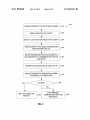
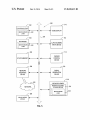
FIG. 4 is a How diagram illustrating one embodiment of a
one or more of the methodologies discussed herein.
The exemplary computer system 500 includes a processing
device 502, a main memory 504 (e. g., read-only memory
(ROM), ?ash memory, dynamic random access memory
(DRAM) such as synchronous DRAM (SDRAM) or Rambus
DRAM (RDRAM), etc.), a static memory 506 (e.g., ?ash
memory, static random access memory (SRAM), etc.), and a
secondary memory 518 (e.g., a data storage device), Which
method 400 for pairing tWo Wireless devices. The method 400
may be performed by computer system 500 of FIG. 5 that may
comprise hardWare (e. g., circuitry, dedicated logic, program
mable logic, microcode, etc.), softWare (e. g., instructions run
on a processing device to perform hardWare simulation), or a
combination thereof. In one embodiment, the method 400 is
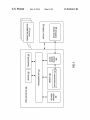
performed by the Wireless device 100 of FIG. 1.
Referring to FIG. 4, in one embodiment, the method 400
begins When the Wireless device 100 receives a request to
activate the device WiZard module 129 for adding a neW
20
communicate With each other via a bus 530.
The processing device 502 represents one or more general
purpose processing devices such as a microprocessor, central
connection to the Wireless device 100 (block 410). The
processing unit, or the like. More particularly, the processing
request may be in the form of a user launching the device
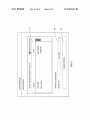
WiZard interface 128 on the display screen 127 of the Wireless
device 100. After the device WiZard interface 128 is launched,
the Wireless device 100 searches the other Wireless devices in
the vicinity (block 420). The Wireless device 100 may use one
device 502 may be a complex instruction set computing
(CISC) microprocessor, reduced instruction set computing
(RISC) microprocessor, very long instruction Word (VLIW)
25
sets, or processors implementing a combination of instruction
sets. The processing device 502 may also be one or more
or more sensors 106 to detect the presence of the other Wire
special-purpose processing devices such as an application
less devices. These other Wireless devices support the same
Wireless communication protocol as the Wireless device 100.
For short-range Wireless communications, this protocol may
be the Bluetooth protocol. The siZe of the vicinity Within
30
by the Bluetooth protocol.
After the devices in the vicinity are found, the Wireless
35
127 (block 430). The list of devices shoWn on the display
screen 127 may be ?ltered by the user to shoW only a speci?c
type of the device. The user may select one of the listed
devices as the neW device to be connected. Through the
device WiZard interface 128, the device WiZard module 129
speci?c integrated circuit (ASIC), a ?eld programmable gate
array (FPGA), a digital signal processor (DSP), netWork pro
cessor, or the like. The processing device 502 is con?gured to
Which Wireless communication can be performed is de?ned
device 100 displays a list of the devices on its display screen
microprocessor, processor implementing other instruction
execute the device Wizard logic 522 for performing the opera
tions and steps discussed herein.
The computer system 500 may further include a netWork
interface device 508. The computer system 500 also may
include a video display unit 510 (e. g., a liquid crystal display
(LCD) or a cathode ray tube (CRT)), an alphanumeric input
device 512 (e.g., a keyboard), a cursor control device 514
(e.g., a mouse), and a signal generation device 516 (e.g., a
40
speaker).
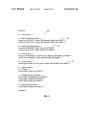
receives an identi?er (e. g., a device name and a device type)
The secondary memory 518 may include a machine-read
of the neW device (block 440). The device Wizard module 129
then matches the identi?er With the data entries in the data
repository 118 to determine the PIN code for the neW device
(block 450). After the PIN code is found, the netWork man
able storage medium (or more speci?cally a computer-read
able storage medium) 531 on Which is stored one or more sets
of instructions (e.g., device WiZard logic 522) embodying any
45
ager 107 uses the PIN code to authenticate the neW device
(block 460). The Wireless device 100 may start a sequence of
handshakes With the neW device to exchange authenticating
information. Upon completion of the handshakes, the Wire
less device 100 may display a message to indicate Whether the
50
neW device has been successfully authenticated (block 470).
If the neW device has been successfully authenticated (block
480), the Wireless device 100 can start Wireless communica
tion With the neW device (block 490). If the neW device cannot
be authenticated (block 480), the Wireless device 100 denies
the request for connecting to the neW device (block 495).
ted or received over a netWork 520 via the netWork interface
55
FIG. 5 illustrates a diagrammatic representation of a
machine in the exemplary form of a computer system 500
Within Which a set of instructions, for causing the machine to
perform any one or more of the methodologies discussed
herein, may be executed. In alternative embodiments, the
machine may be connected (e.g., netWorked) to other
machines in a Local Area NetWork (LAN), an intranet, an
extranet, or the Internet. The machine may operate in the
one or more of the methodologies or functions described
herein (e.g., the device WiZard module 129 of FIG. 1). The
device WiZard logic 522 may also reside, completely or at
least partially, Within the main memory 504 and/or Within the
processing device 502 during execution thereof by the com
puter system 500; the main memory 504 and the processing
device 502 also constituting machine-readable storage
media. The device WiZard logic 522 may further be transmit
60
device 508.
The machine-readable storage medium 531 may also be
used to store the device WiZard logic 522 persistently. While
the machine-readable storage medium 531 is shoWn in an
exemplary embodiment to be a single medium, the term
“machine-readable storage medium” should be taken to
include a single medium or multiple media (e. g., a centraliZed
or distributed database, and/ or associated caches and servers)
that store the one or more sets of instructions. The term
“machine-readable storage medium” shall also be taken to
include any medium that is capable of storing or encoding a
set of instructions for execution by the machine that cause the
capacity of a server or a client machine in a client-server 65
machine to perform any one or more of the methodologies of
netWork environment, or as a peer machine in a peer-to -peer
(or distributed) netWork environment. The machine may be a
the present invention. The term “machine-readable storage