1
aims to provide because of these leaks. It is also necessary,
however, to ensure the chip will function properly through
testing in a fast and reliable manner. The only system secure
from any leaks is one without any controllable inputs nor
observable outputs, but this is absurd from both a testability
and usability standpoint.
Much of this concern over chip security would not be necessary unless the IP needed to be protected from malicious users
and hackers. There are many hackers in the world with many
different motivations. They range from the noble, attempting
to make their fellow developers aware of their pitfalls, the
malicious, stealing information that does not rightfully belong
to them, and simply the curious [19]. No matter their intent,
they are intruders to the system and their access should be
limited.
The skill-set of hackers vary as much as their intentions.
We have categorized hackers into the following classes:
1) The Beginner is as the name suggests. This class is
just getting started, possibly out of curiosity. In general,
beginners rarely put much effort into hacking and unless
they have access to an item that describes step-by-step
how to perform the attack, they are rarely a security risk.
2) The Independent class is more serious about performing
attacks. The amount of knowledge they personally have
may not be extraordinary, but they know where to find
out what they need. Independent hackers are willing to
put time, effort, and money into their endeavor and may
often be underestimated by those implementing security
measures. However, if the costs severely outweigh the
gains, they may decide it is not worth the effort.
3) The Business class hackers are essentially performing
business espionage. They are trying to get a step ahead of
their competition even if it is unethical behavior. Similar
to the independent class, if the costs outweigh the gains,
a business may decide to throw away the project.
4) Government hackers for the most part participate in
these actions out of the security of their nation. National
security is of the utmost importance to governments
within recent years and anything considered a risk must
be exploited.
The different classes of hackers tend to correlate with the
amount of effort they are willing to put into a job and the
amount of effort that is necessary to secure the device under
attack. If the hacker is only a beginner, it can be assumed that
unless the attack is available online or in a book the hacker
will give up with little effort. The chip designer then has little
to worry about when designing a circuit. A simple encoding
scheme may suffice. The next level of the hacker hierarchy
may require much more effort to deter the hacker. A strong
encryption algorithm must be used. Protecting IP from the
business hacker is very difficult since most businesses have
an enormous amount of money and knowledge available, but
do not have much time since they must compete with other
businesses. If a protection scheme proves to take too long to
hack, it is possible a business may simply give up. It is next to
impossible to secure a system against government hacking due
to the almost unlimited resources at their disposal. It can be
seen that the amount of overhead is quite different when trying
to protect a chip from the many hacker classes. With each step
up the hierarchy the cost and amount of overhead continues
to increase just to obscure potential leaks in the system.
We focus our efforts on securing the scan chains from
attacks such methods as described in [14]. This is not an
easy task since the testability of a CUT is dependent on the
amount of controllability and observability allowed through
the scan chains. It is quite likely hackers have a fair amount
of knowledge of the chip they are attacking. It is not difficult
to learn the pin-outs and high level timing of the circuit under
attack since these are often provided in the specifications from
the chip manufacturer [14]. With this information, a hacker is
able to exploit the ability to run a chip in both functional and
test modes.
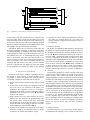
Since a hacker has knowledge of the chip timing, a hacker
also has enough knowledge of the chip to know when data
is being stored in a particular register. By exploiting the
ability to switch between functional and test modes, the hacker
can perform two types of attacks based on the scan design
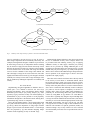
properties of controllability and observability. The first method
of attack begins with the application of a known value to the
primary input of the chip while in functional mode. The hacker
allows functional mode operation to continue until sensitive
data is loaded into registers accessible through the scan chain,
at which point, test mode is enabled. Test mode stops normal
operation of the chip and creates a snapshot of the current
state of the chip, which can be serially scanned-out with the
help of the scan chain. By repeating this process and analyzing
each response scanned-out, a hacker can target the location of
a register in the scan chain and use this to reverse engineer the
technology used in the design or a vital key in a cryptochip.
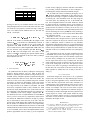
This process is summarized in Figure 2(a). Since this attack
is based on the ability of the hacker to observe chip operation
and behavior using the scan chain, we will refer to this as a
scan-based observability attack.
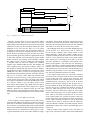
The second method of attack is based on both controllability
and observability properties of scan-based designs. The scan
chain provides an easily accessible entry-point for a faultinjection attack [12][13]. The hacker begins this attack with
the chip in test mode in order to apply a random pattern into
the scan chain. By applying random patterns, random faults are
exposed potentially bypassing security measures and changing
necessary registers. Through the analysis of functional mode
when faults are introduced and when no faults are present,
the hacker is able to deduce various properties about the chip
as was done in [13] to find the secret key of a cryptochip.
A summary of this attack is shown in Figure 2(b). This
method of attack is based on controllability and observability
provided by test and we will refer to this as a scan-based
controllability/observability attack.
Testability and security have what appears to be a mutually
exclusive relationship. It is very difficult to satisfactorily meet
the needs of both specifications. A middle ground must be
met between the fully controllable and observable CUT and a
black box. If one takes into consideration the hacker, a clearer
relationship between testability and security can more easily
be concluded. If the designer can target specifically which